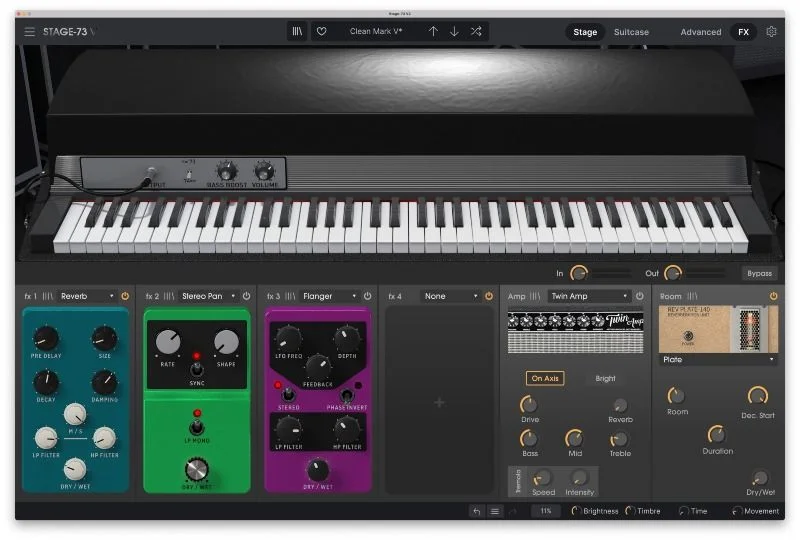
Stage-73 V is the Rhodes emulation most often stacked against Spectrasonics’ Keyscape, and if that’s the comparison you’re running, here’s our answer: Stage-73 V wins on tweakability and CPU logic, Keyscape wins on instant gratification. That’s the whole review in two sentences. Everything below is the evidence.
Arturia’s plugin uses physical modeling, zero samples. No multi-gigabyte library. No velocity-switched recordings. The engine models the tines, the hammers, the pickups, and the preamp circuit from the physics up. When you dig into a key hard, the bark you get isn’t a separate sample firing. It’s the same model responding to velocity input the way a real Rhodes would. That matters when you’re playing live or recording MIDI performances with dynamics.
At $99 it competes in a bracket where Keyscape sits considerably higher. That price gap is part of the decision.
How It Stacks Up the Moment You Load It
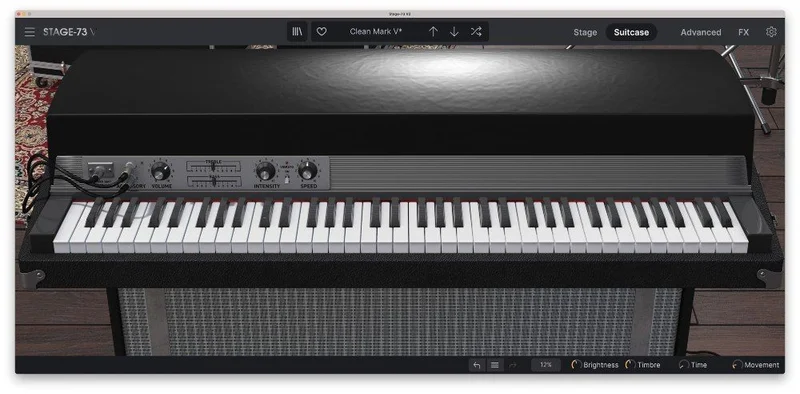
Load Stage-73 V for the first time and you get 50+ presets across Stage and Suitcase models. The 1973 Stage has that brighter, more glassy top end. The 1974 adds a bass boost circuit that makes the low-mid register feel rounder and heavier. Switching between them is not subtle. We played the same chord voicing through both back to back. The 1974 sits lower in the spectrum by a noticeable margin, around 3-4dB more body between 200-400Hz by ear.
Keyscape sounds lush from preset one. Stage-73 V takes more work to get there. That’s not a flaw, it’s a design choice. But new users expecting instant Stevie Wonder or Herbie Hancock are going to need to open the Advanced panel before they’re happy.
Native Instruments’ Scarbee Mark I, a sample-based competitor, ships with more immediately polished presets. Stage-73 V beats it on dynamic response once you’re playing in, not browsing.
Performance Deep Dive
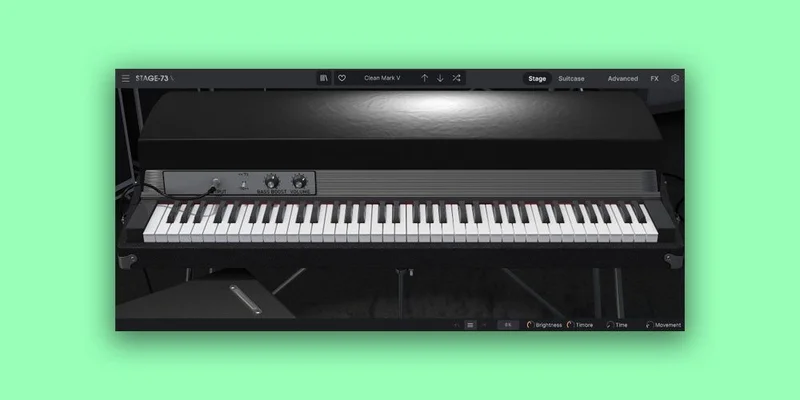
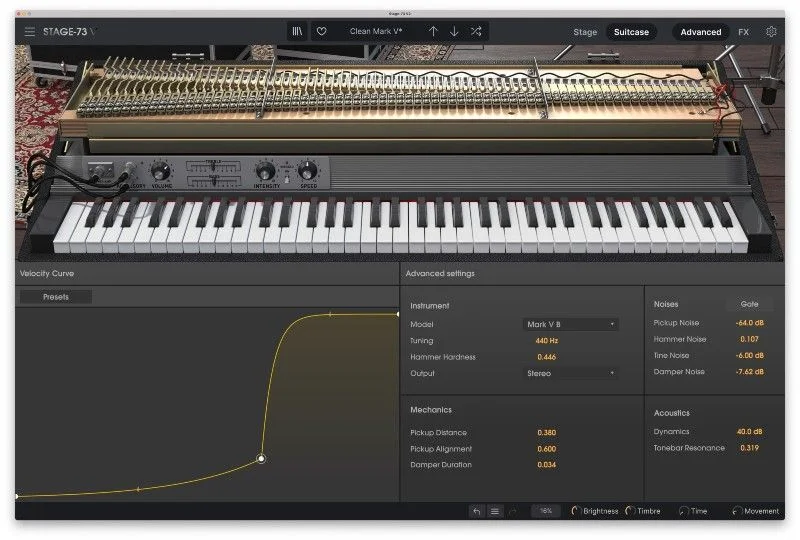
The physical modeling engine is the real story here. Arturia calls it TAE (True Analog Emulation), and in Stage-73 V’s context it’s modeling the electromagnetic behavior of the pickup, not just the waveform shape of a recorded tine. Change the pickup distance in the Advanced panel by a small amount and the harmonic balance shifts. Pull the pickup closer and you get more fundamental with brighter overtones. Push it back and the sound opens up with more air.
We tested this specifically on a sustained chord in the 1973 Stage model. With pickup distance at minimum, the attack was aggressive with a pronounced 2nd harmonic presence. At maximum distance, the same chord had a rounder attack and a tail that decayed more smoothly into the room ambience.
Hammer hardness is the other parameter that changes everything. Soft felt settings give you a jazz cushion. Moving toward metallic strikes adds a click transient that cuts through dense mixes without EQ. We’d put the metallic setting around 60-70% hardness for funk rhythm parts in a busy arrangement. Full metallic is annoying on anything held for more than two beats.
CPU load sits in the medium range. We ran it on a session with 24 other tracks in Ableton Live on an M2 MacBook Air. No dropout. It behaved better than we expected for a modeling engine. No hard benchmark numbers are publicly available from Arturia, which is a frustrating gap in their documentation.
Where Stage-73 V Wins
The Advanced panel is where this plugin earns its money. Velocity curve editing lets you draw a custom response curve for your controller. That’s clever and rare at this price point. Most electric piano plugins give you sensitivity and nothing else.
The pickup alignment control is something we love. Misaligning the pickup slightly introduces an asymmetry in the waveform that adds subtle even-order harmonics. It sounds like a real worn Rhodes that’s been on the road. You can hear it in the slight roughness at the edge of sustained notes.
Noise modeling is also well done. Pickup hum, tine noise, and damper noise all have independent controls. We set tine noise at about 15% for a session recording. The producer in the room stopped and asked if we’d mic’d a real piano. That’s the right reaction.
The 4-slot pedalboard with 13 effects options is a complete rig. Tape echo, phaser, tremolo, distortion. Combined with the Fender Twin or Leslie amp simulator and a room ambience setting, you’re not leaving Stage-73 V to get a finished electric piano sound. Everything’s there.
Where the Competition Wins
Keyscape’s sample library is honest competition on one specific thing: the low velocity sound. At very soft playing levels, Keyscape has more texture and life. Stage-73 V at low velocities can feel like it’s working harder to be convincing. It’s not bad. Keyscape is just better there.
Scarbee Mark I has more immediately usable presets for producers who want to load and go. If your workflow is fast preset browsing and you don’t want to open a single advanced panel, Stage-73 V will frustrate you.
The criticism from early V1 users about the sound feeling “small and cold” wasn’t wrong for that version. V2 addresses it, but only if you engage with the Advanced panel. Default settings still lean cooler than a real vintage Rhodes sounds in a room. You have to add the warmth yourself by increasing tone bar resonance and pulling the pickup closer. That extra step is a real barrier for producers who just want a reference sound fast.
Who Should Buy Which
✅ Buy Stage-73 V if you want physical modeling behavior, a living dynamic response to your playing, and you’re happy spending 20 minutes in the Advanced panel dialing in your sound.
✅ Buy Stage-73 V if you’re already in the Arturia ecosystem and V Collection makes sense for your studio.
✅ Buy Stage-73 V if CPU overhead from sample libraries is a real constraint on your system.
❌ Skip it if you need a Rhodes sound in under five minutes with zero menu diving.
❌ Skip it if your mixes need dense low-velocity softness and you’re comparing directly to Keyscape.
❌ Skip it if you’re building a genre-specific library and only need one locked-in Rhodes preset. Check our synth bundle reviews for faster preset-heavy options
Score Breakdown
| Category | Score | Notes |
|---|---|---|
| Sound Quality | 4.0/5 | Excellent once dialed in, needs Advanced panel work to shine |
| Value for Money | 4.5/5 | Strong at its price point, especially inside V Collection |
| Ease of Use | 3.5/5 | Preset browser is smooth, Advanced panel has a learning curve |
| Features | 4.0/5 | 13 effects, amp and room sims, deep model editing, velocity curve editor |
| CPU Efficiency | 4.0/5 | Modeling engine runs leaner than multi-GB sample alternatives |
| Overall | 4.0/5 | Brilliant modeling with a learning curve that pays off |
Alternatives to Consider
Spectrasonics Keyscape is the direct comparison most producers run. It’s sample-based, heavier on storage and RAM, and more expensive. It wins on low-velocity softness. It loses on dynamic modeling depth and CPU flexibility. Read our breakdown of physics-based vs. sample-based synth engines
Native Instruments Scarbee Mark I is the “faster preset” option at a similar price tier. It’s built on samples, sounds polished immediately, and has less tweaking overhead. Right pick for producers who want to load and bounce. Wrong pick for keyboardists who play with real dynamic range.
UVI Vintage Vault covers the Rhodes alongside dozens of other vintage keys in a bundle. Less modeling depth on any single instrument. More variety. Worth checking if you need more than one vintage keyboard sound in your rig. See how sample-based vintage instruments compare in our synth reviews
If you’re looking for something completely different on the synthesis side, our LOW bass synth review covers a plugin that’s underrated in the low-end modeling space, which complements a Rhodes-based keyboard rig well.
Stage-73 V is a physically modeled Rhodes that rewards the producers who actually open it up. The ones who play five presets and close the window will wonder what the fuss is about. The ones who spend a session inside the Advanced panel will stop looking for alternatives.
It’s not for the producer who needs a Rhodes sound in five minutes. It is for the producer who wants to stop apologizing for their electric piano sound. Check current pricing at Arturia’s site. If you’re already in V Collection, it’s already yours.
Related reviews: Hand Clapper Review
Frequently Asked Questions
Is Stage-73 V physically modeled or sample-based?
It's fully physically modeled. There are no samples in the engine. Arturia's TAE technology models the tines, hammers, pickups, and preamp circuitry from the physics up, which is why the dynamic response changes with velocity the way a real Rhodes does. This also means no multi-gigabyte library to download or manage.
What's the difference between the 1973 and 1974 Stage models?
The 1973 model has a brighter, more glassy character in the upper register reflecting that year's component spec. The 1974 model adds a bass boost circuit that fills out the 200-400Hz region and makes low-mid chord voicings sound rounder and heavier. Both are modeled as separate instruments inside Stage-73 V2, not just EQ presets on the same engine.
How does Stage-73 V compare to Keyscape for Rhodes sounds?
Keyscape sounds fuller at low velocities and requires less setup time for a finished sound. Stage-73 V has a more accurate and flexible dynamic response for players who dig in, and it runs without a sample library. If you play with real keyboard dynamics, Stage-73 V is the stronger choice. If you want instant results from MIDI parts with lower velocity variation, Keyscape is the easier path.
Do I need to buy V Collection to get Stage-73 V?
No. Stage-73 V is available as a standalone purchase separate from V Collection. V Collection includes it alongside Arturia's full range of keyboard and synth emulations, so if you want more than just the Rhodes, the bundle offers better value per instrument. Check Arturia's site for current standalone and bundle pricing.