It was a drum bus session at 2am, a dense hip-hop record with the kick sitting slightly wide and the snare chasing too much room, and we dropped PSP BussPressor across the bus mostly out of curiosity.
Two turns of the attack knob later, the whole kit snapped into shape. Not squashed. Not pumping awkwardly. Just locked in.
That’s the version of this plugin we’d been hearing about since 2012. The V2.0 update, released in February 2025, finally gives it a GUI that doesn’t look like shareware and stepless knob control that doesn’t feel like punishment.
PSP BussPressor is a VCA-style bus compressor inspired by the classic SSL G-Bus topology, built by PSP Audioware and priced at $99. It’s for producers and engineers who want genuine mix-bus character without paying a premium for a branded name.
What This Compressor Actually Is (and Isn't)
PSP BussPressor is not a transparent mastering compressor. Don’t put it across a finished 2-track if you want invisible dynamics control. It has character. It adds lean, muscular VCA colour in the 2-6kHz presence band when you push it, and the transient behaviour is snappy in a way that vintage optical designs simply aren’t.
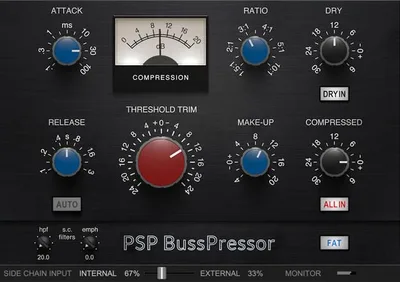
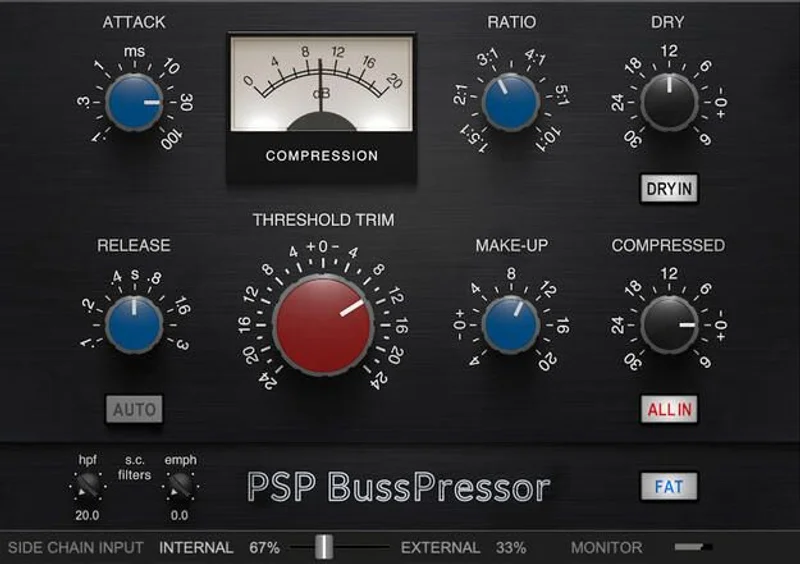
What it is: a workhorse bus compressor with a sweepable high-pass sidechain filter, a built-in wet/dry parallel blend, ratios from 1:1 to 10:1, and now, since V2.0, stepless threshold, gain, and makeup controls that actually dial in smoothly.
It works best on drum buses, mix buses in dense productions, and acoustic instruments competing for space in a crowded arrangement. It does not work well as a serial compressor on a solo vocal. That’s not what it’s built for.
Living With It Day to Day
Setup is clean. The plugin loads fast, uses iLok License Manager for activation (no physical dongle required), and sits comfortably in both the standard and FAT quad-sampling modes. FAT mode oversamples for reduced aliasing, but watch your CPU budget. In our sessions, FAT mode ran roughly 2.5 times the CPU draw of standard mode on a single instance.
We used it across three different sessions over six weeks: a hip-hop record, a live band mix, and a podcast production bus. Each time, the sidechain filter paid for the whole plugin on its own.
Being able to sweep the sidechain high-pass filter up to around 180Hz means the compressor stops chasing kick drum energy and starts reacting to the midrange and snare. On the live band mix, we set the sidechain filter at 120Hz and pulled the ratio back to 2:1. The kick punched through without triggering the gain reduction. The snare sat glued but alive.
The wet/dry blend is a satisfying shortcut. We’d have routed a parallel compression bus anyway. This saves three minutes and a channel strip.
One quirk: zero-latency processing in standard mode makes it genuinely usable for live monitoring and broadcast applications. Most of the competitors with oversampling run latency that rules out that use case. Worth knowing if you track live to bus with processing on.
The Trade-Offs Worth Knowing
The V2.0 GUI is better. Honestly, it’s fine now. The 2012 version looked like it was designed in an afternoon. The 2025 redesign has cleaner layout, better contrast, and legible metering. But it’s still not beautiful. Compare it to the Cherry Audio PSP Studio Modular Collection and you see the difference between polish and function. BussPressor lands on function.
The new high-frequency sidechain emphasis mode in V2.0 is clever. It lets the compressor respond more aggressively to HF content, which can tighten up mix buses with a lot of upper-midrange density. We wish PSP had shipped this in 2012.
There’s no mid/side mode. Cytomic The Glue has it. UAD SSL G Bus Compressor does not at standard settings, but workarounds exist in those DAWs. If M/S bus compression is part of your workflow, BussPressor won’t get you there without external routing.
Against the Field
The obvious comparison is Waves SSL G-Master Buss Compressor. At similar pricing during sales, Waves wins on brand recognition and loses on control flexibility. No built-in wet/dry, no sweepable sidechain filter, and the Waves version can feel slightly harsher in the attack at fast settings.
Cytomic The Glue is our favourite alternative for engineers who want M/S capability and a slightly more musical, rounded character. It’s priced comparably. The Glue wins on versatility. BussPressor wins on snap.
UAD SSL 4000 G Bus Compressor is the reference version, but it costs more and requires UAD hardware or a UA Spark subscription. If you’re already in the UAD ecosystem, it’s the one to use. If you’re not, BussPressor is a frustrating amount of that quality at a fraction of the price.
URS 1980 targets a slightly different vintage character and is harder to find and support now. Skip it.
For best bus compressor plugins, BussPressor sits comfortably in the top five at its price
.
The Real Verdict
PSP BussPressor at $99 is an easy recommendation for anyone building a serious plugin compressor toolkit on a real budget. The V2.0 update fixed the things that were genuinely annoying: the clunky stepped knobs, the dated interface, the missing sidechain flexibility.
It’s not the right tool for mastering work, solo vocal chains, or producers who need M/S processing baked in.
But for drum buses and mix buses in dense productions? We’d buy it again. We have bought it. Check the current price on the PSP Audioware site before purchasing, as it occasionally drops in sales.
Also worth reading: our compression plugins buying guide if you’re still building out your chain.
Score Breakdown
| Category | Score | Notes |
|---|---|---|
| Sound Quality | 4.5/5 | Snappy VCA character that competes with plugins at 2-3x the price |
| Value for Money | 4.5/5 | $99 for this feature set and sonic quality is hard to argue with |
| Ease of Use | 3.5/5 | V2.0 stepless knobs help, but the interface still requires a learning curve on sidechain routing |
| Features | 4.0/5 | Sweepable sidechain filter and wet/dry blend are genuinely useful; no M/S mode hurts |
| CPU Efficiency | 3.5/5 | Standard mode is light; FAT mode pulls noticeably harder and adds latency |
| Overall | 4.2/5 | Excellent bus compressor let down only by a workmanlike GUI and no M/S option |
Alternatives to Consider
If BussPressor isn’t quite right for your workflow, here’s what we’d look at instead.
Cytomic The Glue is our first stop for anyone who needs M/S bus compression built in. Slightly rounder transient response than BussPressor. Marginally more musical on sources that need the compression to breathe. The current price is shown in the buy box on this page. See our Cytomic The Glue review for the full breakdown.
Waves SSL G-Master Buss Compressor is the name everyone recognises. It goes on sale frequently and can be found at a deep discount during Waves promotions. Sounds good. Less flexible. No wet/dry blend built in. Better for someone who wants the SSL character and nothing else to think about.
UAD SSL 4000 G Bus Compressor is the reference if you’re already inside the UAD ecosystem. It’s the most accurate version of that SSL circuit we’ve heard in software. But if you’re not already invested in UAD hardware or a Spark subscription, the entry cost makes BussPressor the smarter choice at $99.
For a broader look at your options, read our guide to the best VCA compressor plugins.
The best bus compressor is the one that’s actually in your session. PSP BussPressor gets out of its own way and does its job. At $99, with zero-latency monitoring, a sweepable sidechain, and a V2.0 update that finally fixed the knobs, that’s enough to earn a permanent slot in our chain.
If you don’t work on dense mixes, don’t track live to bus, and need something for mastering or solo vocal chains, skip it and look at Cytomic instead.
Everyone else: buy it.
Frequently Asked Questions
Is PSP BussPressor good for mastering?
Not really. It has character, and mastering compressors generally want transparency. BussPressor adds lean VCA colour and snap, which is exactly what you want on a drum bus and exactly what you don't want on a finished 2-track headed to a streaming master. Use it in the mix, not after it.
What's new in PSP BussPressor V2.0?
V2.0, released in February 2025, introduced a redesigned GUI, stepless threshold, gain, and makeup knobs (replacing the old stepped controls), a high-frequency sidechain emphasis mode, and FAT quad-sampling for reduced aliasing. Existing customers could upgrade at a low cost. The stepless knobs alone make it a meaningfully better plugin to dial in.
Does PSP BussPressor work without an iLok dongle?
Yes. It uses iLok License Manager for activation but doesn't require a physical iLok dongle. You can license it to your machine directly or to an iLok Cloud session. That's the standard PSP Audioware approach across their plugin range.
How does PSP BussPressor compare to the Waves SSL G-Master Buss Compressor?
BussPressor wins on control flexibility: the built-in wet/dry blend and sweepable sidechain filter have no equivalent in the Waves SSL plugin. Sonically, they're closer than the price gap would suggest when Waves is on sale. If you want more tools to shape how the compression behaves, BussPressor is the better buy at full price. If you just want basic SSL bus glue and Waves is running a deep sale, that's a harder call.