
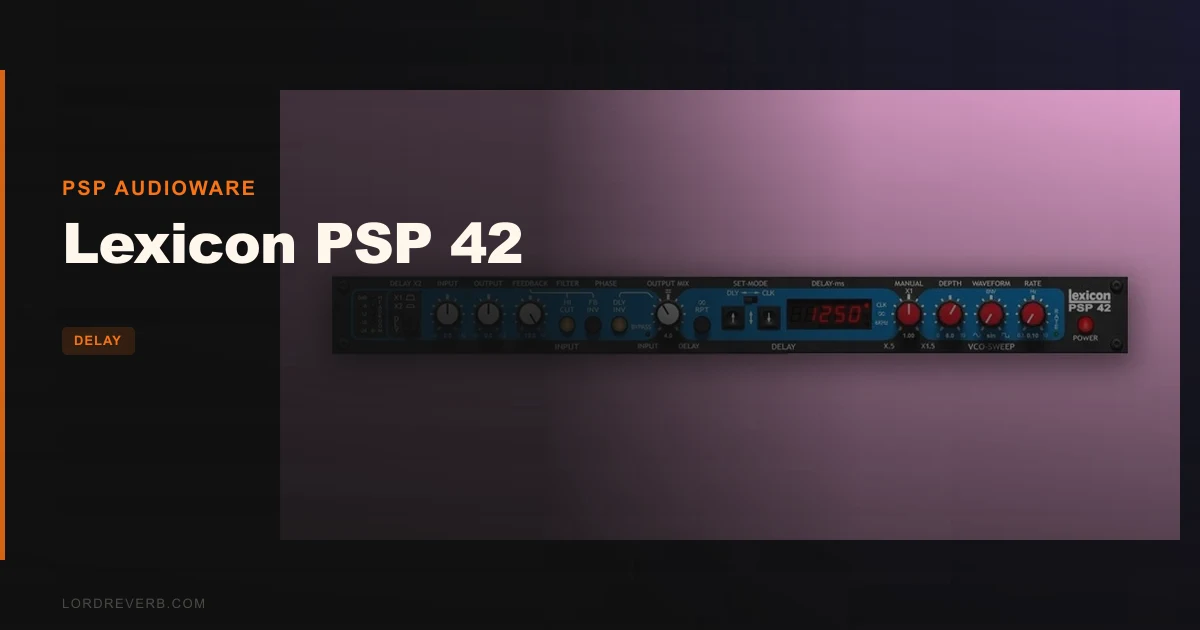
The Lexicon PSP42 is a Lexicon-approved PCM42 emulation at $149, and whether it belongs in your session depends almost entirely on what you need from a delay plugin. If you want the specific warmth of that classic Lexicon hardware, the extended delay times, and the kind of tape-saturated lo-fi smear that sits behind a guitar like smoke, it delivers. If you need something that installs cleanly and runs without drama across every DAW on your system, you might find yourself wrestling with it before you hear a single note.
Lexicon has approved the functionality and sound of the PSP42, and one reviewer who tested it against original hardware preferred the plugin for some settings.
But this is a $149 plugin with real limits. Here's the full picture.
Quick Verdict
The PSP42 scores 3.5 out of 5. The sound is genuinely good, the feature set is deep for a delay plugin, and owners describe it as one of the best delay plugins available. The friction is real, though: installation headaches, reported crashes in Reason and Bitwig, and macOS support that stops at Ventura. Buy it if the PCM42 sound is specifically what you're after. Hold off if stability across your whole rig matters more than tone.
What You're Actually Getting
The PSP42 is a stereo digital delay and phrase sampler modelled on the Lexicon PCM42. The plugin is available in VST, VST 3, AAX, and AU formats across Windows 7 through 11 and macOS 10.12 through 13 Ventura, with Apple Silicon support on Mac.
Maximum delay time runs to 28.8 seconds. That's long enough for Frippertronics-style looping and sustained ambient work, not just slap-back echo. Sampling rates go up to 192 kHz.
The delay line runs with a variable sampling rate, which is where the character comes from. Lower the sampling frequency and the repeats go grainy and degraded. The developer says that variable sampling rate generates good-sounding low-fi effects. A low-pass filter handles high-frequency absorption, and the tape saturation algorithm layers on top of that.
Version 2 arrived in August 2023. iLok License Manager is required for activation.
Where the Sound Lives
Set a moderate delay time, bring the sampling frequency down, and raise the feedback until the repeats start to blur. Reviewers report unbeatable tone on guitars and vocals.
The modulation section gives you plenty to shape that with. Three signal sources are available: sinus, square, and envelope detector. You mix them in any proportions, which gives you a wide range of movement. The envelope detector is the clever part, since it ties modulation to the level of the incoming signal.
The plugin can generate flanging and phasing effects too.
The Bounce mode adds an ethereal tail to audio, which suits textural work.
Tempo-locked feedback delay is available with high-frequency absorption and tape saturation.
The Modulation Section in Practice
You're building the modulation character from three sources mixed together. Sinus gives you smooth, predictable pitch movement. Square gives you choppy, switched modulation. The envelope detector reacts to input level.
The developer calls the plugin an essential tool for experimenting with drum loops and rhythmic patterns, so that's where an input-driven source like the envelope detector is worth trying.
The modulation also handles continuous delay time and pitch control, which means you can sweep the delay time without clicks or pops. The plugin uses parameter filtration and on-the-fly cross-fades for smooth operation.
MIDI and VST automation are both supported, as is Logic Control. If your workflow involves automating delay throws or live performance control, that's all accessible.
The Not-So-Good
The installation process has frustrated users. A dysfunctional installer has been reported, and the requirement for the latest iLok License Manager adds a dependency that not everyone wants to manage. If you've had clean plugin installs become multi-step troubleshooting sessions, this is one where that risk is real.
Stability is the bigger concern. Crashes have been reported in both Reason and Bitwig. One user ran into compatibility issues with macOS 12.6 that required an update. These are user reports rather than universal problems, but they're worth knowing before you commit.
macOS support stops at Ventura (13). If you're running Sonoma or Sequoia, you're outside the stated compatibility range. That's annoying for a plugin at $149, so check current compatibility before you buy.
And honestly? The iLok dependency is a friction point regardless of how smooth the rest of the experience is. Some producers simply don't want that software running on their system. That's a legitimate reason to look elsewhere.
Compared to the Alternatives
Two other PSP plugins come up. The PSP 608 is the one people compare for wide, bouncing delay effects.
The PSP Echo is the one people compare for reggae dub style.
Logic's included delay plugin comes up as a comparison point: users describe the sound as comparable, at lower cost. The PSP42 adds tape saturation, variable sampling rate and a three-source modulation section. Whether those justify $149 is a question to answer from your own work.
For another delay to read about, see our Halo Delay review.
Who Should Buy This
- ✅ Buy if you specifically want a Lexicon-approved PCM42 emulation with genuine vintage tape saturation character.
- ✅ Buy if you need delay times up to 28.8 seconds for ambient looping or Frippertronics-style work.
- ✅ Buy if you're producing music that benefits from lo-fi delay degradation, drum loop processing, or modulated pitch movement in the delay line.
- ❌ Skip if you need a plugin that installs cleanly without complications or iLok dependencies.
- ❌ Skip if you're running Bitwig or Reason as your main DAW, given the reported crashes.
- ❌ Skip if your macOS version is newer than Ventura (13) and you can't confirm current compatibility.
Specs & Technical Details
| Developer | PSP Audioware |
| Price | $149 |
| Plugin Format | VST / VST 3 / AAX / AU |
| OS Support | Windows 7–11 / macOS 10.12–13 Ventura (Apple Silicon supported) |
| Activation | iLok License Manager (required) |
| CPU Usage | N/A |
| Trial Available | N/A |
| Version Reviewed | 2 (released August 2023) |
Score Breakdown
| Category | Score | Notes |
|---|---|---|
| Sound Quality | 4.5/5 | Lexicon-approved PCM42 character; tape saturation and variable sampling rate deliver genuine vintage texture |
| Value for Money | 3.0/5 | Strong tone at $149 but stability issues and macOS ceiling cut into the value proposition |
| Ease of Use | 2.5/5 | Installer problems and iLok dependency add friction before you hear anything |
| Features | 4.0/5 | 28.8-second delay, three-source modulation mixer, Bounce mode, and tempo-locked feedback cover serious ground |
| CPU Efficiency | N/A | No verified data available |
| Overall | 3.5/5 | Brilliant sound with real-world friction that you need to go in knowing about |
Alternatives to Consider
If the macOS compatibility wall or the DAW stability reports push you elsewhere, here are three directions worth looking at.
The PSP 608 from the same developer is the one people compare for wide, bouncing delay effects. Read our comparison of PSP delay plugins if you're unsure which one fits your workflow.
The PSP Echo is the one people compare for reggae dub style.
Halo Delay review is another delay worth reading alongside this one before you decide.
The Bottom Line
The PSP42 has a sound that owners praise as one of the best among delay plugins. The PCM42 character is there: the tape saturation on the feedback, the high-frequency absorption, and a modulation section with an envelope detector that follows the signal. For guitars and vocals especially, the tone is hard to argue with.
What you have to weigh against that is a real installation risk, crash reports in Reason and Bitwig, and a macOS compatibility limit that might already have caught you if you updated your system in the last two years.
If you're on a Mac running Ventura or earlier, or on Windows 7 through 11, the compatibility range covers you, though the installation reports are worth keeping in mind. If you're in Reason or Bitwig, or you've already moved to a newer macOS, check for confirmed updates before spending $149.
This isn't a plugin with a vague identity. It knows exactly what it is. So do you now.
Frequently Asked Questions
Is the Lexicon PSP42 compatible with Apple Silicon Macs?
Yes. The macOS version of PSP42 supports Apple Silicon natively. The compatibility ceiling is macOS 13 Ventura, though. If you're running Sonoma or later, verify current support directly with PSP Audioware before purchasing, as some users have reported issues with specific macOS versions requiring updates.
Does PSP42 require an iLok dongle?
The latest iLok License Manager application is required for activation on both Mac and PC. Whether that means a physical dongle or software-only licensing is something you'll want to confirm with PSP Audioware directly, as licensing structures can change between versions. The dependency on iLok's software is confirmed regardless.
What is the maximum delay time on the PSP42?
The PSP42 goes up to 28.8 seconds of delay time. That puts it well beyond typical rhythmic delay territory and into genuine phrase sampling and Frippertronics-style looping range.
How does PSP42 compare to Logic's built-in delay plugins?
Users describe Logic's included delay as comparable in sound, at lower cost. The PSP42 adds tape saturation, variable sampling rate for lo-fi degradation, and a three-source modulation section. Whether that justifies the extra cost depends on how central vintage delay character is to your sound.