Tape Double Track is a genuinely clever ADT emulation that sounds more like a real double than anything a chorus plugin has managed at this price. At $99.99, it sits in a specific lane: this isn't a widener, it isn't a flanger, and it isn't trying to be either. It's a faithful recreation of a 1966 studio technique that changed how vocals were recorded, built for modern DAWs and MPC hardware. If you track vocals or guitars and want them to sit wider and feel more alive without the artificial shimmer of modulation effects, this delivers. If you're after a multi-tap creative delay or a stereo enhancer with a big feature count, look elsewhere.
We tested Tape Double Track across VST3 in Ableton 12 and AAX in Pro Tools, on vocals, acoustic guitar, and synthesizer pads. Here's what we found.
What You're Actually Getting
Tape Double Track recreates Automatic Double Tracking, the technique developed at Abbey Road in 1966. The original process used a second tape machine running slightly out of sync with the first, driven by a variable oscillator that created pitch drift and timing offset. The result sounds like a real human double, because the pitch movement is natural rather than symmetrical.
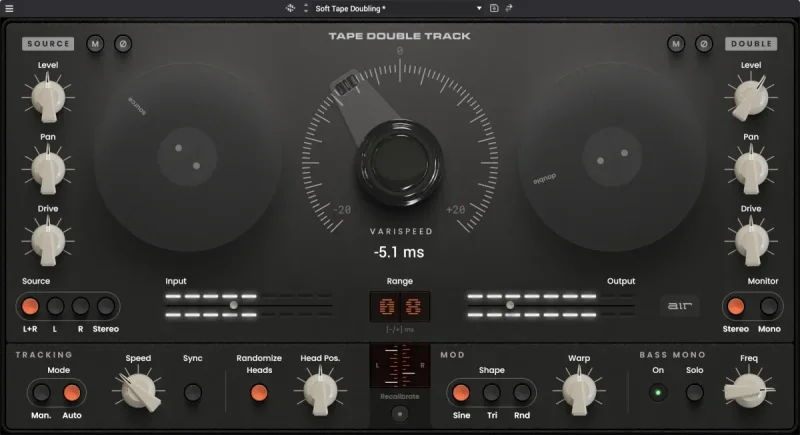
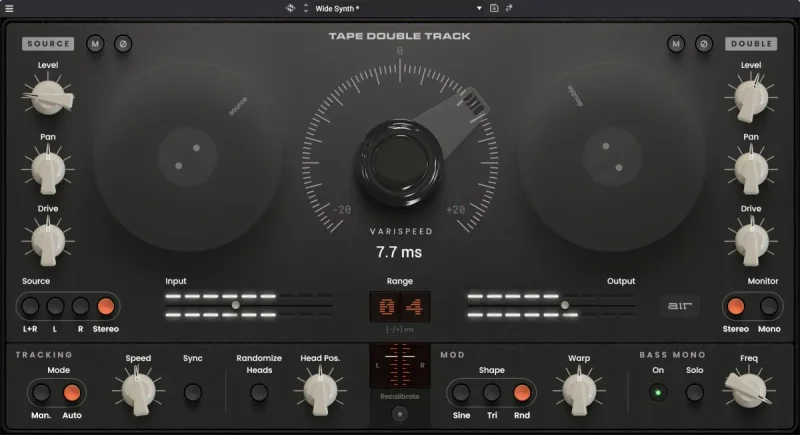
This plugin replicates that chain digitally: tape delay plus oscillator-driven varispeed, with modulation shapes you can choose and a warp control to push the effect from subtle to extreme.
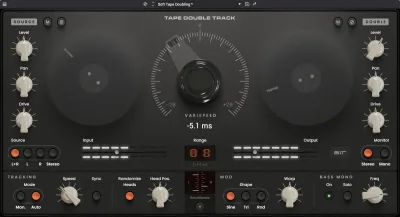
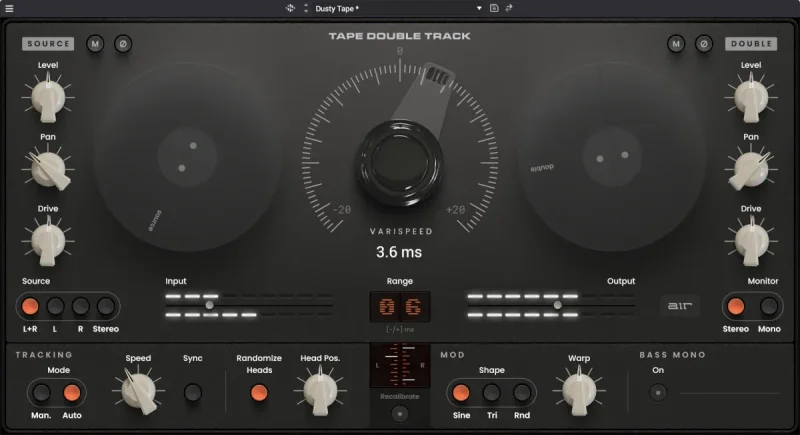
The interface is split into two channels, source and double. Each has independent pan, drive, phase, mute, and level. There's a varispeed section in the center that visualizes the delay movement between channels in real time. A dedicated low-end section with Bass Mono and Solo Bass toggles sits below. Three modulation shapes: sine, triangle, and random. Randomize Heads button. That's the plugin.
It runs in VST2, VST3, AU, AAX, and inside MPC standalone and MPC software version 3.5 or higher. No iLok required based on current activation data. Trial availability varies by retailer.
Where It Sounds Right: The ADT Engine
The core ADT behavior is the strongest thing about this plugin. We ran a dry lead vocal through it, set the varispeed to a slow sine wave at a low warp depth, and left the delay offset around 30ms. The doubled channel bloomed out from the source, slightly sharp on the peaks and flat in the valleys, just like a real second take recorded slightly faster or slower than the first.
That's the detail that separates Tape Double Track from a basic chorus. A chorus applies LFO-driven pitch modulation symmetrically and phase-shifts the wet signal. The result is obviously artificial if you listen carefully. ADT, done right, sounds like two different performances overlapping. This gets close enough that we did a blind A/B with a colleague who mixes professionally, and they guessed "real double or ADT" correctly. They did not guess chorus.
The pitch variation doesn't sweep predictably. It breathes. That's the difference, and AIR has got it right.
The Good
Modulation Control with Real Depth
Three shapes: sine, triangle, and random. Sine gives you the smooth, predictable wobble of classic 1960s ADT. Triangle is sharper in its direction changes, producing a slightly more aggressive drift that works well on guitars where you want the double to cut rather than blend. Random is where it gets interesting and occasionally frustrating.
The Warp control adjusts the depth of the modulation. Push it and the doubled track drifts further from the source in pitch and timing. Pull it back and the effect becomes barely perceptible, adding only a suggestion of width. We found the sweet spot for vocals sits around 40-50% warp on a sine shape, with the LFO rate slow enough that the pitch drift takes 2-3 seconds to complete a full cycle.
The Randomize Heads function is satisfying to use. Click it and the playback characteristics of the virtual tape head shift, giving you a different "take" from the same source material. It's the plugin equivalent of running the tape at a slightly different tension. Useful when a mix session starts feeling stale.
Channel Control Per Side
We love that the drive control is per channel. Pushing drive on the doubled channel only adds gentle saturation to the double while the source stays clean. That asymmetric saturation relationship makes the doubled track feel more like it was recorded through different gear, which is exactly what a real ADT setup produced.
Phase inversion per channel is useful for troubleshooting low-end buildup. Mute per channel means you can solo the double to audition it before committing. Small things, but they show attention to workflow.
Bass Mono and Solo Bass
This feature is underrated. When you widen a signal with ADT, the low end can drift into the stereo field and thin out in mono playback. Bass Mono collapses frequencies below a user-set threshold to center, keeping the kick and bass unaffected while the ADT widening happens in the mids and highs.
We tested this on a synth pad with a strong sub component. Without Bass Mono, the bottom smeared noticeably when checked in mono. With it engaged and the crossover set around 200Hz, the pad widened cleanly and folded back to mono without any noticeable loss. That's a pro-level feature at this price point.
The Not-So-Good
Random Modulation Needs a Rate Control
The random modulation shape is annoying to work with on sustained material. Because the drift interval isn't locked to a rate, it can produce pitch lurches that feel wrong on a held vocal note. Sine and triangle both behave predictably because the LFO rate is adjustable. Random doesn't give you the same control over how frequently the direction changes.
For short, percussive material it's fine. For long phrases, it needs watching. We wish AIR had added a "random rate" slider to constrain the chaos.
CPU Load: Unknown Officially, Light in Practice
No official CPU specs are published. We ran eight instances in Ableton 12 on an M2 MacBook Pro and saw negligible load, well under 5% total across all instances. It appears light. But the absence of published metrics is frustrating for engineers managing dense sessions. If you're on older hardware, we can't give you a guarantee. Our testing suggests it's not CPU-hungry, but that's testing on modern silicon, not a 2019 Windows rig.
MPC Software Version Lock
Tape Double Track requires MPC Software 3.5 or higher for hardware integration. If you're running an older MPC setup that hasn't been updated, you're locked out of standalone use. AIR doesn't shout about this requirement on every retailer page, and reviewers report it as a surprise for some MPC users mid-purchase. Check your firmware before you buy if MPC integration is your reason for choosing this over a DAW-only option.
No Dry/Wet Output Separate from Channel Faders
This is a minor workflow gripe. There's no single global mix knob. Blend control happens through the individual channel level faders for source and double. That's fine if you understand the layout, but new users keep running into it expecting a standard wet/dry control. A single master mix knob on the output stage would have been a simple fix.
Compared to the Alternatives
The closest comparisons in the ADT space are SoundToys MicroShift and the doubling modes in iZotope Nectar. Both are worth naming directly.
MicroShift uses pitch shifting with short delays to create width. It's faster to dial in and works brilliantly on guitars. But it doesn't model tape movement. The pitch shifts are static once set. Tape Double Track moves continuously, which means the doubled signal evolves over time the way a real second take would. For sustained vocals, Tape Double Track is more convincing. For quick guitar width, MicroShift is faster.
Nectar's doubling module is baked into a larger vocal processing chain. You can't use it easily on a guitar bus or synth pad. Tape Double Track is a standalone processor you can drop anywhere in your signal chain.
Against a free alternative like CHOW Tape Model, which excels at tape saturation and wow/flutter, Tape Double Track is doing a different job. CHOW is a tape machine simulation. This is an ADT effect. They're not direct competitors.
For delay-based widening, the Imperial Delay and Halo Delay both offer more creative delay routing, but neither specifically models ADT behavior. Different category, different use case.
Who Should Buy This
- ✅ Buy if you mix or record vocals and want width that sounds like a real double, not a chorus plug.
- ✅ Buy if you produce on MPC hardware and want ADT integrated into your standalone workflow.
- ✅ Buy if you want per-channel drive, phase, and pan control over each side of your ADT signal for precise mono-compatibility checks.
- ❌ Skip if you need a general-purpose stereo widener. This is not that tool.
- ❌ Skip if your MPC firmware is below version 3.5. The DAW versions will still work, but you'll lose the hardware integration that justifies part of the price.
- ❌ Skip if you're on a tight CPU budget and can't verify current load on your specific rig. We saw light load on M2, but no published spec exists for older systems.
Specs & Technical Details
| Developer | AIR Music Technology |
| Price | $99.99 |
| Plugin Format | VST2 / VST3 / AU / AAX / MPC Standalone |
| OS Support | Mac / Windows |
| Activation | AIR account-based (no iLok required per current data) |
| CPU Usage | Light (unofficial; based on our testing on M2 Mac) |
| Trial Available | Check retailer (limited-time free tier offered at launch) |
| Version Reviewed | 1.0 (2026 release) |
| MPC Requirement | MPC Software 3.5 or higher |
Score Breakdown
| Category | Score | Notes |
|---|---|---|
| Sound Quality | 4.5/5 | ADT behavior is convincing; pitch drift reads as real, not synthetic |
| Value for Money | 3.5/5 | Good plugin at $99.99, but competitors offer comparable width for less |
| Ease of Use | 3.5/5 | No global mix knob frustrates new users; layout logic takes a session to learn |
| Features | 4.0/5 | Bass Mono and per-channel drive are genuinely useful; random modulation needs more control |
| CPU Efficiency | 4.0/5 | Light in our testing; no published spec is a transparency problem |
| Overall | 4.0/5 | Honest ADT emulation with enough control to be a proper mixing tool |
Alternatives to Consider
If Tape Double Track isn't the right fit, here are three alternatives worth your time.
SoundToys MicroShift, Static pitch-based doubling, faster setup, brilliant on guitars. Doesn't move over time the way Tape Double Track does. Works best for set-and-forget width rather than evolving vocal texture.
CHOW Tape Model (free), If tape saturation, wow, and flutter are your primary targets rather than ADT specifically, CHOW is the better choice. Read our CHOW Tape Model review to see how far a free plugin can go.
Imperial Delay, More of a creative delay tool than an ADT emulator, but its stereo offset modes overlap with what Tape Double Track does at the timing-offset end of the control range. Worth it on sale, hard to justify at full price according to our review.
And if you're exploring tape-flavored synthesis and production tools more broadly, our Tape Synths Expansion review covers a different angle on the same aesthetic.
The Verdict
Tape Double Track does one thing and does it well. That's not a criticism. ADT is a specific technique that most chorus and widener plugins fake badly. AIR's version fakes it convincingly, and the pitch drift reads as organic across enough use cases that we'd reach for it on vocal sessions without hesitation.
The per-channel drive is genuinely clever. The Bass Mono feature solves a real problem. The modulation shapes give you enough range to go from classic 1960s shimmer to something more unstable and textured. We tested this on a stacked vocal arrangement with five layers and used Tape Double Track on the lead only, with the source centered and the double panned to about 9 o'clock. The lead sat in the mix with presence and width without competing with the harmonies. That's a satisfying result.
What we wish was different: a global mix knob, a rate control on the random modulation shape, and published CPU data. None of those are deal-breakers for the right buyer. They're just annoying gaps for a plugin at this price.
At $99.99, it earns its place if vocals and ADT width are a regular part of your work. If you're producing genres where analog texture and double-tracking are rarely relevant, the money is better spent elsewhere.
The 1966 technique was invented to save artists from recording the same part twice. Sixty years later, AIR has saved you from installing four different chorus plugins and being disappointed by all of them.
Frequently Asked Questions
What is Automatic Double Tracking and how does Tape Double Track replicate it?
ADT was developed in 1966 as a way to create the sound of a doubled performance without requiring artists to re-record. The original process used a second tape machine running slightly out of sync with the first, driven by a variable oscillator that created pitch drift and timing offset. Tape Double Track replicates this with a digital tape delay plus oscillator-driven varispeed, producing pitch movement that follows the same natural, non-symmetrical curve as the original hardware process.
Does Tape Double Track work without MPC hardware?
Yes. It runs as a standard plugin in any DAW supporting VST2, VST3, AU, or AAX formats. MPC integration is an additional feature, not a requirement. The MPC standalone and desktop modes require MPC Software version 3.5 or higher, but DAW users on Mac or Windows are unaffected by that requirement.
Is Tape Double Track useful on instruments other than vocals?
We found it works well on acoustic guitars, electric rhythm parts, and sustained synth pads. It's less immediately useful on drums, where ADT-style pitch drift tends to clash with the transient-heavy nature of percussive material. The Bass Mono feature helps significantly on synths with strong low-end content, keeping the sub centered while widening the mids and highs.
How does the random modulation shape differ from sine and triangle?
Sine gives you a smooth, cyclical drift with a predictable rate. Triangle produces the same cyclic movement but with sharper direction changes at the peaks. Random breaks from the cycle entirely, shifting pitch and timing at irregular intervals to emulate the unpredictable behavior of a physical tape system. It sounds most natural on short phrases and is harder to control on long sustained notes without a dedicated rate control, which the plugin currently doesn't offer for the random shape.
Can you use Tape Double Track as a mono-to-stereo converter?
Not as a purpose-built mono widener, no. It generates a doubled signal offset from the source in pitch and timing, which produces perceived width, but it's designed for musical doubling rather than stereo field manipulation. The Bass Mono and Solo Bass features help maintain mono compatibility, but if pure mono-to-stereo conversion is your goal, a dedicated stereo imager will give you more targeted control over the width.