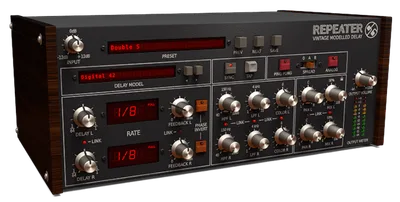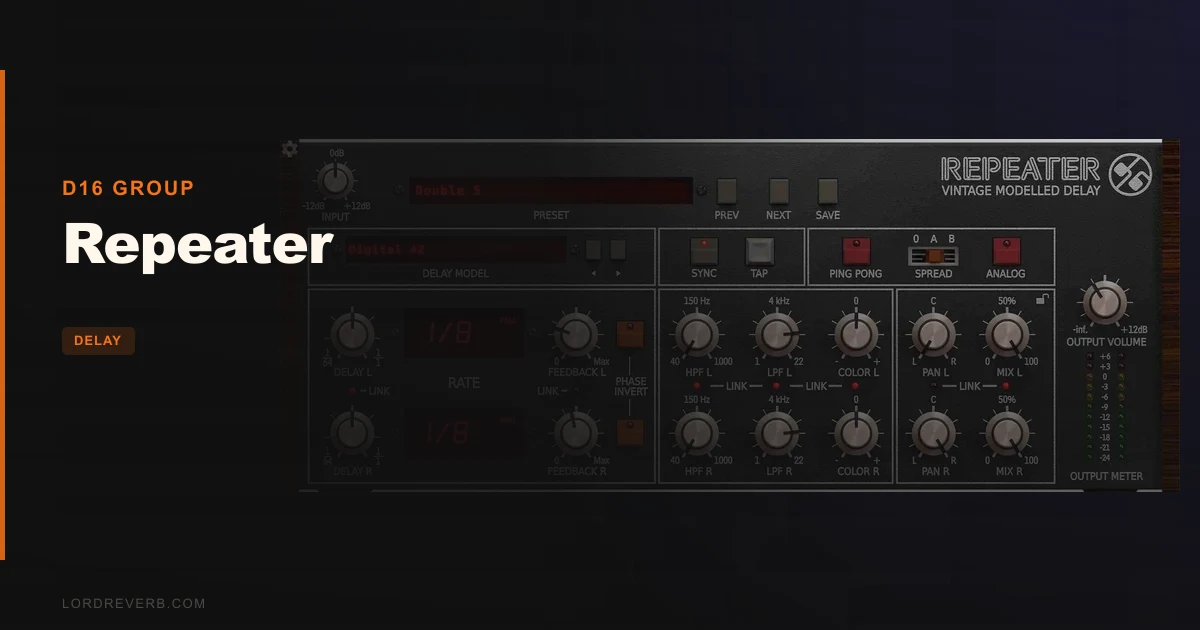
Your delay plugin folder is probably a mess of single-flavor tools: one for tape, one for digital, one for that grimy bucket-brigade thing, and none of them let you treat the left and right sides as separate instruments. Repeater, from D16 Group, is built to fix exactly that, and at $49.50 it’s an easy recommendation for anyone who lives on vocal throws and stereo echoes.
We think it earns a place on the shortlist. It isn’t perfect, and we’ll say where it falls short.
What problem does a dual-delay plugin actually solve?
Open a stock delay on a lead vocal. You get one delay time, one filter, one feedback knob, and a stereo spread that’s basically a fixed pan.
Now you want the left echo dark and short, the right echo bright and long, and the dry signal sitting dead center. You end up with two instances, two buses, and a routing headache.
That’s the frustration. Most delays treat stereo as an afterthought.
Repeater treats it as the whole point. Two separate delay lines, one per channel, each with its own controls. The developer calls it an all-in-one dual-delay powerhouse, and the independent re-panning and dry/wet per channel really is more than a typical fixed-panned stereo delay gives you.
How does Repeater perform with its 23 delay models?
The headline number is 23 authentically modeled delay units, drawn from roughly the last 70 years of echo hardware. The list runs from Cassette Tape, DM-2, Memory Guy and Plexy Echo through Space Delay, four tape-style units (Ancient, Classic, Modern, Vintage), two Telephone models, TelRay, Old Radio, New Radio and several digital designs including Digital 42, Digital 42 x 2 and plain Digital Delay.
Owners describe the delays as musically pleasing and warm. They also say the feedback fades out naturally and organically, which adds depth and vintage color rather than a hard digital cutoff.
That tail behavior matters more than any model name. Push feedback up on a vocal and listen to how the repeats die. Good ones melt away. Bad ones step down like a staircase.
CPU use is friendly, according to users. Under the hood it runs 64-bit internal processing with ultra-low digital aliasing, so the digital models don’t fizz at the top end.
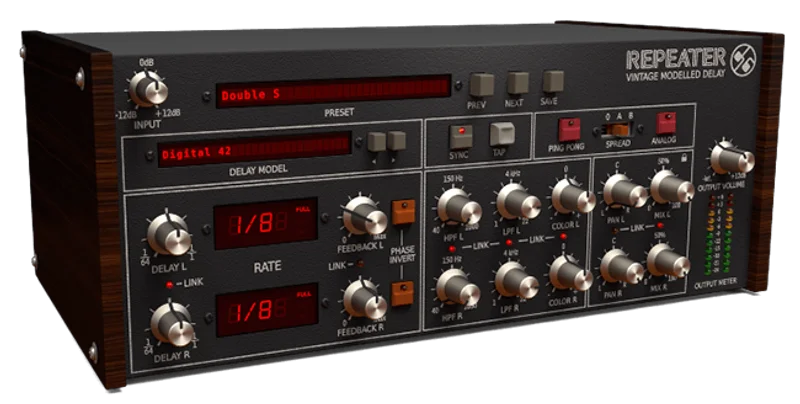
What does each delay line give you to play with?
Here’s the layout, in the order you’ll meet it.
Two separate delay lines
Left and right get their own lines. Set the left to a tapped 180ms and the right to a synced dotted eighth, and you’ve got a wide, uneven echo that a single-line delay can’t fake.
Reviewers single this out. Being able to adjust delay times, panning and mix separately per channel is the feature people praise most.
Tap and sync
You can tap in a delay time for non-synchronized, feel-based timing, or lock to your DAW’s tempo. Tap is handy when the drummer drifted and a grid-locked echo would sound wrong against them.
Phase invert, clipper and Color
Each channel has a phase invert switch and an audio clipper. The clipper has a Color parameter that adds saturation.
Users call the Color control impressive, and they single out the smooth filter shaping. Crank it on a tape model and the repeats get thicker and a bit crunchy. Back it off and they stay clean.
Filters
Dual Hi-Pass and Lo-Pass filters per channel. This is where you stop the echoes from clouding the mix.
Roll the high-pass up so the repeats shed their low end, then pull the low-pass down so they sit behind the vocal instead of fighting it. Dark echoes are easy to get here.
Ping-Pong, feedback mode and stereo spread
Ping-Pong bounces repeats between sides. There’s also a feedback loop analog mode, and a two-stage stereo spread to widen things further.
It’s a lot of stereo tools for one delay. Used carefully, that means wide without being washed out.
Presets and MIDI learn
A tag-based preset browser helps you find sounds quickly, and MIDI learn lets you map knobs to a controller. Some users find the preset handling feels outdated, and we’d flag that as a minor annoyance rather than a deal-breaker.
Which models are worth reaching for first?
D16 describes the Cassette Tape model as mid-fi tone from an early-1980s Japanese cassette deck. DM-2 is pitched as warm, rich bucket-brigade analog. Plexy Echo is based on a 1970s tape delay with a fat tone, and Space Delay on a famous magnetic tape unit with a warm, gritty character.
Those are the developer’s claims, so treat them as a starting point.
Here’s a scene you’ll hit. You’re on a clean electric guitar and want a slapback that doesn’t sound digital. Try a tape model with a short time, low feedback, and the Color control nudged up. Then high-pass the repeats so they don’t muddy the guitar.
Now a cassette scene. Some users report the cassette model produces unwanted high-pitched tones. If you hear a whine on your repeats, that’s likely it. Switch models or filter it down with the Lo-Pass.
Where does Repeater fall short?
Three real limits.
First, there’s no modulation. No wow, no flutter, no chorus on the repeats. The design stays streamlined for delay processing only. That’s a clean choice, but if you want your echoes to wobble like a worn tape, you’ll need to add modulation elsewhere in the chain.
Second, some models sound almost the same in practice. Users report that a few models have hardly any audible difference in real-world use. With 23 models listed, expect some overlap rather than 23 truly distinct voices.
Third, for strict vintage authenticity, some delay models may need extra external processing. Repeater is warm and musical, but it’s not a perfect hardware clone.
Some users also find Echo Boy sounds more realistic and warm for vintage models. That’s a fair point and worth weighing if vintage realism is your top priority.
Is Repeater worth $49.50?
For the price, yes. You get dual independent delay lines, 23 models, filters, a clipper with Color, tap and sync, Ping-Pong, MIDI learn and a friendly CPU load.
The value is in the stereo control. If you regularly want different echoes on each side, Repeater saves you the two-instance, two-bus routing mess. That alone justifies $49.50 for a lot of producers.
The value drops if you only ever need one plain, synced echo. Your DAW’s stock delay will do that for free.
How does Repeater stack up against the competition?
We built this review around the alternatives, because the right choice depends on your situation. Here’s how they line up.
| Plugin | Strongest point | Weakest point |
|---|---|---|
| D16 Repeater | Independent left and right delay lines with 23 models | No modulation, some models overlap |
| SoundToys Echo Boy | More comprehensive emulation set and greater control over roughness | Fewer stereo tools per channel than Repeater's dual lines |
| SoundToys Sigmund | Complex delay times, routing and ducking features | Built around routing, not around a big model library |
| Waves ReplicaXT | Filtering and advanced functionality | Less focused on a wide range of vintage models |
When Repeater wins
Pick it when you want stereo echoes with different settings per side and a wide menu of vintage flavors. It’s our choice for vocal throws and wide guitars.
When the others win
Echo Boy wins if realistic vintage warmth and control over roughness matter most. Sigmund wins when you need ducking and complex timing. ReplicaXT wins when you want deep filtering and advanced functionality.
Who should (and shouldn't) buy this?
✅ Buy if you want different echo times, filters and panning on the left and right sides without building a routing maze.
✅ Buy if you like trying many vintage-style delays in one plugin and want a light CPU load.
✅ Buy if you want saturation on your repeats through the Color control.
❌ Skip if you need modulation on your echoes, since Repeater has none.
❌ Skip if you want 23 truly distinct sounds, because some models are barely different in practice.
❌ Skip if strict vintage realism is your top priority, where Echo Boy was judged more realistic and warm.
Specs & Technical Details
| Developer | D16 Group |
| Price | $49.50 |
| Plugin Format | VST2 / VST3 / AAX on Windows; AU / VST2 / VST3 / AAX on Mac |
| OS Support | Windows 7, 8, 10 (32 or 64-bit); OS X 10.9 through macOS 13, Intel or Apple Silicon |
| Activation | N/A |
| CPU Usage | Light (users report it's CPU friendly) |
| Trial Available | N/A |
| Version Reviewed | N/A |
Score Breakdown
| Category | Score | Notes |
|---|---|---|
| Sound Quality | 4.3/5 | Warm, natural feedback tails, but a few models barely differ |
| Value for Money | 4.5/5 | Dual lines and 23 models for $49.50 |
| Ease of Use | 4.0/5 | Clear per-channel layout, dated preset handling |
| Features | 4.2/5 | Deep stereo control, but no modulation |
| CPU Efficiency | 4.5/5 | Users report a friendly CPU load |
| Overall | 4.3/5 | A strong, stereo-focused delay with a few honest gaps |
What else should you consider before buying?
SoundToys Echo Boy
Go here if vintage realism is the priority. It has a more comprehensive emulation set and greater control over roughness, and some users find it sounds more realistic and warm than Repeater’s vintage models.
SoundToys Sigmund
Pick this for complex delay times, routing and ducking. It’s a different philosophy: less model library, more rhythmic and routing flexibility.
Waves ReplicaXT
Choose it when filtering and advanced functionality come first. It’s the one to look at if your echoes live or die by how they’re filtered.
Should you buy Repeater?
Yes, if stereo echo control is your problem. At $49.50, Repeater gives you two independent delay lines, 23 models and a light CPU load, and it solves the left-versus-right headache cleanly.
It’s the wrong tool if you want modulation or a model list where every entry sounds distinct. For those cases, look at Echo Boy or Sigmund instead.
Our verdict: buy it for the stereo control, and stay for the tails.
Frequently Asked Questions
Does Repeater have modulation?
No. Repeater lacks modulation features, keeping the design streamlined for delay processing only. If you want wobble or chorus on your echoes, add a separate modulation plugin after it in your signal chain.
Is Repeater heavy on the CPU?
Users report it's CPU friendly. It runs 64-bit internal processing with ultra-low digital aliasing. D16 lists a 2.0 GHz minimum on Windows, with a 2.4 GHz multicore recommended, and 8 GB of RAM minimum with 16 GB recommended.
What formats and systems does Repeater support?
On Windows 7, 8 and 10 (32 or 64-bit) you get VST2, VST3 and AAX. On Mac, from OS X 10.9 through macOS 13, you get AU, VST2, VST3 and AAX, with Intel and Apple Silicon both supported. You'll need a DAW host to run it.