
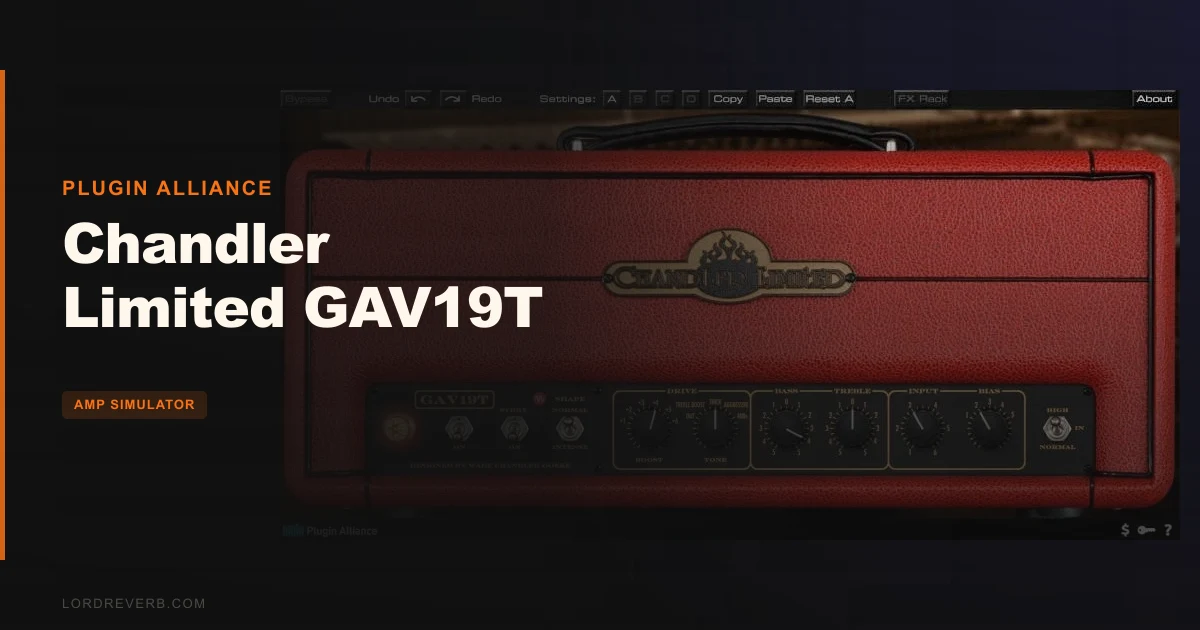
The Chandler Limited GAV19T plugin is a faithful Brainworx emulation of a discontinued boutique British tube amp, and at $49 it delivers one of the most honest EL84-driven tones currently available in a native format. If you're chasing that chimey, lower-mid-forward British crunch and you don't want a 50-genre modeller getting in the way, this is our pick. It's built for indie and alt-rock producers, bedroom guitarists who track DI and fix it ITB, and engineers who want usable guitar heat on a session without firing up the room.
Does the GAV19T Plugin Actually Deliver on a Premium Hardware Legacy?
That's the real doubt here. The hardware GAV19T was discontinued on January 5, 2022. So you're buying a plugin built on an amp you can't even compare against new, and you have to trust Brainworx did the job.
They did. Brainworx, in partnership with Chandler Limited, faithfully recreated this amp as a native plugin so you can record killer-sounding guitar tracks through your interface quietly, or bring a weak DI guitar track up to snuff fast. The tube complement they modelled is a serious circuit: ECC803 preamp tube, two EL84 power tubes, ECC83, and EZ81 rectifier. That's not a Marshall-on-loan. That's squarely Vox-adjacent British territory, pushed through Chandler's own hand-wired architecture.
We ran a dry strat DI through it cold, no gate, Drive at noon, Bias at position 3. It sounded like an amp in a room. Not processed. Not clipped wrong. An amp.
Where the GAV19T Plugin Shines
The Bias control is the underrated star. Five positions, each shifting the preamp tube's operating point. At position 1 it's cooler running: cleaner attack, tighter low end, harmonics that stay polite. At position 5 it's biased hotter: second and third harmonics bloom earlier, the sustain tail lengthens, and single-note lines start to breathe instead of poke. That's not a tone knob. That's a character knob. We love it.
The Drive section features four modes: Treble Boost, Full Range, Aggressive, and Mids, with a boost amount to dial in just the amount of the selected frequency range you want. Critically, the Drive acts only on the power amp section, not the preamp. The preamp stays clean. You're pushing the EL84s directly, which is why the distortion here is smooth and musical rather than gritty and fizzy. It's the difference between saturation that sits in the mix and distortion you have to fight with a 4-5kHz notch later.
The 75 impulse responses were developed at the Brainworx studio using their array of speaker cabinets, mics, and outboard gear, giving you sounds it would take an experienced engineer in a top-tier room all day to get. We tested the 4x12 Celestion stack IRs against our own captures from a similar cab. The Brainworx IRs were tighter in the low mids, around 200-350Hz, which is exactly where cheap IR packs get flabby.
The Baxandall-style tone controls use wide curves that allow large frequency changes without collapsing the core character of the amp. That's the right choice for this circuit. You're not scooping a Marshall. You're shaping a EL84-driven platform that's supposed to stay coherent. Bass fully clockwise adds body without boom. Treble at 3 o'clock adds air without edging into ice-pick.
Where It Falls Short
One amp. One character. That's a feature and a limitation simultaneously. If you need Fender-style 6L6 sag, a clean blackface platform, or anything with American-blues flavour, skip this. It won't get there. The EL84 voice is what it is.
The Master Tone switch (Normal vs. Intense) removes lower-mid frequencies in Intense mode. Useful for cutting through a dense mix. Annoying if you want surgical control, because it's binary. You're either removing those lows mids or you're not. There's no threshold or amount setting. That's a frustrating oversight on an otherwise detailed plugin.
There's no cab-bypass routing option for users who want to load their own IRs in a dedicated IR loader downstream. The plugin version does include useful extra features not found on the original amp, including a noise gate, delay, and power soak, but external IR workflow is not one of them. If your session is already built around a loader like LiquidSonics or Slate's Virtual Mix Rack, you'll have to work around the internal IR system rather than with it.
And the bigger picture question nobody's answering: the hardware was discontinued in January 2022 with no confirmed successor. That raises legitimate questions about how long Plugin Alliance will actively maintain and update this title. We'd buy it now, but we're watching.
How It Stacks Up Against Real Competition
The obvious comparison is Neural DSP's amp plugins, specifically Fortin Nameless or the Archetype series. Neural DSP wins on variety and real-time feel for high-gain work. But it loses on low-to-medium gain British character. The GAV19T's EL84 saturation at bedroom levels is more organic than anything Neural offers in that register. Neural DSP for high gain. GAV19T for crunch.
Against IK Multimedia's AmpliTube 5, the GAV19T is less versatile but more focused. AmpliTube gives you 400 pieces of gear to choose from. That's brilliant for a modeller and overwhelming for a session guitarist who needs one great sound fast. For British-style amp character specifically, the GAV19T wins cleanly on tone depth and IR quality. AmpliTube wins on breadth. Pick based on whether you need breadth or depth.
Is $49 a Fair Price?
Yes. Clearly. The hardware carried a steep price. You're getting a Brainworx emulation with 75 purpose-built IRs, a noise gate, delay, and power soak for $49 at full retail. On sale it has dropped even lower and at that price it is almost embarrassing value.
The caveat: if you already own a full-featured modeller like Neural DSP Archetype or the best amp sim plugins roundup, the GAV19T is a supplemental tool, not a replacement. Buy it for what it specifically does, not as your only amp sim.
Score Breakdown
| Category | Score | Notes |
|---|---|---|
| Sound Quality | 4.5/5 | EL84 power-tube saturation is organic; Brainworx IRs are tight in the critical 200-350Hz range |
| Value for Money | 4.5/5 | A fraction of the hardware price for an emulation with 75 IRs and onboard FX is hard to argue with. |
| Ease of Use | 4.0/5 | Five main knobs keep it simple; the Drive modes and Bias positions require a few minutes of orientation |
| Features | 3.5/5 | 75 IRs, noise gate, delay, power soak are great; no cab-bypass and binary Intense switch limit flexibility |
| CPU Efficiency | 4.0/5 | Medium load; comfortable on a modern session without eating your bus headroom |
| Overall | 4.1/5 | A brilliantly focused British crunch tool held back only by its intentional single-amp identity |
Alternatives to Consider
Neural DSP Archetype series: Better for high-gain and modern amp variety. Worse for low-to-medium gain British EL84 texture. Neural DSP amp plugin comparison
IK Multimedia AmpliTube 5: Wider amp selection across American and British platforms. Less depth on any single amp character. Worth considering if you need a one-stop modeller rather than a specialist tool. best amp simulator plugins 2026
Chandler Limited Zener-Bender: Not an amp sim, but if you love the Chandler hardware character and want it on your mix bus or guitar buss processing, the Chandler Limited Zener-Bender review is worth knowing about. Same brand DNA, different function entirely.
We'd also point you toward the Chandler Zener-Bender upgrade analysis if you're building a Chandler-flavoured signal chain ITB.
The GAV19T is a rare plugin that does one thing with enough conviction that you stop wishing it did more. Buy it, dial in position 3 on the Bias, hit Mids on the Drive at about 9 o'clock, and your guitar track will tell you whether this was the right call. It usually is.
Skip it if you need American cleans, high-gain metal tones, or a full-service modeller. Buy it if you want one British crunch voice done right, with the engineering infrastructure to prove it.
Frequently Asked Questions
Is the Chandler Limited GAV19T plugin still worth buying if the hardware is discontinued?
Yes. The plugin is a Brainworx emulation and runs independently of the hardware's production status. Brainworx partnered with Chandler Limited to faithfully recreate the amp as a native plugin, so the tonal model is captured and stable. The hardware being discontinued since January 2022 means no new hardware reference units, but it has no bearing on the plugin's function or sound quality. The only real question is long-term software support from Plugin Alliance, which remains active as of 2026.
What does the Bias control actually do on the GAV19T plugin?
The Bias control has five positions and adjusts the operating bias of the preamp tube section only, not the power amp. At colder settings (positions 1-2) the response is tighter, cleaner, and more compressed-feeling. At hotter settings (positions 4-5) you get earlier harmonic saturation, longer sustain, and a slightly softer transient attack. It's one of the most useful character controls in any amp sim at this price point.
Can I use my own IRs with the GAV19T plugin?
The plugin comes with 75 impulse responses developed at the Brainworx studio using their array of speaker cabinets, mics, and outboard gear. However, there is no dedicated cab-bypass or external IR routing built into the plugin itself. If you want to use a third-party IR loader, you'll need to route around the internal IR system in your DAW, which is workable but not elegant.
What's the difference between the Drive Tone modes on the GAV19T?
The Drive section features four modes: Treble Boost, Full Range, Aggressive, and Mids, with a boost amount to dial in just the level of the selected frequency range you want. The key distinction is that all four Drive modes act on the power amp section only, not the preamp. This means the preamp stays clean regardless of Drive amount, and you're pushing the EL84 output stage directly. Treble Boost works best for single-coil bite; Mids is our pick for humbuckers and indie rhythm work.