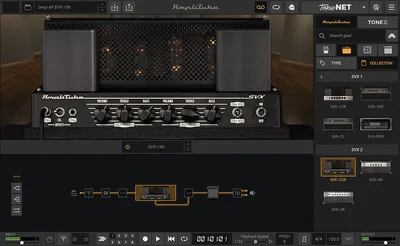
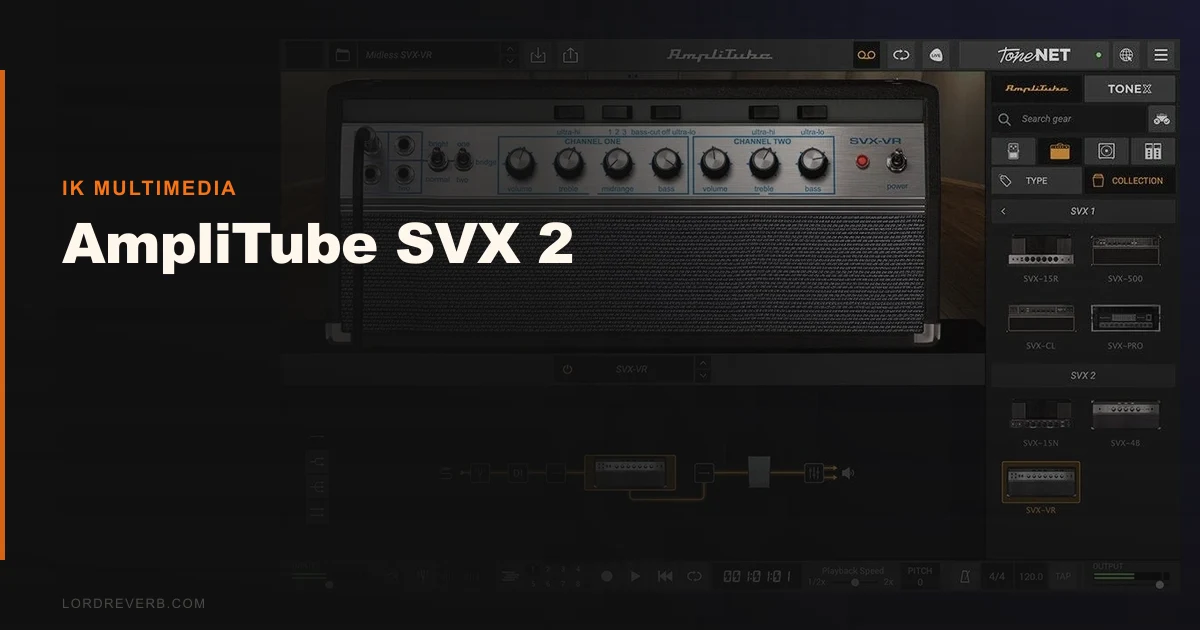
AmpliTube SVX 2 beats most bass amp plugins on tonal accuracy for two of its three amps, but it loses to Darkglass Suite and TONEX on flexibility and loses to its own predecessor on value per dollar. That’s where this review is going, so let’s establish the landscape fast.
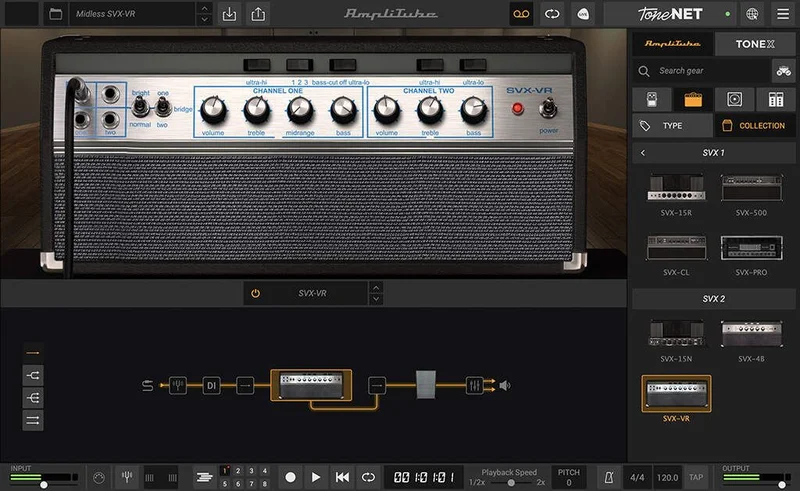
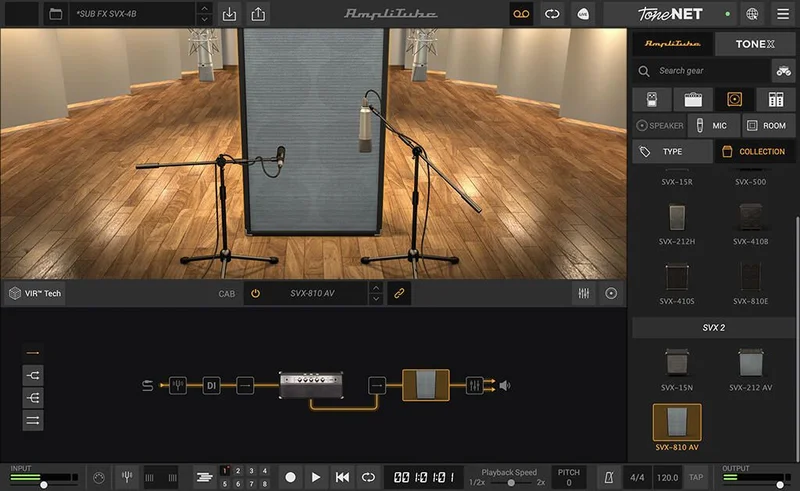
SVX 2 is a three-amp expansion pack built around Ampeg’s vintage catalog: the SVT-VR, the V-4B, and the B-15N. It runs in AAX, AU, and VST3 on both Mac and Windows. IK Multimedia prices it at $99.99 full price, with lower prices for existing SVX 1 owners and for individual amps. It’s built for studio bassists who track ITB and want the Ampeg character without booking a room or renting a backline.
How It Compares Out of the Box
Most bass players shopping in this space are comparing SVX 2 against Darkglass Suite, Neural DSP’s Parallax, and TONEX’s bass captures. Drop it next to any of those and the first difference you notice is scope. Darkglass Suite ships with 12 amplifier models plus a full pedalboard. Parallax gives you 8 signal chain slots and deep routing. SVX 2 gives you 3 amps and their matching cabs. Full stop.
What SVX 2 trades in breadth, it aims to recover in depth. IK calls it Dynamic Interaction Modeling: the idea that the plugin doesn’t just model the EQ curve of each amp, but the internal circuit stage interactions, how the power section compresses, how the preamp saturates when you push the input gain. Whether that translates to what you actually hear is the whole question.
Performance Deep Dive
We ran a Precision Bass direct into SVX 2 across all three amp models, tracking into Pro Tools at 44.1kHz on a session that also had Darkglass Suite and AmpliTube 5 open on adjacent tracks for A/B comparison.
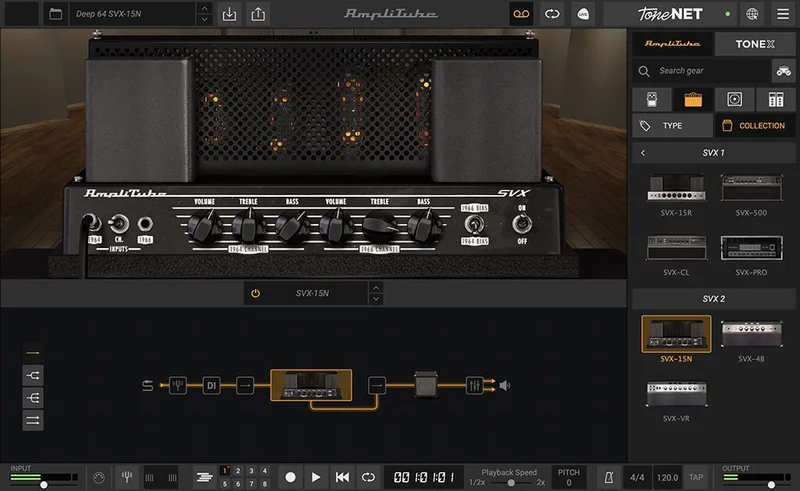
The B-15N is the star. We dialled the input gain to about 60%, kept the bass at 7, mids flat, and hit a low E at 41Hz. The response had that soft, almost cushioned low-end bloom you get from a real Portaflex. We pushed the input gain to 80% and the saturation crept in smoothly, not digitally. It didn’t clip. It compressed and thickened. That’s the Dynamic Interaction Modeling working as advertised.
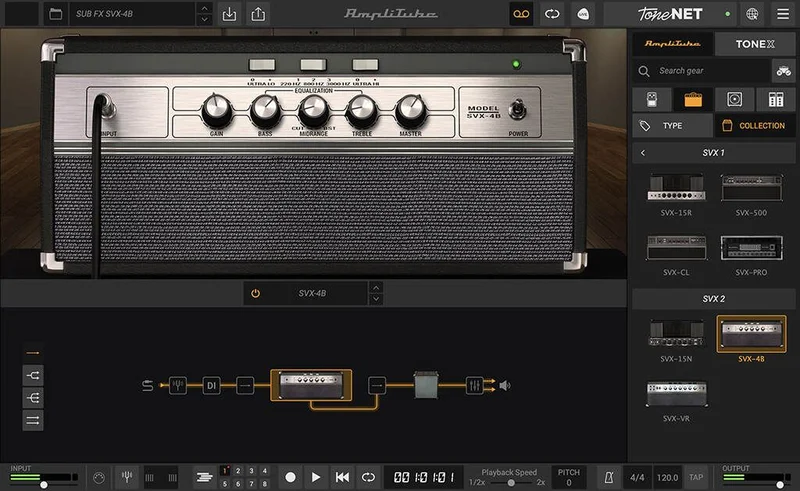
The V-4B told a similar story. 100W of all-tube 1971 character modeled with enough mid-range grit that fingerstyle funk lines sat in the mix without needing a separate saturation plugin after it. We pulled 2dB at 400Hz on the plugin’s EQ to tighten the boxiness, and the remaining tone was clean and authoritative.
The SVT-VR is frustrating. It’s the amp most players come here for. The real SVT-VR has a low-end authority that physically moves the room. The modeled version here sounds like an SVT with a blanket over it. The lows feel processed rather than physical. We pushed gain, tried different cab pairings, ran it against Neural DSP Parallax on an identical DI signal. Parallax felt tighter and more alive on high-gain SVT-style tones. SVX 2’s SVT-VR is not bad. It’s just not convincing enough to justify the plugin’s anchor claim.
CPU load sits at medium. Three instances of SVX 2 running simultaneously on a MacBook Pro M2 Pro used roughly 8% CPU in our session. That’s acceptable, not impressive.
Where It Wins
The B-15N and V-4B modeling are underrated. We haven’t heard these two amps modeled this well anywhere else in the ITB ecosystem. The B-15N in particular is brilliant for recording soul bass, Motown-adjacent lines, anything where you want that warm, slightly compressed fundamental with controlled low-mid presence. That “warm” has a specific meaning here: the low-mids peak around 180-250Hz and sustain rather than decay sharply. You’re not reaching for a compressor plugin after it.
The upgrade path for SVX 1 owners is one of the more honest pricing decisions IK has made in recent years. If you already own the original SVX and its 18 models, adding this at the upgrade price makes sense.
The plugin also integrates with the broader AmpliTube 5 MAX v2 ecosystem cleanly. If you’re already in that world, SVX 2 slots in without friction.
Where the Competition Wins
Darkglass Suite covers more ground. It has modern high-gain bass tones that SVX 2 doesn’t touch, plus integrated distortion and compression options that make it a fuller signal chain in a single plugin.
TONEX deserves a mention here too. The capture-based approach means you can load actual Ampeg SVT captures made by people who own and mic the physical amp. Some of those captures smoke SVX 2’s SVT-VR model on raw feel alone.
Parallax wins on routing flexibility. You get parallel signal path options, a full cab and microphone section, and multiple amp stages that SVX 2 doesn’t offer.
SVX 2 also annoys us with the omission of stomp models. The original SVX bundled 8 pedal emulations. SVX 2 includes zero. If you want a DI box sim or overdrive in your bass chain inside SVX 2, you’re routing outside the pl
ugin. That’s a step backward and it’s hard to defend.
Who Should Buy This
✅ Buy if you record bass ITB primarily for studio work and want the most accurate B-15N or V-4B emulation in a plugin format.
✅ Buy if you already own SVX 1 and can grab SVX 2 at the upgrade price. That’s a fair deal.
✅ Buy if you’re inside the AmpliTube ecosystem already and want to fill out Ampeg’s vintage catalog within the same interface.
❌ Skip if your main tone is high-gain SVT territory. The SVT-VR model here is not strong enough to justify the full price on its own.
❌ Skip if you want a full-featured bass plugin in one purchase. Darkglass Suite or Parallax are better standalone investments.
❌ Skip if you work with live amp tones regularly. SVX 2 is built for studio recording, not low-latency stage performance.
Score Breakdown
| Category | Score | Notes |
|---|---|---|
| Sound Quality | 4.0/5 | B-15N and V-4B are excellent; SVT-VR doesn't hit the mark |
| Value for Money | 3.5/5 | The upgrade price is fair; the full price is hard to justify for 3 amps. |
| Ease of Use | 4.5/5 | Clean UI, fast to dial in, no learning curve if you know Ampeg amps |
| Features | 3.0/5 | No stomp models, no parallel routing, limited to Ampeg's vintage catalog |
| CPU Efficiency | 4.0/5 | Medium load; comfortable in most modern sessions |
| Overall | 4.1/5 | Two excellent models carrying a third that underdelivers |
Alternatives to Consider
If the SVT-VR tone is your primary target, look at Neural DSP Parallax first. It doesn’t model Ampeg specifically, but its high-gain bass character is more physically convincing than SVX 2’s SVT-VR. Check the current price on Neural DSP’s site. Neural DSP Parallax review
Darkglass Suite is the honest recommendation for anyone wanting one plugin to cover modern and vintage bass tones. It ships with more amp models, integrated effects, and a more complete signal chain. Best bass amp simulator plugins
If you’re already deep in AmpliTube and want to understand whether the broader ecosystem makes SVX 2 a smarter buy, read our AmpliTube 5 review. The MAX v2 bundle at times renders SVX 2 redundant.
The Bottom Line
We’d buy SVX 2 at the upgrade price without much hesitation, specifically for the B-15N. That amp model is one of the best we’ve heard in the ITB format. Full stop.
At $99.99 for a fresh purchase, it’s a harder sell. Three amps, no stomps, and one of the three underwhelms. If the SVT-VR were as good as the B-15N, this would be an easy recommendation. It isn’t.
Buy it if you’re an SVX 1 owner chasing that Portaflex sound for studio sessions. Skip it if you’re building a bass plugin toolkit from scratch and need range. The B-15N alone isn’t worth a hundred dollars. Two excellent amps out of three isn’t a perfect record.
Frequently Asked Questions
Is AmpliTube SVX 2 a standalone plugin or does it require AmpliTube 5?
SVX 2 runs as a standalone plugin in VST3, AU, and AAX formats. You don't need AmpliTube 5 to run it. That said, it integrates cleanly into AmpliTube 5's interface if you own that platform, which gives you access to additional signal chain tools and routing options alongside the SVX 2 models.
What's the difference between SVX 1 and SVX 2?
SVX 1 was the original pack and included 4 amps, 6 cabinets, and 8 stomp models, 18 gear models total. SVX 2 is an expansion that adds 3 new amps with matching cabinets, focused on the SVT-VR, V-4B, and B-15N. SVX 2 includes no stomp models. Existing SVX 1 owners can upgrade to SVX 2 at a reduced price.
How does Dynamic Interaction Modeling differ from standard amp modeling?
Standard amp modeling typically captures the frequency response and static harmonic character of an amp. Dynamic Interaction Modeling, as IK Multimedia describes it, attempts to model the circuit stage interactions: how the preamp's behaviour changes as it approaches saturation, how the power section responds under load. In practice, you hear this most clearly when pushing the B-15N and V-4B input gain, where the compression and saturation feel reactive rather than static.
Can SVX 2 be used for live performance with low latency?
SVX 2 is built primarily for studio recording. IK Multimedia doesn't position it as a live performance tool, and there's no dedicated low-latency mode listed in the specifications. For live bass rig use ITB, you'd want to verify your audio interface's buffer settings carefully, and a purpose-built live option like the IK AXE I/O or a dedicated hardware unit would be a safer bet.