
IRDX Core is worth your attention if you rely on third-party IR loaders and you're frustrated by the flat, lifeless quality of static cabinet captures. It's not for everyone, and at $49 it's a targeted tool, not a universal fix. Whether it delivers genuine speaker dynamics or just a clever saturation and EQ combo is a real argument among owners. That argument is worth having before you buy.
Quick verdict: IRDX Core does something audible and useful. Owners consistently report that bypassing it makes their guitar tracks sound cardboard-flat, which is a good sign. But reviewers who've looked harder suggest the effect may be saturation and a high-frequency lift dressed up in speaker-physics language. At $49 and with low CPU overhead, it's a low-risk add for producers locked into non-Bogren IR workflows. If you're already in the Bogren Digital ecosystem, skip it entirely. Score: 3.5/5.
What You're Actually Getting
IRDX Core sits after an amp sim or IR loader in your insert chain. It doesn't load impulse responses itself. It processes the signal coming out of whatever cabinet capture you're already using and adds what Bogren Digital describes as the non-linear behaviour of a real speaker pushed hard.
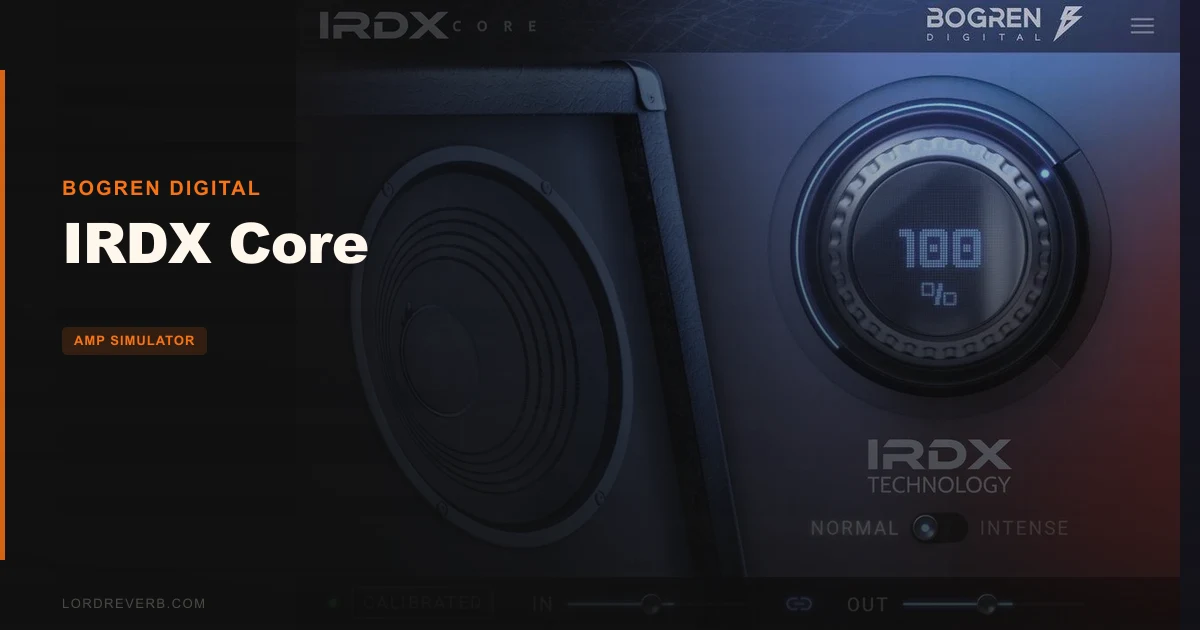
Two modes: Normal and Intense. Normal is subtle, adding gentle movement, a trace of compression, and mild distortion. Intense makes those effects more present. Neither mode is a dramatic transformation. The developer is clear that you're not replacing your IR, you're adding what an IR can't capture.
There's an input level slider with an automatic calibration meter built in. The plugin listens to your signal and sets a healthy input level. That matters, because getting it wrong is how you end up with pumping artefacts instead of natural compression.
Formats covered: VST3, AU, AAX, and Standalone. Windows 10 or newer. macOS 10.13 or newer, with native Apple silicon support. One important hard limit: don't use it after any Bogren Digital amp sim. Those already have IRDX built in. Using IRDX Core on top of them is doubling a process that's already done.
The Good
The liveliness thing is real. Owners describe it consistently: bypass the plugin and the guitar track sounds flat. Re-engage it and there's movement, something harder to name but easy to hear. That's satisfying when it works.
Rhythm tightness is a specific benefit owners call out. Tighten up an 8th-note chug pattern and there's less of that cardboard thwack from an IR that doesn't respond to pick dynamics. Individual strokes become more distinguishable. The developer says the same, and owner reports back it up.
The calibration system is clever. Rather than asking you to guess at gain staging, the plugin listens and sets the level. That reduces the risk of the most common problem: overly aggressive saturation from a hot input signal.
CPU overhead is reported as low. That's genuinely useful when you're stacking multiple guitar tracks, each with their own amp sim and IR loader already eating resources.
And then there's the unexpected use case. Owners report running IRDX Core on synth piano, bass DI, and Hammond organ with positive results, saying it helps with frequency masking. That's a broader value proposition than the marketing suggests, and worth experimenting with on problem tracks.
The Not-So-Good
The skepticism is frustrating, and it doesn't go away. Reviewers who've tried to understand what IRDX Core actually does to the signal report that it looks and behaves like saturation combined with a 10kHz boost rather than a true speaker dynamics emulation. Some owners say they've matched the effect with separate saturation, expansion, and EQ plugins in a custom chain.
That's annoying if you're paying for proprietary machine learning speaker science and getting something replicable with stock tools. It doesn't make the effect wrong. It makes the premium feel questionable.
The pumping issue is real too. If you skip the calibration step or push the input level too hard, the compression characteristic becomes a pumping artefact. It's not subtle when it goes wrong. You'll hear it immediately on sustained chords.
The Bogren Digital compatibility restriction is also worth repeating because it catches people. If you're running Dawnbreaker, Ampknob, or any other Bogren sim, IRDX Core adds nothing. It was built for everyone else's IR workflow.
Compared to the Alternatives
UnitedPlugins DIFIX takes a different angle on the IR enhancement problem. It's worth checking how their approach compares to IRDX Core's speaker dynamics framing. They're solving adjacent problems in different ways.
Cabinetron and Recabinet both attempt saturation-based IR enhancement. If the reviewer criticism that IRDX Core is essentially saturation plus EQ holds up, then those two are worth comparing directly at their respective prices before committing.
The honest question to ask: if IRDX Core's core effect is saturation and a high shelf lift, would a good saturation plugin plus a simple EQ node at 10kHz get you close? Some owners say yes. Others report the movement and compression character feels different from a simple saturator. That debate stays open. Before spending $49, consider whether the effect matches your needs in your own workflow.
Who Should Buy This
- ✅ Buy if you use third-party IR loaders and find your guitar tracks sound static compared to a miked cab.
- ✅ Buy if you want a low-CPU, low-setup liveliness fix that doesn't require building a custom chain.
- ✅ Buy if you work on dense mixes and want individual guitar strokes to cut through more clearly without raising levels.
- ❌ Skip if you already run any Bogren Digital amp sim. The technology is already in your chain.
- ❌ Skip if you need technical transparency about what's happening to your signal. That documentation isn't there.
- ❌ Skip if you're willing to build a saturation plus EQ plus expander chain yourself and want to understand exactly what each stage does.
Specs & Technical Details
| Developer | Bogren Digital |
| Price | $49 |
| Plugin Format | VST3 / AU / AAX / Standalone |
| OS Support | macOS 10.13 or newer (Intel & Apple Silicon native) / Windows 10 or newer |
| Activation | N/A |
| CPU Usage | Light (owner-reported) |
| Trial Available | N/A |
| Version Reviewed | N/A |
Score Breakdown
| Category | Score | Notes |
|---|---|---|
| Sound Quality | 3.5/5 | Audible liveliness improvement reported, but effect may be saturation and EQ rather than true speaker dynamics |
| Value for Money | 3.5/5 | Low-risk price point, but DIY chains may replicate the effect |
| Ease of Use | 4.0/5 | Auto-calibration and two-mode design make setup genuinely simple |
| Features | 3.0/5 | Minimal controls by design; no IR loading, no advanced parameter access |
| CPU Efficiency | 4.0/5 | Low overhead confirmed by multiple owners |
| Overall | 3.5/5 | A focused tool that does something useful, but with legitimate questions about what it's actually doing under the hood |
Alternatives to Consider
UnitedPlugins DIFIX takes a different approach to the IR enhancement problem. If you've looked at IRDX Core and want to compare the underlying philosophy before spending money, DIFIX is the most direct alternative to put on your shortlist.
Cabinetron attempts saturation-based IR enhancement and is frequently mentioned alongside IRDX Core. If the reviewer argument that IRDX Core's effect is primarily saturation plus a 10kHz lift is true, Cabinetron becomes a direct functional comparison worth making.
Recabinet is another saturation-based IR enhancement option that comes up in the same conversations. Check whether its approach to adding warmth and movement to captures fits your signal chain better than IRDX Core's two-mode system.
There's also the DIY route. Some owners build a chain using a saturation plugin, a subtle expander, and a high shelf boost around 10kHz and report results they can't distinguish from IRDX Core. If you love dialling in custom chains anyway, that's worth trying first.
IRDX Core wins on simplicity and speed. If you hate building utility chains and you want one insert that does the job without fuss, $49 and two modes is a faster path.
The case for IRDX Core isn't that it's the only way. It's that it's a fast, low-CPU, low-decision-making way. Some workflows need that more than they need to understand every dB of what's happening.
Frequently Asked Questions
Can I use IRDX Core with Bogren Digital amp sims like Dawnbreaker?
No. Bogren Digital's own amp sim plugins already have IRDX technology built into them. Running IRDX Core after those plugins would double a process that's already complete. IRDX Core is built for third-party amp sims and IR loaders from other developers.
Does IRDX Core work on sources other than guitar?
Owners report positive results using it on bass DI, synth piano, and Hammond organ. The reported benefit on those sources is reduced frequency masking in busy mixes rather than speaker simulation specifically. It's worth experimenting with on any source that feels like it's disappearing into the mid-range.
What causes the pumping effect some owners mention?
Pumping happens when the input signal going into IRDX Core is too hot. The plugin's automatic calibration is there to prevent this: let it listen to your guitar signal and set the input level before you start processing. If you bypass calibration or push the input slider manually without checking the meter, sustained chords and low-frequency content will start to pump noticeably.