
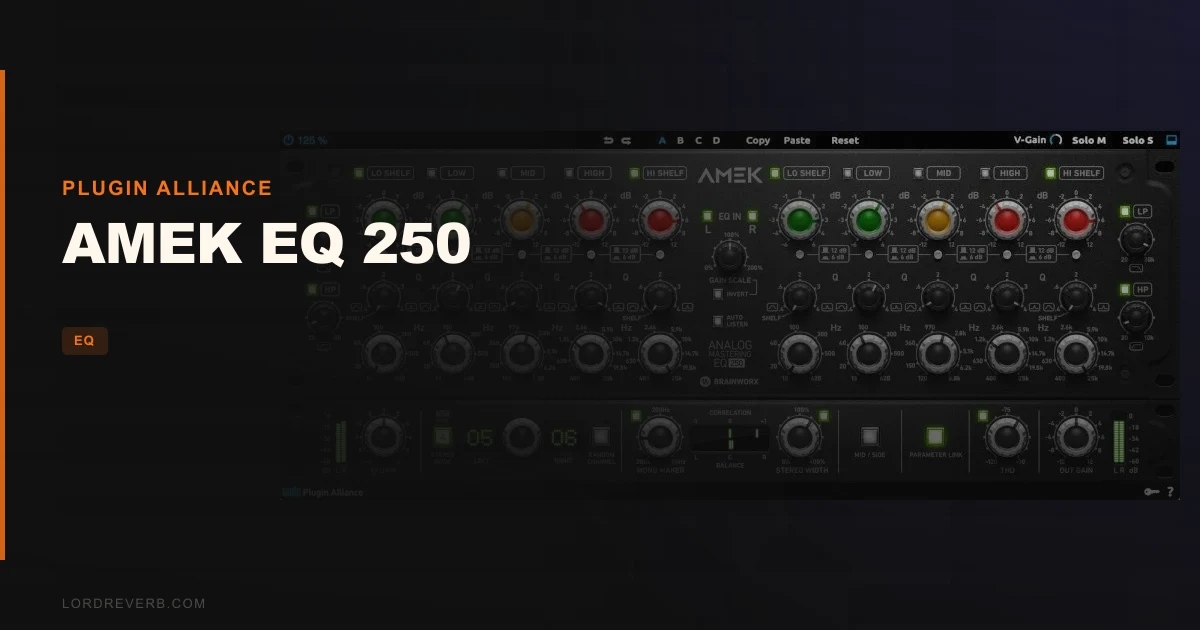
The AMEK EQ 250 is a better mastering EQ than the AMEK EQ 200, and that's the only sentence you need if you already own the 200 and are wondering whether to upgrade. If you don't own either, here's the real question: do you want a character EQ with a specific sonic agenda, or a flexible workhorse that does everything passably? The 250 answers the first call brilliantly. It traces its DNA directly back to the Sontec MEP 250ex, one of the earliest true parametric EQs ever built, and Brainworx has modelled it with obsessive fidelity. It's built for mastering engineers, mix bus operators, and anyone who reaches for colour before they reach for correction.
How the 250 Sits Against the 200 Right Out of the Box
Open both on the same stereo bus and the difference is immediate. The EQ 200 is broader, faster, more aggressive. It'll grab a low-mid and yank it into shape without ceremony. The 250 does the same thing with what we can only describe as more manners: the top end stays coherent above 8kHz where the 200 can introduce a slight edge, and the low end tightens rather than thickens.
We ran both on a dense, over-produced indie rock mix bus with the low-mid band set to cut 3dB at 350Hz, Q at 1.0. The 200 cleared mud fast. The 250 cleared mud and left the body of the guitars intact. That's the practical difference.
Against something like the Neve 1073 EQ from Slate Digital, the 250 is less coloured in the mids and more controlled at the top. Against FabFilter Pro-Q 4, it's narrower in feature set but far more opinionated in character. Those aren't criticisms. They're the point.
Performance Deep Dive
Five bands. Each does up to 12dB of boost or cut. The bands are wide-overlapping, meaning they're designed for broad, musical shaping, not forensic notching. You're not pulling 0.5dB at 2.3kHz with a Q of 8.0. That's not what this EQ is for.
The continuously variable 12dB/octave high-pass and low-pass filters are where we love this plugin most. We set the HP at 35Hz on a vocal bus and the LP at 18kHz on a synth pad. Both filters shaped without that brittle, artificial rolloff you get from many cheaper emulations. The slope felt analogue: gradual edge, no ringing.
TMT (Tolerance Modelling Technology) is the real technical story. Brainworx has modelled 20 discrete analog channel variants. Load two instances of the 250 on different tracks and they'll have subtly different component-level behaviour. We stacked three instances on parallel drum buses. Each instance responded slightly differently to the same boost at 5kHz, which translated into a wider, more three-dimensional high end than a single perfectly-linear plugin would produce. That's not a marketing claim. You can hear it in the upper mids when you A/B against the TMT off.
THD control adds even-order harmonic saturation. Push it past 50% on a bass track and you're adding 2nd-order content that makes the low end audible on smaller speakers. It's subtle and satisfying. On the low-end shelving band it earned its keep every single session.
CPU load sits at medium. We ran four instances alongside a Neve 1073, two compressors and a limiter on our mastering chain inside Pro Tools at 44.1kHz/24-bit on an M2 Mac Mini. No dropouts. We wouldn't call it light, but it's not asking for anything unreasonable.
Where the 250 Wins
The high end. Genuinely. We've tested a lot of parametric EQ emulations, and many of them become aggressive above 10kHz when you boost by more than 3dB. The 250 does not. We boosted 4dB at 12kHz on a drum room overhead bus and the result was air, not harshness. That shelf response traces directly to what made the original MEP 250ex famous in mastering rooms.
The M/S section is brilliant. Flip to Mid/Side, push the sides at 8kHz by 2.5dB, pull the mid at 250Hz by 1.5dB. That's a mastering move that costs thousands of dollars of plugin stack to achieve otherwise. Here it's on a single interface.
Mono-Maker is underrated. Set it to sum below 80Hz and your kick and bass lock to mono below that point immediately. Annoying phase cancellation on streaming services solved in one knob turn.
Stereo Width up to 400% sounds ridiculous on paper. In practice, it's most useful between 90% and 130% for subtle bus widening that doesn't create phasing artifacts the way many width plugins do.
Where the Competition Wins
If you need to see what you're doing, skip this. There's no EQ curve display. No spectral analyser. You're working entirely by ear and by numbers. FabFilter Pro-Q 4 gives you 24 bands, a real-time spectrum analyser, dynamic EQ, linear phase mode, and a per-band solo. The 250 gives you five bands and a philosophy. That trade-off is only worth it if you love the sound of the philosophy.
The standard price is also frustrating when the plugin drops so much lower regularly on Plugin Boutique. If you're reading this and it's on sale: buy it. If it's at full price: wait. That's our honest position on it.
FabFilter Pro-Q 4 wins for corrective work. The Neve 1073 emulations win for mid-forward colour. The 250 wins for mastering-grade top-end character on buses and full mixes. Pick based on what you do most.
Who Should Buy Which
- ✅ Buy if you work primarily on mix buses, mastering chains, or full-mix final passes where character matters more than precision.
- ✅ Buy if you already own the AMEK EQ 200 and want a smoother, more analogue-feeling complement for mastering work.
- ✅ Buy if you catch it on sale. At that price it's one of the best-value character EQs in the box.
- ❌ Skip if you need surgical correction on individual tracks. Five wide bands will not save a badly recorded guitar.
- ❌ Skip if you work without a spectrum analyser and find flying blind stressful. The interface gives you nothing visual to work with.
- ❌ Skip if you're new to EQ and want something that teaches you what you're doing. This rewards experience. It doesn't build it. Check out our VEQ-HLF Review if you want a simpler Pultec-style starting point.
Score Breakdown
| Category | Score | Notes |
|---|---|---|
| Sound Quality | 4.8/5 | High-frequency response is class-leading; the top end genuinely behaves like hardware |
| Value for Money | 3.8/5 | Excellent on sale; hard to justify at full price with Pro-Q 4 sitting at the same full price |
| Ease of Use | 3.8/5 | No visual EQ curve makes it opaque for anyone not working purely by ear |
| Features | 4.2/5 | M/S, Mono-Maker, THD, and TMT are genuinely useful; five bands is the ceiling though |
| CPU Efficiency | 4.0/5 | Medium draw; comfortable at multiple instances on any current-gen Mac or PC |
| Overall | 4.4/5 | A specialist tool that does its one job better than almost anything else in the box |
Alternatives to Consider
FabFilter Pro-Q 4: More bands, spectrum analyser, dynamic EQ mode, linear phase. If you need flexibility over character, Pro-Q 4 wins on paper every time. Our BLEASS Motion EQ Review covers another creative EQ approach if static shaping isn't your thing.
AMEK EQ 200 (Plugin Alliance): The 200 is the generalist of the pair. More aggressive in the mids, better for tracking and individual instruments. Buy the 250 for mastering and bus work; buy the 200 if you want one character EQ to cover everything. We'd love to own both, but if we're picking one, the 250 wins on buses.
Slate Digital Neve 1073 EQ: More mid-forward colour, more transformer-style low-end saturation baked in. The Neve flavour is distinct and some engineers find it more immediately exciting than the 250. But it doesn't have the 250's top-end refinement or M/S capabilities. Our VEQ-HLF Review covers a third path if you want a Pultec-style filter rather than a full parametric.
If your workflow is more about sequencing and creative movement than static EQ shaping, also read our BLEASS Motion EQ Review for a very different kind of EQ approach entirely.
The AMEK EQ 250 is a mastering-grade character EQ that earns its reputation on buses and final mixes. At $49 on sale, it's an easy yes. At full price, you need to already know you want what it specifically does. If you're buying a parametric EQ to learn EQ, this isn't it. If you're buying one because you know exactly what a Sontec-style high end sounds like and you want it inside your DAW every day, stop reading and buy it.
Frequently Asked Questions
How does the AMEK EQ 250 differ from the AMEK EQ 200?
The EQ 200 is the more aggressive, general-purpose sibling. It works well on individual instruments and tracking sessions where you want fast, bold tonal decisions. The 250 is smoother in the high frequencies and tighter in the low end, making it the better choice for mastering chains and stereo bus work. If you only buy one, your intended use case should decide which.
What is TMT and does it actually make a difference?
TMT stands for Tolerance Modelling Technology, and it models the subtle component-level variance between 20 different physical analog channels of the original hardware. In practice, different instances of the plugin on different tracks will respond slightly differently to the same EQ moves. We tested it with three parallel bus instances and heard a genuinely wider, more dimensional sound compared to three identical digital copies of the same settings. It makes a difference, especially when stacking multiple instances.
Is the AMEK EQ 250 suitable for surgical EQ work on individual tracks?
No. Five wide-overlapping bands at a fixed 12dB/octave slope are built for broad, musical shaping, not precise problem-solving. If you need to notch out a room resonance at 187Hz with a Q of 6, you need FabFilter Pro-Q 4 or something similarly precise. The 250 is for character and tone, not correction.
Does the AMEK EQ 250 work natively on Apple Silicon Macs?
Yes, the AMEK EQ 250 runs natively on Apple Silicon in AU, VST3, and AAX Native formats. The one exception is AAX DSP, which does not have native Apple Silicon support. For the vast majority of users running Logic, Ableton, or Pro Tools Native on an M-series Mac, there's nothing to worry about.