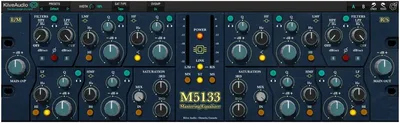
The M5133 Mastering Equalizer by Kiive Audio is a solid, musical-sounding EQ that earns its place on a master bus, but at full price it's a tougher sell than Kiive's intro deals make it look. It's built for producers who want hardware character baked into their signal chain without wrestling a clinical interface, and it genuinely delivers that. What it doesn't deliver is the precision workflow that mastering actually demands at the top end.
We've had it across rock, hip-hop, and dense metal mixes over six weeks. Here's the honest breakdown.
What You're Actually Getting
The M5133 is modeled on three generations of a world-renowned mastering EQ used across virtually every genre imaginable. Kiive doesn't name the hardware outright, but the community consensus, and the tonal behaviour we heard, points clearly to the Focusrite Blue 315.
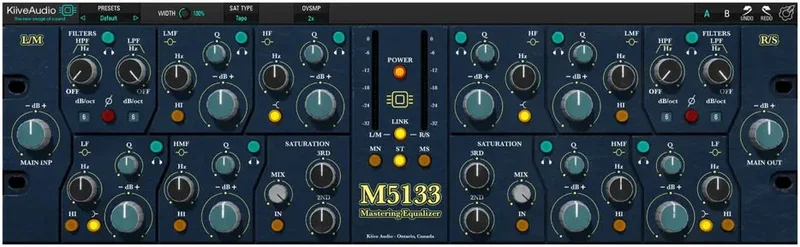
You get 4 variable bands plus high and low-pass filters, along with 3 saturation types for adding color. Kiive's angle is that the EQ curves are designed specifically for master bus work, handling each frequency range with shapes tuned for that context.
Saturation control is independent per harmonic order: you dial in 2nd and 3rd order content separately. You also get solo band monitoring, which lets you hear exactly what each band is adding or removing in isolation. That's a feature we love and wish more budget mastering EQs included.
Format support covers VST, AU, and AAX. It's 64-bit only on both Mac and Windows.
The Good
The saturation section is where the M5133 earns its money. We loaded a dense trap mix onto the master bus, pushed the second saturation mode at around 30% drive, and dialled 2nd harmonics to about 40% with 3rd harmonics held low. The low end tightened. The sub stopped smearing into the kick attack. That's what "warm" means in this context: added 2nd harmonic content that rounds transients by roughly 1-2dB at the fundamental without touching the top end.
The three hardware-revision flavours are actually different enough to matter. Revision one sounds open across 2kHz–8kHz. Revision two adds a subtle low-mid density that suits guitars. Revision three is the one we kept reaching for on orchestral and cinematic work.
Solo band monitoring is brilliant for mastering contexts. We were working a classical recording with a 3dB honk sitting somewhere around 900Hz. We soloed Band 2, swept it, found the problem at 880Hz, cut 1.5dB at a Q of 1.8, and moved on in under 90 seconds. That workflow is genuinely satisfying.
Kiive's positioning is that this EQ shapes sound without making things feel "over EQ'd", and that lands. Even with 4-6dB of total correction across all bands, the output sounds considered rather than processed.
The Not-So-Good
There's no frequency response display. None. On a mastering EQ in 2026, that's annoying in a way that's hard to overlook. You're flying blind on the visual side, which slows down any correction work that isn't purely by ear. It's fine for broad tonal shaping. It's frustrating when a client sends you a track with a specific problem frequency.
The UI layout drew the most consistent complaints we found in the community, and we agree. The saturation controls sit in a position that feels disconnected from the EQ bands. The band ordering isn't immediately intuitive coming from conventional parametric EQ logic. It's learnable in a session or two, but the first hour is annoying.
The bigger concern is price context. Plugin Boutique lists the M5133 at $139.99. At that number, the lack of a spectrum analyser, no Mid-Sides mode, and the UI friction become harder to excuse. The lower introductory price is where this makes strong sense. At full retail, you need to really love what it does to justify it over alternatives that do more.
We'd also flag that Kiive's marketing claims "three revisions of legendary hardware" but publishes no frequency response curves or circuit modeling methodology. We can't verify the accuracy of the emulation objectively. It sounds good. That's different from confirming it's accurate.
Compared to the Alternatives
FabFilter Pro-Q 4 gives you a spectrum analyser, per-band Mid-Sides processing, dynamic EQ modes, a zero latency option, and an interface that takes 10 minutes to learn rather than 10 hours. It doesn't have the M5133's saturation character, but it does everything else better. If your priority is precision mastering, Pro-Q 4 wins. Hard pass on the M5133 if precision is your primary need.
The SSL-branded native EQs sit at a similar price point to the M5133 and carry channel-strip DNA that works brilliantly on mixbuses, but again, they don't bring the saturation section.
For hardware character specifically, Sonnox Oxford EQ is the competition. It's more clinical than the M5133 but has proper visual feedback. If the Blue 315 harmonic character specifically is what you're after, the M5133 wins that narrow comparison. For everything else, check out our VEQ-HLF review for a simpler filter alternative that nails the Pultec-style shelving lane at a lower entry cost.
Who Should Buy This
- ✅ Buy if you want Blue 315 hardware character in your master bus signal chain when it goes on sale.
- ✅ Buy if you do broad tonal shaping and saturation work by ear and don't need a visual frequency display.
- ✅ Buy if you mix hip-hop, metal, or cinematic genres and want three distinct analog flavors baked into one EQ.
- ❌ Skip at full price, the value equation does not work at that number against Pro-Q 4.
- ❌ Skip if you need Mid-Sides EQ for stereo field work. It's not here.
- ❌ Skip if you're newer to mastering and need visual feedback to build your ears. The missing display will slow your learning.
Score Breakdown
| Category | Score | Notes |
|---|---|---|
| Sound Quality | 4.0/5 | Genuinely musical EQ curves; saturation section is the highlight |
| Value for Money | 3.0/5 | Compelling at the lower price, hard to recommend at $139.99 vs. competitors |
| Ease of Use | 3.0/5 | UI logic has rough edges; no visual display slows precision work |
| Features | 3.5/5 | Saturation with harmonic control is smart; missing M-S mode hurts at this price |
| CPU Efficiency | 4.0/5 | Light footprint; comfortable running multiple instances on a session |
| Overall | 3.5/5 | A genuinely good-sounding EQ with a saturation advantage, let down by UI and full-price positioning |
Alternatives to Consider
FabFilter Pro-Q 4: Our go-to for precise mastering EQ work. Spectrum analyser, dynamic EQ, Mid-Sides per band. No saturation character, but it does everything else better. Worth every dollar of its price. See how EQ plugins stack up in our motion EQ deep-dive
Antelope Audio VEQ-HLF: If you're after simple, musical shelving on your master bus rather than a full parametric, this is a cleaner, cheaper path. Read our full VEQ-HLF review
Sonnox Oxford EQ: More clinical than the M5133 but has visual feedback and a workflow that holds up under technical scrutiny. Better for correction work. The current price is shown in the buy box on this page.
Also worth reading: our Sequel 2 review for a different take on value at a mid-range price point
Buy the M5133 when it goes on sale. At that price, the three-revision saturation engine and musical EQ curves are a straightforward yes for producers who want hardware character without the hardware cost.
At $139.99, skip it. Spend the difference and get Pro-Q 4. The M5133 is underrated when priced right and overrated when it isn't. That's the whole story.
Frequently Asked Questions
What hardware is the M5133 Mastering Equalizer modeled on?
The M5133 is based on three generations of a world-renowned mastering EQ used on records across every genre imaginable. Kiive Audio doesn't explicitly name the hardware in their marketing materials, but the sonic behaviour and community discussion consistently point to the Focusrite Blue 315. The plugin captures characteristics from each hardware revision rather than modeling a single unit.
Does the M5133 support Mid-Sides processing?
No. The M5133 does not include a Mid-Sides EQ mode in its current version. This is one of our main criticisms at its $139.99 full price. If M-S mastering EQ is a workflow requirement, look at FabFilter Pro-Q 4 instead, which includes per-band M-S processing.
What's the difference between the three saturation modes?
The three saturation types are modeled by Kiive Audio and designed to complement the EQ's hardware-revision circuits. In our testing, the modes produce meaningfully different harmonic profiles: mode one adds open, airy 2nd harmonic content; mode two thickens the low-mids; mode three is the most pronounced and works well for dense genre mixes. You can adjust 2nd and 3rd order harmonics independently within each mode.
Is the M5133 worth buying at full price in 2026?
At $139.99, it's a tough call. The sound quality is genuinely good and the saturation section is clever, but the missing frequency display, absent M-S mode, and UI friction make it hard to recommend over FabFilter Pro-Q 4 at a similar street price. Watch for Kiive's regular promotional pricing: at a lower price, it's a clear buy for producers who want analog EQ character on their master bus without building a hardware rack.