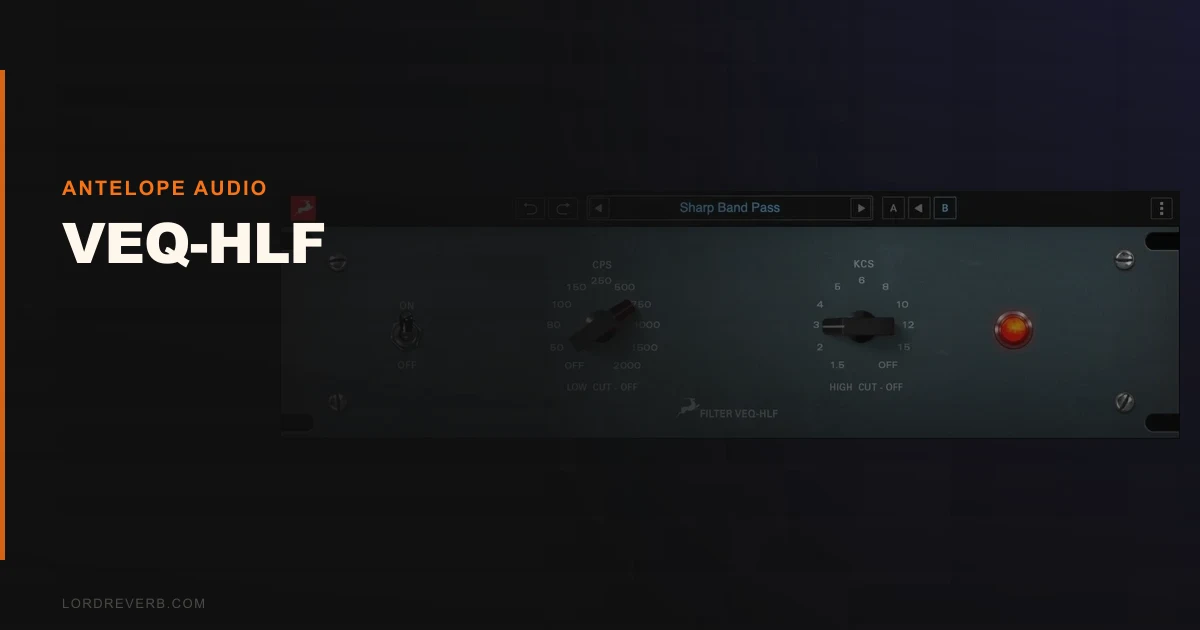
The VEQ-HLF is a simple, honest Pultec-style passive filter plugin that does one thing well: clean up the frequency extremes of any signal without overthinking it.
The VEQ-HLF is part of Antelope Audio's Pultec emulation lineup, and it's the stripped-back member of that family. Two knobs. One handles the low-cut. One handles the high-cut. There's no multiband surgery here, no dynamic processing, no character controls. It's a passive filter design built to remove what doesn't belong at either end of the spectrum.
At that sale price for the full Tube Glow EQ Pack bundle, it is genuinely hard to argue with the price. The question is whether it earns a permanent spot in your signal chain beyond the initial novelty.
We tested it across full mix buses, individual drum buses, and acoustic guitar tracks. Here's the honest account.
What You're Actually Getting
The VEQ-HLF is a two-band passive filter modelled on Pultec HPF circuit behaviour. That means the filter curves aren't surgical. They're graduated, slightly musical, and they interact with the signal in a way that a clean digital brickwall filter doesn't.
You get 10 selectable frequency points on the low-cut band and 10 on the high-cut band. You're turning a stepped knob, not dragging a node around a graph. There's no frequency readout, no curve display, no metering. What you see is what you get: two knobs on a clean interface.
It ships as part of the Tube Glow EQ Pack alongside the VEQ-1A and the VMEQ-5. The three together form a Pultec-inspired EQ suite that covers filtering, mid-frequency shaping, and program EQ duties. The VEQ-HLF handles only the extremes. It knows what it is.
Plugin format covers VST3, AU, and AAX. Compatible with both Mac and Windows. Antelope's activation runs through their standard licensing system.
The Good
We dropped the VEQ-HLF across a full acoustic guitar bus and rolled the low-cut up to remove rumble below roughly 80Hz. The transition felt organic. Not a cliff edge. The guitar didn't suddenly sound thin. It just lost the low-end weight that was muddying the low mids.
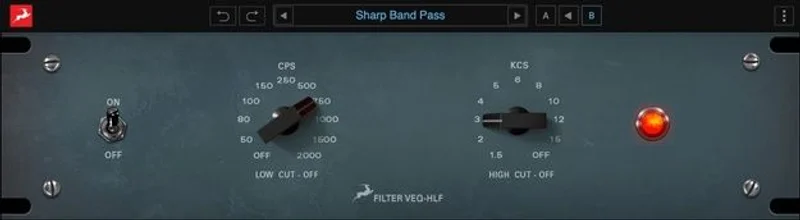
That's the Pultec passive filter character working correctly. The rolloff has a gentle slope that sits naturally against real acoustic instruments. We've used sharper digital HPFs that technically do the same job but leave the signal sounding slightly wrong in a way that's hard to describe until you A/B them against something like this.
The stepped frequency points are a genuine strength for recall. You snap a setting in, you know exactly where it is next session. No parameter drift, no "was it 78Hz or 82Hz?" moments. For tracking sessions and template-based workflows, that's satisfying in a way that continuous knobs often aren't.
We also love how light it runs on CPU. Stack six of these across a session and you won't notice the hit. See our full EQ plugins guide EQ plugins guide for context on how passive filter designs typically compare on resource draw.
The Not-So-Good
Ten frequency steps per band sounds like plenty. It isn't always.
We ran a test on a piano track where the ideal high-cut sat between two of the available steps. One setting left too much harshness in the upper range. The next step down removed too much air. We sat there frustrated, wishing for just one point between them. That's the trade-off with stepped passive filter designs, and the VEQ-HLF doesn't escape it.
The lack of any visual curve readout is annoying in 2026. We're not asking for a full spectrum analyzer. Even a static curve display showing the approximate rolloff shape would make the plugin feel less opaque, especially for producers who are still learning where their filters are actually cutting.
The standalone pricing situation is also frustrating. Antelope doesn't make it easy to find out what the VEQ-HLF costs outside of bundle context. If you already own the other two pack plugins and just want this one, finding a clear price takes more effort than it should. Check Antelope Audio's site directly for current pricing rather than relying on anything we'd print here.
Compared to the Alternatives
Universal Audio's Pultec EQP-1A has the HPF circuit built into a fuller program EQ. You're getting more functionality but you're paying multiples of what the Tube Glow EQ Pack costs. If you want the filter behaviour and the shelving boosts in one unit, UA's emulation is more complete. It also has better visual feedback and more documentation behind its sound.
Waves' Pultec bundle covers similar territory. The PEQ curve readout is cleaner, and the frequency choices feel slightly less constrained in practice. But Waves has its own licensing headaches and the pricing structure changes constantly.
Softube's Tube-Tech PE 1C is a fair comparison for pure filter quality. It sounds brilliant on mix buses. It's also considerably more expensive than picking up the full Tube Glow EQ Pack.
For a completely different approach to dynamic EQ work that sometimes overlaps with filter shaping du ties, the BLEASS Motion EQ review is worth reading if you want motion in your filtering rather than static cuts.
The honest comparison: the VEQ-HLF doesn't beat any of those alternatives on features or flexibility. It wins on price, simplicity, and the feel of those stepped filter movements.
Who Should Buy This
- ✅ Buy if you're building a Pultec-style EQ suite ITB and want a dedicated HPF/LPF to complement a program EQ on buses.
- ✅ Buy if you're picking up the Tube Glow EQ Pack during a sale and want the full three-plugin set for tonal shaping.
- ✅ Buy if you work in template-based sessions and value stepped recall over continuous knob precision.
- ❌ Skip if you need a visual curve display and real-time frequency feedback in your workflow.
- ❌ Skip if you're looking for surgical filter placement with exact Hz control at any point in the spectrum.
- ❌ Skip if you already own a full Pultec program EQ emulation with a built-in HPF circuit. You probably don't need this on top of that.
Score Breakdown
| Category | Score | Notes |
|---|---|---|
| Sound Quality | 3.8/5 | Passive filter character is genuinely musical; rolloff curves feel analog-weighted |
| Value for Money | 4.3/5 | At the current price for the full three-plugin pack, it's hard to fault the bundle math |
| Ease of Use | 4.5/5 | Two knobs. Can't get much simpler than this |
| Features | 2.5/5 | Ten steps per band and no visual display is lean, even for a passive filter tool |
| CPU Efficiency | 4.5/5 | Runs light; stack freely without worrying about session overhead |
| Overall | 3.6/5 | Solid for its specific role; too limited to stand alone as your only filter tool |
Alternatives to Consider
Universal Audio Pultec EQP-1A: The full Pultec program EQ with HPF circuit built in. More expensive, more complete. If you want one plugin to handle filtering and program EQ shaping together, this is the obvious answer. Pultec EQ emulations compared
Softube Tube-Tech PE 1C: Outstanding on mix buses. Better visual feedback, smoother workflow for engineers who want to see what their filters are doing. Price is the sticking point. The current price is shown in the buy box on this page.
BLEASS Motion EQ: A completely different philosophy. If static filtering feels limiting and you want filters that move with the dynamics of your material, read our BLEASS Motion EQ review before committing to a passive-style filter approach.
For broader context on how EQ tools fit into different mixing roles, our complete EQ plugins guide covers the full spectrum from surgical to character-based options.
The VEQ-HLF is a tool that does a small job with some genuine analog charm. At that price for the pack, we would buy it. As a standalone purchase at an unclear retail price, we'd want to see that price clearly before committing. It's not the filter plugin for every situation. It's the filter plugin for producers who already have a surgical HPF elsewhere and want something that sounds more alive on acoustic material and full program buses.
Buy the Tube Glow EQ Pack when it's on sale. Use the VEQ-HLF on the things that respond well to musical filtering. Route everything else through a precision tool. That's the honest workflow for this plugin.
Frequently Asked Questions
Is the VEQ-HLF available as a standalone plugin or only in the bundle?
Our research found the VEQ-HLF primarily positioned within the Tube Glow EQ Pack alongside the VEQ-1A and VMEQ-5. Standalone pricing and availability weren't clearly documented at the time of writing. Check Antelope Audio's official site for the most current purchase options.
What DAWs is the VEQ-HLF compatible with?
The VEQ-HLF ships in VST3, AU, and AAX formats, covering the major DAW hosts including Pro Tools, Logic Pro, Ableton Live, Cubase, and Studio One. Both Mac and Windows are supported. We'd confirm compatibility with your specific DAW version on Antelope's site before purchasing.
How does the VEQ-HLF differ from the VEQ-1A in the same pack?
The VEQ-HLF is a dedicated two-band passive filter handling only the low-cut and high-cut at the frequency extremes. The VEQ-1A is a fuller Pultec EQ emulation covering low-shelf and high-shelf boosts and cuts across the broader program range. They're built for different jobs and genuinely complement each other in a signal chain.
Can the VEQ-HLF be used on a mix bus or is it better for individual tracks?
We tested it on both and found it works well in either context. The passive filter character is soft enough that it doesn't sound clinical on a full mix bus. On individual tracks like acoustic guitar and piano it adds a natural rolloff that digital HPFs can struggle to match. It's versatile for something this simple.