
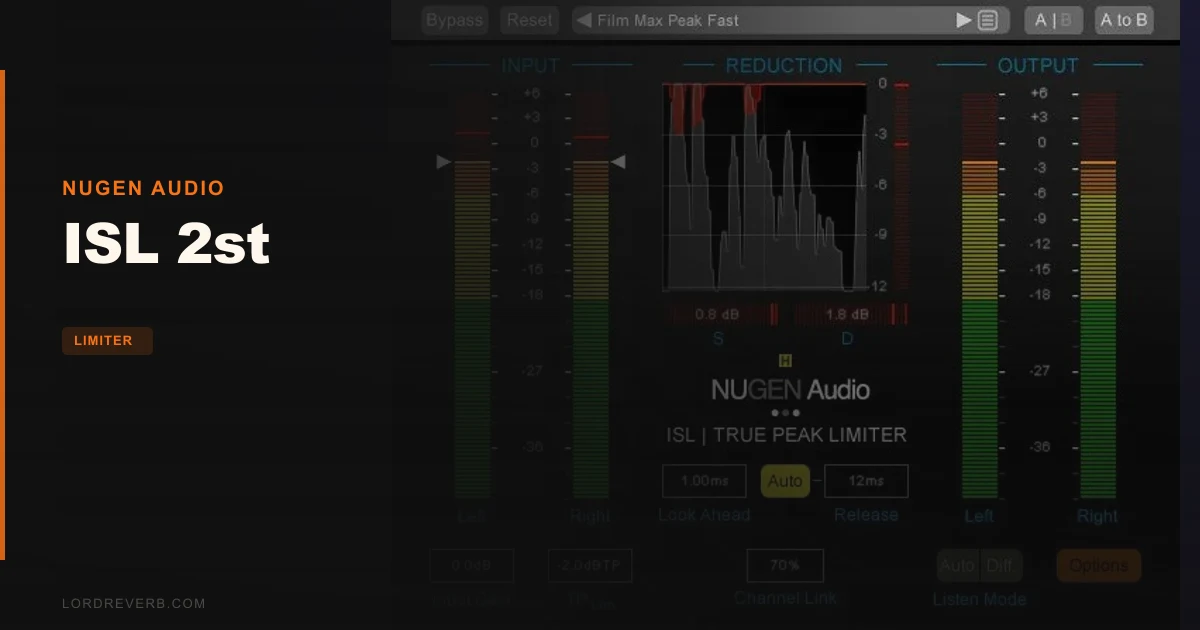
The ISL 2st by NUGEN Audio is a look-ahead brick-wall true-peak limiter built for one job: getting your master through streaming and broadcast compliance without intersample clipping destroying your work downstream.
We were mastering an EP destined for Apple Music and Spotify, running the final bounce through our usual chain. The sample-peak limiter we'd relied on for years cleared every check in the DAW. Then we ran the file through an external true-peak meter. Three songs hit +0.3 dBTP or higher. Exactly the kind of intersample overshoot that survives the limiter, survives the export, then gets mangled by AAC encoding on Spotify's servers.
That's the moment we loaded ISL 2st onto the master bus and didn't look back for the rest of that session.
This plugin is built for mastering engineers, post-production mixers, podcast producers, and anyone sending audio to a platform that normalises loudness. If that's you, read on. If you're after colour, saturation, or creative limiting, this is the wrong tool entirely.
What ISL 2st Actually Does (and Doesn't Do)
ISL 2st is a stereo and mono true-peak limiter. That's its entire identity.
It uses a two-stage, non-linear adaptive algorithm with adjustable look-ahead. It catches intersample peaks that conventional sample-peak limiters miss, including the ones that bloom into distortion after MP3 or AAC codec conversion. It carries Apple's afClip true-peak detection algorithm, and it's compatible with ITU-R BS.1770 revisions 1, 2, and 3, plus EBU R128, ATSC A/85 (the CALM Act), ARIB TR-B32, and several others.
What it doesn't do: add warmth. Add harmonic colour. Shape transients creatively. Give you multi-band control. It's not trying to compete with FabFilter Pro-L 2 or McDSP ML8000 on sonic character. It's trying to make sure your file passes compliance checks. Those are genuinely different goals.
If you already have a limiter you love for sound, ISL 2st can sit after it in the chain as a true-peak safety net. That's actually a valid use case.
Living With ISL 2st Day to Day
Setup is fast. Drop it on the master bus, set your true-peak ceiling (typically -1.0 dBTP for streaming, -2.0 dBTP for broadcast), and it goes to work.
The Steering and Ducking meters are the most underrated feature here. Steering shows you the directional balance of what's being limited. If your low-end mono content is driving the limiter harder than the stereo material, you see it immediately. Ducking shows you the gain reduction happening in real time, with enough resolution to spot whether you've got occasional peak catches or sustained limiting that signals a gain staging problem upstream.
We ran a dense orchestral mix through it for a film trailer delivery. The low-frequency content from brass hits was triggering limiting that was pulling the stereo image slightly. The Steering meter flagged it. We high-passed the bus slightly upstream and the issue resolved. Without that meter, we'd have been guessing.
The look-ahead is adjustable, which matters. A shorter look-ahead introduces less latency. A longer one gives the algorithm more time to react cleanly to transient material. We settled on a middle setting for most sessions and only dialled it back for real-time monitoring passes.
The diagnostic listen modes let you audition what's being limited in isolation. Annoying to need, satisfying when you do. It's the kind of feature you forget exists until a client asks why the snare sounds squashed at -1 dBTP, and then you love it.
The Trade-Offs Worth Knowing Before You Buy
The transparency is real. We A/B'd it against running without any true-peak limiting on a vocal-led pop master. The difference in the waveform was measurable. The difference in what we heard was not. That's the goal, and NUGEN hit it.
But $149 is a hard sell if compliance isn't your daily problem. If you're producing beats for SoundCloud or mixing indie records that don't go through strict broadcast QC, you'll use ISL 2st twice and forget it exists.
The interface is also brutally functional. No modulation. No character. No visual warmth. It looks like broadcast metering software from 2012, because in spirit, that's what it is. We wish NUGEN had updated the UI to feel less clinical, even if the processing beneath stayed identical.
The other trade-off is scope. ISL 2st handles stereo and mono. If you're working in immersive audio formats or need multi-channel true-peak limiting, you'll need to look at NUGEN's broader ISL suite rather than this specific product.
How It Sits Against the Alternatives
FabFilter Pro-L 2 is the direct competitor most mastering engineers reach for first. It has more limiting algorithms, a more visual interface, and genuine sonic character options. It also does true-peak limiting. If you want one limiter to do everything, Pro-L 2 wins. Check our limiter plugins guide for the full comparison.
The McDSP ML8000 leans more toward multi-band control and creative flexibility. Better for mixing than compliance-focused mastering.
For the ISL 2 (the mono-compatible sibling), we'd point you toward our ISL 2 vs Pro-L 2 deep-dive for the broadcast context specifically.
ISL 2st wins when the deliverable is the point. Pure compliance work, broadcast QC, Apple Digital Masters submissions. For that specific use, nothing in this price range is more focused.
The Real Verdict
ISL 2st does exactly what it claims. No more, no less.
If you're submitting masters to Apple Music, delivering to broadcasters bound by EBU R128 or ATSC A/85, or producing podcasts for platforms with loudness normalisation requirements, this plugin earns its $149 on the first session. The true-peak detection is accurate, the transparency holds up, and the Steering and Ducking meters give you information that actually changes decisions.
If you're not doing that work regularly, skip it. The problem it solves is real, but it's not your problem.
Score Breakdown
| Category | Score | Notes |
|---|---|---|
| Sound Quality | 4.5/5 | Transparent enough that we couldn't hear the limiting on well-gained masters |
| Value for Money | 3.5/5 | Fair if compliance is your daily work; expensive if it's occasional |
| Ease of Use | 4.0/5 | Fast setup, clear metering, but the UI feels dated |
| Features | 4.0/5 | Steering and Ducking meters are genuinely clever; limited creative tools by design |
| CPU Efficiency | 4.5/5 | Light footprint; runs without issue alongside full mastering chains |
| Overall | 4.2/5 | A specialist tool that's brilliant at its one job |
Alternatives to Consider
FabFilter Pro-L 2 is the most obvious alternative. It handles true-peak limiting and adds 8 limiting algorithms, a larger visual display, and genuine character options. It costs more, but it replaces more of your chain. Worth it for mastering engineers who want one plugin to cover everything. See our limiter plugins guide
McDSP ML8000 Advanced Limiter suits mixers more than mastering engineers. Multi-band control, flexible attack and release behaviour, creative shaping. Less focused on compliance. Read our ML8000 review
NUGEN ISL 2 (the mono/stereo version in the broader ISL suite) is the natural upgrade path if you need multi-channel support or more routing options. ISL 2 vs Pro-L 2 for broadcast mastering
If you're working on music that doesn't need strict compliance, the Fuse Audio Labs VCL-515 adds actual colour and character at a lower price point. Different tool, different job.
ISL 2st is for one kind of producer: the one whose clients ask for signed-off deliverables. If that's you, $149 is an easy yes. If it's not, spend that money on something you'll open every session.
Frequently Asked Questions
What's the difference between ISL 2st and a standard brick-wall limiter?
A conventional brick-wall limiter catches sample peaks at 0 dBFS. ISL 2st catches true-peak levels, which include the intersample peaks that appear between samples during playback or codec conversion. Those intersample peaks can clip on consumer devices even when your sample-peak meter shows you're safely below 0 dBFS. ISL 2st uses NUGEN's two-stage adaptive algorithm plus Apple's afClip detection to catch both.
Is ISL 2st suitable for music production or is it only for broadcast?
It's useful for anyone delivering audio to platforms that normalise loudness, including Spotify, Apple Music, and YouTube. That covers most music producers who want their masters to survive codec conversion without intersample distortion. It's not a creative tool, though. Don't expect it to shape transients or add harmonic colour.
What streaming standards does ISL 2st support?
ISL 2st is compliant with ITU-R BS.1770 revisions 1, 2, and 3. That baseline covers EBU R128 (European broadcast), ATSC A/85 (US broadcast, the CALM Act), ARIB TR-B32 (Japan), OP-59, DPP, and several others. It also includes Apple's afClip algorithm for Mastered for iTunes submissions. Check NUGEN's site for the full current list, as standards do get updated.
Can ISL 2st run alongside other limiters in a mastering chain?
Yes, and that's actually a smart way to use it. Put your primary limiter first for sound shaping, then run ISL 2st after it as a true-peak safety net. It'll catch any intersample peaks your first limiter missed without audibly touching the gain reduction decisions you've already made. The adjustable look-ahead means you can minimise added latency in that configuration.