
If your doubt about Pendulate is "is a free synth based on a physics experiment actually useful, or just a novelty?" we can answer that fast: it's legitimate, and we'd install it today.
Newfangled Audio built Pendulate around a double-pendulum oscillator. Not as a gimmick. As a genuinely new approach to generating sound that sits nowhere on the spectrum between analog modeling and wavetable synthesis.
It's free. Fully free. No introductory price, no stripped trial, no "free tier." You make an iLok account, download the installer, and you're running VST, VST3, AU, or AAX within five minutes.
This review is for producers who are skeptical. We were too. Here's what we actually found when we pushed it.
Does the Double-Pendulum Concept Actually Deliver?
Yes. And that surprised us more than we expected.
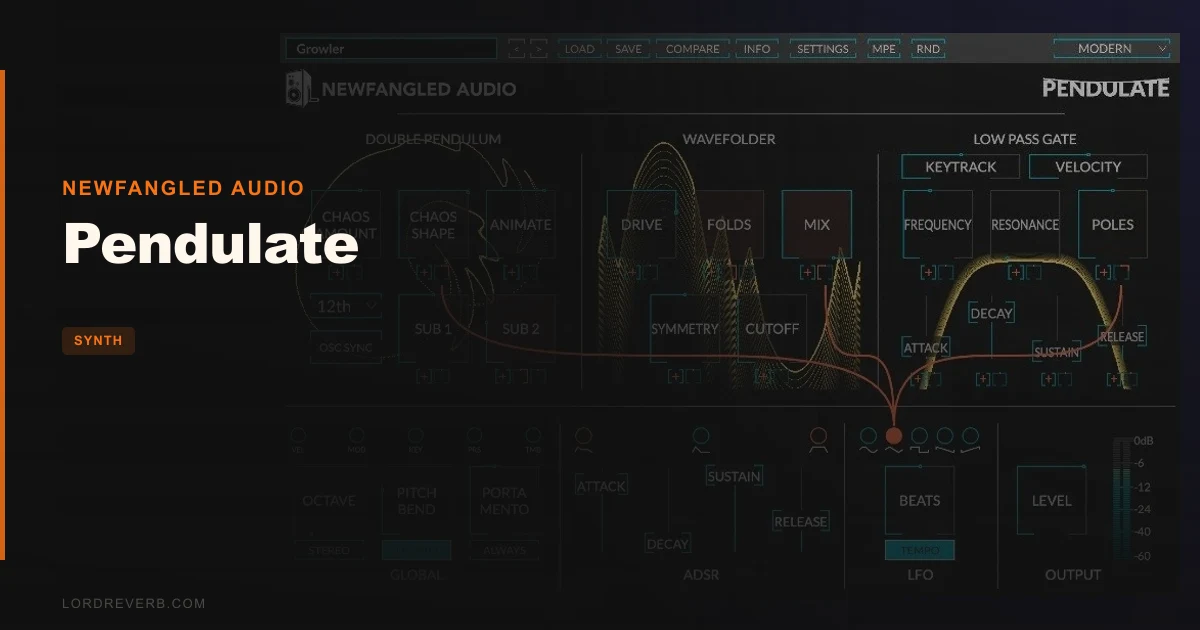
Newfangled Audio's premise is that a double pendulum, a chaotic mechanical system where predicting future behaviour from past state is mathematically hard, translates into audio as an oscillator that moves between clean sine output and full unpredictable chaos. The territory between those two poles is where Pendulate lives.
The signal chain is Buchla-inspired. The wavefolder comes from the 259 Complex Waveform Generator, with MIX and CUTOFF controls added. The low-pass gate references the 292, with POLES and RESONANCE on board. Those two modules wrapped around a chaos oscillator give you a sound design path that feels more like modular patching than typical softsynth programming.
We loaded it into Ableton Live 12 on Windows. Stable. No CPU spikes during testing. Animations on all three modules update in real time, which is actually useful for understanding what the chaos parameter is doing to your waveform.
Where Pendulate Shines
The chaos-to-sine sweep is the thing. Dialing the chaos parameter from 0 to maximum isn't a binary switch. At around 30%, you get a slightly unstable fundamental with organic harmonic flutter. Around 60%, the pitch starts to smear and fold back on itself. By 90%, you're in genuinely unpredictable territory that no LFO modulating a standard oscillator will replicate.
We ran a bass patch at chaos 45%, folded the wavefolder at about 60% wet, and pulled the low-pass gate down to two poles with resonance at roughly 40%. The result was a bass that sat between a Moog-style growl and something we'd describe as alive. It moved slightly on every note. Not randomly. Consistently musical, but never static.
That's the satisfying part: the chaos has underlying structure. It's not random noise. It self-organizes, which means you can lock in a character and trust it will repeat across your session.
The modulation system is genuinely clever. Up to 169 simultaneous routings from a single-pane UI sounds absurd on paper, and it looks intimidating at first. But once you understand the virtual cabling, patching the envelope to the wavefolder cutoff while an LFO hits chaos depth becomes fast work. The Sample and Hold module adds another layer for stepped modulation. This is modular-style thinking without the patch cable bill.
MPE support means a Roli Seaboard or LinnStrument can address pressure, slide, and per-note pitch bend into Pendulate's parameters directly. For that workflow, a free synth with this level of MPE integration is hard to find at any price.
136 presets ship with the synth. Matt Lange's contributions lean dark and cinematic. Matthew Wang's patches push further into glitchy, textural territory. About half the factory presets are genuinely worth keeping. That's a better hit rate than most paid libraries.
Where It Falls Short
Pendulate is monophonic. Full stop. No unison. No chord mode. No polyphonic workaround. If you need pads or stacked intervals, you're loading a second instance and routing carefully, which is annoying in fast sessions.
The learning curve is real. We spent about 40 minutes before the modulation system felt natural. The visual cabling helps, but there's no built-in patch documentation and the manual doesn't hold your hand. If you open it cold expecting a typical synth layout, you'll find the chaos parameter confusing before you find it useful.
Predictability under automation is the other friction point. When chaos is above 70%, automating pitch in a melodic line gets unpredictable in ways that aren't always musical. For experimental sound design, that's fine. For a searing lead that needs to hit the same note every bar, you'll want chaos below 40% or you'll be frustrated by takes that don't repeat cleanly.
The wavefolder CUTOFF also doesn't behave like a standard filter. It took us a while to stop expecting it to and start using it on its own terms. That's a workflow cost worth naming.
How It Stacks Up Against Paid Alternatives
The honest comparison for chaos-based synthesis is Cycling '74's Gen-based tools or something like u-he Bazille. Bazille gives you more routing flexibility, polyphony, and a more familiar modular interface. It wins on depth and control. But it doesn't have a double-pendulum oscillator, and it won't give you Pendulate's specific character for free.
Arturia's MiniFreak V is another reference point. Check our full MiniFreak V review for detail, but the short version is that MiniFreak V has more oscillator modes, polyphony, and a more immediately intuitive layout. It costs significantly more. If polyphony matters to you, it wins. If you want something genuinely strange and free, Pendulate wins.
For bass specifically, LOW by Beatsurfing is worth comparing. LOW is more focused, more predictable, and better for locked-in sub bass. Pendulate is better for moving, evolving, character-forward bass that you want to feel slightly unstable.
No paid synth in this category offers chaos synthesis at this price. That's the factual answer.
Is the Price Fair?
It's free. The value question becomes: is it worth the time investment to learn it?
For experimental producers, bass designers, or anyone building a modular-style plugin signal chain, yes. Absolutely. The MPE support alone would justify a higher price on a different synth.
For producers who want something to dial in fast without a learning curve, the time cost is real. Free doesn't mean zero cost. Budget a session for learning the modulation system before you use this on a deadline.
Score Breakdown
| Category | Score | Notes |
|---|---|---|
| Sound Quality | 4.5/5 | Genuinely original character; the chaos-to-sine sweep produces sounds no standard oscillator will |
| Value for Money | 5.0/5 | Free with MPE, MTS-ESP, 136 presets, and full format support |
| Ease of Use | 3.0/5 | Modulation system takes real time to learn; not a fast dial-in synth |
| Features | 4.0/5 | 169 mod routings, S+H, loop envelopes, animations; monophony is the ceiling |
| CPU Efficiency | 4.5/5 | Light footprint; stable across Ableton, FL Studio, Logic, Pro Tools per Newfangled's own testing |
| Overall | 4.2/5 | A free synth with a genuinely novel architecture, held back only by its monophonic limitation and learning curve |
Alternatives to Consider
If you want something with more immediate playability and polyphony, Arturia MiniFreak V is worth the price difference. It's a broader instrument. Less weird. More immediately usable.
For acoustic and physical modelling in a different direction, Applied Acoustics Chromaphone 3 covers territory Pendulate doesn't touch, especially pitched percussion and melodic sounds that need polyphony.
If grit and texture are your goal but you want something more immediately controllable, the Tape Synths expansion gives you character through saturation and wow rather than mathematical chaos. Different tool, overlapping use cases.
For dedicated bass work without the learning curve, LOW by Beatsurfing is the more predictable choice if you're not interested in evolving, unstable character.
Pendulate is free. Download it regardless of which alternative you choose. It takes five minutes to install and costs you nothing to have it sitting in your plugin folder for the session that needs it.
The producers who'll love it are already opening a browser tab. The ones who need a synth that works predictably every take should look elsewhere. Both answers are honest.
Related reviews: Farfisa V Review
Frequently Asked Questions
Is Pendulate really free, or is there a paid version?
Pendulate is completely free. There's no paid upgrade, no premium tier, and no features locked behind a purchase. You need a free iLok account for activation, but no physical dongle is required. Download directly from Newfangled Audio's site.
Can Pendulate do polyphonic sounds or chords?
No. Pendulate is strictly monophonic. One note at a time. If you need chords or stacked intervals, you'd need to run multiple instances and layer them manually, which works but adds complexity. It's the one area where the synth genuinely limits your options.
How hard is Pendulate to learn for a producer who hasn't used modular synthesis?
Harder than most standard softsynths. The oscillator, wavefolder, and low-pass gate chain makes sense once you understand each module's role, but the modulation system requires real time investment. Budget one focused session before using it on a project with a deadline. The animations help significantly with understanding what each parameter is doing.
What genres or styles is Pendulate best suited for?
Dark bass music, sound design for film and games, experimental electronic, and any genre where moving, unstable textures are an asset rather than a problem. It's less suited for clean leads, melodic polyphonic work, or any context where you need a sound to repeat identically under heavy automation. The chaos parameter is a feature, but it does require management in controlled melodic contexts.