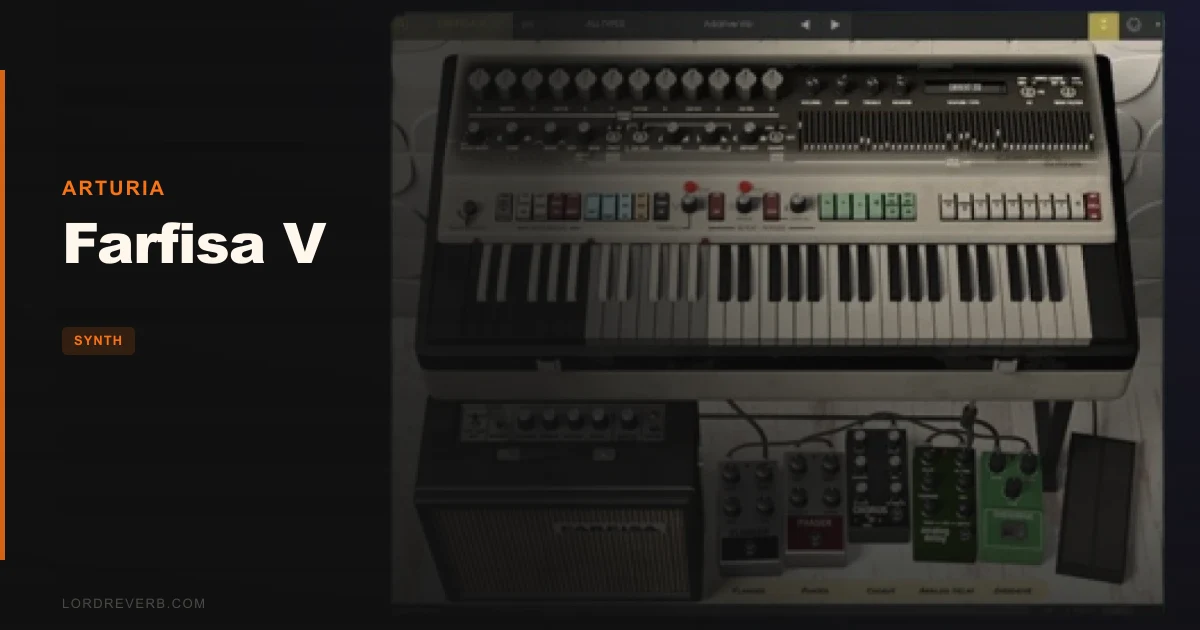
Arturia's Farfisa V is the most convincing software emulation of the Farfisa Compact organs currently available, and at $99 it costs less than a single repair bill on the hardware original.
We loaded it up during a psych-pop session. The brief was simple: find that slightly queasy, cheerful-but-wrong organ tone from the back half of the 1960s. You know the one. "Incense and Peppermints." "96 Tears." Rick Wright's earliest Pink Floyd work before he moved to the Farfisa's weirder cousin.
We dialled up preset number 12. Hit a C major chord. Sat back.
The attack had that particular plasticky sharpness where the note starts before it fully blooms. Not a Hammond warmth, not a Vox bite. Farfisa character. It sat in the mix with almost no EQ needed, sitting around 800Hz to 2kHz where combo organs live.
This review is for producers chasing vintage Top 40, psych, surf, garage rock, or reggae textures, and for any organist who wants a Farfisa without the cigarette burns and the electrical gremlins.
What the Farfisa V Actually Is (and What It Isn't)
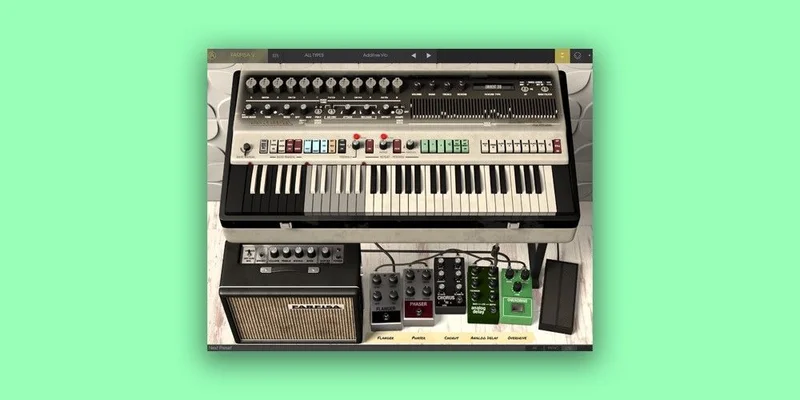
This is a physical model of the Farfisa Compact Deluxe and Compact Duo combo organs, powered by Arturia's TAE (True Analog Emulation) technology. It models the tone generator voicings: bass, strings, flute, oboe, and the additional voices across both manuals and bass pedal sections.
Then Arturia added things the hardware never had. A 48-band additive waveform generator called ToneDraw. Selectable bass waveforms with a 4-pole resonant filter. Upper attack and release envelopes. Polyphonic and paraphonic operation. Vintage stompboxes and a guitar amp sim with drag-and-drop FX ordering.
What it isn't: a Hammond. Not even close. If you need that drawbar-driven, tonewheeled warmth, look elsewhere. This is the scrappier, stranger cousin. Brilliant for what it is. Wrong tool if you need organ bread-and-butter.
Living With It: Three Sessions In
Setup was clean. Arturia Software Center handles activation across up to five instances per license. Install, activate, open your DAW. Ten minutes total.
The preset browser is genuinely good. Tag-based filtering, favorites, comments, playlists. We found usable sounds fast. 147 presets sounds like a lot until you realise how focused Farfisa tones are. There's less variation here than in a broad synth library. That's not a complaint. It's accurate to the source material.
ToneDraw is where things get satisfying. We spent 40 minutes drawing custom additive waveforms in the upper manual section during a reggae session. Pulled the flute voice down, boosted the upper partials, ran it through the wah-style knee lever mapped to aftertouch. The result was something between a Farfisa and a cheap string machine. Loved it. It would have taken a rack of outboard gear to get there on hardware.
The knee lever implementation deserves a mention. On the original organs, you pressed a physical knee lever to control filter sweep. Here it maps to expression pedal, mod wheel, or aftertouch. We used aftertouch on a Keylab 88. It felt immediate and playable. That wah-adjacent sweep is genuinely fun to perform.
One frustration: the GUI, while resizable, defaults to a size that fills too much screen real estate in a standard DAW window. We kept scaling it down. It's gorgeous, but it's designed to impress first and fit second.
CPU usage sits at medium-to-heavy for an organ emulation. On an M2 MacBook Pro it ran fine. On an older 4-core Windows machine hitting 3.4GHz, we saw it chew about 8-12% CPU solo, climbing higher with the amp sim and reverb active. Not a dealbreaker, but not lightweight either.
The Trade-Offs Worth Talking About
The physical modeling is convincing. But it isn't perfect by spec-sheet standards.
The most documented gap: the final white voicing tab from the Compact Duo is missing. For most users, this won't register. For a purist trying to recreate a specific recording from a specific organ configuration, it might. We noticed the absence in a side-by-side with archival recordings. The overall character holds up. The fine detail doesn't always.
The synthesizer additions are a double-edged thing. ToneDraw and the resonant filter push the Farfisa V into original territory, which is clever and genuinely useful. But it also means you're no longer playing a pure organ emulation. Some sessions want purity. Others want the hybrid. Know which you need before you load it up.
Value framing matters here. At $99 standalone, it's strong. Inside the V Collection bundle, it becomes excellent value alongside instruments like the Hammond B-3 V, Stage-73 V, and MiniFreak V. If you're building an Arturia-heavy rig, the bundle math works in your favour fast.
Against the Field: Where It Wins and Where It Doesn't
The obvious competitor in the Arturia catalogue is the Hammond B-3 V. For gospel, soul, and classic rock organ, the Hammond wins. Fuller low end, more headroom in the drawbar system, better-suited to grinding sustained chords. The Farfisa V wins on attack character, upper-register brightness, and that specific 60s pop voicing.
AudioThing's SX1000 covers Italian combo organ territory with a different approach. More sampling-influenced, less synthesis freedom. We'd pick the Farfisa V for playability and sound design depth. The SX1000 wins on a few specific tonal characters the Farfisa V doesn't quite reach.
Against any sampled Farfisa library: physical modeling responds to velocity, aftertouch, and real-time parameter changes in ways samples can't match. The Farfisa V feels more alive under your fingers. That's worth paying for if you're performing, not just placing loops.
The Real Verdict
The Farfisa V earns its price. It sounds right, it plays well, and the synthesizer additions give it a shelf life beyond pure nostalgia.
The missing Compact Duo voicing tab is a real omission for the obsessive. Medium-to-heavy CPU is a real cost on older systems. But for the session where you need that 60s combo organ character fast, without hunting Craigslist for functional hardware, this does the job cleanly.
Skip it if you need a Hammond. Skip it if you're on a weak CPU. Buy it if the sound of 1966 is on your reference track and you need to get there in under ten minutes.
Score Breakdown
| Category | Score | Notes |
|---|---|---|
| Sound Quality | 4.5/5 | Physical modeling nails Compact Deluxe character; minor deviations on the Duo's final voicing tab |
| Value for Money | 4.0/5 | Strong at $99 standalone; outstanding inside V Collection |
| Ease of Use | 4.5/5 | 147 presets and logical layout make it immediately playable; ToneDraw has a short learning curve |
| Features | 4.0/5 | ToneDraw, knee lever, stomp boxes, and amp sim push it well beyond a straight emulation |
| CPU Efficiency | 3.5/5 | Heavier than expected for an organ plugin; older machines will feel it with effects active |
| Overall | 4.2/5 | The best Farfisa emulation available, with useful synthesis additions and one notable purist gap |
Alternatives to Consider
Arturia Hammond B-3 V, If your sessions skew more towards soul, gospel, or classic rock organ, the Hammond B-3 V is the right choice. Fuller drawbar system, more headroom, better-suited to grinding sustained chords. It's the organ emulation benchmark in the V Collection for traditional organ work.
AudioThing SX1000, Covers related Italian combo organ territory. We reviewed it and found its tonal character slightly different from the Farfisa V's physical model. Check our SX1000 review for a direct comparison. It's the better pick if you need a specific SX1000 character rather than Farfisa voicing.
Applied Acoustics Systems Chromaphone 3, Not an organ. But if you're building a vintage texture toolkit and want physical modeling depth in a different direction, the Chromaphone 3 sound bank shows what physical modeling can do at a similar price point.
The Farfisa V sits in a narrow category and wins it. If that category is your category, buy it. If you're unsure whether you need a Farfisa specifically, load the demo first. Ten minutes with those presets will tell you everything.
Related reviews: Largo 2 Review
Frequently Asked Questions
Is the Farfisa V included in the Arturia V Collection?
Yes. The Farfisa V is included in Arturia's V Collection bundle alongside the Hammond B-3 V, Stage-73 V, and 30+ other instruments. If you're buying more than two or three Arturia instruments, the bundle pricing makes significantly more sense than buying each standalone. Check Arturia's site or Plugin Boutique for current bundle pricing.
How does the Farfisa V differ from sampling-based organ plugins?
The Farfisa V uses physical modeling (TAE technology) rather than samples. This means it responds dynamically to velocity, aftertouch, and real-time parameter changes in ways a sample library can't replicate. The knee lever mapped to aftertouch is a good example: it's a live, continuous response, not a triggered sample crossfade. For performing, this matters. For static production work, a sampled alternative might be lighter on CPU.
What organs does the Farfisa V model?
It models the Farfisa Compact Deluxe and the Farfisa Compact Duo, both combo organs from the 1960s. The Compact Deluxe provides the main upper and lower manual voicings. The Compact Duo adds additional voice options. One voicing tab from the Compact Duo's white register is missing from the emulation, which purists should be aware of before buying.
What are the minimum system requirements for the Farfisa V?
On Mac, you need macOS 10.13 or later, 4GB RAM, a 4-core CPU at 2.5GHz or Apple Silicon, and 2GB of free disk space. On Windows, you need Windows 10 64-bit, 4GB RAM, a 4-core CPU at 3.4GHz, and 6GB of disk space. ARM processors are not supported on Windows. OpenGL 2.0 compatible GPU is required on both platforms.