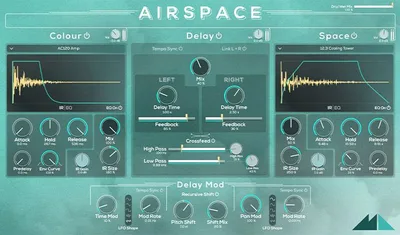
Airspace is worth $80 if you want a convolution reverb that’s all texture and character, but you’ll regret it if you expected to load your own impulse responses.
That’s the sore spot. The plugin ships with 450+ recorded samples and no way to import a single extra one. For some buyers that’s fine. For anyone with a hard drive full of IRs they’ve collected over the years, it’s annoying.
Then there’s the loudness. Owners report presets that jump out much louder than their neighbours, so you click through the browser and your monitors bite you.
Who’s it for? Sound designers, ambient writers and anyone who treats reverb as an instrument. If you only want a tasteful vocal plate, keep reading anyway, because the alternatives section matters here.
Who Ends Up Regretting This
Start with the collector. If your workflow is built around your own captured spaces, a sealed IR library is a dealbreaker. We’d call that the biggest mismatch.
Next, the tinkerer who wants to rearrange the signal path. Reviewers flag routing and module reordering as constraining. You get a fixed chain, and if your idea needs the delay before the reverb, you’re stuck working around it.
Then the gain-staging purist. Output volume swings between presets and input sources, and resonance can build up. You’ll want a meter on the output and possibly an EQ after it.
Finally, anyone who only needs one clean room sound. This is a lot of plugin for a job a simple reverb does.
What Owners Actually Say
The praise is consistent. Owners say the impulse responses add texture and character that algorithmic reverbs simply don’t have. Reviewers keep landing on the same point: the magic shows up when you blend all three modules, the two convolution engines and the delay, rather than treating any one in isolation.
The delay gets love too. Users report that independent left/right feedback and crossfeed stretch it from subtle chorusing to shimmering soundscapes.
CPU gets a good mark. Reviewers describe it as less taxing than competing convolution options.
The complaints are the ones above: volume spikes, resonance buildup, and a routing setup that limits experiments. One more: some users notice a volume drop between the dry input and the impulse responses. Reviewers consider that non-critical, and we’d agree it’s a gain-trim chore, not a flaw in the sound.
What You Actually Get
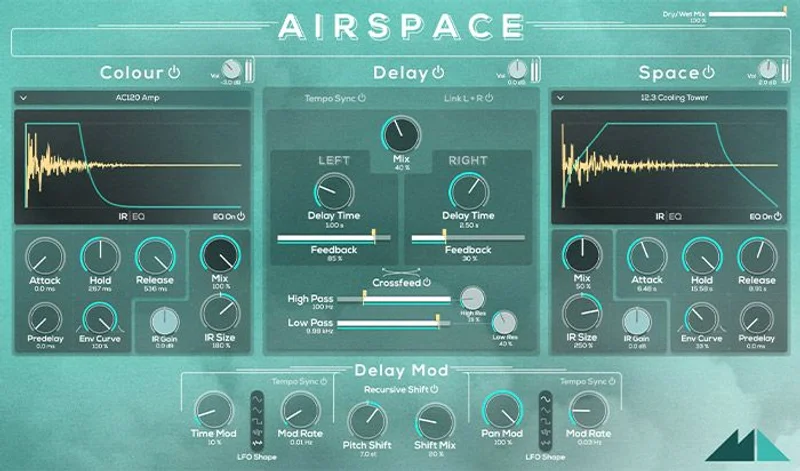
Two convolution engines sit side by side, so you can stack, say, a Real Spaces (Long) cathedral under a Springs & Plates layer and blend the two.
The 450+ IRs live in 11 folders: Amplifiers, Drums & Percussion, Found Percussion, Kitchen, Piano, Experimental Textures, Hardware Reverbs, Loops, and three Real Spaces folders (Long, Medium, Short), plus Springs & Plates. Yes, a kitchen. Love that.
You can stretch IR size from 20% to 500%. Shrink a cathedral to 20% and it turns into something boxy and odd. Push a small room to 500% and it blooms into a cavern that never existed.
Shaping tools include amplitude enveloping, pre-delay and gain. Dual 4-band EQs sculpt the IR sound.
The stereo delay adds crossfeed, high and low pass filters, resonance, and a 4-octave pitch-shifter. Dual LFOs modulate delay time and panorama with five shapes: sine, triangle, square, random and smooth random. There are 240+ presets in six folders: Ambient, Blur, Cosmos, Reflect, Transform and Warp.
The Smarter Route
Our take: this plugin wins on breadth, and the comparison depends on what you’re replacing.
| Product | Strongest point | Weakest point |
|---|---|---|
| Airspace | Dual convolution plus delay and 240+ presets in one plugin | No custom IR loading, limited routing |
| Fog Convolver 2 (AudioThing) | Similar price point, focused convolution | Less delay and fewer presets than Airspace |
| Vintage Verb / Blackhole | Dedicated reverb character | No delay section, shallower EQ controls |
| Turnado / Movement | Multi-effects sound design between delay and reverb | Not convolution reverbs |
If you want convolution at a similar cost, Airspace beats Fog Convolver 2 on extras. If you want pure algorithmic wash, Vintage Verb and Blackhole are the cleaner fit. Turnado and Movement suit you if your goal is movement, not space.
Buy or Wait?
Buy it. At $80 you get a deep, texture-first reverb and delay that stays gentle on your CPU, and the 15-day free trial means you can check the level jumps for yourself before paying.
Skip it if custom IR loading matters to you. Hard pass for you.
Also skip it if you want a fixed, flexible routing matrix. You won’t get one here.
Specs & Technical Details
| Developer | ModeAudio |
| Price | $80 |
| Plugin Format | VST3 / AU |
| OS Support | macOS 10.13 or later (Intel and Apple Silicon) / Windows 11 or later |
| Activation | N/A |
| CPU Usage | Lighter than competing convolution options, per reviewers |
| Trial Available | Yes (15 days) |
| Version Reviewed | N/A |
Score Breakdown
| Category | Score | Notes |
|---|---|---|
| Sound Quality | 4.5/5 | Recorded IRs give texture algorithmic reverbs lack |
| Value for Money | 4.5/5 | Two reverbs, a delay and 240+ presets in one plugin |
| Ease of Use | 4.0/5 | Great presets, but level jumps need managing |
| Features | 4.0/5 | Deep delay and EQ, held back by no custom IRs and limited routing |
| CPU Efficiency | 4.5/5 | Reviewers report lighter load than rival convolution plugins |
| Overall | 4.3/5 | Excellent texture machine with a sealed library and fixed routing |
Alternatives to Consider
Fog Convolver 2 by AudioThing
Similar price point and a focused convolution tool. You give up the delay section and the larger preset count.
Vintage Verb and Blackhole
Pick these for pure reverb character. They lack Airspace’s delay and deeper EQ controls.
Turnado and Movement
Better when you want modulation-driven sound design in the gap between delay and reverb. They aren’t convolution engines.
The Last Word
Airspace is a brilliant, slightly stubborn texture box. At $80, grab it if you’d rather borrow a kitchen and a cathedral than import your own rooms, and skip it if your IR library is the whole point.
Frequently Asked Questions
Is Airspace worth $80?
For sound designers and ambient producers, yes. You get dual convolution engines, a full stereo delay and 240+ presets in one plugin. It's the wrong buy if you need to load your own impulse responses.
Can Airspace load custom impulse responses?
No. It ships with 450+ recorded impulse responses and doesn't import your own samples. That's its biggest limit.
Is there a free trial for Airspace?
Yes, a 15-day free trial. Use it to check how the preset loudness jumps behave in your own sessions.
What formats and systems does Airspace support?
VST3 and AU. The Mac version needs macOS 10.13 or later and runs on Intel and Apple Silicon. The Windows version needs Windows 11 or later.
Is Airspace heavy on CPU?
Reviewers report it's less taxing than competing convolution options. Still, load it in your own project first, since results depend on your machine.