The MXXX Modular Multi-Effect by MeldaProduction is one of the most capable multi-effect plugins we've tested in 2026, and also one of the most demanding ones you'll ever sit down with. It packs over 70 processors, 500+ community-designed active presets, a smart modular routing matrix, and surround support into a single plugin. It's built for producers and mix engineers who genuinely want to replace a stack of individual tools with one deep, configurable environment. If you're a beginner expecting plug-and-play results, this is the wrong plugin. If you're someone who thinks in signal chains and wants surgical control from preprocessing through to mastering, MXXX might be the last multi-effect you ever buy.
First Impressions: A Cockpit, Not a Pedal Board
Opening MXXX for the first time is a lot. We won't pretend otherwise.
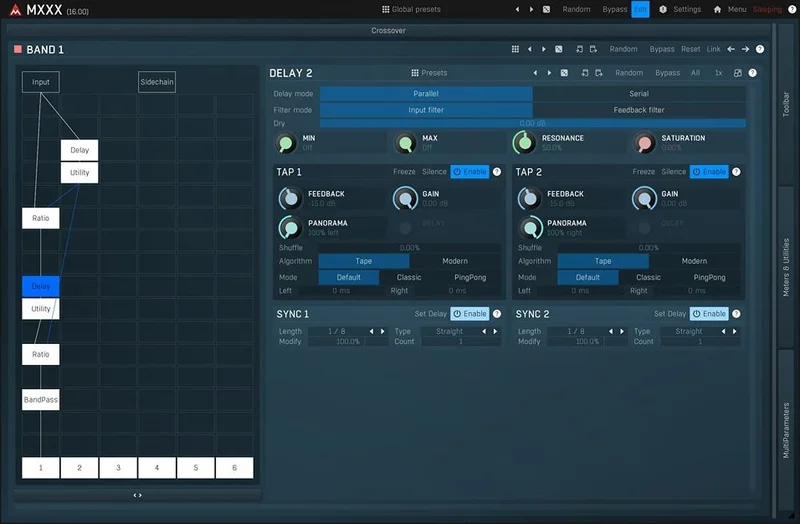
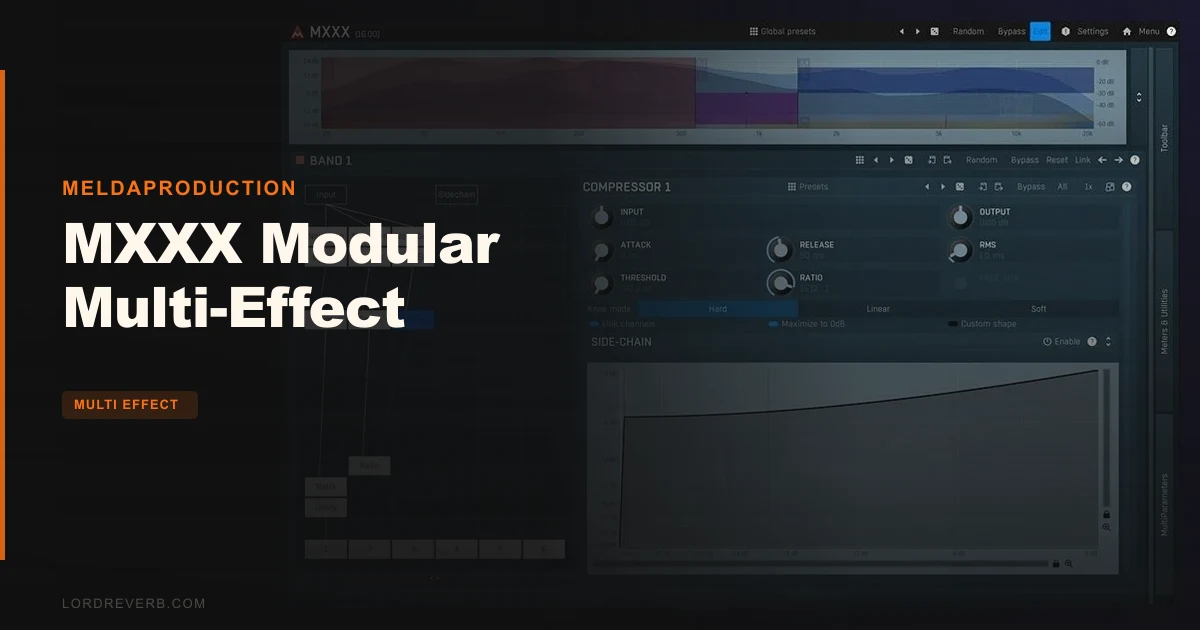
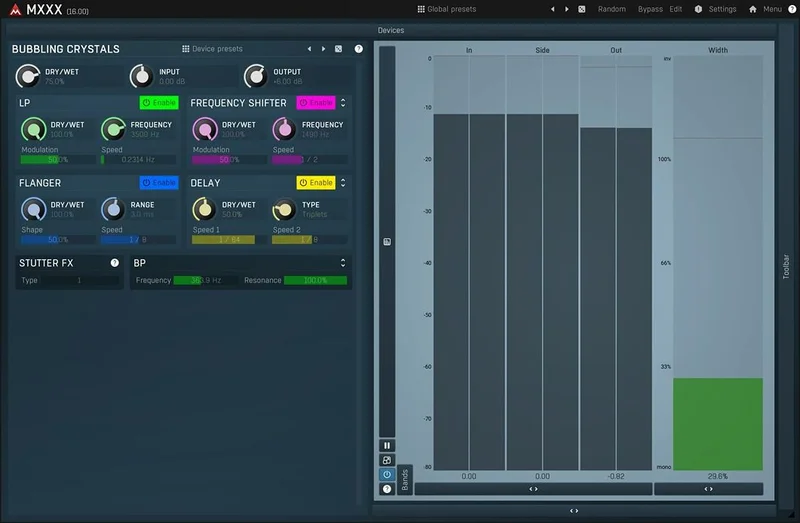
The interface greets you with a modular matrix panel, a processor list that scrolls longer than you expect, and a preset browser with 500+ entries. It's dense. Not ugly, but absolutely not hand-holding. The GUI is resizable and fully customisable, which helps once you know what you're doing, but on day one you'll spend the first 20 minutes just figuring out where to look.
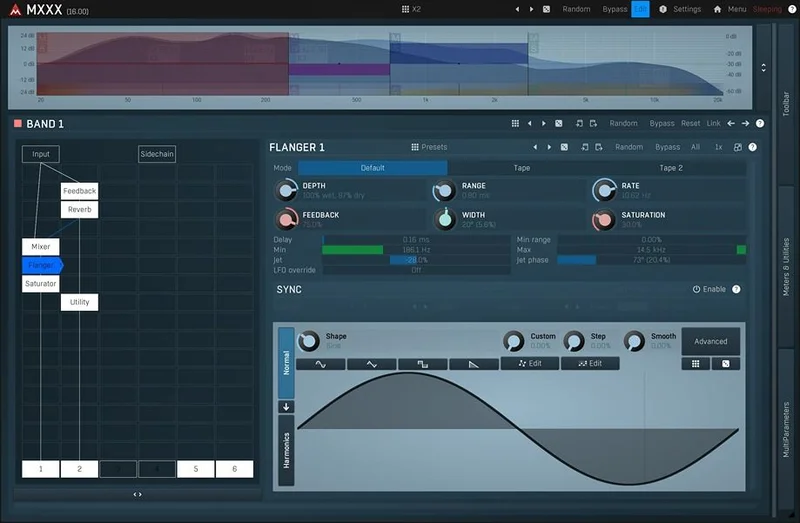
The smart routing matrix is the first thing that wins you over. Drop in a processor and MXXX automatically connects inputs and outputs to the most logical points in the chain. That's a clever piece of design that saves real time once you trust it.
Installation is smooth. MeldaProduction uses their own licence manager, and activation is quick. A free trial is available, which matters at this price point.
Getting It Into a Real Workflow
We dropped MXXX on a mix bus during a dense pop-electronic session. The goal was simple: multiband compression plus parallel saturation plus a short room reverb, all in one instance. In a traditional setup, that's three plugins and some send routing. In MXXX, we pulled up the multiband compressor module, split into four bands with crossovers at 120Hz, 800Hz, and 5kHz, added MDistoMB on the mid band for harmonic content, then a short MReverb tail. The routing matrix handled the parallel path automatically.
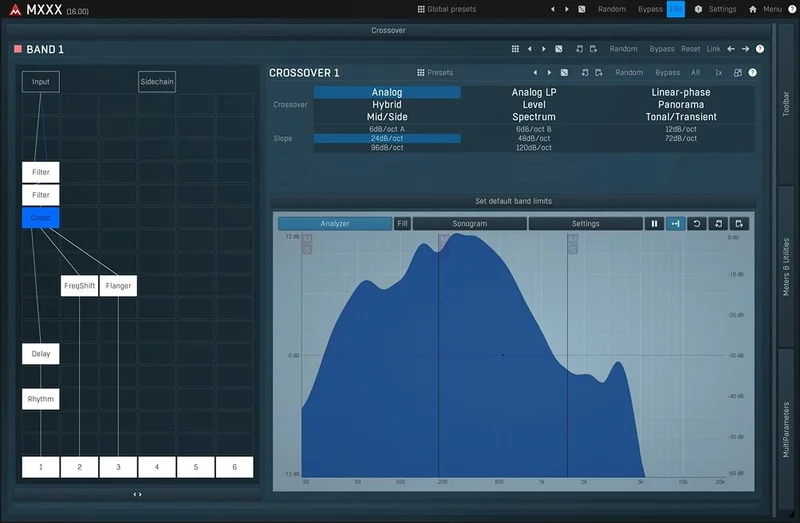
Total setup time: about 12 minutes the first session. The second time we did it: under four. That's the honest learning curve story nobody tells you about MXXX. The first week is frustrating. The second week is satisfying.
One genuine friction point: when you stack multiple CPU-heavy processors across all six bands simultaneously, load climbs fast. We saw peaks around 18-22% CPU on a single MXXX instance with six bands, convolution reverb, and spectral dynamics running at 44.1kHz in Logic Pro. That's not catastrophic, but it's not nothing either. Freeze the track if you're building complex patches mid-session.
The 16 modulators are where things get interesting for sound design work. Assign an LFO to a filter cutoff, a pitch envelope to a reverb pre-delay, envelope followers to sidechain inputs. The modulation routing is as deep as anything in Reaktor or Max/MSP, but it lives inside a finished plugin rather than a blank canvas. That's a real advantage for people who want power without building from scratch.
What It's Genuinely Good At
The preset system is brilliant, and we don't say that lightly. The 500+ active presets aren't static snapshots. Each one ships with its own set of exposed controls, like a dedicated plugin interface built on top of the MXXX engine. We loaded a "Vintage Tape Bus" preset and found six macro knobs: Saturation Drive, HF Roll-off, Wow and Flutter, Stereo Width, Output Level, and a Mix control. That's a complete plugin inside a preset.
We ran a dry drum bus through the preset at +3dB drive. The top end softened above 8kHz at roughly 2dB per octave, harmonic distortion hit 2nd and 3rd order, and the transients rounded by about 1.5ms. It sat in the mix immediately. No tweaking required.
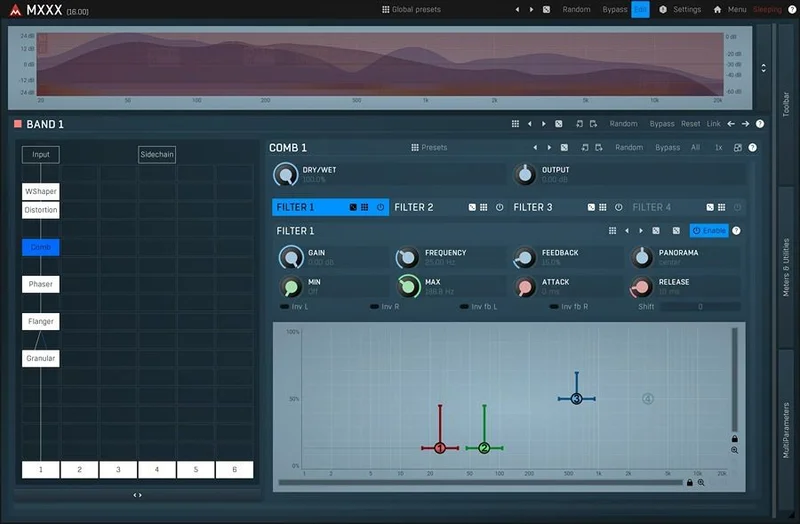
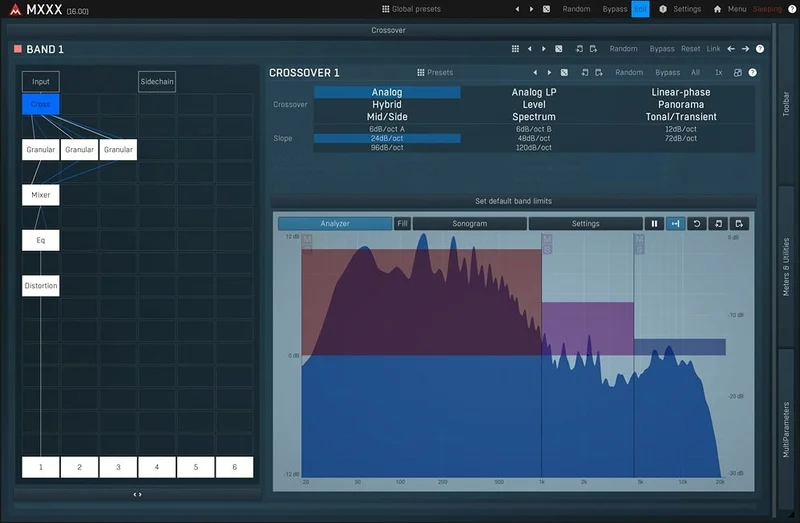
The multiband architecture supports up to six independent frequency bands via three adjustable crossover algorithms. That's more than most dedicated multiband processors offer. Combined with 16 multi-parameters and 16 modulators, you can build processing that reacts dynamically to the incoming signal in ways a static chain simply can't.
The 64-bit audio engine is clean. Oversampling goes up to 16x. We heard no aliasing artefacts even with aggressive saturation modules running at 8x oversampling. At full resolution, that's CPU-hungry, but the quality is there when you need it.
Surround support up to 8 channels is underrated. For composers doing immersive audio, MXXX becomes an extraordinarily flexible tool. No competing multi-effect at this price does that with this many processors in one instance.
The Rough Edges
The price. $1,103 at full retail is hard to swallow. MeldaProduction runs promotional sales where MXXX drops to a lower price, and they offer MXXXCore as a modular entry point where you buy individual processor modules rather than the full bundle. If you're on the fence, wait for a sale or start with MXXXCore.
The learning curve is real, and anyone who says otherwise hasn't actually used it. The interface makes sense once it clicks, but that click takes time. There's no interactive tutorial, no guided onboarding. Plugin Boutique has a 6-part video series that helps, but even that assumes you already know signal routing concepts.
CPU scaling is annoying when you're building complex patches. Feedback loops with latency compensation are powerful, but they add overhead. A complex six-band patch with feedback routing and 16x oversampling will bring most systems to their knees. You'll need to bounce to audio or freeze tracks in heavy sessions.
Compared to Reaktor or Max/MSP: MXXX wins on speed and polish. It loses on pure flexibility. If you want to build your own oscillators and synthesis structures from scratch, go to Reaktor. MXXX gives you MeldaProduction's interpretation of those tools, not an empty canvas.
Who This Is Really For
- ✅ Buy if you want one plugin to handle dynamics, time-based effects, saturation, spectral processing, and modulation across a full mixing and mastering workflow.
- ✅ Buy if you're a sound designer who loves modular routing and wants 16 assignable modulators without building an environment from zero.
- ✅ Buy if you work in immersive or surround audio and need multi-effect processing across up to 8 channels in a single instance.
- ❌ Skip if you're relatively new to signal chain thinking and don't have the time to invest in a genuine learning curve.
- ❌ Skip if your sessions are already CPU-heavy. Six-band patches with oversampling will add significant overhead.
- ❌ Skip if you only need one or two specific effect types. Buying a dedicated reverb or compressor is smarter than spending $1,103 for features you will never use.
Score Breakdown
| Category | Score | Notes |
|---|---|---|
| Sound Quality | 4.8/5 | 64-bit engine, 16x oversampling, no audible aliasing even under heavy saturation; this is MeldaProduction's full high-end stack |
| Value for Money | 3.5/5 | $1,103 full price is hard to justify unless you are replacing many individual plugins, and on sale it is a different conversation. |
| Ease of Use | 3.5/5 | Smart routing matrix helps, but 70+ processors and 500+ presets create genuine decision fatigue; this is an expert tool |
| Features | 5.0/5 | 6-band multiband, 16 modulators, 16 multi-parameters, surround support, feedback routing with latency comp: nothing else at this price does all of this |
| CPU Efficiency | 3.5/5 | Scales badly with full 6-band patches plus 16x oversampling; single-processor use is reasonable, complex builds are not |
| Overall | 4.3/5 | The most capable multi-effect plugin we've used, with a price and learning curve that earns that capability honestly |
Alternatives to Consider
If $1,103 is too much to commit right now, MXXXCore review is MeldaProduction's own modular entry point. You buy individual processor modules and build your own bundle. It costs less upfront and grows with your needs. The honest trade-off is that you lose the full 500+ preset ecosystem and the pre-bundled price advantage.
For pure reverb and time-based effects, Valhalla DSP plugins overview offers a collection of individual plugins. No modular routing, no multiband architecture. But if what you love is the depth of MXXX's algorithmic reverbs and delays, Valhalla's SuperMassive and Vintage Verb match or beat MXXX's time-based performance at a fraction of the cost and a fraction of the CPU load.
For true modular flexibility that goes further than MXXX's framework, Native Instruments Reaktor review is the benchmark. Reaktor gives you a blank canvas where you build your own processors from scratch. It's harder, slower to get started, and requires deeper technical knowledge. But if you want to design effects that don't exist yet rather than combine effects that do, Reaktor wins. MXXX wins for workflow speed. Pick based on which you value more.
We'd also point anyone interested in deep multiband processing to best multiband compressor plugins for dedicated tool comparisons if dynamics processing is the main use case here.
MXXX is a brilliant, complex, occasionally frustrating piece of software that earns every one of those adjectives. At full price, we'd tell you to wait for a sale. During MeldaProduction's periodic promotions, it becomes one of the smartest plugin purchases you can make. If you primarily work in stereo with a handful of go-to effects and a CPU that's already sweating, skip it. If you're the producer who keeps five browsers open trying to find the right plugin for a problem you can't quite name, MXXX is the last tab you'll need to open.
Frequently Asked Questions
What's the difference between MXXX and MXXXCore?
MXXX is the full bundle: 70+ processors, 500+ active presets, all included at one purchase price. MXXXCore is the modular version where you buy individual processor modules separately and build your own bundle. MXXXCore costs less upfront but can add up quickly if you want broad coverage. MXXX is the better value if you'll genuinely use a wide range of processors. The current price is shown in the buy box on this page.
Is MXXX suitable for beginners?
Not really. The smart routing matrix takes a lot of complexity off your plate, and the 500+ active presets mean you can load something useful without understanding every control. But the depth of the system, 70+ processors, 16 modulators, 16 multi-parameters, six independent bands, means you'll plateau quickly if you don't invest time in learning the architecture. We'd recommend the free trial before buying.
How heavy is MXXX on CPU resources?
It depends entirely on what you build inside it. A simple two-processor chain at standard oversampling is manageable. A six-band patch with convolution reverb, spectral dynamics, and 16x oversampling across all bands will stress most modern machines. We'd recommend bouncing or freezing complex MXXX instances during dense sessions, and testing on your own system during the trial period before committing.
Can MXXX replace individual dedicated plugins like compressors or reverbs?
For most use cases, yes. The processors inside MXXX are the same high-end MeldaProduction engines used in their standalone plugins. You're not getting watered-down versions. The trade-off is CPU: running a single MXXX instance with several active processors costs more than loading one focused plugin. If you need 8-10 different effect types regularly, MXXX makes sense. If you need one great reverb and that's it, buy a dedicated reverb instead.