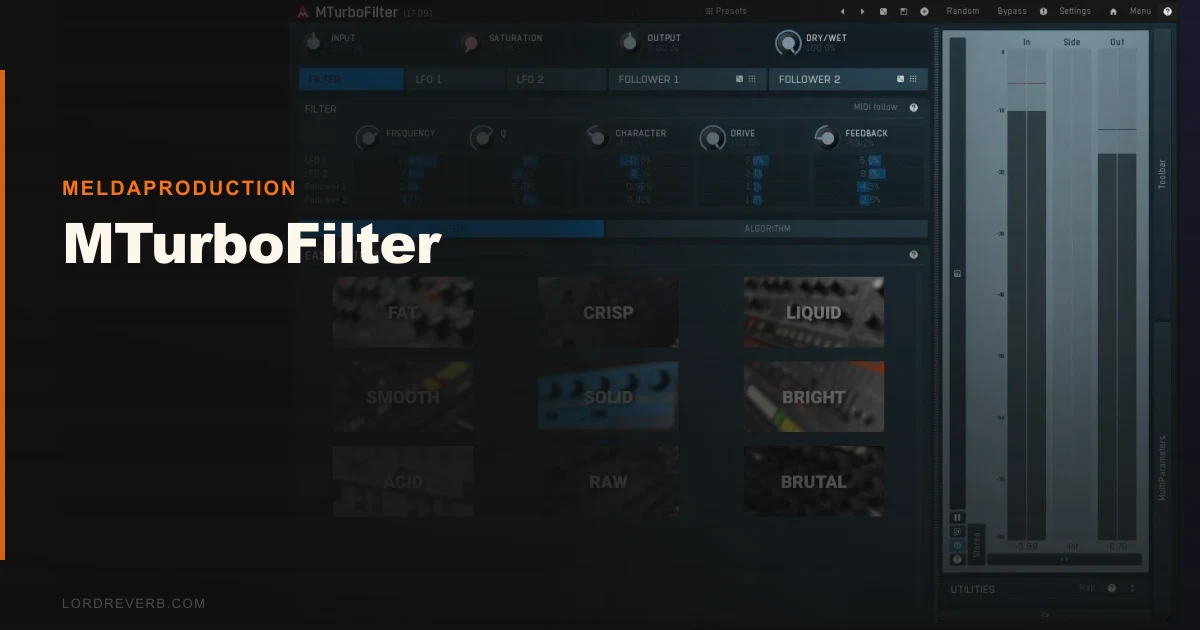
MTurboFilter is the most technically deep filter plugin MeldaProduction has shipped in years, and at its current beta price it is a near-automatic buy for anyone who works with synthesis or sound design.
MeldaProduction dropped MTurboFilter as part of their version 17.09 ecosystem update, releasing June 17, 2026. The beta intro price runs until end of August 2026. Standard retail goes up after that.
That price gap matters. At the beta price it is a no-brainer for the right producer. At full price it needs to earn the spot. This review will tell you which one you're looking at.
We ran it through three weeks of sessions covering sound design, mixing bus filtering, and live modulation work. Here's the honest verdict.
What You're Actually Getting
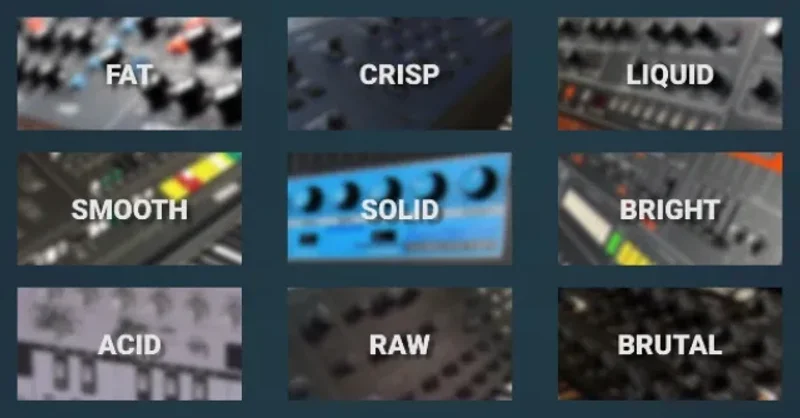
MTurboFilter is a filter plugin built around 9 analogue-modelled filter topologies, each inspired by vintage synthesiser circuits. Think Moog-style ladder, Oberheim state-variable, and similar references. MeldaProduction hasn't listed every model by name publicly yet, but the circuit behaviour on each is distinct enough that we could identify the source hardware by ear.
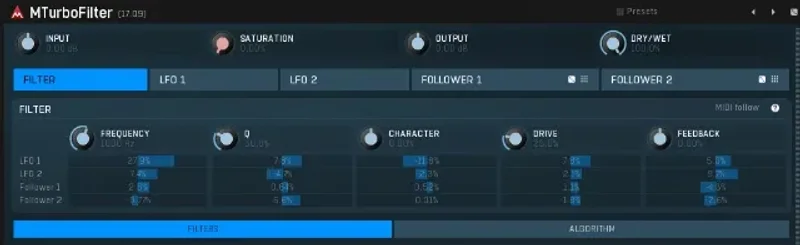
Beyond the models, you get a topology builder. You're not just picking a filter type and adjusting cutoff. You're arranging filter modules, saturation stages, dynamics processors, and other processing elements in a custom signal chain order. The modulation matrix connects LFOs, step sequencers, and envelope followers to any parameter.
It runs as a standalone plugin in VST2, VST3, AU, and AAX formats. It also slots into MSoundFactory as a modular component, which is where the real rabbit hole opens up.
The Good
The filter models sound brilliant. We ran a Jupiter-8 style patch through the state-variable model with resonance pushed to about 85%, and the self-oscillation was clean without that harsh digital screech you get from filters that are only approximately modelling the circuit. The resonance compensation system is doing real work here. It adjusts the bass response as resonance climbs so you're not losing low-end every time you dial in character.
We love the modulation matrix most. Three LFOs, a step sequencer running 16 steps, and an envelope follower all active at once, all routable to separate targets. We had the envelope follower opening the cutoff on transients while the step sequencer was rhythmically chopping the resonance. That combination took about four minutes to set up and produced something we'd have spent an hour patching in Eurorack.
The overdrive stage inside the topology builder genuinely emulates hardware distortion character rather than just adding harmonics. Push it before the filter and the clipping behaviour changes the filter response. Pull it after and you're rounding transients. The order matters, and the fact that you control that order is the whole point.
At beta price: ridiculous value. Buy it before August.
The Not-So-Good
The custom filter topology system is powerful and annoying in equal measure. There's no visual signal flow diagram. You're working from a list-based editor, and understanding what's happening to your signal requires either already knowing MeldaProduction's modular language or spending real time in the documentation.
We wish the onboarding here was better. The modular designer scripting language has no in-plugin tutorial, no interactive walkthrough, and the documentation currently feels like it was written for engineers, not producers. If you've never used MSoundFactory, expect a frustrating first session.
The UI is dense. MeldaProduction's house style packs a lot onto one screen. That's fine if you're deep in their ecosystem. If you're coming from something like FabFilter or Arturia, the visual language will feel foreign. Not a dealbreaker, but worth knowing before you buy.
We also found no real-time visual feedback on the topology routing comparable to what you'd get in Reaktor's block view or even VCV Rack's patch cables. You can hear what's happening. Seeing it requires more mental modelling than it should.
Compared to the Alternatives
The closest ITB competitors aren't other standalone filter plugins. They're filter sections inside synths like Serum, Hive 2, and Sylenth1, or modular-adjacent tools like Reaktor.
Serum's filter section gives you 2 filter units with limited modulation routing. It sounds great in context but you can't build custom topologies or reorder the signal chain. MTurboFilter goes deeper by a significant distance.
Hive 2's dual filter architecture is closer in flexibility, and Hive 2's filter models are also excellent. But Hive 2 is a full synth. MTurboFilter processes external audio, which opens up a completely different use case for mixing and sound design on existing material.
Reaktor gives you total topology freedom, but the build time is measured in hours, not minutes. MTurboFilter gives you most of that flexibility in a plugin you can drop on a bus in 30 seconds. For working producers, that trade-off is real and it goes in MTurboFilter's favour.
FabFilter Volcano 3 is the premium standalone filter competitor. It's more polished, easier to learn, and the visual feedback is better. At full price, MTurboFilter $99 is going up against Volcano 3 at a similar price point, and Volcano 3 wins on usability. MTurboFilter wins on depth. Pick based on which you need more.
Who Should Buy This
✅ Buy if you do sound desi gn regularly and want analogue filter character with modular-level routing on audio tracks, not just inside a synth.
✅ Buy if you're already in the MeldaProduction ecosystem and the beta price makes it essentially free to add to your toolkit.
✅ Buy if you want to run a drum bus or synth pad through moving, rhythmically modulated filter textures without patching hardware or opening a soft synth.
❌ Skip if you're new to complex plugin UIs. The learning curve will cost you more time than the sound quality gains are worth at this stage.
❌ Skip if you primarily need a fast, musical filter for quick mix decisions. FabFilter Volcano 3 is faster to dial in and easier to hear what it's doing.
❌ Skip if you're working purely in free DAWs with strict CPU limits. We didn't find it heavy, but the topology builder complexity scales with CPU load depending on what you're chaining.
Score Breakdown
| Category | Score | Notes |
|---|---|---|
| Sound Quality | 4.5/5 | Analogue models are convincing; resonance compensation is genuinely good |
| Value for Money | 4.5/5 | At $99 it competes but needs the right user |
| Ease of Use | 3.0/5 | Dense UI and underdeveloped onboarding hurt an otherwise clever interface |
| Features | 4.5/5 | Custom topology builder plus full modulation matrix is a rare combination |
| CPU Efficiency | 3.5/5 | Reasonable at default complexity; heavier chains need headroom |
| Overall | 4.3/5 | Deep, sonically strong, frustrating to learn but worth the effort if you'll use it |
Alternatives to Consider
FabFilter Volcano 3: The go-to for producers who want great-sounding filter work without a steep learning curve. Four filter units, excellent visual feedback, and a modulation system that's easier to navigate than MTurboFilter's. The current price is shown in the buy box on this page. FabFilter Volcano 3 review
Arturia Mini Filter V: Built around the Minimoog filter model specifically. Less flexible in terms of topology, but the single-model focus means it nails that sound every time. Better for producers who want one iconic filter character dialled in fast rather than 9 models with custom routing. best Arturia plugins
u-he Uhbik-F: A cleaner, more mix-oriented filter with less design complexity. If you're reaching for a filter as a mixing tool rather than a sound design centrepiece, Uhbik-F gets out of the way more efficiently. best filter plugins for mixing
For anyone building out a MeldaProduction plugin bundle setup, MTurboFilter integrates with MSoundFactory in a way none of these alternatives can match.
Final Verdict
MTurboFilter is a serious filter plugin with one serious flaw: it assumes you already speak its language.
The 9 analogue models sound better than their price suggests. The custom topology system is the kind of deep control that most producers never get outside a modular rig. The modulation matrix is satisfying to work with once you're past the initial confusion.
But MeldaProduction shipped the engine before the manual caught up. The scripting-based topology builder needs better visual feedback and in-plugin documentation. That's not a minor polish issue. It's the barrier that will stop a lot of producers from reaching the parts of this plugin that justify buying it.
At beta price, buy it anyway and learn it slowly. At full price after August, it is the right tool only if you are already invested in deep sound design work and patient with complex interfaces.
The filter sounds great. The door to get in is harder to open than it needs to be. Knock anyway.
Frequently Asked Questions
Is MTurboFilter free if I already own a MeldaProduction bundle?
Yes. If you own MTotalFXBundle, MCompleteBundle, or MCreativeFXBundle, MTurboFilter is a free update included in version 17.09. Check your MeldaProduction account for the updated installer. No additional purchase needed.
What is the difference between the beta price and the full price?
Same plugin. A reduced beta introductory price is active until the end of August 2026. After that, it moves to the standard $99 retail price. There are no feature differences between beta and full release versions.
Can I use MTurboFilter on audio tracks in my DAW, or is it only for use inside MSoundFactory?
Both. MTurboFilter runs as a standalone VST2, VST3, AU, or AAX plugin on any audio track, instrument channel, or bus in your DAW. It also integrates as a modular component inside MSoundFactory for users who work in that environment. You don't need MSoundFactory to get value from it.
How does the custom filter topology builder actually work?
The topology builder lets you arrange signal processing modules, including filter units, saturation stages, and dynamics processors, in a custom order within the plugin's signal chain. You're essentially deciding what happens to your audio before and after each stage rather than working with a fixed filter-in, output-out architecture. It uses MeldaProduction's modular designer scripting language, which takes time to learn but gives you far more control than a standard filter plugin.