OD DeEdger is a genuinely useful transient de-harshening tool for producers who need to tame frequency peaks without triggering conventional de-esser artifacts, but at $100, it's priced in a bracket where the competition is fierce and the use-case is narrow enough that most mixers won't need it daily.
OD DeEdger is not a de-esser. That's the first thing to get straight. It processes transient peaks at specific frequencies without engaging a threshold detector, which means it won't pump, breathe, or mistrack the way a classic de-esser will on complex material. Developer Jan Ohlhorst built this originally with mastering in mind, and that heritage shows. It's calm, surgical, and frankly a little boring to look at. That's a compliment.
The plugin carries a 4.6/5 from 91 reviews on Plugin Boutique. We tested it across vocals, Moog-style synth leads, slap bass, overhead cymbals, and a distorted guitar bus. It earned its score on some of those. Not all of them.
This is a niche tool. Know the niche before you spend the money.
What You're Actually Getting
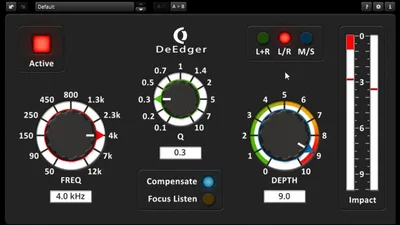
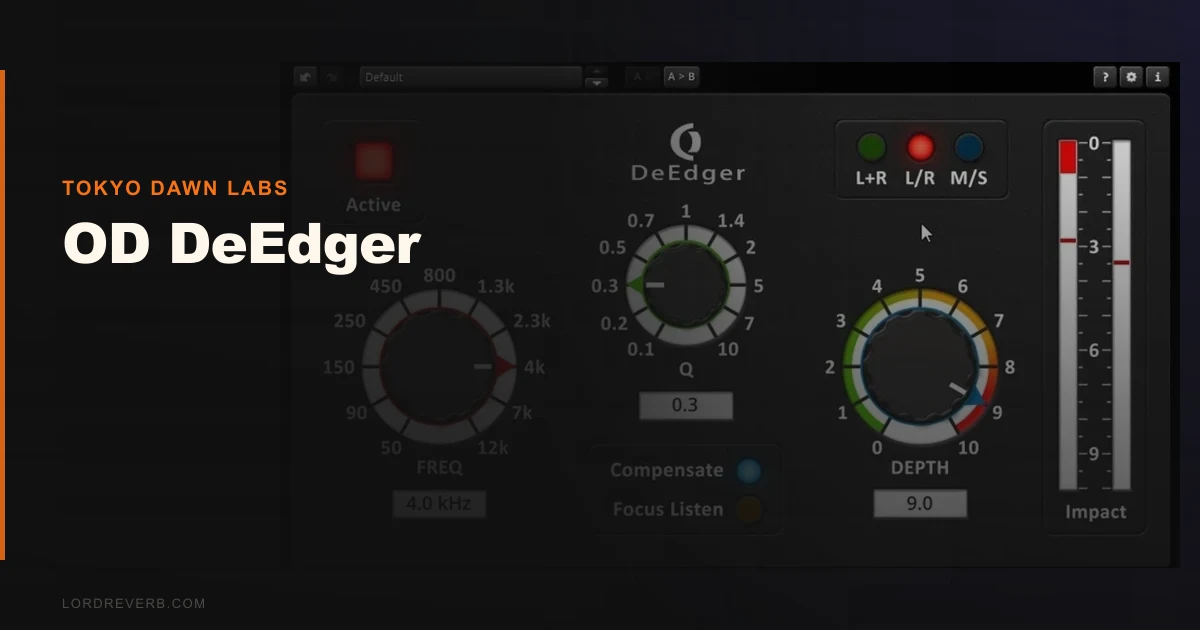
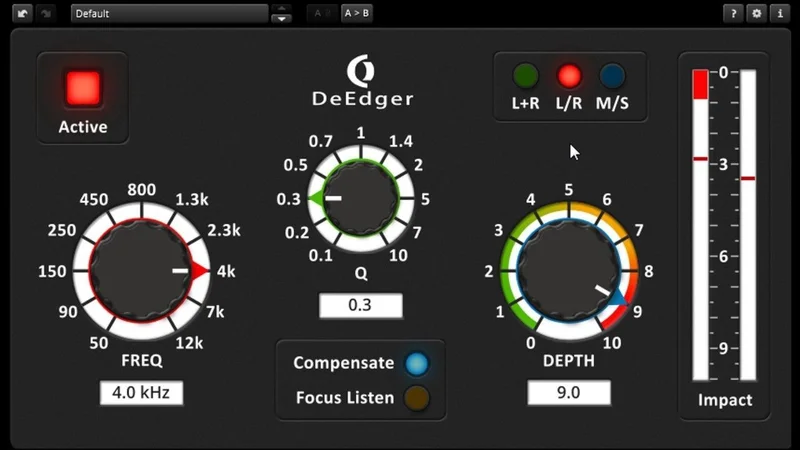
OD DeEdger gives you three controls: a frequency selector, a Q-factor knob, and a depth control. That's the whole interface. There's no threshold. No attack or release. No lookahead toggle.
The plugin identifies transient energy concentrated at your target frequency and reduces it dynamically, responding to the signal level in real time without needing you to set a trip point. It's closer in behaviour to iZotope's Spectral Shaper than to anything in the FabFilter Pro-DS family.
Format support covers VST, VST3, AU, and AAX. It runs on Windows 7 and up, and macOS 10.13 and up. A free trial is available directly from Ohlhorst Digital's site. We'd strongly recommend using it before buying.
Price sits at $100. Check the manufacturer's site for current pricing, as promotional windows do appear.
The Good
We inserted DeEdger on a synth lead that was shredding the 5-6kHz range on held notes. A stock de-esser on that signal was a disaster: it killed the brightness inconsistently, with audible ducking every time the note sustained. DeEdger, set to 5.5kHz with a Q of around 1.8 and depth at roughly 40%, just shaved the top off the transient spike. The lead stopped hurting. It still had presence. That's the whole value proposition right there.
Same result on an overhead bus. Cymbals were spiking in the 8kHz range on hard hits from a heavy-handed drummer. We set DeEdger at 8.2kHz, kept Q tight at 2.1, and the crack became a shimmer instead of a stab. No tonal shift on softer hits. Satisfying.
The threshold-free architecture is genuinely clever. It eliminates the most frustrating failure mode of de-essers on non-vocal sources: the moment where the detector triggers on the wrong element in a complex signal. On material like slap bass, where a de-esser will latch onto the wrong transient entirely, DeEdger just works quietly and consistently.
CPU load is light. We measured no meaningful hit across three instances on a dense 64-track session.
The Not-So-Good
No frequency display. This is annoying. You're targeting a specific frequency peak, but you're doing it blind. You'll need a spectrum analyser open in a separate plugin to identify the problem frequency, then dial it in by ear. That's an extra step and an extra plugin slot.
Most professional de-essing tools in 2026 show you what they're doing visually. FabFilter Pro-DS shows the detection signal. Soothe2 maps the suppression in real time. DeEdger shows you three knobs. That's it.
We also found it less effective on vocals than advertised. On a breathy female vocal with sibilance concentrated between 7-9kHz, a well-set FabFilter Pro-DS outperformed it by a significant margin. The issue: vocal sibilance isn't purely a transient phenomenon. It has a sustain component that DeEdger doesn't address. It handles the attack of a harsh "s" but leaves the tail partially untouched.
At $100, that limitation matters. You're not replacing your de-esser. You're adding a specialist tool for specific problem sources. That's a harder sell.
Compared to the Alternatives
TB Sibilance handles most standard de-essing tasks with a clean interface and reliable detection. It's not doing what DeEdger does, but for 80% of vocal work, it doesn't need to.
Soothe2 by oeksound does resonance suppression dynamically across the full frequency spectrum. It's the more powerful tool with a much steeper learning curve and significantly higher CPU draw. If your harshness problems are broadband and unpredictable, Soothe2 wins on capability, though it costs more and takes more work to dial in.
iZotope's Spectral Shaper, available inside RX, takes the closest approach to DeEdger's architecture. It works on spectral transients rather than amplitude, and it adds visual feedback DeEdger lacks. If you already own RX, you have something that overlaps DeEdger substantially. That overlap is worth considering before you spend $100.
For filter plugin context, take a look at our VEQ-HLF Review, it handles a different problem, but illustrates what simple controls done right look like at this price point.
Who Should Buy This
✅ Buy if you mix electronic music with synth leads that peak harshly on sustained notes and de-essers make things worse.
✅ Buy if you work with live drum overheads where cymbal transients are spiking above 8kHz inconsistently.
✅ Buy if you already own a conventional de-esser and need a second tool for non-vocal harshness the de-esser can't handle cleanly.
❌ Skip if your main problem is vocal sibilance. A standard de-esser will outperform this on vocals.
❌ Skip if you already own Soothe2 or iZotope RX. You likely have the capability already.
❌ Skip if you're on a budget. TB Sibilance handles most everyday de-essing tasks for a fraction of the cost.
Score Breakdown
| Category | Score | Notes |
|---|---|---|
| Sound Quality | 4.0/5 | Transparent on complex sources where de-essers fail; less effective on full vocal sibilance |
| Value for Money | 3.0/5 | $100 is hard to defend against Soothe2 or RX for broader use; fair only for the specific niche |
| Ease of Use | 3.5/5 | Three controls is genuinely fast, but no frequency display forces you to work with a separate analyser |
| Features | 3.0/5 | Threshold-free processing is the standout feature; everything else is minimal to a fault |
| CPU Efficiency | 4.5/5 | Light footprint; multiple instances with no measurable session impact |
| Overall | 3.8/5 | Specialist tool that does its specific job well, but too narrow and too expensive for general use |
Alternatives to Consider
Soothe2 by oeksound: Broadband resonance suppression with real-time visual feedback and frequency-linked dynamic processing. Higher CPU cost and a steeper learning curve than DeEdger, but it handles the full spectrum of harshness problems DeEdger only partially addresses. Our preferred tool for complex program material. Check our HALO-2 Review for another take on dynamic processing tools in this price range.
FabFilter Pro-DS: The benchmark de-esser for most vocal work. Its wideband mode approaches resonance suppression in a way that competes with DeEdger on non-vocal sources. Better visual feedback, more flexible detection, and broadly more useful across session types. Worth every penny at its price point.
CHOW Tape Model (free): An off-label alternative worth mentioning. Tape saturation gently smooths high-frequency transients on distorted guitars and cymbals. Not surgical, but often more musical than a de-harshener. We reviewed it here: CHOW Tape Model Review.
For broader plugin context in your signal chain, the PSP Studio Modular Collection Review covers processing tools worth knowing at various price points.
OD DeEdger is an underrated idea hamstrung by an overrated price. The threshold-free architecture is genuinely smart, and on the right source, it outperforms anything in the standard de-esser category. But "the right source" covers maybe 15% of the harshness problems we hit in a typical week of mixing. The other 85% are better served by a tool with broader capability or a much smaller price tag.
At $100, buy it if you've tried the trial and felt that specific relief on synth leads or drum overheads that nothing else gave you. That feeling is real. Just don't buy it hoping it'll replace the de-esser you already own. It won't.
Frequently Asked Questions
Is OD DeEdger the same as a de-esser?
No. A traditional de-esser uses a threshold: it listens for a signal crossing a set level at a target frequency, then attenuates. OD DeEdger uses no threshold. It processes transient peaks at the selected frequency dynamically in response to signal level, which means it won't pump or mistrack the way a de-esser does on complex material. It's built for transient reshaping, not sibilance detection.
Can OD DeEdger be used on vocals?
You can use it on vocals, but we wouldn't recommend it as a primary de-esser. It handles the transient attack of sibilance effectively, but vocal "s" sounds have a sustain component that DeEdger leaves partially intact. On vocals, a conventional de-esser like FabFilter Pro-DS or TB Sibilance will do a cleaner, more complete job.
What sources does OD DeEdger work best on?
We got the best results on synth leads with harsh upper-mid resonances on sustained notes, drum overheads with spiking cymbal transients, distorted guitars with fizzy high-end, and slap bass with pick attack that defeats standard de-esser detection. It's a specialist processor for sources where threshold-based detection misfires consistently.
How does OD DeEdger compare to iZotope Spectral Shaper?
Both tools work on spectral transient content rather than wideband amplitude. The key difference is visual feedback: iZotope's Spectral Shaper (inside RX) shows you what it's doing in real time. DeEdger gives you three knobs and no display. If you own RX, you likely have overlapping capability already, which makes the $100 investment harder to justify unless DeEdger's simpler interface suits your workflow better.