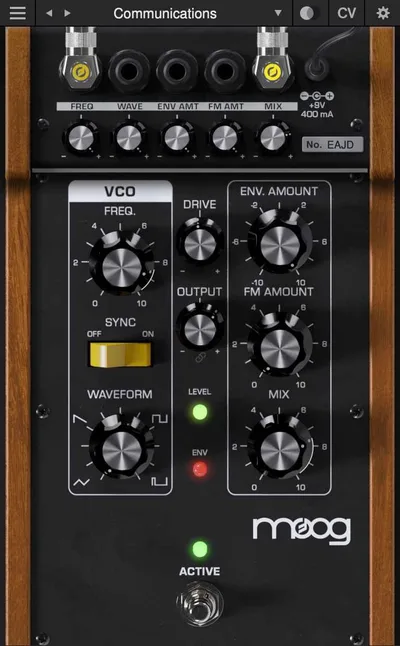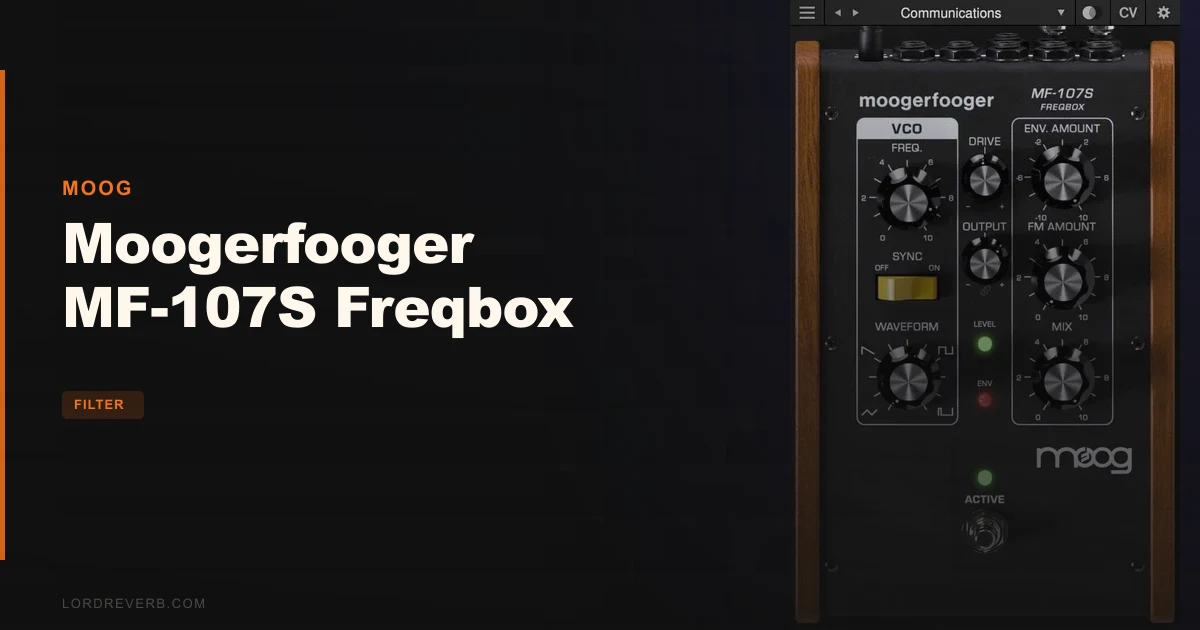
The Moogerfooger MF-107S Freqbox gets compared most often to Moog's own MF Ring Mod, and that comparison lands in an interesting place: they're both strange, they're both Moog, but the FreqBox is the weirder sibling who shows up late and breaks something. At $79, this is not a utility plugin you slot into every session. It's a voltage-controlled oscillator that eats your audio signal and spits back something gnarlier. If you want dirty, radioactive guitar tones, deranged bass textures, or a fourth VCO bolted onto a larger rig, this is worth your attention. If you want an effect you can dial in on a deadline, keep reading before you buy.
How Does It Compare Out of the Box?
Stack the FreqBox against the MF Ring Mod and you're looking at two very different tools wearing the same Moogerfooger badge. The Ring Mod is strange but playable. The FreqBox takes longer to yield anything musical.
Out of the box, the FreqBox's internal VCO doesn't respond to your signal the way a standard effect does. It's modulated by your input, not processing it cleanly. Load a dry guitar riff, hit play, and what comes back depends on how hard you're playing, what pitch you're on, and how the envelope follower is reading your dynamics. The first five minutes feel unreliable.
That's not a flaw in design. It's the whole point. But the Ring Mod will sound musical after sixty seconds. The FreqBox asks for more from you.
Performance Deep Dive
The core of the FreqBox is a VCO with variable waveshape. That VCO syncs hard to your input signal and can be frequency-modulated by audio. The envelope follower reads your playing dynamics and uses them to shift VCO pitch, so your signal chain becomes a kind of performance input, not just audio passing through.
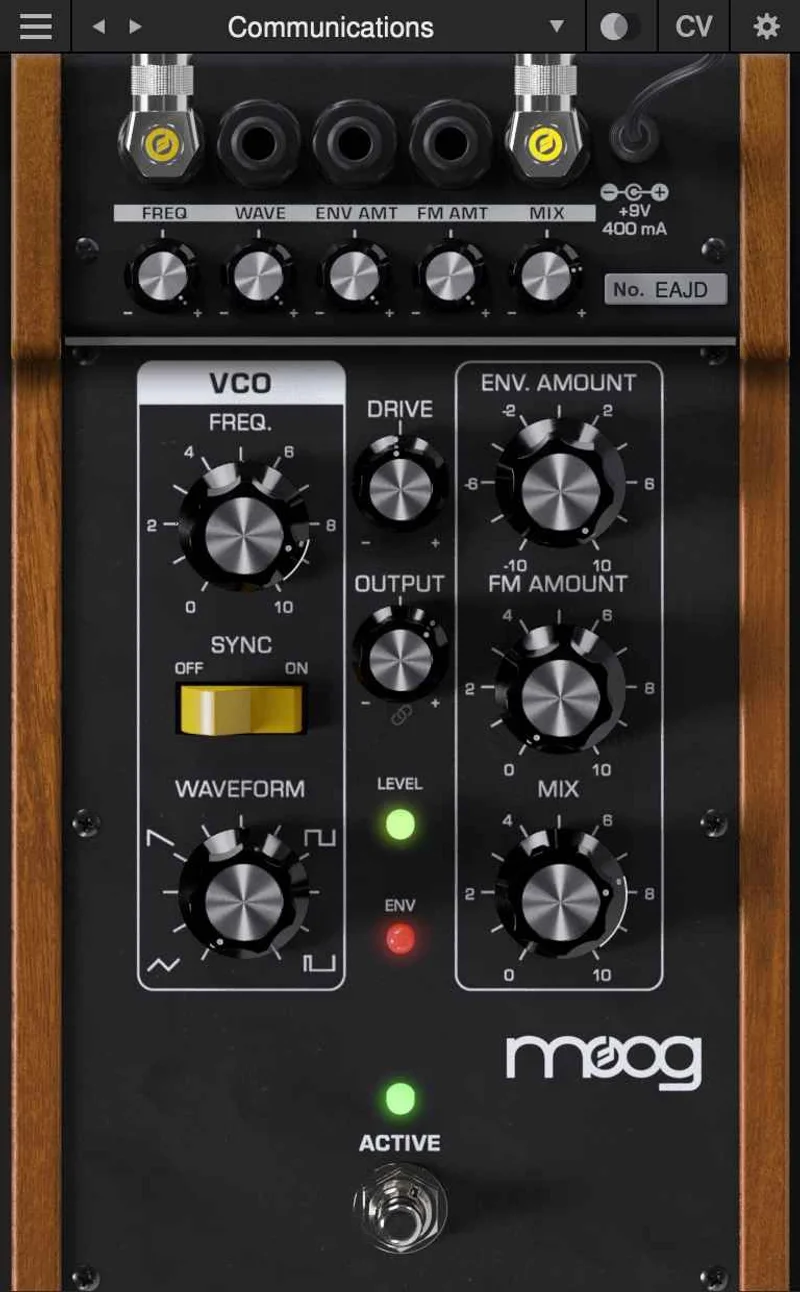
Push a bass line through it. As your notes decay, the VCO pitch tracks the drop in amplitude. Play harder and the envelope follower pushes the oscillator higher. That interaction is what owners describe when they talk about its organic character.
Tracking issues are real, though. Users have reported frequency sync dropouts, particularly on fast transients or polyphonic input. The FreqBox is built for monophonic sources: single guitar notes, bass, a lead vocal line. Feed it a dense chord and it starts guessing.
CV interconnectivity between multiple instances is genuinely clever. You can route modulation from one FreqBox to another across your project, which opens routing possibilities that go well beyond a standard effects plugin. Pair it with the MF Ring Mod in the same session and you're building something closer to a software modular rig than a effects chain.
All parameters automate. Stereo output is there. Sidechain is available. These aren't small additions for a plugin based on a mono hardware pedal.
Where It Wins
The sounds it makes are unlike what you'll get from a standard distortion, filter, or ring modulator. Owners describe tones as radioactive, like a sludge-heavy wildcat running through layers of fuzz and FM dirt. That's not marketing copy. It's what happens when a Moog oscillator locks onto a guitar and hard-syncs to it.
The CV interconnectivity is a real differentiator. Set up two or three instances, run modulation between them, and your project starts behaving like a semi-modular patch.
If you're using something like a Moog Voyager XL, the FreqBox can operate as a supplementary VCO, adding thickness even if it won't match the precision of the Voyager's own oscillators. For sound designers who want texture over tuning, that tradeoff is fine.
The digital attenuverters on every CV input give you real control over modulation depth and direction, which is satisfying once you understand what you're routing.
Where the Competition Wins
The MF Ring Mod is easier to integrate. If you want Moog weirdness with less friction, that's your starting point. The FreqBox requires patience that some sessions simply don't have.
The mono output limitation is a frustration that runs across the whole Moogerfooger line. Stereo functionality exists in the plugin version, but the original circuit architecture shows up in how the VCO tracks. Owners notice it.
Compatibility is a real problem for some users. GarageBand and BandLab have both produced activation failures. If either of those is your DAW, this is a hard pass until Moog confirms a fix.
And honestly? The FreqBox is not a great tool for quick work. Reviewers who love it describe spending significant time just learning how to get it to behave. That's time the Ring Mod doesn't ask for.
Who Should Buy Which
- ✅ Buy if you work in experimental, doom, sludge, or industrial genres and want tones that standard distortion can't get near.
- ✅ Buy if you're running multiple Moogerfooger instances and want CV routing between them for a semi-modular ITB setup.
- ✅ Buy if you use a Moog Voyager XL or similar synth and want an additional VCO-style texture source at $79.
- ❌ Skip if your primary DAW is GarageBand or BandLab until compatibility issues are resolved.
- ❌ Skip if you need an effect you can dial in fast. This one requires a learning commitment.
- ❌ Skip if you're processing polyphonic material. Its tracking is built around monophonic sources.
Specs & Technical Details
| Spec | Detail |
|---|---|
| Developer | Moog |
| Price | $79 |
| Plugin Format | VST3 / AU / AAX |
| OS Support | macOS 11.7 or newer (Intel & Apple Silicon) / Windows 10 or newer (64-bit) |
| Activation | N/A |
| CPU Usage | N/A |
| Trial Available | N/A |
| Version Reviewed | N/A |
Score Breakdown
| Category | Score | Notes |
|---|---|---|
| Sound Quality | 4.5/5 | VCO character and FM-modulated textures are the real thing; tracking on fast material slips |
| Value for Money | 4.0/5 | At $79 it delivers a niche but legitimate capability; not for everyone |
| Ease of Use | 3.0/5 | Users report it takes significant time before results feel musical and intentional |
| Features | 4.5/5 | CV interconnectivity, attenuverters, sidechain, automation, and stereo output are all present |
| CPU Efficiency | N/A | No data available from source material |
| Overall | 4.1/5 | Brilliant sounds, real workflow friction, and a narrow but devoted audience |
Alternatives to Consider
Moog MF Ring Mod
The MF Ring Mod is the FreqBox's closest sibling in the Moogerfooger software lineup. It functions well alongside the FreqBox in multi-instance semi-modular setups. If you want Moog character with a faster route to musical results, the Ring Mod is the better first purchase. If you already own it and want to go further, the FreqBox is the logical next step.
Moog Voyager XL (supplementary VCO use)
Some users run the FreqBox as a supplementary fourth VCO in a Voyager XL setup. The Voyager's own oscillators are more precise and stable. The FreqBox adds a looser, more reactive texture alongside them. If you want tight pitch precision, stay on the Voyager. If you want something reactive and unpredictable sitting underneath, the FreqBox earns its place.
The FreqBox is not a plugin for everyone, and that's not a problem. It's a focused tool with a specific sonic personality that it delivers consistently. You'll love it if you're chasing filth and texture and you're willing to invest the hours. You'll hate it if you expected a plug-and-play effect. Sound designers and experimental producers in 2026 have a genuine reason to own it at $79. Bedroom producers who just want something interesting on a guitar track? Start somewhere with less attitude, and come back to this when you're ready for the argument.
Frequently Asked Questions
What does the Moogerfooger MF-107S Freqbox actually do?
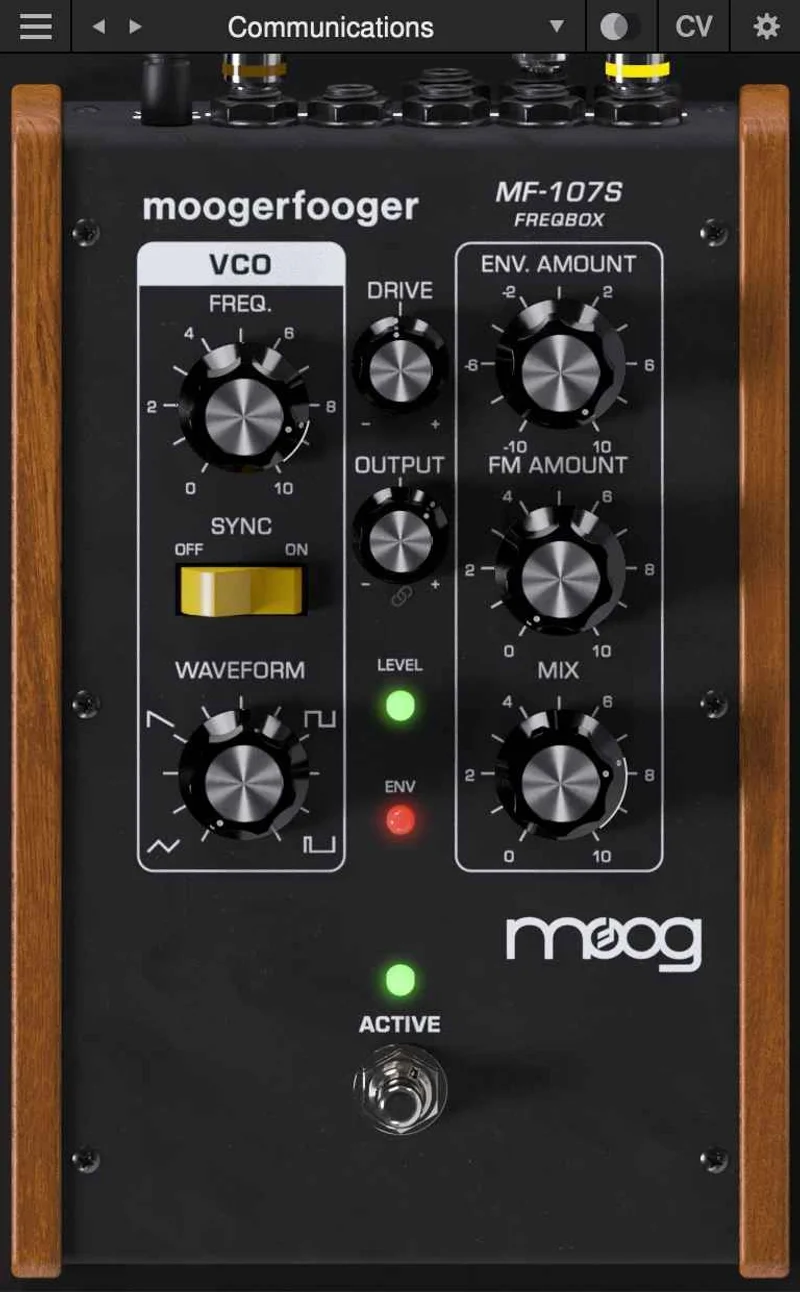
It contains an internal VCO that gets modulated by your incoming audio signal. Instead of processing your signal like a filter or distortion, it generates its own oscillator tone shaped by your input's pitch and dynamics, then mixes that with your original signal. The result is FM-style frequency interaction and hard-sync tones that are unlike standard effects.
Is the MF-107S FreqBox good for guitar?
Yes, with patience. Reviewers and owners specifically highlight guitar and bass as its strongest use cases, describing tones as radioactive and sludge-heavy. It works best with single-note playing rather than chords, since the envelope follower and VCO track monophonic sources more reliably. Have an expression pedal available if you can; it makes the plugin significantly more controllable.
Does the Moogerfooger MF-107S Freqbox work with GarageBand?
Users have reported activation failures with GarageBand and BandLab. If either is your main DAW, this is a known compatibility issue.