The question most buyers are really asking about Narcotic isn't "does it sound interesting?" It's "is Lunatic Audio still alive enough to fix it if it breaks?" That's the honest doubt here. And the honest answer is: probably not, based on what owners report. That context shapes every decision this review makes.
Quick verdict: Narcotic is a creative multi-effects engine with real depth: 32 effects, six-unit chains, per-parameter step sequencers, and a randomizer that actually works. At $119, the feature set is genuinely interesting. But the developer has a documented pattern of no post-launch support and unresolved crashes. We'd only recommend it to producers who treat plugins as toys rather than session tools, and who can live without a safety net. Score: 2.8/5.
Does It Actually Deliver on the Motion Promise?
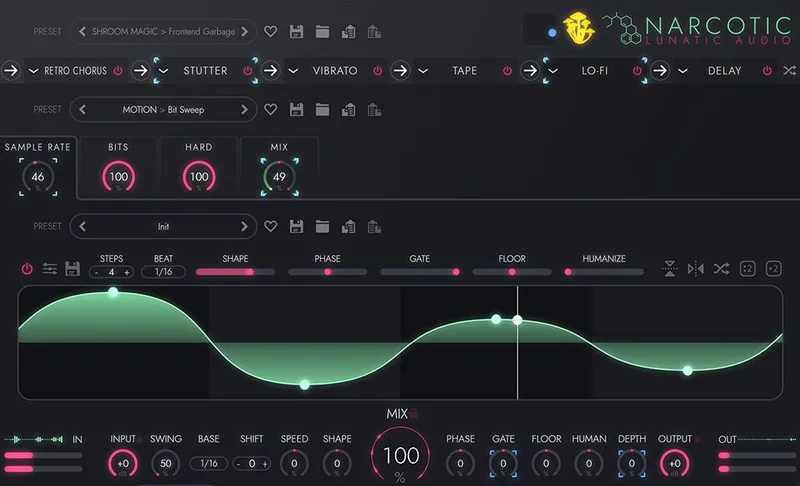
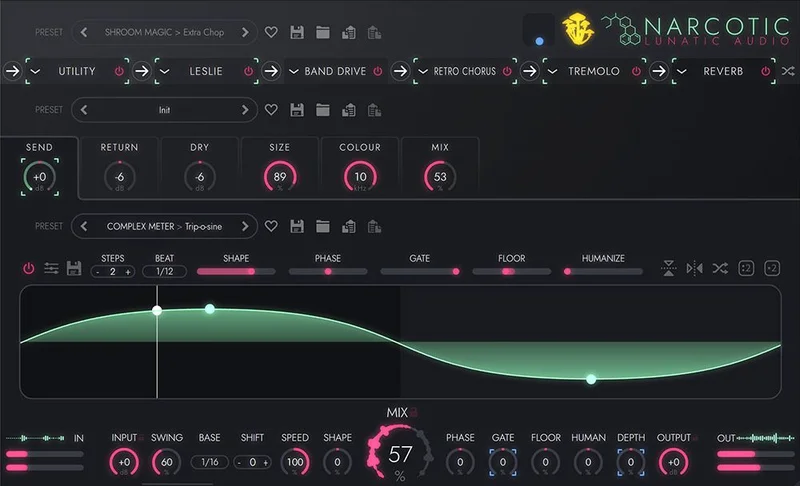
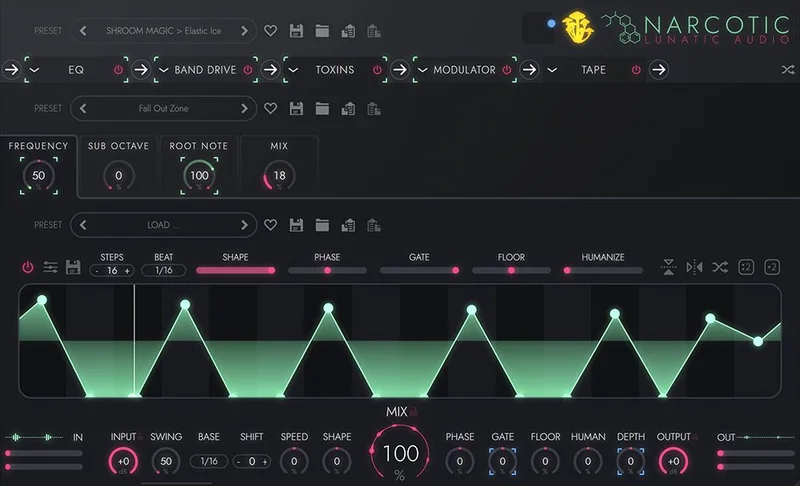
Lunatic Audio built Narcotic around one idea: everything moves. You chain up to six of the 32 onboard effects in series, and every individual parameter on every effect gets its own independent step sequencer. That's not a shared LFO assigned to a macro. Each knob can pulse at its own rate, its own shape, its own depth.
On top of that, the XY pad runs two additional dedicated step sequencers, one per axis, so you can drive multiple parameters across multiple effects simultaneously. A global controls bar lets you adjust all active sequencers at once instead of hunting through each module.
The developer says this is "the ultimate way to add motion, movement, and pulse to your sounds." That's a big claim. Owners who like the plugin report it does deliver genuine movement: WAV files getting a new lease of life, static synth pads gaining real animation, drum loops shifting in both sonic and rhythmic character. Those reports are credible given the architecture.
What the developer can't claim is stability. And that matters more than any feature list.
Where Narcotic Actually Shines
The modulation depth is the real draw. Six effects in series, each with per-parameter sequencers, means the combinations are effectively endless. If you're designing sound for sync, games, or experimental electronic music, that density of movement options is hard to find at this price tier.
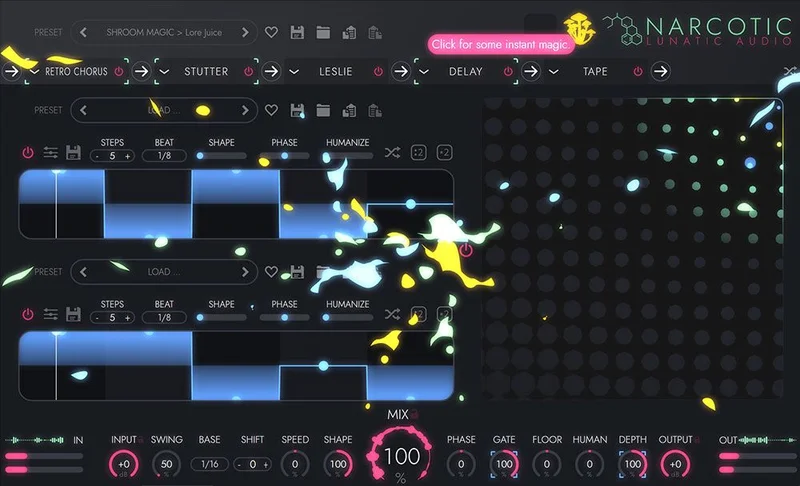
The Shroom Magic button is genuinely clever, not a gimmick. Hit it and Narcotic randomizes from its preset pool intelligently rather than generating pure noise. Owners report it as a strong starting-point generator. If you're stuck on a pad or loop, hitting Shroom Magic a few times gives you directions worth chasing.
The preset library earns its place too. It's organised by category, which sounds basic but matters when you're mid-session and want movement for a specific sound type rather than scrolling through 400 unnamed patches. Reviewers flag this as one of the better-organised preset collections in this bracket.
The interface is all-vector and fully scalable. Put it on a large monitor or a laptop screen and it adjusts without going blurry. That's a practical win that many plugins at this price don't bother with.
For synth bass sound design specifically: load Narcotic after your synth, assign a couple of effects, and let the step sequencers run at sixteenth-note divisions. Users report that's where the plugin earns its name.
Where It Falls Short
Start with the big one. Multiple users report crashes with zero response from Lunatic Audio support. Not slow responses. Zero. Some needed retailer intervention just to get any acknowledgement. That's not a quirk. That's a support failure, and for a plugin at $119, it's disqualifying for most working producers.
The effects quality is disputed. Two of the four user opinions in the record are negative, with one reviewer reporting disappointment since launch and describing the effects as poor-sounding, with minimal updates to address it.
No MIDI Learn. Annoying. If you want to map parameters to a physical controller for live use, Narcotic won't cooperate. For a plugin that's supposedly built around real-time movement, the absence of hardware control is a frustrating gap.
Setting parameter min/max limits for the step sequencers requires precise mouse positioning. Users describe it as fiddly. Heavy modulation at high sample rates also increases CPU load noticeably on less powerful systems, and the graphics-heavy installation option reportedly causes performance issues worth avoiding.
How It Stacks Up Against the Real Competition
Sugar Bytes' Turnado sits in the same creative processing space. It's deeper in complexity, more battle-tested in live performance, and has an active developer behind it. If you want a multi-effects engine for serious stage use or demanding sessions, Turnado is the safer choice.
Output's Movement takes a different angle, focusing on rhythm-driven modulation with a more streamlined UI and a macro-forward approach. Less raw depth than Narcotic, but far less friction to get results.
Infiltrator gets named by reviewers as a superior comparable multi-effects with better overall value. We'd check that one before committing to Narcotic.
UJAM's Finisher Dynamo targets the same movement-and-pulse idea with a streamlined macro-controlled UI. Less modulation depth, but considerably lower risk profile given UJAM's track record on support.
Is the Price Fair?
At $119, the feature count is hard to argue with on paper. Per-parameter step sequencers on 32 effects with a functional randomizer would be worth the money if the plugin ran reliably and the developer picked up the phone.
But support that doesn't respond and reported crashes you can't get fixed make $119 a gamble, not a purchase. You're not just buying a plugin. You're betting on it staying functional through DAW updates and OS upgrades.
We'd call the price unfair at current support standards. The features say yes. The developer track record says no.
Specs & Technical Details
| Developer | Lunatic Audio |
| Price | $119 |
| Plugin Format | VST / AU / AAX / Standalone |
| OS Support | Windows 7+ (32/64-bit), macOS 10.8+ (64-bit Intel & M1) |
| Activation | N/A |
| CPU Usage | Light to medium; heavier under high modulation at elevated sample rates |
| Trial Available | No confirmed demo |
| Version Reviewed | N/A |
Score Breakdown
| Category | Score | Notes |
|---|---|---|
| Sound Quality | 3.0/5 | Owners are split: some report excellent results, others flag poor-sounding effects with no improvement post-launch |
| Value for Money | 2.5/5 | Feature set is real, but zero support and crash risk gut the value proposition |
| Ease of Use | 2.5/5 | Shroom Magic lowers the floor, but modulation controls are complex and min/max adjustment is fiddly |
| Features | 4.0/5 | 32 effects, per-parameter sequencers, XY pad with dual sequencers: the architecture is legitimately deep |
| CPU Efficiency | 3.0/5 | Relatively efficient under normal use; high sample rates with heavy modulation push it harder |
| Overall | 2.8/5 | Great ideas, real depth, serious support problems that tip the verdict against for most buyers |
Alternatives to Consider
If the modulation depth is what draws you, Sugar Bytes Turnado deserves a serious look first. It's more complex at the top end and has a developer who answers emails.
Output Movement is the smoother ride for producers who want rhythmic movement without a steep learning curve. Less raw control, more immediate results.
Infiltrator comes up repeatedly as the comparison that Narcotic loses. Reviewers describe it as a stronger multi-effects overall. Worth checking before you commit here.
For the "movement and pulse" brief specifically, UJAM's Finisher Dynamo trades depth for reliability and a support team that exists. If you're in a session-first workflow, that trade is worth making.
The Verdict
Load Narcotic on a static synth pad, chain three or four effects, hit Shroom Magic twice, and you'll see why some producers love it. The architecture is genuinely clever. Six effects in series with individual step sequencers per parameter is a real sandbox, not a marketing claim.
But here's what love doesn't fix: a plugin that crashes and a developer you can't reach. That's the deal with Narcotic in 2026. The ideas are good. The support is reportedly non-existent. When your DAW updates and Narcotic stops loading, you may be on your own.
Buy it if you're an experimental sound designer who treats plugins as disposable tools and you already know you won't lean on it for client sessions. Skip it if you need something dependable or if hands-on controller mapping matters to you.
At $119, there are better-supported alternatives in this category. The plugin's architecture is one of the more interesting things in the multi-effects space. The developer's track record is one of the more worrying ones. Those two facts don't cancel each other out.
Some plugins are worth the risk. This one asks for a lot of trust it hasn't earned.
Related reviews: Cloudmax 3 Upgrade from Cloudmax 1 or Cloudmax 2 · Does This TAL-DAC Review Prove Free Lo-Fi Has No Limits?
Frequently Asked Questions
Does Narcotic work on Apple Silicon Macs?
Yes. Narcotic supports 64-bit Intel and M1 macOS, so it runs natively on Apple Silicon hardware. You'll need macOS 10.8 or higher. Check whether your specific DAW version handles the format you're running before buying, since AAX, AU, and VST behave differently across hosts.
Is there a free trial for Narcotic?
There's no confirmed demo version available. That's a real problem given the reported stability issues. If your retailer offers a return window, check the terms before purchasing. Buying blind on a plugin with documented crash reports and poor support is a risk you should go in knowing about.
What's the difference between Narcotic and Sugar Bytes Turnado?
Both are creative multi-effects engines built for movement and real-time modulation. Turnado is more complex at the performance end, more established in live and DJ contexts, and backed by a developer with a reliable support track record. Narcotic has a different modulation architecture with per-parameter sequencers per effect, but carries more stability risk. For most producers, Turnado is the safer call.
Can I map Narcotic parameters to a hardware controller?
No. Narcotic doesn't include MIDI Learn functionality, which means you can't map parameters to knobs or faders on a physical controller. That's a real limitation for live use or anyone who prefers hands-on control. If controller integration is part of your workflow, this gap should be a deciding factor against purchasing.