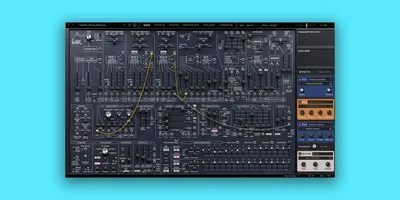
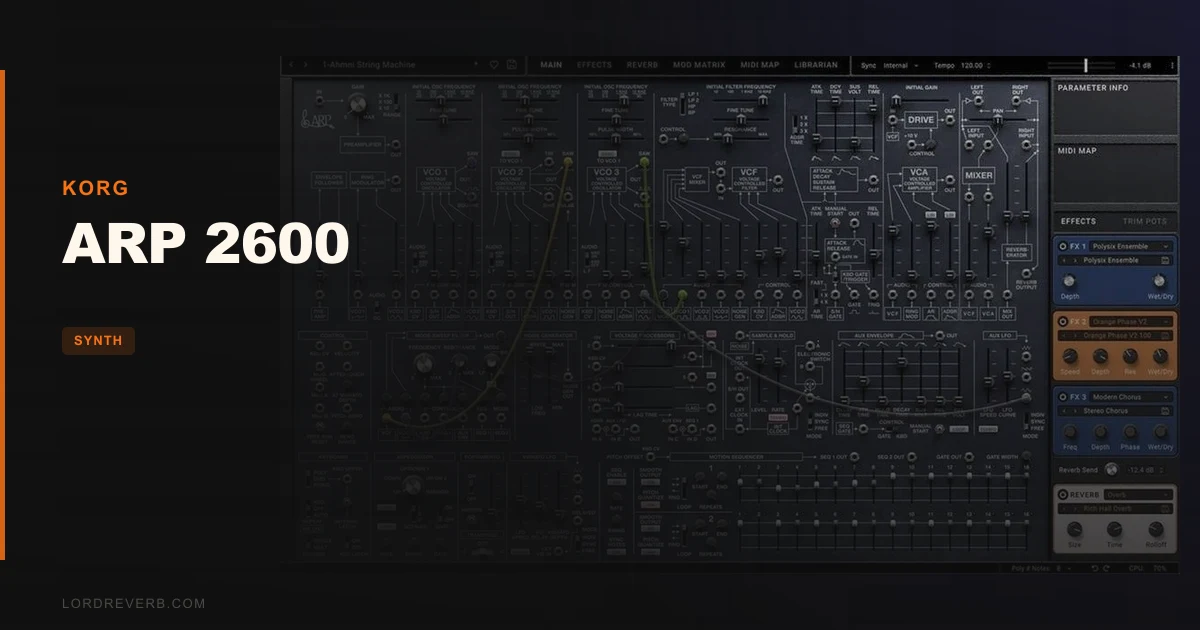
We patched VCO 1 into the spring reverb, routed the envelope follower back into the filter cutoff, and left it running for three minutes before we touched another thing. The sound just… breathed. Unprompted. The filter opened and closed with the amplitude of the signal, the reverb tail smeared behind each attack, and we sat there like idiots grinning at a plugin window. That’s what the Korg Collection ARP 2600 does. It makes you stop working and start listening. This review is for producers who want the most convincing software version of one of the most important synthesizers ever built, and for anyone trying to learn how synthesis actually works at a circuit level.
What It Is (and What It's Not)
The Korg Collection ARP 2600 is a software recreation of the 1971 ARP 2600, built using Korg’s Component Modeling Technology (CMT). It runs as VST, VST3, AU, and AAX on Mac and Windows.
It is not a simple preset player. It’s not a beginner synth you’ll sound great on in ten minutes. And it’s not a modular system, despite the patch panel.
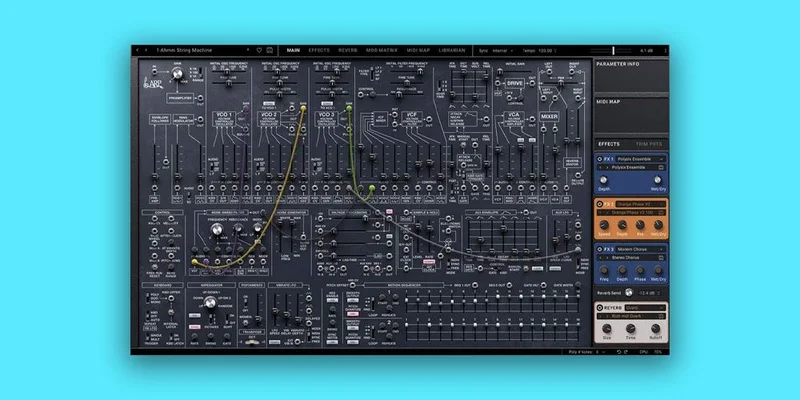
What it is: the most accurate software version of the 2600 that exists. It faithfully reproduces all 100 patches from the original ARP 2600 Patch Book. No other plugin does that. It also adds 16-voice polyphony, two filter types (the original 4012 and 4072 circuits, switchable), a SEM-inspired second filter, an aux LFO, a looping DAHDSR envelope, a two-lane step sequencer, and 31 effects types.
It’s built for sound designers, experimental producers, and people who genuinely want to understand signal flow.
Living With It
Setup took us about twenty minutes. Authorization through Korg’s system, 16 GB of disk space cleared, and we were in. The plugin opened at a size that works on a 1080p screen without scrolling, which the original hardware absolutely could not claim.
The first thing we loved: the color-coded silkscreen. Signal sources in one color, processors in another, modulation sources in a third. Patch cables show flow direction, and jacks that don’t apply to your current signal fade back visually. It sounds like a small thing. It’s not. We connected a beginner producer friend to it for an hour with zero instruction. She had a working patch in fifteen minutes.
We spent two sessions working through bassline patches. The Thriller pulsing bass took about four minutes to dial in using the Patch Book PDF, which Korg offers as a free download. It matched. Not “close enough.” Matched.
The annoyance: CPU load. On a machine with 16 GB RAM and an i7, running the plugin polyphonically at 12 voices with effects active pushed our DAW buffer up. On older machines, you’ll want to freeze tracks. Light use is fine. Push it hard and you’ll feel it.
One quirk we love: you can connect multiple cables to any single output jack. No mults needed. That single decision saves more time than you’d expect during complex patches. Satisfying.
The Trade-Offs
Here’s the honest version. The Korg ARP 2600 sounds brilliant because it models the imperfections. The slight asymmetry in the triangle wave. The saturation points distributed across the signal chain. The nonlinear filter behavior. These aren’t bugs. They’re the reason the hardware commands five-figure prices on the secondhand market.
But those same characteristics make this plugin frustrating if you want fast, predictable results. You won’t get a clean, transparent tone out of this thing. It colors everything. That’s the point. If you’re building polished pop stems that need to sit quietly in a dense mix, you’ll fight this instrument constantly.
The step sequencer is two lanes and genuinely clever, inspired by the ARP 16xx series. But it’s not a full-featured modern sequencer. Don’t come here expecting Sequencer-style automation recording.
The 20-odd Trim Pots for calibrating between different 2600 hardware vintages are a love letter to nerds and a mild annoyance for everyone else. You won’t need them. But knowing they’re there is satisfying.
Against the Field
The main competitor is the Arturia ARP 2600 V3, which carries a user rating of 4.00 out of 5 and costs less. Arturia’s version sounds good. It does not reproduce the original Patch Book patches accurately. If that matters to you, the choice is already made.
Arturia MiniFreak V review gives you a different kind of Arturia experience: faster workflow, more modern architecture, less historical weight.
For bass-focused synthesis, Beatsurfing LOW review is purpose-built and CPU-friendly in a way the ARP 2600 is not.
If you want something experimental and affordable with acid DNA, Audio Blast ABX3 Bundle review is worth a look.
The Korg hardware ARP 2600 FS, the limited reissue from 2020, sold out globally and now trades at prices that make a mortgage nervous. The software version gives you 95% of that experience.
The Real Verdict
Buy this if you’re serious about analog synthesis, sound design, or you want to learn how subtractive synthesis actually works at a component level. The CMT modeling is the best we’ve heard on any 2600 software. The expanded features don’t dilute the original character. They extend it intelligently.
Skip it if you need fast, clean, set-and-forget synth sounds. This instrument rewards patience and punishes impatience.
It’s also wrong for live performance setups without a dedicated machine. DAW-dependency plus high polyphony load is a bad combination on stage.
Check the manufacturer’s site for current pricing, as Korg Collection bundles change regularly.
Score Breakdown
| Category | Score | Notes |
|---|---|---|
| Sound Quality | 5.0/5 | CMT modeling captures filter nonlinearities and waveform imperfections that competitors miss entirely |
| Value for Money | 4.5/5 | Expensive compared to simpler synth plugins, but fraction of hardware cost with near-equivalent results |
| Ease of Use | 3.5/5 | Color-coded layout helps, but semi-modular architecture has a real learning curve for newcomers |
| Features | 4.5/5 | 16-voice poly, dual filter types, SEM filter, looping envelope, 31 effects, step sequencer: hard to fault |
| CPU Efficiency | 3.5/5 | Heavy at high polyphony with effects active; older machines will need track freezing |
| Overall | 4.5/5 | The most accurate ARP 2600 software in existence, with modern additions that genuinely respect the original |
Alternatives to Consider
Arturia ARP 2600 V3: Cheaper and easier to learn. Sounds good. Doesn't match the Patch Book patches accurately and doesn't model the dual filter types with the same depth. It's the right call if your budget is tight and you're not obsessing over authenticity.
Arturia MiniFreak V: A completely different beast, but if you want modern semi-modular sound design without the historical baggage, MiniFreak V review is worth reading before you commit. Lighter CPU load and a faster workflow.
Applied Acoustics Chromaphone 3: Not a 2600 replacement at all, but if your interest is in experimental sound design rather than analog emulation specifically, Chromaphone 3 review opens up different textures entirely. Different tool. Worth knowing about.
And if you're building a broader library of analog-flavored sounds on a budget, Tape Synths Expansion review adds gritty character for less money and zero CPU drama.
The Korg Collection ARP 2600 is the one we'd buy. It's the one we did buy. For sound design, for learning, for genuinely weird and brilliant patches that don't sound like anything else in a session: nothing else touches it at this level of accuracy. The price is real. So is the payoff.
Frequently Asked Questions
Is the Korg Collection ARP 2600 suitable for beginners?
It's more beginner-friendly than a real modular system, but it's not plug-and-play. The color-coded signal flow and on-screen help for every control make it learnable. We'd say it's the best tool for learning subtractive synthesis properly, but budget a few hours of confusion upfront. Stick with it. The understanding you build carries to every other synth you'll ever use.
How does the software version compare to the Korg ARP 2600 FS hardware reissue?
The hardware FS sold out globally and now commands prices that are hard to justify for most producers. The software version uses CMT modeling to reproduce the same filter nonlinearities, waveform imperfections, and saturation points. It also adds features the hardware doesn't have: 16-voice polyphony, a second SEM-inspired filter, a step sequencer, and 31 effects types. For most use cases, the software is the smarter buy.
What's the difference between the 4012 and 4072 filter modes?
The original ARP 2600 hardware used different filter chips across its production run. The 4012 is the earlier Moog-licensed design with a slightly warmer, rounder character. The 4072 is ARP's own design, a touch brighter and more open in the high-mids. Korg models both accurately and gives you a switch to choose between them. Most producers will find the 4012 better for bass and leads, the 4072 better for pads and textural work.
Can I use the Korg ARP 2600 without knowing how to patch a modular synth?
Yes. The 2600 is semi-modular, which means all the core signal routings are pre-wired internally. You can make full, complex sounds just by moving sliders and turning knobs, with no patch cables at all. Cables are optional and extend what's possible. Start without them, learn the architecture, then start experimenting with routing. That's exactly how the original was designed to be taught.