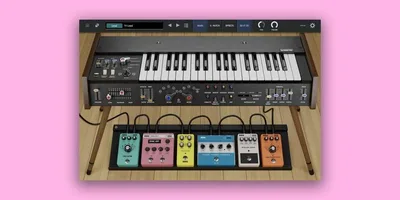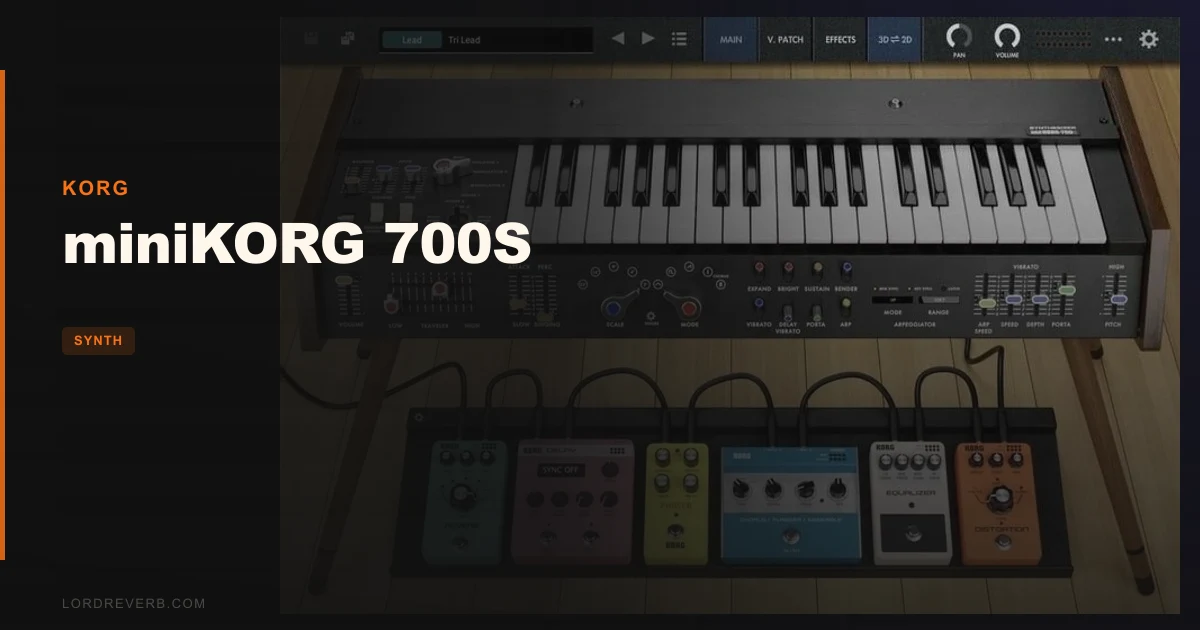
The KORG miniKORG 700S plugin is a genuinely faithful software recreation of a historically significant synthesizer, and it sounds exactly as strange and wonderful as that sentence implies. It's not for everyone. If you need a Swiss-army-knife monosynth, this isn't it. But if you want that specific thick, oddly musical tone that came out of Hamamatsu in 1974, this is the fastest way to get there without bidding on a broken unit from a Tokyo auction.
We tested it across bass lines, leads, and some experimental noise work. The results were uneven in the best possible way.
It's built for producers who love the sound of early KORG DNA, live performers who want vintage character without vintage maintenance costs, and anyone who finds modern monosynths too polished.
What You're Actually Getting
The original miniKORG 700S launched in 1974 as a 2VCO, 2VCF, 1EG, 1LFO monophonic synthesizer. The software version recreates that architecture faithfully, then adds layers the hardware never had.
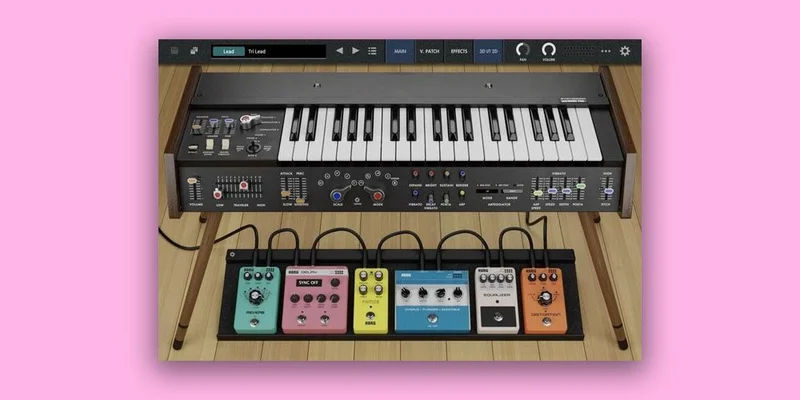
The defining feature is the Traveler Controller: a single hardware element that combined low-pass and high-pass filtering into one unit. KORG recreated this in software, and it's the heart of the plugin's character.
On top of the vintage core, you get polyphonic mode, unison with stereo spread, three LFOs with BPM sync, three ADSR envelope generators, a virtual patch bay with 33 modulation sources and 80 destinations, and five stompbox-style effects. The GUI ships in 2D and 3D views at three switchable sizes. It runs as VST, VST3, AU, and AAX on both Mac and Windows.
The Good
The Traveler Controller is the reason to own this. We dialled the low-pass cutoff down to around 60% and swept the high-pass up simultaneously on a sustained pad. The result was a narrow bandpass that shifted midrange in a way that no standard filter plugin replicates cleanly. It's a specific sound, and KORG nailed it.
That's micro-story one: we spent 40 minutes just moving those two sliders. Satisfying in a way that modern filter designs rarely are.
The virtual patch bay is where the plugin stops being a museum piece. Assigning LFO 2 to filter cutoff at a depth of around 40% while routing note velocity to VCO 2 detune produced a lead that felt alive. Eight simultaneous modulation routings is generous for a plugin at this price point.
The triangle wave oscillator also deserves mention. KORG's engineers originally designed the circuit to sound "beautifully musical" rather than mathematically accurate. That philosophy survived the software conversion. The triangle wave here has a warmth, meaning upper harmonics that roll off slower than a textbook triangle would, that works brilliantly on bass patches.
The 150+ presets split across 13 categories are better than most plugin presets. The lead and bass categories include patches that don't sound like 1974 at all, which is a compliment.
The Not-So-Good
One envelope generator on the original hardware was a limitation KORG chose to keep in the software's core architecture, even though the software version adds three ADSR generators via the expanded section. The original envelope is not ADSR. It's two sliders: one that sweeps attack into decay, and one that links sustain to release. You can't set a long attack with a short decay. Annoying, once you try to build a slow-attack pad and hit the wall.
We understand the fidelity argument. But the limitation costs you flexibility at the exact moment you'd want it most.
The ring modulation capabilities listed in the hardware specs, including keyboard-tracking and non-tracking variants, feel underserved in the plugin's preset library. We found only a handful of patches that explored it seriously. For producers coming to this without vintage KORG knowledge, discovering ring mod takes more digging than it should.
The 8 GB disk space requirement is also frustrating for a monophonic-origin synth. That's more storage than some multi-sample orchestral libraries ask for.
Compared to the Alternatives
The Moog Minimoog Model D plugin sits in similar territory at a comparable price. It wins on filter character for Western-style leads and has a more flexible envelope. It loses on the Traveler Controller's bandpass behaviour and the miniKORG's stranger oscillator voicing. If you're making psych rock or kosmische, the KORG wins. If you're making anything with a recognisable bass line, the Moog is safer.
Elektron's Monomachine is the hardware comparison most producers raise. It does more, costs more, and sounds different enough that comparing them is almost unfair.
The BLEASS Analog FM Synth Bundle offers more oscillator flexibility at a lower price, but it doesn't touch the specific vintage KORG character.
For bass-specific work, LOW by
The miniKORG 700S wins on authenticity. It loses on flexibility. Pick based on which matters more to you.
Who Should Buy This
- ✅ Buy if you want the Traveler Controller's combined low/high-pass filter and there's no other software that provides it.
- ✅ Buy if your productions need 1970s Japanese synthesizer character and you can't find or afford a hardware unit.
- ✅ Buy if you produce ambient, kosmische, vintage electronic, or retro-tinged music and want a genuinely period-accurate source.
- ❌ Skip if you need a flexible modern monosynth with full ADSR control on the core envelope.
- ❌ Skip if you're after a bread-and-butter lead or bass synth for contemporary pop or hip-hop production.
- ❌ Skip if disk space is tight. Eight gigabytes is a lot to ask.
Score Breakdown
| Category | Score | Notes |
|---|---|---|
| Sound Quality | 4.5/5 | The Traveler Controller and triangle wave oscillator are genuinely distinctive and hard to replicate elsewhere |
| Value for Money | 3.0/5 | Competes with more flexible modern monosynths; the niche use case limits its score here |
| Ease of Use | 3.5/5 | 2D/3D GUI is clever but the envelope slider system takes adjustment time |
| Features | 3.5/5 | Virtual patch bay and polyphonic mode impress; ring mod feels underdeveloped in context |
| CPU Efficiency | 3.0/5 | 8 GB disk requirement and i7 recommendation feel heavy for a monophonic-origin plugin |
| Overall | 3.5/5 | Brilliant for its specific purpose; limited outside it |
Alternatives to Consider
BLEASS Analog FM Synth Bundle gives you more oscillator architecture and costs less. It won't sound like 1974 Hamamatsu, but it covers more sonic ground. See our full review of the BLEASS Analog FM Synth Bundle.
Audio Blast ABX3 Bundle covers acid-adjacent monophonic territory with more filter aggression. Different character entirely, but worth knowing if the miniKORG feels too polite. Check our Audio Blast ABX3 Bundle review for the comparison.
BeatSurfing LOW wins on bass-specific performance. If your main use case is low-end rather than vintage leads, it's a smarter spend. We covered it in detail in the LOW review.
If you want something that shows what a completely different era of sample-based sound design looks like alongside this, the Tape Synths Expansion review is worth reading next.
Here's the honest version: the miniKORG 700S plugin is a brilliant recreation of a weird, specific synthesizer that most producers don't need. If you need it, you'll know. If you're asking whether you need it, you probably don't. Check pricing on the manufacturer's site before you commit, and make sure your DAW has 8 GB to spare before the purchase becomes a headache.
The Traveler Controller alone is worth the price of admission for the right producer. For everyone else, it's a beautiful piece of software history that'll sit in the plugin folder unopened.
Related reviews: Usynth DRIVE Loyalty Upgrade Is Worth It in 2026 · Simple Concept Review 2026
Frequently Asked Questions
Is the miniKORG 700S plugin a faithful recreation of the original hardware?
Yes. KORG recreated the Traveler Controller, the triangle wave oscillator's non-standard circuit, and the dual-slider envelope system accurately. The software version adds polyphonic mode, three LFOs, three ADSR generators, and a virtual patch bay on top of the original architecture. The original hardware's specific quirks are all present.
Can the miniKORG 700S plugin do polyphonic sounds?
The original hardware was strictly monophonic. The software version adds a polyphonic mode, unison functionality, and a stereo spread control. These are software-only additions. You can switch between mono, legato, and polyphonic operation from within the plugin interface.
How does the Traveler Controller work?
The Traveler Controller was KORG's original solution to combining low-pass and high-pass filtering into a single physical control. In the plugin, it works the same way: moving the controller sweeps both filters simultaneously. This creates bandpass-style filtering and tonal narrowing that standard independent LPF/HPF setups don't replicate naturally.
Does the miniKORG 700S plugin work on Apple Silicon Macs?
Yes. KORG confirmed Apple Silicon native support in the system requirements. You'll need Mac OS X 10.14 Mojave or higher with the latest update installed. The plugin runs as AU, VST, VST3, and AAX in 64-bit format only. An internet connection is required for activation.