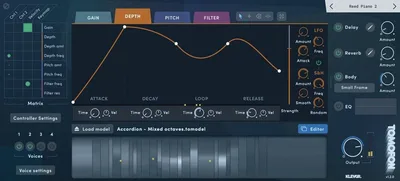
You know the frustration. You load up a wavetable synth, spend 40 minutes dialling in a pad, and it still sounds like every other pad on every other record made in the last five years. Wavetable synthesis is brilliant, but the sonic palette has been strip-mined. Samplers get you closer to organic, but they're just playing back recordings, not synthesising anything. The gap between "sounds real" and "sounds synthesised" has always needed a different answer. Tomofon by Klevgrand is that answer, and at $129.99 it's one of the more interesting synth buys in 2026 for producers who build cinematic, experimental, or ambient work.
The Problem Tomofon Was Built to Solve
Wavetable synths work from mathematical waveforms. Samplers work from recordings. Neither morphs continuously between thousands of real audio waves organised across a pitch map.
That's the actual gap Tomofon fills. Its Audio Model engine extracts waves from real audio files, organises them into pitch zones, and morphs between layers and zones in real time. The result sits in a strange, useful space: organic enough to sound alive, synthetic enough to sound like nothing you've recorded.
It's not trying to imitate a violin or a choir. It's trying to make something your ears don't already have a category for. For producers building atmospheres, scoring picture, or just sick of their pads folder, that's a genuinely useful problem to solve.
How It Actually Performs
We dragged a 30-second vocal chop into the import editor. One click on automatic mapping, and Tomofon distributed the extracted waves across the keyboard range. Played a C2. What came back was something between a breath and a chord, shifting subtly with each note held. Not the vocal. Something made from it.
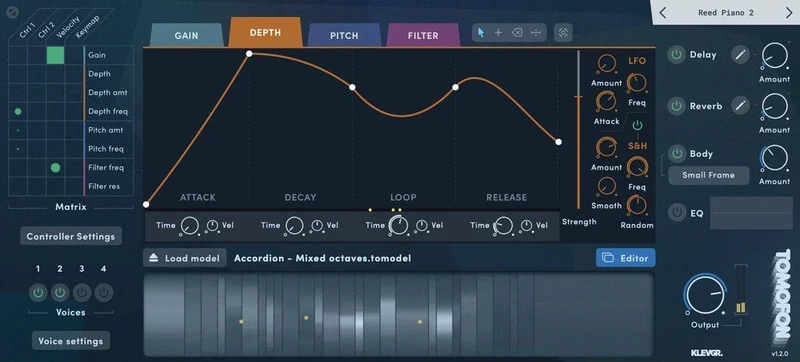
That's the engine working as advertised. The morph between layers is continuous and smooth. There's no audible stepping between pitch zones, which is the failure point for most zone-based systems.
Four doubling voices add width and movement. You can set separate pitch, pan, and level per voice, which means a single note can become a cluster. The ADSR envelopes cover gain, depth, pitch, and filter cutoff independently. The modulation matrix handles two MIDI CC assignments, velocity, and a keymap source, plus several LFOs including a sample-and-hold with randomness control.
MPE compatibility arrived in v1.2 and it works cleanly. Run it from a Roli or a Linnstrument and per-note pitch bend gives the morphing engine a new layer of expression that a standard keyboard can't touch.
Reviewers report that certain audio sources produce unpredictable results. Polyphonic or harmonically dense sources tend to create muddier Audio Models than monophonic content. The documentation is thin on workarounds. Our suggestion: start with monophonic recordings. Flute, voice, bowed strings, single-note guitar. The engine rewards focus.
Strengths and Weaknesses
The sound design ceiling is high. We loaded a bowed metal bowl recording, ran it through the automatic import, added a slow depth envelope and a sample-and-hold LFO on filter cutoff. The result was a shifting metallic texture we'd never heard before. That's the best version of Tomofon.
The 124 included Audio Models cover a wide range. Voices, instruments, abstract sources. The 180+ presets are a solid starting point, and several are immediately usable in a mix without tweaking.
The weaknesses are real, though. The effects section is frustrating. One lowpass filter, delay, reverb, EQ. That's it. No saturation, no chorus, no phaser. For a synth that excels at evolving pads, the absence of a proper modulated effect feels like a missed opportunity. You'll be sending to a bus for everything else.
Reviewers also flag the effects as "thin in the features department" and we agree. It's annoying when the synth engine is this clever and the signal chain runs out of ideas at the output stage.
The learning curve for manual Audio Model creation is steeper than the automatic path suggests. The drag-and-drop editor is intuitive visually, but understanding which waves end up in which zones, and why certain sources don't behave, takes time that the manual doesn't fully recover for you.
Value for the Price
At $129.99, Tomofon isn't cheap, but it's not competing with Serum on features-per-dollar. It's competing on what it does that nothing else does.
If you produce ambient, cinematic, or experimental music regularly, the Audio Model engine alone justifies the spend. You're not buying another wavetable synth. You're buying a new synthesis method.
If you want a full-featured synth with deep effects, modulation, and a traditional sound design workflow, the value calculation is harder. You'd be paying for the engine and then buying effects separately. That's a legitimate concern at this price point.
MusicTech rated it 8/10. We'd land at 4.2 out of 5. The deductions are all in the effects suite and documentation gaps, not the core engine.
Who Should (and Shouldn't) Buy This
- ✅ Buy if you produce cinematic, ambient, or experimental music and want textures that don't sound like anyone else's library.
- ✅ Buy if you own an MPE controller and want a synth that uses that expressiveness in an organic, non-obvious way.
- ✅ Buy if you love sound design from unusual sources and want a structured, playable instrument built from your own audio.
- ❌ Skip if you need a full-featured effects chain inside the plugin. Thin output processing will frustrate you.
- ❌ Skip if you work primarily in dense, rhythmic genres where evolving pads aren't part of the toolkit.
- ❌ Skip if you want predictable, repeatable results from complex audio sources. The engine rewards experimentation, not precision.
Specs & Technical Details
| Developer | Klevgrand |
| Price | $129.99 |
| Plugin Format | VST3 / AU / AAX |
| OS Support | macOS 10.10 or later (M1 optimised) / Windows 7 SP1 or later |
| Activation | N/A |
| CPU Usage | Medium |
| Trial Available | N/A |
| Version Reviewed | 1.2 |
Score Breakdown
| Category | Score | Notes |
|---|---|---|
| Sound Quality | 4.5/5 | The Audio Model morphing engine produces sounds that genuinely sit apart from wavetable or sampler output |
| Value for Money | 4.0/5 | Justified by uniqueness of the engine, but the thin effects suite means extra spend elsewhere |
| Ease of Use | 3.5/5 | Automatic import is a one-click win; manual Audio Model creation has a real learning curve with thin documentation |
| Features | 3.5/5 | 124 models, 180+ presets, MPE support, and a solid modulation matrix, but the effects section lets it down |
| CPU Efficiency | 4.0/5 | Runs acceptably on modern machines; M1 optimisation helps on Apple Silicon |
| Overall | 4.2/5 | A brilliant synthesis concept held back by an effects section that needed two more years of development |
Alternatives to Consider
If Tomofon's effects limitations are a dealbreaker, Arturia's MiniFreq V gives you a much deeper modulation and effects chain inside a single plugin. See our MiniFreak V review for the full breakdown.
For physically modelled acoustic textures, Applied Acoustics Systems Chromaphone 3 is the intelligent alternative. It's a different synthesis method, but it covers the "organic but not a sample" territory that Tomofon also occupies. Our Chromaphone 3 review covers it in detail.
If you want analogue-style synthesis with a broader effects suite at a comparable spend, the SEM V review and the AudioThing SX1000 are both worth considering. Neither does what Tomofon does, but both are more complete instruments out of the box.
The honest truth: nothing else runs an Audio Model engine. If that's what you came for, there's no direct substitute.
Tomofon earns its place in a specific kind of studio. If you build music that needs textures no sample library has ever shipped, this is the most interesting synthesis tool Klevgrand has made. The effects suite will annoy you and the documentation will occasionally leave you on your own. But when you drag in a recording of a struck metal pipe and play a chord that sounds like a cathedral made of breath, you'll understand exactly why it exists at $129.99.
Not the right fit? Start with MiniFreak V. But if you're building atmospheres for a living, clear some space in your signal chain. Tomofon needs room to breathe.
Related reviews: miniKORG 700S Review
Frequently Asked Questions
Is Tomofon a sampler or a synthesiser?
It's a synthesiser, not a sampler. Tomofon converts audio files into sets of oscillating waves, then morphs between them continuously across pitch zones. A sampler plays back recordings. Tomofon generates sounds from them. The difference is audible immediately.
Can I use my own audio in Tomofon?
Yes. You drag audio files into the built-in editor, and Tomofon maps the extracted waves across the keyboard range. Automatic import is a single click. Manual import gives you zone-by-zone control. Monophonic source material works best. Dense or polyphonic recordings tend to produce murkier results.
Does Tomofon support MPE controllers?
Yes, MPE support was added in version 1.2. Per-note pitch bend, pressure, and slide data all feed into the synth engine. If you own a Roli Seaboard, Linnstrument, or similar controller, Tomofon rewards that kind of expressive input more than most conventional synths do.
What are the system requirements for Tomofon?
Mac users need macOS 10.10 or later, and the plugin is optimised for Apple Silicon M1 processors. Windows users need Windows 7 SP1 or later. The host DAW must be 64-bit and support AU, VST3, or AAX formats. It runs at medium CPU usage on most modern machines.