The KORG Polysix plugin is the honest answer to a frustrating question: how do you get that 1981 silk-and-chorus pad sound without buying a 40-year-old synthesizer that might have a leaking battery eating through its circuit board right now.
At $99.99, this is a serious piece of kit. It's built on KORG's Component Modeling Technology, ships with 300 presets, and adds a 21-effect multi-effects chain that the original hardware never had. It's for producers who write pads, strings, lush bass lines, and slow-attack textures, and who want that specific Korg warmth without the hardware lottery.
It's not for everyone. We'll tell you exactly who should skip it.
What You're Actually Getting
The Polysix plugin is a software reproduction of KORG's 1981 six-voice polyphonic synthesizer, updated and expanded from their original 2004 Legacy Collection version.
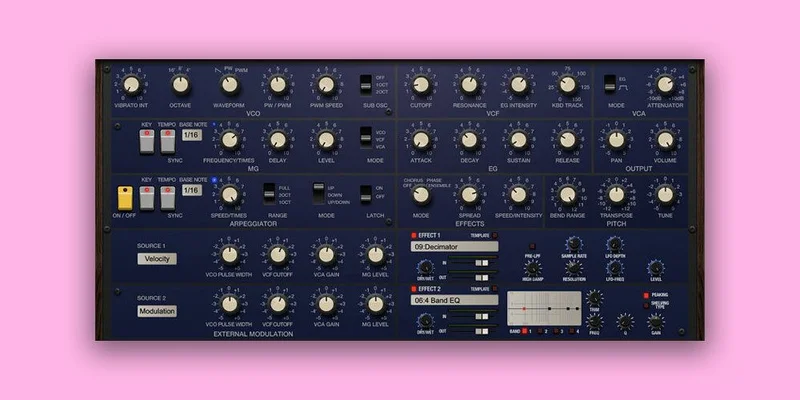
The architecture is simple by design. Each voice runs one VCO, one VCF, one VCA, and one EG. That's it. The VCO covers 16', 8', and 4' pitch ranges with sub-octave options sitting one or two octaves below. The original hardware's SSM2044 low-pass filter is the star here, and KORG's CMT reconstruction models it at the component level: transistors, capacitors, resistors, all digitally represented in the signal path rather than just approximated from the output.
The plugin adds 32 voices of polyphony and up to 16-voice unison with detune and spread. The built-in effects cover chorus, phaser, and ensemble from the original, plus two new multi-effects units drawing from a pool of 21 effect types and 127 ready-to-use effect programs.
The Good
Load the "Slow Strings" preset, drop the attack to about 80ms, and play a maj7 chord in the mid-register. The filter opens just past the midpoint. What comes back is a smooth, slightly nasal string bloom that sits in the upper-mid range without fighting your reverb send. That's the SSM2044 character doing its job, and the CMT modeling catches it.
We kept reaching for this over brighter polysynths when a pad needed to disappear into a dense mix. The single-oscillator architecture, which sounds like a limitation on paper, actually keeps things narrow enough to layer without fighting your lead. It's a brilliant accidental feature.
The ensemble effect is wide without going phasey at the edges. Push the rate down to around 0.3Hz and it breathes rather than wobbles. That's harder to dial in on cheaper emulations.
The preset browser is genuinely good. Filter by type, mark favorites, and you're not scrolling past 200 irrelevant patches to find a pad. KORG clearly thought about workflow here.
The 4K and Retina interface is sharp and scales across six levels. No blurry knobs. Satisfying to use on a large display.
The Not-So-Good
One VCO per voice is honest to the hardware. But it's also frustrating when you want movement. You can't stack two oscillators at a slight detune the way you can on a Juno-106 emulation or Arturia SEM V. If your sound design relies on that beating-oscillator thickness, you're going to hit a wall fast.
The hardware Polysix reviewers keep coming back to is reliability. Battery leaks, voice chip failures, and noise floor issues are real problems on vintage units. The plugin obviously sidesteps all of that. But it also means you lose whatever happy accidents and quirks come from a unit that's aged in a specific way. Some users report that the hardware's character is something no plugin has quite nailed, even KORG's own.
The 21 effects are welcome, but 127 preset programs is a strange number to advertise. We'd rather have fewer programs and more transparency about what each effect is actually doing to the signal chain.
Annoying: no standalone mode confirmed in the specs. You're staying in your DAW.
Compared to the Alternatives
The Arturia MiniFreak V is a different beast entirely. Two oscillators per voice, wavetable and virtual analog hybrid architecture, far more aggressive sound design territory. If you want the Polysix's restraint and vintage warmth, MiniFreak V won't scratch that itch. If you want versatility, it wins on paper.
Arturia's SEM V is worth a direct comparison. The Oberheim SEM filter is rounder than the SSM2044, which reads as darker and slightly less defined in the upper mids. Both are excellent for pads. We'd call the Polysix more suited to layered string beds; the SEM V better for solo pad statements.
The AudioThing SX1000 covers Italian vintage analog territory and is worth checking if you want something outside the Korg/Oberheim conversation.
Against the vintage hardware Polysix: the plugin wins on reliability, polyphony, and effects. The hardware wins on intangibles and that specific aged-component character some producers love.
Who Should Buy This
- ✅ Buy if you write cinematic or ambient music and need pad textures that blend rather than cut.
- ✅ Buy if you've priced vintage Polysix hardware and want the sound without the servicing risk.
- ✅ Buy if you're building a KORG Collection and want a historically important piece of the analog poly story.
- ❌ Skip if you need dual-oscillator complexity and sound design range. There are better tools.
- ❌ Skip if you're primarily a lead synth or bass designer. The architecture isn't built for that.
- ❌ Skip if you already own a well-serviced hardware Polysix. The plugin is excellent. It's not that.
Specs & Technical Details
| Developer | KORG |
| Price | $99.99 |
| Plugin Format | VST / VST3 / AU / AAX (64-bit only) |
| OS Support | Mac (macOS 11 or higher, Apple Silicon native) / Windows 10 64-bit or higher |
| Activation | Internet connection required |
| CPU Usage | Medium (Core i5 minimum, i7 recommended; 8GB RAM minimum) |
| Trial Available | N/A |
| Version Reviewed | Polysix V2 (KORG Collection) |
Score Breakdown
| Category | Score | Notes |
|---|---|---|
| Sound Quality | 4.5/5 | CMT filter modeling is the real deal; SSM2044 character comes through |
| Value for Money | 4.0/5 | Strong at this price versus the hardware alternative cost and risk |
| Ease of Use | 4.5/5 | Simple architecture by design; preset browser is genuinely helpful |
| Features | 3.5/5 | 21 effects and 300 presets are solid; single VCO limits sound design ceiling |
| CPU Efficiency | 4.0/5 | Medium load; nothing alarming but not as light as simpler emulations |
| Overall | 4.2/5 | An underrated plugin that earns its place for anyone serious about vintage pad tones |
Alternatives to Consider
If you want more oscillator muscle in a vintage poly package, the Arturia SEM V is the first stop. Different filter character, more open sound design.
For something with a completely different DNA but excellent for texture work, check the Applied Acoustics Chromaphone 3 sound bank as a complementary tool to physical modeling pads.
If you want to understand what a modern hybrid soft synth does differently, the Arturia MiniFreak V is the direct comparison to make before you commit here.
The Bottom Line
We loaded three string patches, ran them against a hardware Juno emulation and a modern wavetable synth, and the Polysix was the one that disappeared into the mix the right way every time.
That's not a small thing. Pads that sit without fighting are harder to find than pads that sound impressive soloed. The Polysix plugin is brilliant at exactly that job.
At $99.99, it's not a casual purchase. But if your sessions regularly need 1980s-style strings and chorus pad textures, the cost of a serviced vintage unit would buy you several licenses and still leave you without a guarantee the hardware survives the next summer.
We'd buy this. We'd skip it if we primarily write aggressive leads or want dual-oscillator movement. And we'd keep it open on a dedicated pad bus and never close the session.
Related reviews: Cherry Audio Year One Collection
Frequently Asked Questions
Is the KORG Polysix plugin an accurate emulation of the original hardware?
KORG built it using their Component Modeling Technology, which models individual circuit components rather than approximating the output sound. That means transistors, capacitors, and resistors are all digitally reconstructed in the signal path. Reviewers generally say it gets very close to the hardware character. Some hardware purists say an aged, well-serviced original has an intangible quality the plugin doesn't fully replicate, but most working producers can't tell the difference in a mix.
What is the SSM2044 filter and why does it matter?
The SSM2044 is the low-pass filter chip used in the original Polysix hardware. It has a specific sonic character: smooth in the upper mids, slightly nasal at resonance, and very controlled in how it opens. It's a big part of why Polysix pads have that recognizable silk quality. The plugin's CMT modeling targets this chip specifically, which sets it apart from generic low-pass filter emulations.
Can the Polysix plugin handle bass and lead sounds, or is it strictly for pads?
It can do bass. The VCO goes down to 16' with a sub-octave option, and the filter responds well to higher resonance settings for a round, vintage bass character. Lead sounds are possible but limited by the single-oscillator architecture. You won't get the oscillator beating and harmonic density of a dual-VCO synth. Think of leads as a secondary function, not a strength.
Does the Polysix V2 plugin work on Apple Silicon Macs?
Yes. KORG confirmed Apple Silicon native support in the current KORG Collection version. You'll need macOS 11 or higher with the latest update installed. It runs AU, VST, VST3, and AAX formats on Mac, all 64-bit only. An internet connection is required for activation.