STARK sits most naturally in the conversation alongside Neural DSP Archetype plugins and IK Multimedia AmpliTube, and this review is going to land here: it beats them both on noise reduction and CPU overhead, but loses on sheer amp variety. Klevgrand built STARK for the producer who tracks a lot of di guitar, needs a quiet signal chain fast, and isn't hunting for 80 amp models. At $99.99, it's a specific tool for a specific job. Buy it for the right reasons and you'll love it. Buy it expecting a modelling powerhouse and you'll be annoyed before the first session is over.
This is a T5 review with a comparison angle. We're telling you exactly where STARK fits in your arsenal, and where it doesn't.
How It Compares Out of the Box
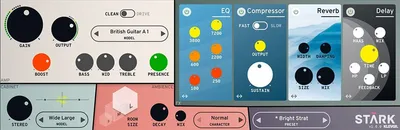
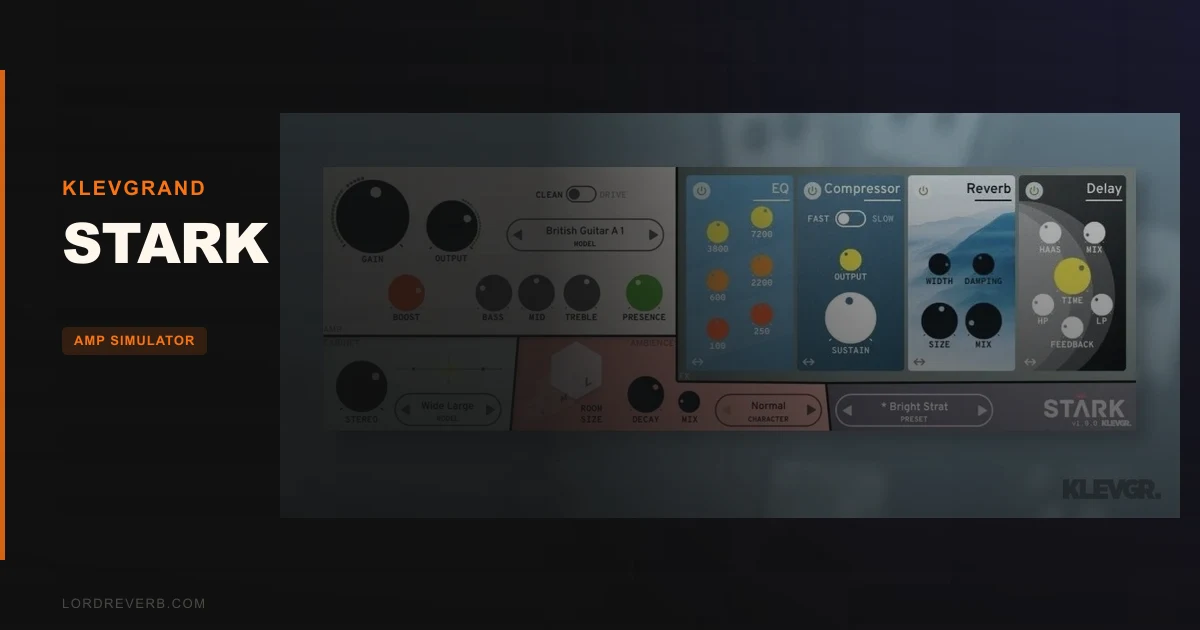
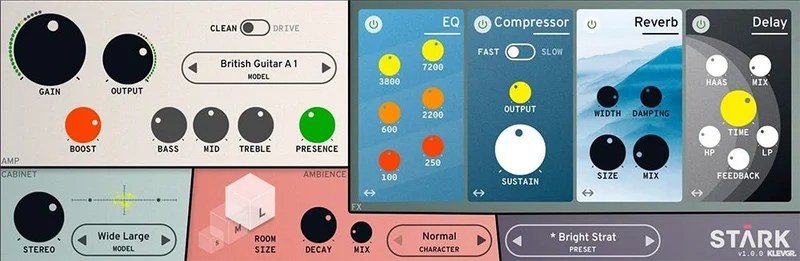
Open STARK next to AmpliTube 5 and the first thing you notice is how uncluttered it feels. No scrolling cabinet library. No separate tuner window. Everything, amp, cab, room, and four pedal slots, sits on one screen.
Neural DSP gives you more amp character per plugin, but each Archetype targets one artist's tone. STARK targets no one's tone specifically, which is a strength for producers and a weakness for guitarists who want "that sound."
The no-convolution approach is the real differentiator. Where AmpliTube uses IR-based cabinet loading and BIAS FX 2 leans on convolution for room simulation, Klevgrand wrote their own algorithms for every module. The result is a plugin that breathes a little differently under aggressive picking dynamics.
On first load, the default preset is honest: a medium-gain crunch that sits in a mix without much EQ work. That alone tells you something about the design philosophy.
Performance Deep Dive
We ran a Telecaster DI through STARK's full chain: amp on overdrive channel, a 4x12 cab, medium room with 1.4s decay, and a tape delay in slot one. CPU usage sat comfortably low in Logic Pro at 256 samples buffer. Running four instances simultaneously, we stayed well clear of a performance warning. That's a win Neural DSP can't always match on dense sessions.
The 12 amp models cover the expected spread: clean Fender-adjacent tones, British crunch, a high-gain voice that gets djent-y without fizzing out above 5kHz. We pushed the booster knob to about 70% on the high-gain model. The saturation thickened without the digital clamp you get from cheaper simulators. Transients held their shape.
The Brusfri noise reduction is the headline addition in v1.2. We held the ear icon with a single coil running through a noisy interface, let it learn for two seconds, and the hum dropped cleanly. No musical content affected. Reviewers who've tracked in less-than-perfect environments report this is the feature that keeps them using STARK over competitors in everyday sessions.
The 10 cabinets and six room types with three sizes each give you a matrix of 60 possible amp-room combinations before you touch a pedal. That's more flexibility than the front panel suggests.
Where It Wins
The no-convolution engine is a genuine advantage for dynamic playing. We ran hard strummed chords into a clean amp model and dug in with pick attack. The response curved naturally. It didn't brick-wall the transient the way convolution-based cabs sometimes do at high input levels.
Modular routing is clever here. You can bypass the amp section entirely and run your own preamp sound into just the cabinet and room. Or run the amp into no cab and treat it as a preamp coloration stage. Users keep pointing to this flexibility as the reason they reach for STARK on bass DI tracks, not just guitar.
The built-in noise reduction removes a plugin from your signal chain on every tracking session. That's real. Most guitarists are running a noise gate or a dedicated denoise plugin anyway.
Low latency means you can monitor through it live. That matters for tracking takes.
Where the Competition Wins
Twelve amp models is frustrating in 2026. Neural DSP Fortin Cali gives you more variation within a single tonal family than STARK gives you across its entire model list. If you need to flip between a clean jazz tone and a scooped metal sound in the same session, STARK will stretch.
There's no IR loader. That's a hard wall. If you've built a cab IR library from your real cabs, or you want to drop in a third-party impulse from OwnHammer or Celestion, STARK can't use them. You're locked to the 10 onboard cabinets. For some producers that's fine. For others it's a dealbreaker.
The preset system leans heavily toward "song starter" categories. Engineers who want to dial in a specific tone from scratch may find the interface doesn't reward surgical tweaking as well as BIAS FX 2's channel strip approach does.
Reviewers also note the overdrive pedal options, while varied at 17 total, don't match the feel of dedicated stompbox emulations from Line 6 Helix Native.
Who Should Buy Which
- ✅ Buy STARK if you track DI guitar regularly in a noisy room and want noise reduction baked into your amp sim, not bolted on after.
- ✅ Buy STARK if you're a producer pulling guitar sounds quickly and low CPU overhead matters more than exhaustive amp variety.
- ✅ Buy STARK if you want to mix amp models with different cabs freely, without being locked to a preset-brand-pairing.
- ❌ Skip it if you have a specific amp sound in mind that requires more than 12 models to find.
- ❌ Skip it if your workflow depends on loading third-party cabinet IRs.
- ❌ Skip it if you need the depth of a full live-rig emulator like Helix Native for complex patch-building.
Specs & Technical Details
| Developer | Klevgrand |
| Price | $99.99 |
| Plugin Format | VST2 / VST3 / AU / AAX |
| OS Support | macOS 10.10 or later (M1 optimised) / Windows 7 SP1 or later |
| Activation | N/A (check Klevgrand for current method) |
| CPU Usage | Light to medium |
| Trial Available | N/A (check Klevgrand site) |
| Version Reviewed | 1.2.0 |
Score Breakdown
| Category | Score | Notes |
|---|---|---|
| Sound Quality | 4.0/5 | No-convolution engine sounds natural under hard dynamics; amp variety is the ceiling |
| Value for Money | 4.0/5 | Brusfri integration alone adds real value to the package price |
| Ease of Use | 4.5/5 | One-screen layout and drag-and-drop pedal order keep workflow friction low |
| Features | 3.5/5 | 17 pedals and modular routing impress; no IR loader and 12 amp models disappoint |
| CPU Efficiency | 4.5/5 | Runs four instances with headroom to spare at 256 samples |
| Overall | 4.0/5 | A strong, honest amp sim with a specific use case it nails completely |
Alternatives to Consider
If STARK's 12 amp models feel limiting, Neural DSP's Archetype series is where we'd point you next. Each plugin targets a specific tonal territory deeply rather than broadly.
For producers who want IR loading and a larger amp library in one box, IK Multimedia AmpliTube 5 covers more ground. It's heavier on CPU and has a steeper learning curve, but the cab flexibility is in a different league.
Line 6 Helix Native is the right call if you're building complex multi-amp patches or replicating a full live rig ITB. It costs more and uses more CPU, but no other amp sim in this price bracket touches it for signal chain depth.
If STARK's approach interests you but you want to see how Klevgrand's work fits into a broader plugin strategy, our full category guide is worth your time.
STARK is a satisfying tool when it's the right tool. The no-convolution engine genuinely responds differently from anything IR-based in this price range, and the Brusfri integration is the kind of underrated quality-of-life feature that makes you wish more developers thought this way. But at $99.99, you need to know what you're buying. Twelve amp models won't cover every session. The IR wall will eventually frustrate you if your workflow leans on third-party cabs. Buy it for the noise reduction, the CPU headroom, and the clean modular routing. If your sessions are IR-dependent or amp-variety-driven, it's a hard pass.
Frequently Asked Questions
Does STARK work with third-party cabinet impulse responses?
No. STARK uses Klevgrand's own cabinet simulation algorithms and does not include an IR loader. You're limited to the 10 onboard cabinet models. If your workflow depends on loading custom or third-party IRs, you'll need a different plugin or a separate IR loader in your signal chain.
How does the Brusfri noise reduction work inside STARK?
You hold the ear icon while only the noise is present in the signal, no playing. STARK captures a noise profile in a couple of seconds and applies it continuously from that point. It's the same technology as Klevgrand's standalone Brusfri plugin, adapted for the guitar tracking context. Users report it handles single-coil hum and fan noise well without affecting guitar tone.
Is STARK suitable for bass guitar as well as electric guitar?
Yes, and users report it works well on bass DI. The modular routing helps here: you can bypass the cabinet section, which tends to roll off low-end, and run just the amp and room modules for a preamp-style tone. It's not marketed as a dedicated bass amp sim, but the flexibility is there.
How does STARK compare to BIAS FX 2 for in-the-box guitar tracking?
BIAS FX 2 wins on amp variety and IR loading. STARK wins on CPU efficiency and built-in noise reduction. If you're building complex patches with multiple amps and detailed cab matching, BIAS FX 2 is the deeper tool. If you track DI guitar regularly and want a fast, quiet, low-overhead chain, STARK's workflow is cleaner for everyday sessions.