Minipol is a capable, beginner-friendly virtual analog synth that earns its place in a starter rig but runs out of road faster than its price tag suggests. At $79, it's a reasonable entry point for producers who want a clean analog-style sound without learning synthesis from scratch. The Smart Randomizer is the standout feature. The 300 presets cover a solid range of electronic and cinematic sounds. But if you're already past the beginner stage, or you produce in Pro Tools, this isn't your plugin.
Karanyi Sounds built Minipol as their first commercial virtual instrument, and it shows both the ambition and the constraints of that position. We spent time running it through pads, stabs, and bass patches to see where it shines and where it quietly disappoints.
What You're Actually Getting
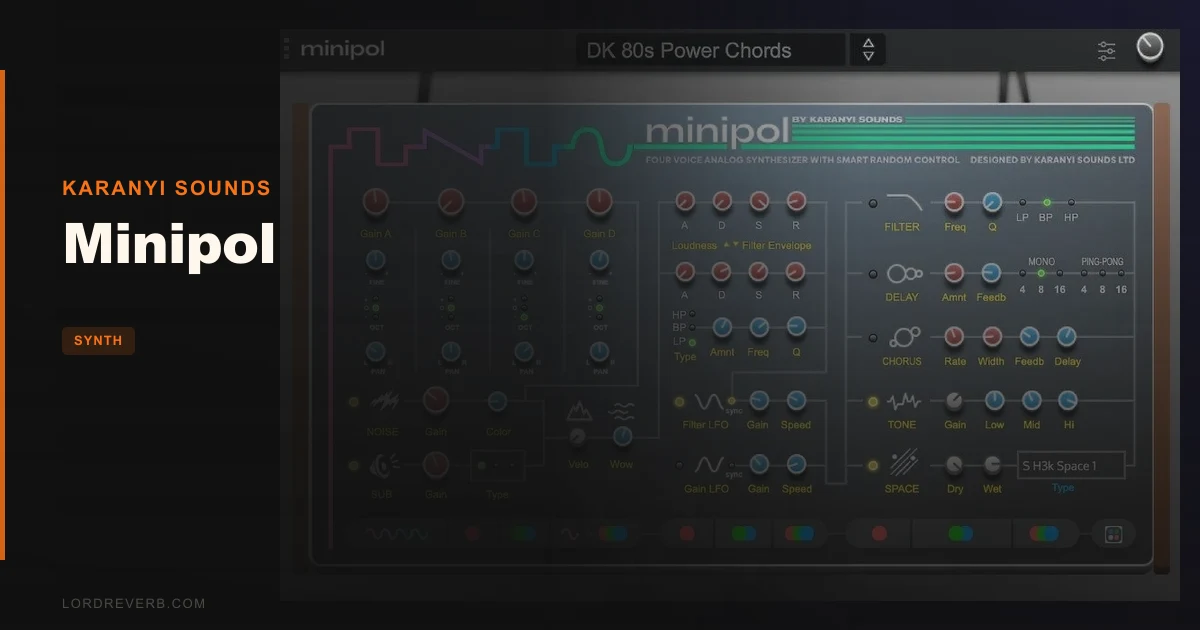
Minipol is a 6-voice virtual analog synth with a single-page interface. Everything lives on one screen: oscillators, envelopes, modulation, and effects. No tabs. No hidden pages. That's the entire design philosophy in practice.
The engine runs 4 virtual analog oscillators modeled on classic synth hardware, each with independent detune, octave, and pan controls. You also get a noise oscillator and a sub-oscillator. The sub is sample-based, lifted from a Sequential OB-6, which is a clever shortcut to a thick, stable low end.
Effects sit in their own panel: a multimode filter (high-pass, band-pass, and low-pass), delay with mono/stereo modes, a chorus that doubles as phaser and flanger, a 3-band EQ, and a convolution reverb with 70 presets sampled from actual TC, Lexicon, Quantec, and Eventide hardware units. That reverb section is better than it has any right to be at this price.
The tape wow control adds subtle pitch drift. It's a nice texture detail, not a deep effect. The whole plugin runs on 120MB of disk space and stays light on CPU. We noticed zero latency complaints on an M1 MacBook with 12 instances open across a session.
Formats: VST3 and AU on Mac, VST3 on Windows, plus standalone. No AAX. Pro Tools users need to know that upfront.
The Smart Randomizer: Where This Plugin Actually Earns Its Keep
The Smart Random Bar is the most interesting thing Minipol does. You can randomize individual sections, groups of controls, or everything at once. Karanyi Sounds says all 47 randomizable controls are "smartly adjusted," meaning the randomizer stays within musically useful ranges. It doesn't throw noise at you.
We put that claim to the test. We hit the full randomizer 30 times across a single session. Every result was usable. Some were predictable. A few were genuinely surprising, including a pad with a mid-scooped chorus texture that we'd never have dialed in manually. That's the real value here: the randomizer surfaces combinations you'd skip past when scrolling through presets.
You can also randomize by section. Hit randomize on just the oscillators while keeping your filter settings locked. That kind of targeted randomization is where the workflow gets clever. It's not as deep as Vital's modulation randomizer, but it's faster to reach and easier to control.
For film composers on a deadline or producers trying to break out of a creative rut, this feature alone justifies the price. It genuinely moves faster than browsing presets.
Where it falls short: there's no way to save a "seed" or lock a randomization result before tweaking. If you like what the randomizer gave you, save a preset immediately. One accidental click and it's gone.
The Oscillator Section: Solid Foundation, Narrow Ceiling
The four oscillators cover the basics well. Each one has detune, octave, and pan. The detune on all four simultaneously is where you start building wide pads and chorus-style unison sounds. We stacked them at +6, +3, -3, and -6 cents with alternating hard-left and hard-right pan, and the result sat well in a mix without needing additional width processing.
The OB-6-sampled sub-oscillator is a genuine differentiator. It's not a synthesized sub: it's a recorded sample from a Sequential OB-6, which means it has real analog character. Running a house bass patch through the high-pass filter at around 40Hz while the sub carries the low end gave us a split that most budget synths can't replicate cleanly.
The noise oscillator is simple. White noise, no color control. It works for breath textures and sound design but offers nothing beyond the basic function.
Here's the honest limit: four oscillators with fixed waveforms and no wavetable or FM capability means you hit the ceiling of timbral variety fast. Reviewers and users report that after an hour of sound design, patches start to feel like variations on the same core character. That's not wrong. The engine is warm in a specific way, meaning harmonics cluster in the 200Hz-2kHz range with a predictable low-mid weight. It's pleasant. It's also limited.
The filter is multimode and sounds clean. It won't saturate dramatically or self-oscillate in wild ways. It's a workman's filter, not a creative centerpiece.
Effects Panel: The Reverb Is the Star
The convolution reverb is the best thing in Minipol's effects chain by a clear margin. Seventy presets sampled from hardware units including TC Electronic, Lexicon, Quantec, and Eventide gear. We loaded a long pad, dropped in the Lexicon 480L plate preset, set the mix to around 35%, and the result had that unmistakable early-digital shimmer that you normally need a dedicated reverb plugin to get.
That's not a small thing. Hardware-sampled convolution reverb at this price point is underrated.
The delay is straightforward and host-syncable, which matters for keeping rhythmic patches locked to tempo. It has mono and stereo presets, no filtering on the feedback path. You can't make it get weird. That's the theme here: effects that work cleanly but don't invite experimentation.
The chorus section covering phaser and flanger modes is serviceable. We ran a stab through the phaser setting and it added movement without washing the attack. Nothing to get excited about, but nothing frustrating either.
The tape wow control applies pitch drift modeled on tape machine behavior. It's subtle. Set it low and it adds life. Set it high and it gets wobbly in a lo-fi way that works well on keyboard patches. There's no separate speed control for the wow rate, which is annoying when you want to dial in a specific drift character.
The 3-band EQ is a trim tool, not a sculpting tool. It's there so you don't have to chain an EQ plugin immediately after Minipol in your signal chain. Useful. Basic.
The Not-So-Good
Let's be direct about the gaps. Users keep running into the same wall: 300 presets sounds like a lot until you realize a significant portion of them share the same tonal DNA. The engine has a specific character, and after a while, you hear it in almost everything. Basses have a consistent low-mid weight. Pads share a harmonic envelope shape. It's not bad, but it's narrow.
The modulation system is thin. You get LFOs for filter, gain, and delay, all host-syncable. That's it. No pitch modulation via LFO, no envelope-to-oscillator routing, no mod matrix. For a synth positioned as a creative tool, that's a real limit. Free alternatives like Vital have a visual mod matrix that makes Minipol's modulation section look like a draft version.
No AAX support is a hard exclusion. If you work in Pro Tools, this plugin doesn't exist for you. Reviewers have flagged this, but Karanyi Sounds hasn't addressed it.
The preset browser is flat. No tag filtering, no category search, no favorites. 300 presets sorted in a linear list. Scrolling through 300 presets to find a specific texture is frustrating in 2026. Every competing plugin at this price has a searchable browser. This doesn't.
And the interface, while clean, gives you no visual feedback on signal flow. You can't see modulation happening. A beginner will find it friendly. An intermediate producer will want more control visibility.
Compared to the Alternatives
Vital is free and immediately harder to compare against. It has wavetables, a full mod matrix, and an active community sharing presets. Minipol is easier to start with, but Vital offers more ceiling for zero additional cost. If you're willing to spend a few hours learning it, Vital replaces Minipol for most use cases.
The Arturia MiniFreak V offers digital-physical hybrid synthesis with a deeper modulation system. It's a more complex plugin at a higher price, and it asks more of the user. If you want growth room, that's the better investment.
For pure analog character, the Arturia SEM V nails a specific Oberheim tone with more authentic filter behavior. Narrower range than Minipol, but deeper in its lane.
The AudioThing SX1000 is worth considering if you want a synth with more personality baked into the engine. It's more opinionated than Minipol but delivers a stronger sonic identity.
Where Minipol does win: CPU load, interface clarity, and the Smart Randomizer speed. For a producer who just wants something working in five minutes, Minipol is faster to reach than any of those alternatives.
Who Should Buy This
- ✅ Buy if you're new to synthesis and want something that sounds good without a manual.
- ✅ Buy if you score for games or film and need a fast source of pad and texture ideas.
- ✅ Buy if you're building a CPU-light rig and need a light analog synth for live use or low-spec hardware.
- ❌ Skip if you produce in Pro Tools. There's no AAX version and no workaround.
- ❌ Skip if you're already comfortable with synthesis and want modulation depth. Vital is free and stronger.
- ❌ Skip if you need a wide range of timbral variety. The engine character gets repetitive across long sessions.
Specs & Technical Details
| Developer | Karanyi Sounds |
| Price | $79 |
| Plugin Format | VST3 / AU / Standalone (No AAX) |
| OS Support | Mac (10.11+, Apple Silicon Native) / Windows (7 SP1+) |
| Activation | N/A |
| CPU Usage | Light |
| Trial Available | N/A |
| Version Reviewed | Minipol (original) |
Score Breakdown
| Category | Score | Notes |
|---|---|---|
| Sound Quality | 3.5/5 | Warm analog character that becomes predictable across extended use |
| Value for Money | 3.5/5 | Competitive at this price, but free alternatives close the gap fast |
| Ease of Use | 4.5/5 | One-window interface, Smart Randomizer, and no hidden menus make this genuinely fast to learn |
| Features | 3.0/5 | Solid reverb and oscillator section, but modulation depth and preset browser are weak |
| CPU Efficiency | 4.5/5 | 12 instances on an M1 MacBook with no strain, genuinely impressive |
| Overall | 3.5/5 | A clever entry-point synth with a real creative tool in the randomizer, held back by a narrow engine and thin modulation |
Alternatives to Consider
If Minipol's ceiling is too low for your workflow, here's where we'd look instead.
Arturia MiniFreak V, Full MiniFreak V review, Better modulation, more complex engine, steeper learning curve. Worth it if you want a synth that grows with you.
Arturia SEM V, SEM V review, Authentic Oberheim filter character with a narrower focus. Better for producers who want a specific vintage tone rather than a general-purpose synth.
Synth City for Chromaphone 3, Chromaphone 3 sound bank review, Different engine entirely (physical modeling), but covers some of the same cinematic and textural territory with more sonic variety.
AudioThing SX1000, SX1000 review, More personality, stronger sonic identity, works best if you want a synth with character baked in rather than a blank canvas.
If your budget is tight and your DAW isn't Pro Tools, download Vital first. It's free, it's deeper, and it's worth the learning investment before spending money on a synth plugin at any price point.
Minipol is for the producer who wants something working right now, sounds good out of the box, and won't eat a session's worth of CPU budget. That's a real niche. Just know exactly what you're buying.
At $79, it's not a mistake. But it's also not a long-term tool for anyone serious about sound design. Buy it for the Smart Randomizer and the hardware-sampled reverb. Accept that you'll grow out of it.

Related reviews: Trilobite Review vs VCV Rack
Frequently Asked Questions
Does Minipol work with Pro Tools?
No. Minipol is available in VST3 and AU formats only. There is no AAX version, which means it cannot run inside Pro Tools at all. If you work primarily in Pro Tools, you'll need to look at a different synth. There's no announced roadmap for AAX support from Karanyi Sounds.
What's the difference between Minipol and Minipol Pro?
Minipol is the original release with 300 presets. Minipol Pro and Minipol Plus are expanded versions with 400+ presets and additional features. The core engine is the same across versions. If you're evaluating a purchase, check the current version available on the Plugin Boutique listing, as Karanyi Sounds has updated the product line since the original launch.
How light is Minipol on CPU, really?
Genuinely light. The plugin runs on 120MB of disk space and we experienced no performance issues running 12 simultaneous instances on an M1 MacBook during testing. Users and reviewers consistently report low CPU draw compared to competing virtual analog synths. It's one of the more honest "CPU-light" claims we've come across in this category.
Is the Smart Randomizer actually useful or just a gimmick?
It's genuinely useful, especially for producers who use synths for inspiration rather than precision sound design. The 47 randomizable controls stay within musically useful ranges, meaning you won't get random noise or broken patches. The ability to randomize by section rather than all at once is what makes it practical. The one real frustration: there's no way to save a randomization seed, so save your preset immediately after finding something you like.
Can Minipol handle bass sounds well?
Yes, within limits. The OB-6-sampled sub-oscillator gives it a stable, characterful low end that most budget synths fake with a synthesized sub. House stabs and chunky 80s-style basses are a clear strength. For more aggressive bass design like growl or distorted FM bass, the engine doesn't have the flexibility. You'd need a synth with a more complex modulation system for that territory.