
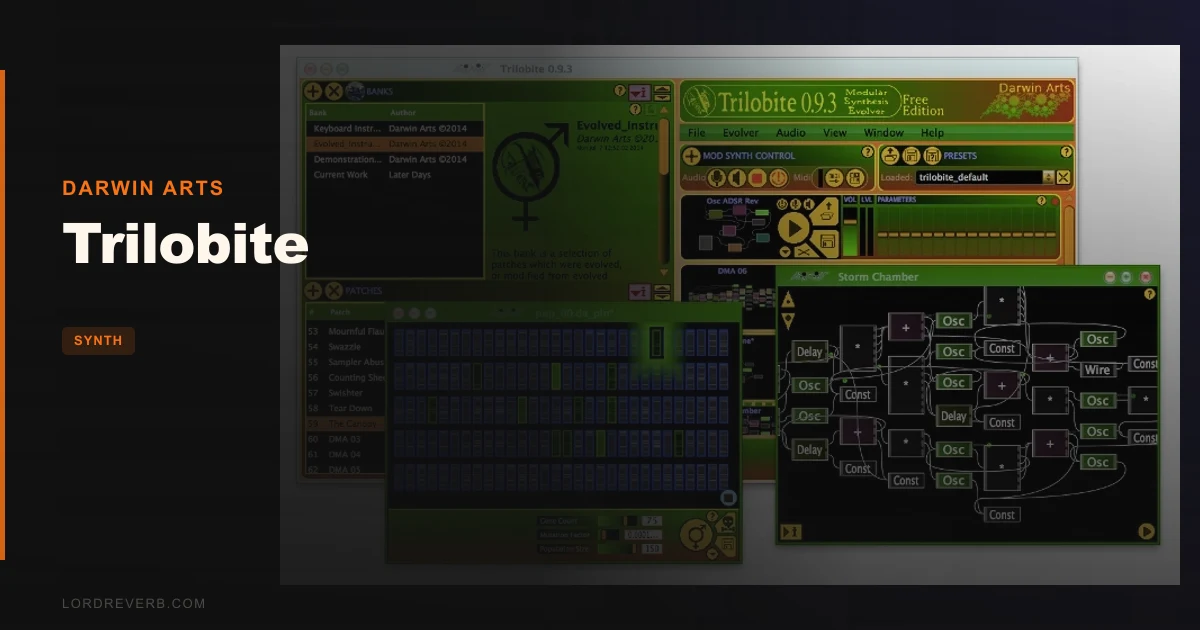
Trilobite gets compared most often to VCV Rack and other free modular environments, and that comparison is where this review starts: Trilobite wins on integration, loses on maturity, and is free either way. Darwin Arts built this as an evolution of their earlier Cambrian Suite, and if you're a sound designer who wants patch evolution baked into your plugin rather than hacked together across three separate tools, Trilobite has something real to offer. It's not finished. Version 0.9.3 is still a beta release. We'd still recommend it to the right person, but that person is specific, and we'll tell you exactly who they are.
How Trilobite Stacks Up Against Free Modular Alternatives
VCV Rack is the obvious comparison. It's free, it's massive, and it has years of community modules behind it. Trilobite can't touch that module library. Nobody could.
What Trilobite does differently is consolidation. VCV Rack is a standalone environment. Trilobite loads as an AU or VST directly into your DAW. No routing workarounds. No virtual audio cable nonsense.
The Interactive Patch Evolver is the feature that genuinely separates it. VCV Rack doesn't have a built-in equivalent. Neither does Surge XT, another free synth we'd put in the same conversation. Trilobite's evolver generates patch variations algorithmically, which is either the most exciting thing you've read today or completely irrelevant to your workflow.
The Visual Patch Editor puts it closer to Softube Modular territory than VCV Rack aesthetically. Cleaner. More contained. Whether that's a strength depends on how deep you want to go.
Performance Deep Dive
We loaded Trilobite 0.9.3 on a Mac running a current OS build with both AU and VST instances running for comparison. The modular synthesis engine is described as "completely overhauled and optimized" from the Cambrian Suite days, and we can confirm it's stable enough for serious patch work.
The Patch Evolver is where we spent most of our time. Load a demonstration patch, dial up the evolution rate, and Trilobite starts mutating parameters across the synthesis chain. We ran a basic subtractive patch through three evolution cycles. The first pass stayed conservative. By the third, the filter envelope had drifted into territory we wouldn't have dialled in manually. Satisfying and a little unnerving in the best way.
The integrated Patch Bank Librarian handles metadata including text descriptions and images attached to each patch. That's a level of organisation most commercial synths don't bother with. The drag-and-drop loading works cleanly. No crashes in our session.
Where we hit friction: the UI density. There's a lot happening on screen at once. We wished for clearer visual hierarchy during the first 30 minutes. The customizable colour schemes help, but they don't fix the underlying information architecture.
CPU behaviour sits in the medium range for a modular synth. Complex patches with heavy modulation routing will push your processor harder. Plan your signal chain accordingly and freeze tracks when you're done designing.
Where Trilobite Wins
The Patch Evolver is the standout. It's a generative composition tool disguised as a preset browser, and nothing free competes with it directly. We loved watching a static patch develop a life of its own mid-session.
The all-in-one architecture is underrated. Modular engine, visual editor, patch library, and web publishing in one plugin is an ambitious scope. Most developers would sell those as four separate products.
The Descriptive Metadata system with images attached to patches is a brilliant organisational move for anyone managing large sound libraries. You can document your sound design process inside the plugin itself.
It's free. That's not a throwaway point. For zero budget, you get a modular synthesis environment that runs natively in your DAW. The barrier to experimenting is nothing.
Where the Competition Wins
Stability. Trilobite is a 0.9.3 beta. That's honest labelling, and we respect Darwin Arts for shipping it clearly marked. But it means you're testing software, not relying on it. Commercial alternatives like Arturia MiniFreak V are finished products with support teams behind them.
Documentation is thin. VCV Rack has a community that has produced thousands of tutorials. Trilobite has demonstration patches and not much else. Annoying when you hit a wall at 2am and need answers fast.
The module library depth isn't there yet. If you need a specific filter type or complex oscillator behaviour, VCV Rack's ecosystem has it covered. Trilobite works within its own engine, which is capable but contained.
Preset quality from third parties: zero. There's no community patch exchange for Trilobite yet. You're building from scratch or from the included demos.
Who Should Buy Which
- ✅ Buy if you want a free modular synth that loads as a plugin inside your DAW without routing headaches.
- ✅ Buy if you're drawn to generative and evolutionary patch design as a compositional tool.
- ✅ Buy if you want to build and document a personal sound library with metadata and visual organisation baked in.
- ❌ Skip if you need a finished, production-stable instrument for client work or live performance.
- ❌ Skip if you're new to synthesis. The UI will frustrate you before it inspires you.
- ❌ Skip if you rely on community patches and third-party content. That ecosystem doesn't exist here yet.
Specs & Technical Details
| Developer | Darwin Arts |
| Price | Free |
| Plugin Format | VST / AU |
| OS Support | Mac / Windows |
| Activation | N/A |
| CPU Usage | Medium (scales with patch complexity) |
| Trial Available | N/A (free product) |
| Version Reviewed | 0.9.3 (beta) |
Score Breakdown
| Category | Score | Notes |
|---|---|---|
| Sound Quality | 3.5/5 | Capable modular engine with room to grow as the beta matures |
| Value for Money | 5.0/5 | Free with no activation hassle |
| Ease of Use | 2.5/5 | Dense UI and thin documentation create a steep early wall |
| Features | 4.0/5 | Patch Evolver and metadata library stand out for the category |
| CPU Efficiency | 3.5/5 | Medium load; complex patches need managed routing and freezing |
| Overall | 3.5/5 | A genuinely interesting free plugin held back by beta limitations |
Alternatives to Consider
If you want a free synth that's further along development and has a deep community behind it, start with Surge XT and similar free instruments before committing time to learning Trilobite's architecture.
For physical modelling synthesis in a similarly experimental direction, Applied Acoustics Chromaphone 3 is a finished, polished alternative. It costs money. It's also a completely different beast oriented around acoustic body resonance rather than modular patching.
If the generative angle is what drew you here, Arturia MiniFreak V offers macro-level randomisation with a far more navigable interface and a stable codebase. Worth the comparison before you commit to Trilobite's workflow.
For pure experimental synthesis on zero budget, also check our Audio Blast ABX3 Bundle review as another free-tier option worth stacking alongside Trilobite.
Trilobite is worth downloading today. Install it, run the demo patches through the Evolver, and see if that generative approach sparks something. If it does, you've found a free tool with real creative depth. If after an hour you're still fighting the interface more than playing it, close the session and don't feel guilty about it. Beta software earns its place in your toolkit by being useful to you specifically, not by existing.
The honest take: Darwin Arts built something genuinely clever here. The Patch Evolver alone justifies the zero-dollar download. Just don't stake a deadline on it.
Related reviews: Cherry Audio Year One Collection · Tomofon
Frequently Asked Questions
Is Trilobite actually free, or is there a paid tier?
Trilobite is free to download with no paid upgrade path listed. Darwin Arts released it as a free plugin through Plugin Boutique. There's no activation requirement, which means no license management headaches either.
What DAWs does Trilobite work with?
Trilobite ships as a VST plugin for Windows and an Audio Units plugin for Mac. That covers most major DAWs: Ableton Live, Logic Pro, Cubase, Reaper, and Studio One among them. AAX is not listed, so Pro Tools users are out of luck for now.
What is the Interactive Patch Evolver and how do you use it?
The Patch Evolver is an algorithmic mutation engine built into Trilobite's patch management system. Load a starting patch, then let the evolver generate variations by mutating synthesis parameters across the signal chain. It's useful for discovering sounds you wouldn't have programmed manually, and works best as a starting-point generator rather than a final-patch tool.
Is Trilobite stable enough for professional use?
Trilobite 0.9.3 is officially a beta release. We found it stable for sound design sessions, but we wouldn't rely on it for live performance or session work with hard deadlines. Darwin Arts is active in development, and the architecture is solid, but beta means beta.