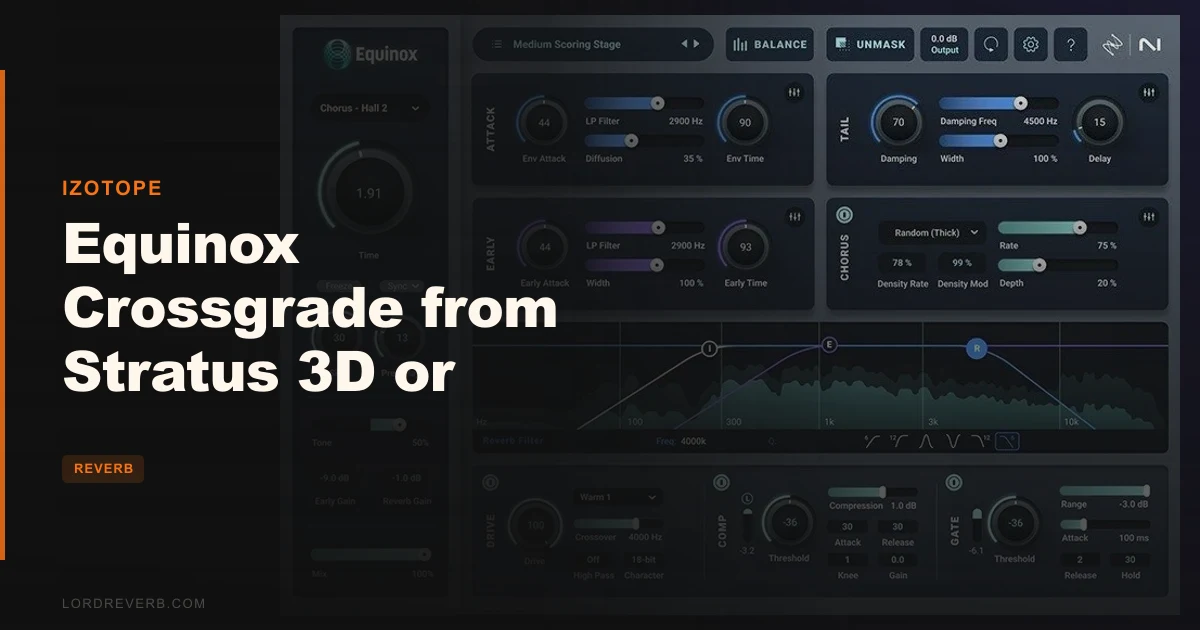
If you own both Stratus 3D and Symphony 3D, you already know the problem: two windows, two license slots, two preset libraries, and a constant mental tax deciding which engine to open first. Equinox is iZotope's answer to that frustration, and the crossgrade pricing at $99 makes it an easy decision to at least consider seriously. This is a single plugin that consolidates both Exponential Audio reverb engines, adds iZotope's adaptive unmasking technology, and brings over 1250 professional presets into one redesigned browser. It's built for post-production engineers, immersive mixing specialists, and anyone tired of juggling two legacy plugins to get the same result. We spent time with it. Here's the honest take.
The Real Problem: Two Plugins Where One Should Live
Stratus and Symphony were never designed to coexist gracefully in a session. They share sonic DNA but live in separate ecosystems with separate preset libraries. If you do immersive audio work in Pro Tools, that means duplicate instances, mismatched recall, and a frustrating workaround every time you want to blend their characters on the same bus.
That's annoying in a music session. In post-production, where a single scene might need dialogue-friendly reverb on one stem and a massive orchestral room on another, it's genuinely disruptive.
Equinox addresses this directly. One plugin. Both engines. A unified preset library. And a backward compatibility workflow that can scan a Pro Tools session and replace every Stratus or Symphony instance with its Equinox counterpart, settings intact. That last feature alone justifies the crossgrade conversation.
How Equinox Actually Performs in a Session
We loaded a dialogue stem with some room ambience already baked in and put Equinox on the reverb send. The dynamic unmasking, borrowed from iZotope's Aurora and Cascadia, is the headline feature and it earns its spot.
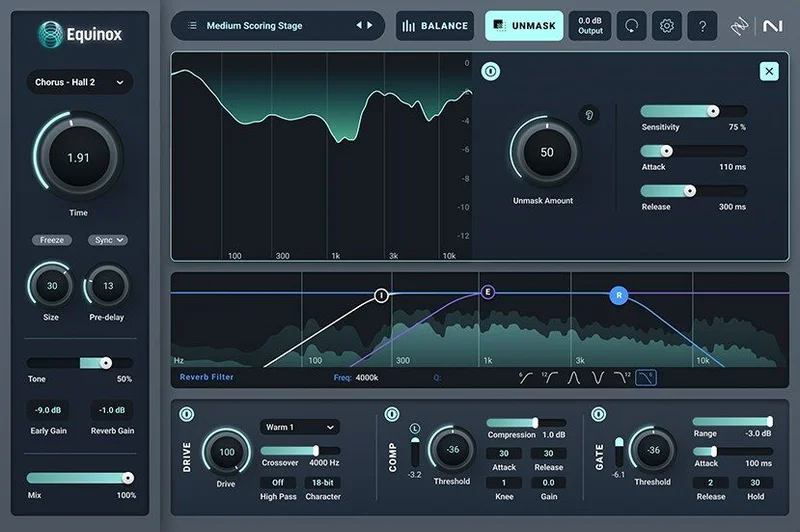
We pushed the reverb tail out to 2.8 seconds on a vocal and watched the unmasking carve transient space in real time. The vocal stayed present. The reverb filled behind it without turning the low-mids into mud. That's the specific fix this tool promises, and it delivers it without heavy manual EQ on the return channel.
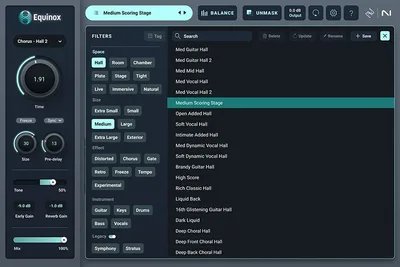
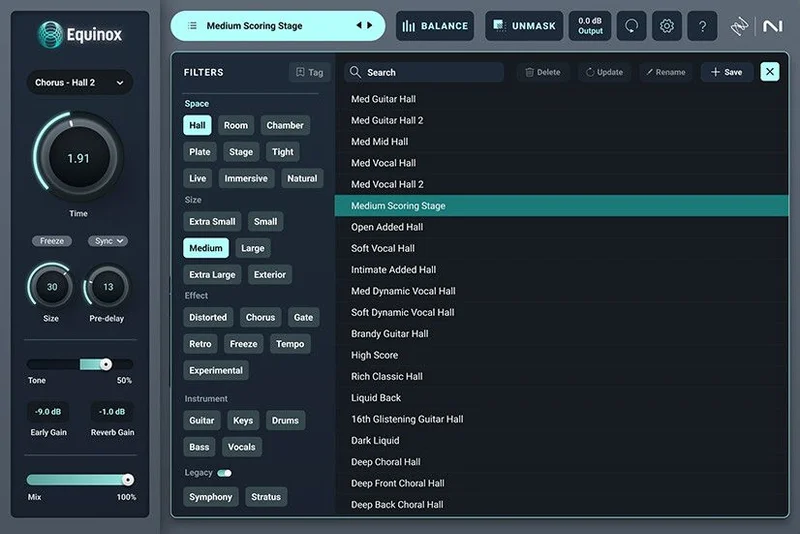
The preset browser is a genuine upgrade over the legacy Stratus/Symphony approach. Keyword search across 1250 presets, plus the ability to save favorites, means finding a starting point takes seconds rather than minutes of scrolling. We searched "large hall low decay" and had three usable options in under 30 seconds.
On the creative side, the Freeze function for infinite drones is satisfying to use for sound design. We held a string pad chord through Freeze at a 3.1 second room size and got a usable bed texture with zero pitch drift. The Gate and Chorus functions work, though they're not deep enough to replace dedicated tools in a serious signal chain.
Reviewers report some sluggishness in the GUI on certain Windows systems, and we've seen similar complaints in the user forums. It's not a dealbreaker, but it's annoying when you're toggling presets quickly during a session. iZotope has a 12-month support window for Stratus and Symphony post-launch, so legacy users aren't immediately orphaned.
Strengths and Weaknesses, No Softening
The strongest thing about Equinox is the workflow consolidation. Having both Exponential Audio engines in a single plugin with shared preset recall is something the immersive audio community has needed for a while. The global tilt EQ for fast tone shaping is clever. It's not a full parametric, but for darkening a room or brightening a plate without opening another plugin, it works.
The unmasking is legitimate. It's not a gimmick borrowed from iZotope's noise tools and stapled on. It behaves musically, and for dialogue-over-music or lead-vocal mixing, it solves a real problem without requiring you to understand sidechain routing.
The weaknesses are honest ones. The drive, envelope, compressor, and chorus engines feel like they were added to check boxes. We ran the drive on a guitar reverb return and the saturation was flat compared to what a dedicated harmonic saturation plugin produces. The compressor on the reverb tail has about four useful positions and no real character. These aren't reasons to skip Equinox. They are reasons not to cancel your other tools expecting this to replace them.
VST2 is gone. If your template still runs VST2 instances of Stratus or Symphony, you're doing migration work before you get the benefits.
Is $99 Justified Here?
Yes. For existing Stratus or Symphony owners, this crossgrade represents access to the merged engine, the new preset browser, and the unmasking tech at a price that doesn't require a painful budget conversation. The full Equinox retails significantly higher. The crossgrade is the correct entry point if you already own either legacy plugin.
The only real caveat: if you never use immersive or surround formats and you already love your Stratus workflow, the upgrade is less urgent. The unmasking alone might justify it for mix engineers who fight reverb buildup regularly. For everyone else in the target audience, $99 is fair.
Who Should (and Shouldn't) Buy This
- ✅ Buy if you own Stratus 3D or Symphony 3D and regularly switch between the two in sessions.
- ✅ Buy if you work in post-production, immersive audio, or Dolby Atmos and need a single reverb with surround-format Balance controls.
- ✅ Buy if reverb buildup in dialogue or vocal mixes is a recurring problem and you want unmasking baked into the reverb itself.
- ❌ Skip if you primarily work in stereo music production with no immersive mixing needs and your current reverb workflow already runs clean.
- ❌ Skip if you rely on VST2 format and aren't ready to migrate your templates to VST3 or AAX.
- ❌ Skip if you want deep creative effects engines. The chorus and drive here are supplementary, not primary tools. Get a dedicated reverb with built-in effects instead.
Specs & Technical Details
| Developer | iZotope |
| Price | $99 |
| Plugin Format | VST3 / AU / AAX (64-bit only; VST2 not supported) |
| OS Support | Mac (macOS 13.7.4 Ventura or later, Intel & Apple Silicon) / Windows 10 (22H2) or Windows 11 (23H2) |
| Activation | iZotope / Native Instruments licensing |
| CPU Usage | Medium to heavy (immersive formats increase load) |
| Trial Available | Check iZotope site for current trial status |
| Version Reviewed | Equinox 1.x (crossgrade from Stratus 3D / Symphony 3D) |
Score Breakdown
| Category | Score | Notes |
|---|---|---|
| Sound Quality | 4.5/5 | Exponential Audio engines remain best-in-class for algorithmic reverb; unmasking preserves mix clarity without artifacts |
| Value for Money | 4.5/5 | Crossgrade pricing makes this an easy call for legacy Stratus/Symphony owners |
| Ease of Use | 4.0/5 | Preset browser is a real improvement; GUI sluggishness on some systems is a friction point |
| Features | 4.0/5 | Unmasking, surround Balance, and Freeze are strong; drive and compressor engines feel shallow |
| CPU Efficiency | 3.5/5 | Immersive format instances push CPU harder than comparable stereo reverbs; plan your instance count |
| Overall | 4.2/5 | A focused, well-priced upgrade for the right user; not a universal reverb replacement |
Alternatives Worth Knowing
If you're not a Stratus or Symphony owner, the crossgrade path doesn't apply to you. Here's where to look instead.
Apogee Clearmountain's Spaces is a legitimate option for mix engineers who want curated, immediately usable reverb rooms without deep parameter diving. It won't do immersive formats, but it sits in a stereo mix brilliantly. We reviewed it: Can Clearmountain's Spaces Change How You Reverb?.
Eventide Spring is the choice if you want a reverb with genuine character and a specific sonic identity rather than an algorithmic all-rounder. See our full take: Eventide Spring Review: Best Tank Reverb of 2026.
IK Multimedia CSR Room Reverb is worth a look for producers working with dry room recordings who need a natural-sounding fix without the immersive overhead. We broke it down here: Can CSR Room Reverb Fix Dry Recordings in 2026?.
And if you're still figuring out where reverb fits in your signal chain generally, read this first: Reverb Plugins Guide: 5 Things Every Producer Must Know.
The Bottom Line
Equinox is the plugin that should have existed the moment iZotope acquired Exponential Audio. It's not a dramatic reinvention. It's a smart consolidation of two beloved engines with enough new technology, specifically the dynamic unmasking, to make the crossgrade genuinely worth doing rather than just tidier.
At $99 for existing Stratus or Symphony owners, we'd buy it. If you're in post-production or immersive work and you're still running both legacy plugins separately, this is the obvious move. If you're a stereo-only music producer who barely touched either legacy plugin, the urgency is low and your money is probably better spent elsewhere.
The test that matters: open your last immersive session and count how many times you reached for Stratus and Symphony separately. If that number is above zero, Equinox already pays for itself in tab management alone.
Related reviews: Lair
Frequently Asked Questions
Do I need to own both Stratus 3D and Symphony 3D to crossgrade to Equinox?
No. The crossgrade is available to owners of either Stratus 3D or Symphony 3D, not both. If you own one of the two legacy plugins, you qualify. Check your iZotope account to confirm your eligibility before purchasing.
Will my existing Stratus and Symphony presets work in Equinox?
Yes. Equinox includes a one-click import for personal Stratus and Symphony presets. There's also a backward compatibility workflow for Pro Tools sessions that can scan and replace legacy instances while preserving your plugin settings. It's one of the strongest migration tools iZotope has shipped with a crossgrade.
Does Equinox support Dolby Atmos and immersive audio formats?
Yes. Equinox includes a Balance tab for adjusting and automating reverb in surround audio formats, which covers immersive mixing workflows. The dynamic unmasking is designed with dialogue and lead instrument presence in mind, making it a practical fit for Atmos post-production work. Confirm your specific format requirements against iZotope's current system documentation before purchasing.
Is the VST2 version of Equinox available for legacy template users?
No. iZotope dropped VST2 support with Equinox. The plugin ships in VST3, AU, and AAX formats only. If your session templates rely on VST2 instances of Stratus or Symphony, you'll need to plan a migration before switching over. For most modern DAW setups on the supported host list, VST3 covers everything you need.