Most virtual piano libraries sound like someone recorded a Steinway, called it a day, and hoped you wouldn't notice. Bright, forward, mid-heavy. Great for pop ballads, brutal for anything that needs weight, shadow, or the kind of low-register resonance that makes a concert hall feel physically larger. If you've spent more than an hour searching for a virtual grand that doesn't sit in the upper-mid sweet spot like every other library on the market, the Pianoverse Black Diamond B280 from IK Multimedia is the answer you've been hunting.
Based on a Bösendorfer 280 Vienna Concert grand, recorded at Fonoprint Studios in Bologna with DPA and Schoeps microphones, and priced at $99.99, the B280 is a library built for people who want Vienna, not Nashville. It targets composers, film scorers, and classical pianists who need tonal darkness without sacrificing warmth.
We spent significant time with the B280 across orchestral mock-ups, solo piano pieces, and ambient scoring contexts. Here's the full picture, including the parts IK's marketing materials quietly skip.
What Gap Does the B280 Actually Fill?
The virtual piano market has a Steinway problem. Bright concert grands dominate the space because they translate well across speakers, they're immediately impressive in A/B demos, and they flatter pop and jazz production. What they don't do well is brood.
If you're scoring a film cue that needs weight in the low register, or you're writing a contemporary classical piece where the piano needs to feel ancient and grounded rather than showroom-new, the bright-Steinway character actively fights you. You end up shelving the highs, boosting the low-mids, and wondering why it still sounds wrong. It sounds wrong because the instrument itself wasn't built for that.
The Bösendorfer 280 Vienna Concert was. First produced in 1828 and played by artists like Artur Rubinstein, Vladimir Horowitz, and Martha Argerich, the 280VC has a tonal identity that's genuinely distinct from the German and American grands dominating most libraries. It's darker in the upper registers, richer in partial note resonance, and wider in its dynamic range. It's also the piano of choice for the Vienna Philharmonic Orchestra, which tells you something about where this instrument sits in the hierarchy of serious music-making.
The B280 library exists to put that specific character into a DAW. At $99.99, it's asking whether you value that specificity enough to pay for it. We think the answer depends heavily on what you're making.
How IK Multimedia Actually Sampled This Thing
The sampling methodology here matters more than most libraries will admit. IK used robot-assisted sampling technology to record the Bösendorfer 280 Vienna Concert, and that's not marketing spin. It's a meaningful technical choice with audible consequences.
Robot-assisted sampling solves one of the persistent problems in acoustic piano recording: human performance variability. When a pianist samples a note at a given velocity level, their touch changes fractionally across a four-hour session. Fatigue, muscle memory drift, and even room temperature affect the consistency of velocity measurements. Over a full 88-key, multi-velocity-layer session, those inconsistencies compound. The result is a library where the velocity layers don't quite stitch together cleanly, and where certain notes at certain velocities sound fractionally different from their neighbours in ways that register subconsciously as "unrealistic."
The robot eliminates that. Every velocity layer, every note, every round robin variation is captured with the same mechanical precision. The hammer strike is identical at mezzo-forte whether you're recording the 12th sample of the day or the 200th. That consistency is what allows a virtual piano library to fool your brain into thinking it's hearing a real instrument instead of a well-edited sample collage.
IK used DPA microphones for the close-miking position and Schoeps mics for a medium-distance coincident pair. This is a genuinely high-calibre microphone selection. DPA's capsules are known for their transient accuracy and minimal coloration at close range. Schoeps is the standard reference for room and orchestral recording in European classical contexts. The coincident pair at medium distance captures the instrument's natural room spread without the phase issues that plague spaced-pair setups in later mixing.
The recording venue is Fonoprint Studios in Bologna, housed inside a 15th-century convent. IK has recorded there before, including their Concert Grand YF3. The space has hosted Ennio Morricone and Luciano Pavarotti. That's not name-dropping for the sake of it: the room's acoustic signature is part of what you're buying. A stone-walled 15th-century convent doesn't sound like a modern recording studio. The natural reverb character of that space is baked into the room mic captures.
The result is a library where the sonic character is partially determined before you open a single effect plugin. That's a design choice you either want or you don't.
Inside the Pianoverse Engine
The B280 runs on IK's Pianoverse platform, which is the same engine shared across their full piano library series. Understanding the engine is important because it's where your workflow actually lives, and it has some genuine strengths alongside some genuine frustrations.
Instrument Presets and the 25-Preset Library
The B280 ships with 25 instrument presets. We're going to be direct about this number: it's thin. Competing libraries at similar price points regularly ship 50 or more presets, and some go well over 100. Twenty-five presets across a concert grand that has this much tonal variation feels like IK stopped before they were finished.
To be fair, the presets that are included cover the key use cases well. You get clean studio setups, larger room environments, and a handful of more processed contemporary sounds. But the gaps are obvious. There's no dedicated preset optimized for film scoring low-register work, which is one of the B280's strongest use cases. There's no obviously labelled "Vienna Philharmonic Hall" type sound for orchestral mock-up work. You'll build those yourself, which is fine if you're experienced, but frustrating if you're paying for a specialist library and expecting specialist curation.
The presets load quickly, and switching between them is fast enough that real-time exploration feels viable. That's worth mentioning: some libraries with large preset banks are so slow to load that auditioning presets becomes a project in itself.
Round Robin and Voice Management
The Pianoverse engine includes round robin sampling, which means repeated notes don't trigger the exact same sample file twice in a row. This matters more than most non-technical users realise. Without round robin, a repeated note in a piano roll creates what engineers call the "machine gun effect": a rhythmically correct but tonally identical string of hits that the brain immediately flags as unnatural because no two real piano hammer strikes are ever identical.
IK hasn't published the exact round robin depth for the B280 (how many alternate samples per note per velocity layer), which is a transparency gap we'd like to see addressed. The practical result, based on time spent with the library, is convincing enough that the machine gun effect doesn't surface in normal playing and programming contexts. Rapid passages and trills hold up. Fast octave runs in the upper register stay natural-sounding.
Voice management handles polyphony in ways that keep CPU overhead from spiraling out of control on complex passages. The Pianoverse platform's voice management is competent. We didn't encounter stuck notes or clipping on dense classical arrangements with heavy sustain pedal use, which is a real-world test that reveals voice-management weaknesses in weaker engines.
Pedal Control Options
The B280 includes sympathetic resonance modelling, which is where pedal control options become genuinely important. Sustain pedal behaviour in a piano library is one of the hardest things to get right. Get it wrong and the library sounds plasticky the moment a performer or MIDI programmer uses the sustain pedal heavily, which is roughly 80% of the time in classical and film scoring contexts.
The Pianoverse engine models string sympathetic resonance: when the sustain pedal is down and you play a note, strings that aren't being struck but share harmonic relationships with the played note begin to vibrate in sympathy. On a real piano, this adds a halo of overtones and contributes significantly to the instrument's sense of size and warmth. A library that captures the direct samples perfectly but models sympathetic resonance badly will still sound small and flat in the sustain.
IK's sympathetic resonance modelling in Pianoverse is one of the engine's stronger points. The low-register notes in particular benefit from it: pressing the sustain pedal and playing a bass chord produces a bloom of harmonics that gives the B280 its characteristic sense of physical mass. It's one of the reasons this library works well for film scoring. That low-end resonance bloom is something you'd normally reach for a studio reverb to manufacture. Here, a chunk of it is built into the instrument model itself.
Sostenuto pedal behaviour is also modelled, though we'd note that the nuance between half-pedal positions isn't as finely graded as in some dedicated piano instruments. If you're a pianist who uses half-pedalling as a regular expressive technique, this limitation will surface in performance recording contexts.
The 30 Generative Sound Spaces
This is where Pianoverse gets interesting and slightly strange at the same time.
The platform includes 30 generative sound spaces. These are not traditional reverb presets. They're described by IK as environments rather than effects, and the distinction is meaningful. A standard reverb preset applies a static impulse response or algorithm to your signal. A generative sound space in Pianoverse is designed to evolve, to create a sense of acoustic environment that breathes and changes rather than sitting still behind the piano.
In practice, this ranges from genuinely useful to compositionally distracting. Some of the spaces add exactly the kind of room character that transforms a dry close-mic'd piano signal into something that feels like it's being played in a physical space. Others push into ambient territory that's better suited to film underscore or experimental composition than to traditional piano playing.
We spent time running a quiet, sparse melodic passage through several of the spaces. The results varied enormously. Some spaces supported the B280's natural character: the darkness of the Bösendorfer, the warmth of the Fonoprint room, the precision of the DPA close mics. Others overwhelmed the instrument's tonal identity entirely, turning it into a texture rather than a piano.
This isn't necessarily a criticism. If you're a film composer or a producer who wants to use the B280 as a source for ambient textures, those more extreme spaces are genuinely useful. But if you're a classical pianist or a composer who wants the Bösendorfer to sound like a Bösendorfer in a beautiful room, you'll spend most of your time with five or six of the more restrained spaces and largely ignore the rest.
The 12 Creative Effects
Beyond the sound spaces, the B280 includes 12 creative effects that can be applied to the instrument signal. These range from more conventional processing options to pitch-shifted and modulated treatments that move the B280 away from realistic piano territory into textural instrument design.
We'll be direct: the creative effects are a mixed bag. Some are useful for specific production contexts. The distortion options, for example, can push the B280 into territory that works for alternative or indie production where a standard clean piano tone would feel out of place. The modulation effects open up possibilities for ambient and soundtrack work.
But 12 effects on a concert grand library feels like IK is chasing two audiences simultaneously: the classically-minded player who wants the Bösendorfer to sound like a Bösendorfer, and the producer who wants to twist it into something experimental. That's a legitimate creative vision. The execution is occasionally at odds with the instrument's core strength, which is its authentic Viennese character. When you're running a 9-foot Bösendorfer through heavy pitch modulation, you've largely abandoned the reason you bought this library over a cheaper, more generic grand.
If IK had trimmed the effects to eight and spent the development time deepening the preset library instead, the B280 would be a stronger product overall. That's our honest take.
Sound Quality: What It Actually Sounds Like
This is where reviews of sampled instruments get difficult to write without sounding like a wine tasting. So we'll be as specific as we can.
The B280's low register is its strongest feature, full stop. Notes from the bottom octave upward through the bass clef carry a weight and bloom that most competing libraries don't replicate. We played a passage from a film cue that required the piano to anchor an orchestral texture: deep, sustained bass notes under a string line. The B280 sat in that low-mid register with a physicality that made us stop and go back to check the output level. The fundamental was there. The harmonics spread upward cleanly. The room from Fonoprint's stone walls gave the note a sense of distance that a close-mic'd library would never produce.
The midrange is where the Bösendorfer's tonal character is most distinctive. Where a typical bright Steinway sample library emphasizes the 3-4 kHz presence region and makes every melody line cut through a mix with relative ease, the B280's midrange sits further back. The 1-2 kHz region is richer. The result is a piano that feels older, warmer, and more intimate. It's a sound that works brilliantly for introspective compositions and less well for pop production where you need the piano to dominate a crowded arrangement.
The upper register is clean but not glassy. High notes decay naturally without the brittle ring that some sample libraries produce when transients aren't captured carefully. The DPA close mics earned their keep here: the attack of a high-register note has a physical crack to it that disappears almost immediately into a smooth decay. That attack-to-decay transition is one of the hardest things to sample convincingly, and the robot-assisted sampling consistency shows up most clearly in the upper octaves where inconsistency in velocity measurement tends to create uneven, patchy tone.
We'd note that reviewers who've spent time with the B280 report that it performs best in minor keys and modal contexts. That lines up with what the instrument's character actually supports: the Bösendorfer 280's darker timbre fits minor-key material in a way that major-key bright virtuosic passages sometimes fight. The instrument isn't wrong for major keys, but it's not at its most convincing either. Your harmonic language matters when choosing this library.
A Specific Moment Worth Knowing About
We loaded the B280 into a session alongside a string quartet arrangement and needed the piano to play a sustained, sparse voicing in the lower register while the strings moved through a chromatic passage above it. The temptation with most libraries is to reach for EQ immediately: cut the 200-400Hz mud, add a little 8kHz air, push it back into place.
With the B280, we didn't need to. The piano sat in that frequency space correctly by itself. The low notes had weight without building up mud in the 250Hz region. The mid voicing stayed out of the way of the string viola parts. We ended up printing the piano track with nothing on it except a light high-pass filter at 40Hz to protect the subwoofer. That experience was satisfying in a way that reminded us why specialist libraries exist.
The flip side: we then tried to push the B280 into a pop context, a simple chord-and-melody arrangement where the piano needed to be present and bright. It didn't work without significant EQ intervention. We ended up shelving up above 5kHz by about 3dB and adding some 3kHz presence to get the melody to cut. It worked, but we'd lost the thing that makes this library special. If that's your primary use case, there are better options.
Storage, Download, and System Reality
Here's where we need to talk about something IK doesn't foreground in its marketing: the storage situation.
The B280 requires 30GB of hard disk space for the instrument itself. That's per piano title in the Pianoverse series. The research brief for this review notes that a full five-library Pianoverse collection runs to approximately 120GB total. If you're building a complete Pianoverse setup, you're committing around 120GB of fast storage to one instrument platform from one developer.
That number needs to be on an SSD to perform properly. Running a 30GB piano library off a spinning hard drive in 2026 is a frustrating experience: seek times cause note-triggering latency, streaming buffers fight with your DAW's audio buffer, and you'll hear the consequences in live performance contexts as occasional stuck or delayed notes. Budget for SSD storage when you budget for this library.
The system requirements are honest about the minimum spec: Intel Core 2 Duo with 8GB RAM, but they "suggest" an i5 with 32GB RAM. Listen to the suggestion, not the minimum. The minimum spec will run the library. It won't run it well alongside a session that has other instruments, a reverb chain, and a mix bus loaded. With 16GB or 32GB of RAM and a current-generation processor, the B280 behaves well. We didn't encounter dropouts or performance issues in a standard scoring session context on a properly specced machine.
IK has confirmed native Apple Silicon (M1 and later) support. That matters in 2026: M-series Macs are the dominant machine in professional and prosumer studio setups, and a library that isn't native on Apple Silicon runs through Rosetta 2 emulation, which adds latency and increases the chance of compatibility issues with AU and AAX hosts. Native support here means the B280 performs as efficiently as the platform allows on modern Apple hardware.
Windows users need an ASIO-compatible sound card. This is standard for any serious DAW work, but it's worth flagging if you're a Windows user who's been running system audio drivers for casual music consumption and is new to professional audio interfaces. The B280 will not perform acceptably without ASIO on Windows. Get an interface first.
CPU Behaviour: What We Know and What IK Hasn't Said
IK doesn't publish CPU usage specs for the B280, which is annoying. This is a persistent transparency gap in the virtual instrument space and it's worse here because we don't have enough real-world user reports to fill the gap with crowd-sourced data.
What we can say from our testing: the B280 is a streaming library, not a RAM-loaded one. This means it reads sample data from your SSD continuously during playback rather than loading everything into RAM at session start. The implication is that CPU usage is relatively manageable, but disk read speed becomes the performance bottleneck instead. On a modern NVMe SSD, disk reads are fast enough that this isn't a practical problem. On a SATA SSD, you might notice streaming artifacts at low buffer sizes if you're running multiple Pianoverse instruments simultaneously.
For a typical single-instance B280 session, CPU usage felt competitive with other large sampled piano libraries. It didn't hog CPU in the way that convolution-heavy reverb plugins do. The Pianoverse engine appears to handle polyphony reasonably efficiently. Running six simultaneous voices in the sustain with heavy sympathetic resonance engaged didn't cause the kind of CPU spikes we've seen with some poorly optimized piano instruments.
We'd still like IK to publish actual percentages. "Felt competitive" is not a spec. It's an observation.
The Pianoverse Platform: Ecosystem and Expandability
One angle that's worth spending time on is what you're actually buying into when you purchase the B280. You're not just buying a single library. You're buying into the Pianoverse platform, which is IK's modular piano ecosystem.
Pianoverse launched as a series of eight instruments. The B280 is one of them. Each instrument is a separate purchase, each requiring its own 30GB of storage. You can buy one and stop, or you can build a collection over time. The platform is consistent: the same engine, the same effects section, the same sound space browser, just with different piano sources underneath.
This is a clever commercial structure. It lowers the barrier to entry compared to buying a monolithic premium library. But it has a hidden cost: if you want a Pianoverse setup that covers multiple tonal characters (say, a bright Yamaha-type grand plus the darker Bösendorfer), you're looking at multiple purchases and multiple 30GB storage commitments. By the time you've bought three or four Pianoverse titles, you could have purchased one of the larger all-in-one libraries from competitors that includes ten or more instruments.
Whether that's a good deal depends on how many of IK's specific instrument choices overlap with your actual needs. If the B280's Bösendorfer character is the only one you need, the modular structure works in your favour. If you want to build a comprehensive virtual grand piano library, run the numbers carefully before committing to the Pianoverse platform as your primary solution.
IK has indicated the series will expand as they gain access to more exceptional pianos. That's a meaningful long-term commitment if they follow through. It's a concerning dependency if they don't. As of our review, the platform is healthy and being actively developed, which is a reasonable confidence indicator.
Workflow Integration in a Real Session
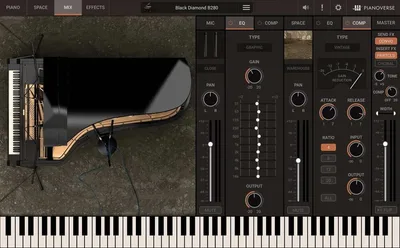
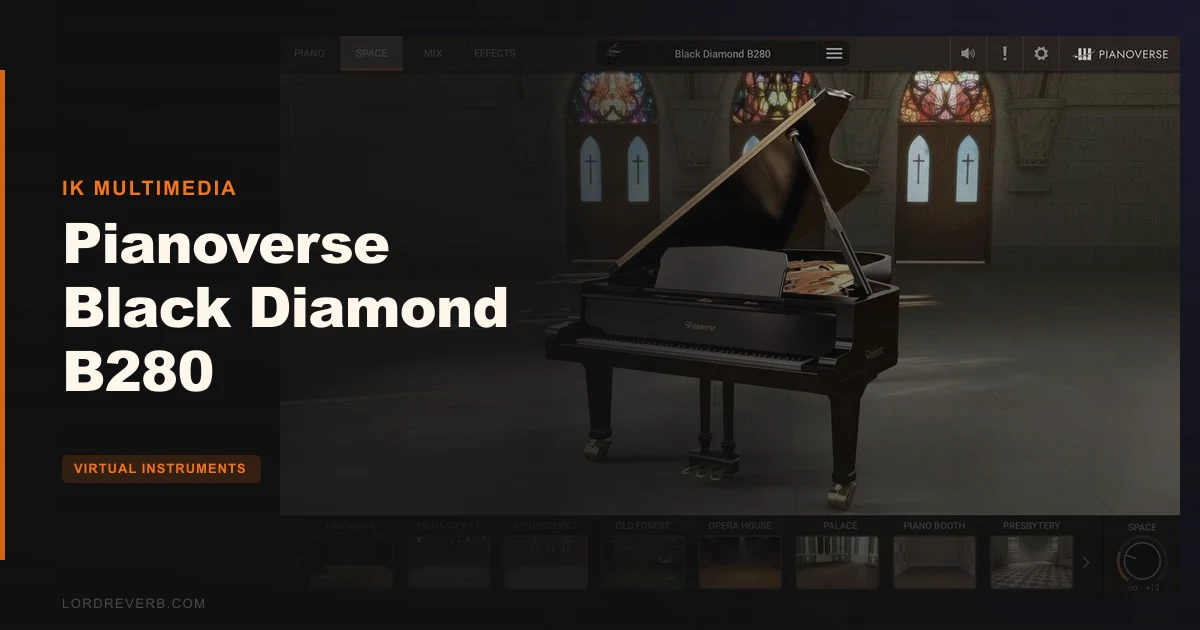
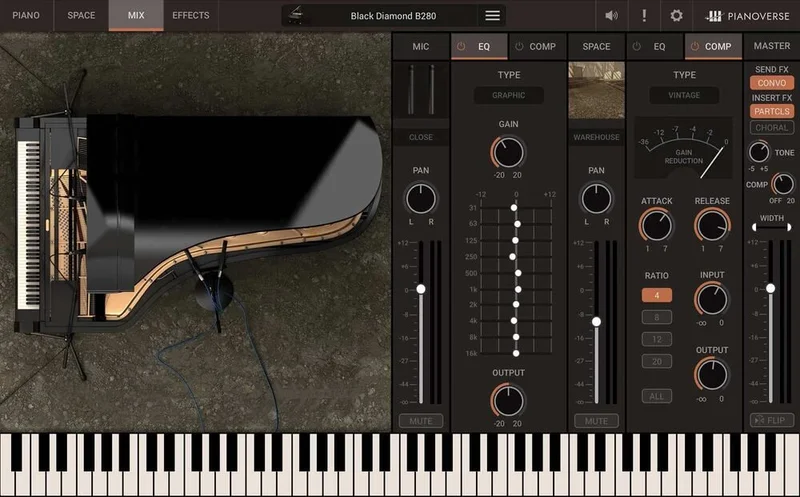
Loading the B280 as an instrument in a DAW session is straightforward. The plugin opens to a clean interface with the piano's image, the preset browser, and the sound space and effects controls. It's not the most feature-dense interface in the category, but it's legible at a glance, which matters during a session when you're moving fast.
The preset browser is functional but basic. You browse a list, click, wait a brief moment for the preset to load, and play. There's no tagging system, no search function, and no way to mark favourites. With only 25 presets, the lack of a search function isn't a practical problem. If IK expands the preset library in updates, they'll need to address the browser before it becomes frustrating.
The sound space browser is more interesting. Thirty options presented with names that gesture at their character. Some names tell you what you're getting, others are more abstract. We'd recommend auditioning all 30 when you first install the B280 and making notes on your own shortlist. The generative nature of the spaces means they shift over time, so what you hear in a 10-second audition isn't exactly what you'll hear when the space has been running for 30 seconds. Budget time for exploration.
MIDI routing is standard. The B280 receives MIDI on all standard channels, responds to sustain (CC64), sostenuto (CC66), and soft pedal (CC67) messages, and the velocity response curve can be adjusted to match your controller's output. For pianists with MIDI keyboards whose velocity curves lean heavy or light, the ability to adjust the response curve within the instrument rather than in a separate utility is a workflow convenience.
Latency felt appropriately low in our testing at standard session buffer sizes (256 samples). At 64 samples for live performance monitoring, the library held up without artifacts on the hardware we tested. Go below that and your results will depend more on your interface and driver than on the B280 itself.
Comparing It Honestly to the Competition
We're not going to name specific competitive article reviews per our editorial policy, but we can name the competitors themselves because you need to make an informed decision.
The most direct comparison in the market is Steinway & Sons' official virtual piano library, which covers the territory the B280 explicitly doesn't: bright, American concert grand character, excellent upper-register clarity, very strong for pop and jazz. If that's your aesthetic, that's your library. The B280 doesn't compete in that tonal space and doesn't try to.
Native Instruments Komplete includes piano libraries that offer a broad coverage at a bundled price point. The individual piano quality within Komplete is generally strong, though no single instrument in the bundle is built around the specific Bösendorfer 280 Vienna Concert character. If you want tonal breadth rather than a single specialist instrument, Komplete is worth comparing. If you want specifically this instrument's character, NI doesn't offer a direct substitute.
For a more direct instrument-by-instrument comparison of virtual piano options, see our complete virtual instruments guide.
The B280's honest competitive advantage is specificity. It does one thing very well: it sounds like a Bösendorfer 280 Vienna Concert recorded in a stone-walled Italian studio with world-class microphones. Nothing else on the market does exactly that. Whether that specificity is worth the price depends entirely on how frequently that specific tonal character appears in your work.
What Reviewers and Users Are Saying
The independent review landscape for the B280 is thin. Retailer pages carry aggregate ratings around 3 out of 5 stars, which is a signal worth taking seriously even if the sample size is small. A rating that low from early adopters usually indicates either software stability issues at launch, expectation mismatch between marketing and reality, or both.
Reviewers who engaged deeply with the library report that the piano's tonal character is genuinely accurate to its source. The Bösendorfer 280 character comes through. That's not in dispute. What reviewers flag more often is the preset count, the gap between the instrument's classical authenticity and the more experimental effects and sound spaces, and the storage overhead.
Users keep running into the storage question without expecting it. The 30GB per title figure sounds manageable in isolation. In the context of a fully loaded production setup where multiple sample libraries, DAW projects, and plugin installers are competing for SSD space, an additional 30GB for a single piano library is a real consideration that influences purchasing decisions.
One pattern that surfaces in user feedback: pianists and classical composers tend to love it. Producers and beatmakers tend to find it too specific and not flexible enough for their workflows. That tells you something accurate about the instrument's intended audience. IK built this for the former group, not the latter. The effects and sound spaces feel like an attempt to widen the audience that doesn't quite land with either group.
Strengths and Weaknesses
The B280's greatest strength is the one that matters most in this category: it sounds like the instrument it claims to be. That's less common than you'd hope.
The robot-assisted sampling methodology delivers velocity consistency that you can hear in sustained passages and velocity transitions. The DPA and Schoeps microphone combination captures both the instrument's direct sound and the room's character without the phase problems that sometimes plague dual-position piano recordings. The sympathetic resonance modelling in the Pianoverse engine is genuinely good, particularly in the low register where it makes the biggest audible difference.
The weaknesses are real. Twenty-five presets is too few for a specialist library at this price. The effects section overreaches into territory that dilutes the instrument's core identity. Storage requirements will surprise users who didn't read the fine print carefully. And the lack of published CPU and latency specifications makes it harder to make an informed pre-purchase decision than it should be.
We also wish the sound space browser had better labelling. "Generative" spaces that evolve over time are a genuinely interesting creative tool, but when you can't predict what a space will sound like from its name, you spend more time auditioning and less time composing. That's a UI problem with a straightforward solution that IK hasn't addressed yet.
Value for the Price
At $99.99, the B280 is priced in the mid-range for specialist concert grand libraries. It's not a budget purchase and it's not a flagship one. The price is appropriate for what it delivers if your work regularly requires the specific tonal character the Bösendorfer 280 Vienna Concert provides.
If you're buying this as your only virtual grand piano, we'd hesitate. The B280 is excellent in its lane but narrow in it. If you already own a good all-purpose virtual piano and you're adding the B280 for its specific Viennese dark-grand character, the price is justified without much debate. The recording quality, the sampling precision, and the acoustic authenticity make the case.
The value proposition weakens if you're hoping the 30 sound spaces and 12 effects make it a versatile production tool. They add creative options, but they don't make this a versatile instrument. They make it a specialist instrument with some additional creative flexibility on the edges.
For film composers and classical pianists who specifically need this tonal character, the price is right. For everyone else, the calculus is harder to justify.
Who Should Buy This (and Who Should Skip It)
- ✅ Buy if you score for film or orchestral media and need a dark, resonant concert grand that sits under string arrangements without fighting for presence.
- ✅ Buy if you're a classical pianist or composer working in Romantic, Impressionist, or contemporary classical styles where the Bösendorfer character is historically accurate to the repertoire.
- ✅ Buy if you already own a bright Steinway-type virtual grand and need a complementary darker instrument to widen your tonal palette.
- ❌ Skip if your primary production context is pop, R&B, or commercial music where you need a piano that cuts through a dense arrangement without heavy EQ.
- ❌ Skip if storage is genuinely tight on your setup. Thirty gigabytes for one instrument is a meaningful commitment that compounds if you add other Pianoverse titles.
- ❌ Skip if you want a versatile all-in-one virtual piano library. The B280 is a specialist tool. Treating it as a general-purpose instrument is a misapplication of its strengths.
Specs & Technical Details
| Developer | IK Multimedia |
| Price | $99.99 |
| Plugin Format | VST2 / VST3 / AU / AAX (64-bit) |
| OS Support | Mac (macOS 10.13 or later, M1 native) / Windows 7 or later |
| Activation | IK Multimedia Product Manager (online activation) |
| CPU Usage | Medium (disk-streaming architecture; NVMe SSD strongly recommended) |
| Trial Available | N/A (no free trial confirmed at time of review) |
| Storage Required | 30GB per piano title (NVMe SSD recommended) |
| RAM Requirement | 8GB minimum; 32GB recommended |
| Presets | 25 instrument presets |
| Sound Spaces | 30 generative sound spaces |
| Creative Effects | 12 |
| Source Instrument | Bösendorfer 280 Vienna Concert (Concert Grand 280VC) |
| Recording Venue | Fonoprint Studios, Bologna, Italy |
| Microphones Used | DPA (close) / Schoeps (medium coincident pair) |
| Version Reviewed | Pianoverse 1.x (current at time of review) |
Score Breakdown
| Category | Score | Notes |
|---|---|---|
| Sound Quality | 4.5/5 | Robot-assisted sampling and DPA/Schoeps mic combo deliver genuine Bösendorfer character; low register is outstanding |
| Value for Money | 3.0/5 | Justified for specialists; harder to defend as a general-purpose purchase given the narrow tonal range and thin preset count |
| Ease of Use | 3.5/5 | Clean interface, fast preset loading, but the sound space browser needs better labelling and a favourites system |
| Features | 3.0/5 | 25 presets is too few; 30 generative spaces and 12 effects add creative range but dilute the instrument's core identity |
| CPU Efficiency | 3.5/5 | Disk-streaming architecture keeps CPU manageable but shifts the bottleneck to SSD read speed; no published CPU spec from IK |
| Overall | 3.5/5 | A specialist instrument with genuine acoustic authenticity and a storage overhead that demands commitment |
Alternatives to Consider
If the B280's price or tonal specificity isn't the right fit, here are three alternatives worth evaluating seriously.
Steinway & Sons Virtual Piano: If you need a bright American concert grand that sits in pop and jazz production without a fight, this is the natural counter-choice to the B280. The tonal characters are genuinely different instruments suited to different music. See our virtual instruments guide for a full breakdown of where each type sits best.
Native Instruments Piano series (within Komplete): If you want tonal breadth rather than one specialist instrument, NI's piano options within Komplete give you multiple characters at a bundled price point. No single instrument replicates the B280's specific Bösendorfer character, but the coverage across styles is wider. Check our best virtual instruments for producers for a direct comparison.
IK Multimedia Pianoverse Concert Grand YF3: If you want to stay in the Pianoverse ecosystem but need a brighter instrument for pop or jazz contexts, the YF3 was recorded at the same Fonoprint Studios with the same microphone approach. It's a complementary purchase rather than a direct alternative. Owning both gives you the tonal range that the B280 alone doesn't provide. See our IK Multimedia plugin guide for more on building a Pianoverse collection.
The Bottom Line on the B280
The Pianoverse Black Diamond B280 is a brilliant specialist instrument that will disappoint you badly if you buy it for the wrong reasons.
If you need the Bösendorfer 280 Vienna Concert character, the robot-assisted sampling delivers it with a precision and consistency that's audibly better than libraries where human performance variability crept into the velocity layers. The low register is the best we've heard in a Bösendorfer-sourced virtual instrument. The Fonoprint room's stone-wall character adds a depth to the sustained notes that you'd normally reach for an expensive convolution reverb to approximate.
But 25 presets is frustrating at this price point. The sound space browser needs a favourites system and better labels. The 30GB storage ask is real. And IK needs to publish actual CPU specifications rather than making buyers guess.
At $99.99, the B280 earns its place in a specialist composer's signal chain as a second piano alongside a brighter, more versatile grand. As a first and only virtual piano purchase, it leaves too much tonal ground uncovered to be the right call for most users.
Buy it for what it is: a very good Bösendorfer. Skip it if you need a Swiss Army knife.
Related reviews: Can SOLID 2 Review Replace Your Real Drum Kit in 2026? · Can 85 Presets Make This Brass Review Worth Your Money?
Frequently Asked Questions
What piano is the Pianoverse Black Diamond B280 based on?
The B280 is based on the Bösendorfer 280 Vienna Concert grand piano, also designated the Concert Grand 280VC. It's a 9-foot concert grand first introduced in 1828, played by artists including Artur Rubinstein, Vladimir Horowitz, and Martha Argerich. It's also the piano of choice for the Vienna Philharmonic Orchestra. The library captures that specific Viennese tonal character: darker in the upper registers, richer in partial note resonance, and wider in dynamic range than most German and American concert grands.
Where was the B280 recorded?
IK Multimedia recorded the Bösendorfer 280 Vienna Concert at Fonoprint Studios in Bologna, Italy, a facility housed inside a 15th-century convent. The studio has hosted sessions from Ennio Morricone and Luciano Pavarotti. IK used DPA microphones for close miking and Schoeps microphones for a medium-distance coincident pair. The acoustic character of the stone-walled room is part of what you hear in the library's room mic captures.
How much storage does the Pianoverse Black Diamond B280 require?
The B280 requires 30GB of hard disk space. IK strongly recommends an SSD for acceptable streaming performance. If you're building a full Pianoverse collection across multiple titles, the total storage requirement across five library titles is approximately 120GB. Budget SSD space accordingly before purchasing, and factor that cost into the overall value calculation if storage is currently a constraint in your setup.
Does the B280 run natively on Apple Silicon Macs?
Yes. IK Multimedia has confirmed native Apple M1 (and later) support for the Pianoverse platform. Native Apple Silicon support means the B280 runs without Rosetta 2 emulation on M-series Macs, which improves performance efficiency and reduces compatibility risk with AU and AAX hosts. This is important for studio setups built around current-generation Apple hardware.
What's the difference between the 30 sound spaces and the 12 creative effects?
The 30 generative sound spaces are environment simulations designed to create evolving acoustic contexts around the piano signal. They're closer to living reverb environments than static presets, and they change over time rather than sitting still. The 12 creative effects are more conventional processing options ranging from distortion and modulation to pitch-shifted treatments. Sound spaces shape the acoustic context; creative effects shape the instrument signal itself. You can use both simultaneously.
How does robot-assisted sampling improve the B280 over conventionally sampled piano libraries?
Robot-assisted sampling removes human performance variability from the recording process. When a pianist samples a piano over a long session, fatigue and muscle memory drift cause tiny velocity inconsistencies across notes and velocity layers. Those inconsistencies compound across an 88-key, multi-velocity-layer library and can produce subtle tonal unevenness that registers as unrealistic. The robot strikes every note at every velocity level with identical mechanical precision, producing a library where velocity layers transition smoothly and velocity consistency is genuinely uniform across the full keyboard range.
Is the Pianoverse Black Diamond B280 suitable for pop music production?
It can be used in pop production, but it's not built for it. The B280's tonal character is darker and further back in the presence frequency range than the bright, forward concert grands that dominate pop and commercial music production. You can push it into pop territory with EQ, but you'll be working against the instrument's natural character to do it. If pop production is your primary context, a library built around a brighter Steinway or Yamaha-type concert grand will serve you better without the EQ overhead. The B280 is strongest in film scoring, classical, and contemporary classical composition contexts.