
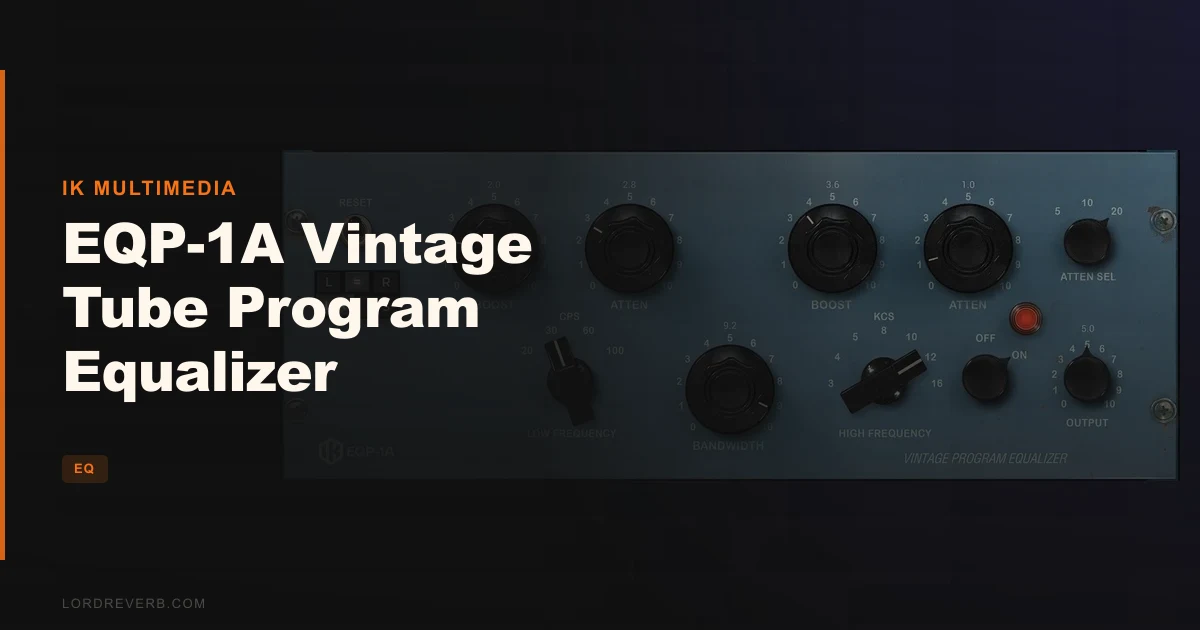
The real question with the IK Multimedia EQP-1A Vintage Tube Program Equalizer is whether a software emulation can actually give you that specific Pultec magic, or whether you're paying $99.99 for a pretty GUI on a shelf. Owners and reviewers report the warmth is genuine, the Pultec EQ Trick works exactly as it should, and acoustic sources respond the way they do on the hardware. That's the short answer.
Quick verdict: This is a well-executed emulation of one of the most storied EQs in studio history. At $99.99, it's a reasonable ask for producers who live on mix bus work, vocal polish, and acoustic instrument tracking. The CPU hit is real and the mid-range cut limitation will frustrate surgical mixers. But if your signal chain leans toward color and character over precision cutting, the EQP-1A earns its place. Score: 4.2/5.
Does It Actually Deliver?
IK Multimedia built this plugin by modeling two real original Pultec EQP-1A units using their DSM and SCC technology. The goal was to replicate the frequency centers, boost/cut ranges, and filter bandwidth of the hardware, including the output makeup gain stage with its 12AU7, 12AX7 and 6X4 tubes.
IK says sonic performance is indistinguishable from the originals. That's a bold claim. What reviewers and owners actually report backs it up in the areas the hardware is known for: low-end warmth, high-end air, and the kind of character that sits in a mix without drawing attention to itself.
The wide filter bandwidth design is what makes the Pultec EQ Trick possible here. You boost and cut the same low frequency simultaneously, and the interaction between those two filter curves creates a specific shape that tightens the low end while adding weight. That behavior is baked into the hardware's passive filter design. The plugin replicates it.
For passive EQ plugin comparisons and where this style of EQ fits in a modern signal chain, we've covered the broader category. But the EQP-1A is its own conversation.
Where It Shines
Stack this on your mix bus and push a gentle boost somewhere between 60 Hz and 100 Hz. Then cut at the same frequency. The low end gets tighter and warmer at the same time. It sounds contradictory on paper. In practice, it's the trick that made the original hardware famous, and it works here.
Owners describe the sound as warm and rich in a way that breathes life into mixes without harshness. On acoustic instruments specifically, reviewers highlight this as a particular strength. Put it on an acoustic guitar bus, nudge a few kHz of high-end boost, and the pick attack and string resonance come forward without turning brittle. That's the wide bandwidth doing its job.
Vocals also benefit. The broad, gentle high-frequency curves add presence and air in ways that narrowband digital EQ often can't touch without creating artifacts. IK points to drum overheads and kick drum as natural homes too: a low-end boost on a kick can add what they call "whomp," which in measurable terms means a rise in level and harmonic content in the 60 Hz to 100 Hz range that makes the attack feel heavier.
The plugin runs at up to 192 kHz, which matters if your session or deliverable demands high sample rate work. That's not a given at this price point. It's a satisfying detail. best EQ plugins for mix bus processing covers where this style of processing slots into a full chain.
Where It Falls Short
The cut function is restricted to low and high frequencies only. No mid-range cut. That's not a flaw in the plugin, it's a faithful replication of the hardware's design. But it means the EQP-1A is not a Swiss Army knife. If your session needs surgical mid-range removal, a notch at 400 Hz to pull out boxiness, or any precise mid cut, this is the wrong tool.
The CPU demand is a real complaint. Users report it draws significant processing resources. For producers running large sessions with dense signal chains, that cost can be frustrating. If your rig is already stretched, loading multiple instances on individual tracks will create problems.
The product manager interface has also drawn criticism. Multiple users describe it as confusing to navigate. That's annoying in a way that has nothing to do with the audio quality, but onboarding friction is still friction. And an internet connection is required for Custom Shop operations, which adds a dependency some users would prefer to avoid.
If you want a simpler Pultec-style passive filter without the full program EQ complexity, VEQ-HLF Review: A Simple Pultec Filter Done Right 2026 is worth reading before you decide.
Is the Price Fair?
At $99.99, the EQP-1A sits in a range where you're paying for the quality of the emulation, not just the license. Modeling two real hardware units using IK's technology is a legitimate differentiator. The Pultec EQ Trick works. The sound holds up on bus processing and acoustic sources.
If you're a mixing engineer who regularly works with acoustic music, vocals, or needs a character bus EQ, $99.99 is a defensible spend. If you're a producer who mostly needs precise cutting and mid-range control, spend that money on something built for that job instead.
Specs & Technical Details
| Developer | IK Multimedia |
| Price | $99.99 |
| Plugin Format | VST 2, VST 3, AAX (Mac & Windows); Audio Units (Mac only) |
| OS Support | Mac (macOS 10.15 or newer), Windows 10 64-bit or newer |
| Activation | N/A |
| CPU Usage | Heavy |
| Trial Available | N/A |
| Version Reviewed | N/A |
Score Breakdown
| Category | Score | Notes |
|---|---|---|
| Sound Quality | 4.5/5 | Warm, characterful output on bus and acoustic sources; Pultec EQ Trick behaves authentically |
| Value for Money | 4.0/5 | Reasonable for a dual-unit hardware emulation with 192 kHz support |
| Ease of Use | 3.5/5 | Plugin itself is straightforward; product manager interface frustrates new users |
| Features | 3.5/5 | Faithful to the hardware, but no mid-range cut is a real constraint |
| CPU Efficiency | 3.0/5 | Heavy processing demand limits multi-instance use on typical rigs |
| Overall | 4.2/5 | Strong emulation with specific strengths; not a general-purpose EQ |
The EQP-1A Vintage Tube Program Equalizer is a specialized tool that does its specific job well. Reach for it when you want color, warmth, and the Pultec low-end trick. Keep a different EQ in the chain for any mid-range work. Producers who love acoustic music or run heavy vocal sessions will find it satisfying. Those who need precise surgical control will find it frustrating, and honestly should look elsewhere.
The product manager interface and CPU overhead are notable drawbacks that limit the plugin's accessibility. Those complaints haven't gone away. But the sound? That's the real thing. And at $99.99, that still counts for a lot.
For producers interested in other creative sequencing and bundle options that pair well with character processing like this, 510k SEQUND + POLYLLOP Bundle Breaks Loop Fatigue in 2026 is worth a look for building out your toolkit.
Frequently Asked Questions
What is the Pultec EQ Trick and does the EQP-1A plugin support it?
The Pultec EQ Trick involves boosting and cutting the same low frequency simultaneously on the hardware unit, creating a curve that adds weight while tightening the bottom end. The IK Multimedia EQP-1A replicates the wide filter bandwidth of the original passive circuit design, so the trick works exactly as it does on hardware. It's one of the clearest reasons to choose this plugin over a generic EQ.
Is the EQP-1A plugin heavy on CPU?
Yes. Multiple users report that the plugin draws significant processing resources. If you're running a dense session with many tracks and busses, you'll want to check your CPU headroom before loading multiple instances. It's worth bouncing heavily processed stems if your rig starts to struggle, rather than expecting light performance from this emulation.
Can the EQP-1A cut mid-range frequencies?
No. The cut function is restricted to low and high frequencies only, which mirrors the original hardware's design. This is a faithful emulation choice, not an oversight, but it does mean the EQP-1A isn't suited for surgical mid-range work like removing boxiness at 300 Hz to 400 Hz. For that kind of task, you'll want a different EQ alongside it in your signal chain.