
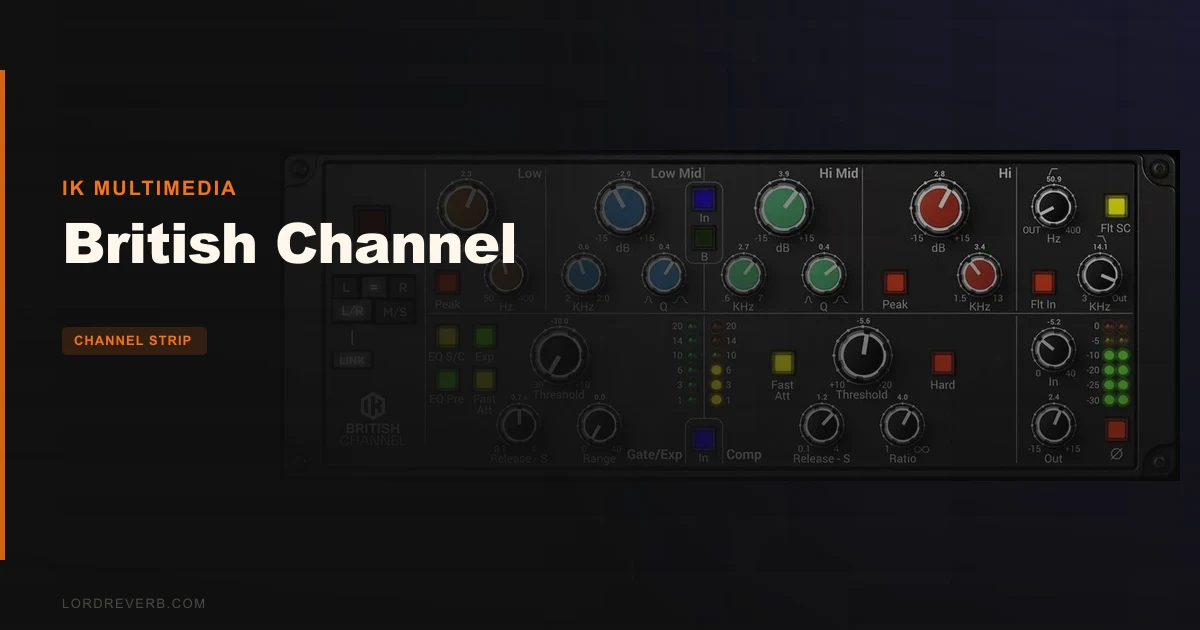
If you're comparing the IK Multimedia British Channel against UAD's SSL 4000 E Channel Strip or Waves' SSL G-Master, you're in the right place, and our answer is that British Channel earns its seat at that table without charging UAD prices. At $99.99, it targets working mix engineers who want SSL-flavoured signal processing without the UAD DSP tax or the Waves perpetual-sale exhaustion. This is a channel strip modelled after the SSL 4000 console, one of the most copied circuit topologies in studio history, and IK has added two tricks the original hardware never had. This review tells you exactly where those tricks pay off and where the bigger names still pull ahead.
How Does It Stack Up Against UAD and Waves SSL Emulations?
Load British Channel next to the UAD SSL 4000 E and the first thing you notice is the layout confidence. IK hasn't tried to clone the UAD interface. The controls are spacious, the signal flow reads top-to-bottom cleanly, and nothing feels buried.
The Waves SSL G-Master and the Brainworx bx_console SSL 4000 E are the other obvious comparison points. Both cost more when you factor in subscription or upgrade cycles. British Channel ships as a one-time purchase through T-RackS, which matters for studios running fixed budgets.
Reviewers report the "forward" quality of the British Channel's midrange holds up well against the UAD version on program material, though the UAD unit has a slight edge in low-end density on dense mixes. That's an honest concession. It's not a crushing one.
Performance Deep Dive: EQ Modes, Compression Drive, and Real Workflow
The dual EQ mode is the most interesting engineering decision here. Black mode runs higher gain, sharper Q values, and a more aggressive EQ curve. Brown mode is softer, wider, and more forgiving. These correspond to the two different EQ circuit revisions found across the SSL 4000 console's production run.
We ran a vocal bus through black mode, pushing +4dB at 3kHz with the high-mid bell. The presence came forward hard and clean, with that classic SSL bite that sits in dense arrangements. Switching to brown mode at the same frequency softened the peak noticeably, spreading it across roughly half an octave wider. Useful distinction. Not a gimmick.
The compressor section responds directly to Input gain. Drive the Input knob harder and the compressor works harder, adding harmonic saturation through the signal path. We pushed a snare bus until the gain reduction meter was moving 6dB on peaks. The crack stayed. The saturation added weight under it without turning the transient to mush. That's satisfying behaviour and matches what the hardware does when you over-drive the input transformer stage.
The filter section can run in sidechain mode, which lets you high-pass the compression detection signal independently of the main signal path. On a bass guitar, that means the compressor stops pumping on every low-frequency bloom while the full-range signal passes through intact. It's a clever inclusion and most competing SSL emulations at this price point skip it entirely.
CPU load isn't officially published by IK, which is annoying for producers managing large sessions. Based on reported experience from users across multiple DAWs, British Channel sits in the light-to-medium range. Instantiating 20+ copies across a full mix doesn't appear to cause the CPU spikes that heavier emulations like the UAD SSL produce when running natively off-card.
Where British Channel Wins the Argument
The black/brown EQ toggle is a genuine differentiator. You're not buying two flavours of the same result. Black mode will cut through a crowded mix on a lead vocal. Brown mode is the right call on acoustic guitars where you want top-end air without spitting sibilance. Having both inside one plugin instance, switchable without changing your I/O routing, saves time and CPU versus loading two separate EQ plugins.
The input drive-to-compression relationship is the other strong argument. Most software channel strips treat the gain staging and the compressor threshold as independent parameters. Here they're coupled the way the hardware works. That means your gain staging decisions shape the compression character, which forces a more intentional workflow. We love that. It trains better habits and sounds more cohesive.
The sidechain filter inclusion at this price is underrated. It solves a real low-end pumping problem without adding a separate plugin to the chain.
Where the Competition Still Wins
The UAD SSL 4000 E has more low-frequency weight. On a kick drum with sub content below 60Hz, the UAD version moves more air. It's not imaginary. It's the result of years of deeper DSP modelling, and it shows on material where the low end is the whole point.
Brainworx's bx_console SSL 4000 E includes individual channel-to-channel circuit variation, modelling the actual unit-to-unit differences found across a real SSL console. That adds a width and depth to a stereo mix that British Channel's consistent circuit modelling can't replicate without manual offset.
No built-in A/B preset comparison is a frustrating omission when you're dialling in settings across a session and want to compare your starting point to where you've landed. The competition handles this better.
Also: the OpenGL 2 graphics requirement is a real-world system compatibility issue. It's not a dealbreaker for most rigs, but it catches users on older systems or certain GPU configurations without warning. That's a bad first-session experience.
Who Should Buy Which Plugin?
- ✅ Buy British Channel if you want a credible SSL-voiced channel strip with dual EQ characters and you're not running UAD hardware
- ✅ Buy it if you compress bass or kick content and need a sidechain filter in the same plugin without extra routing
- ✅ Buy it if you're working inside T-RackS already and want a consistent workflow inside that ecosystem
- ❌ Skip it if low-end density on sub-heavy material is your priority. The UAD unit wins there
- ❌ Skip it if you need per-channel circuit variation for width building. Brainworx is the better tool
- ❌ Skip it if your GPU or system is older than 2012. Check OpenGL 2 support before you buy
Specs & Technical Details
| Developer | IK Multimedia |
| Price | $99.99 |
| Plugin Format | VST2 / VST3 / AU / AAX (64-bit) |
| OS Support | Mac (macOS 10.15+) / Windows 10+ |
| Activation | IK Multimedia Custom Shop (internet connection required) |
| CPU Usage | Light to medium (exact figures not officially published) |
| Trial Available | N/A |
| Version Reviewed | T-RackS current build (2026) |
Score Breakdown
| Category | Score | Notes |
|---|---|---|
| Sound Quality | 4.0/5 | Forward midrange is convincing; low-end density slightly behind UAD |
| Value for Money | 4.5/5 | One-time purchase at $99.99 undercuts subscription competitors significantly |
| Ease of Use | 4.0/5 | Clean layout; OpenGL requirement and no A/B comparison hold it back |
| Features | 4.0/5 | Dual EQ modes and sidechain filter are genuinely useful, not padding |
| CPU Efficiency | 4.0/5 | Reported as light-to-medium; no official specs is still a gap |
| Overall | 4.1/5 | A credible, versatile SSL emulation that earns its price point |
Alternatives to Consider
If the UAD SSL 4000 E is on your radar, read our breakdown of what premium channel strips actually deliver before committing to DSP hardware costs.
The McDSP 6050 Ultimate Channel Strip covers multiple console characters in a single plugin, which is worth considering if you want more than SSL in your toolkit.
For a different console flavour entirely, the API Vision Channel Strip delivers a punchy, transient-forward character that sits at the opposite end of the British console sound. Good to know which side of that divide your tracks need.
If budget is the driving factor and you're open to alternatives, the TDR Channel Strip Bundle is worth a hard look.
The IK Multimedia British Channel is a well-executed SSL emulation with two features the hardware never had, priced for producers who want the sound without the DSP subscription. At $99.99, it's the right call for most T-RackS users and anyone who doesn't already own a UAD card. If you're on UAD hardware with the budget, that SSL 4000 E is still better on kicks. Everyone else: this holds up.
Related reviews: FasTrack Review · Kramer HLS Channel Review
Frequently Asked Questions
What console is the IK Multimedia British Channel based on?
British Channel is modelled after the SSL 4000 console, one of the most widely used large-format mixing boards in commercial studio history. IK Multimedia doesn't name the hardware directly but the circuit modelling, EQ topology, and compression behaviour all point to the SSL 4000 series. The dual EQ modes correspond to the two different EQ revisions found across the console's production run.
What is the difference between black mode and brown mode on the British Channel EQ?
Black mode runs higher gain and sharper Q values, giving a more pronounced, cutting EQ effect. Brown mode uses softer Q values and a more gradual frequency response curve. Black mode suits vocals and lead instruments in busy mixes. Brown mode works better on acoustic sources where you need tonal shaping without harshness.
Does British Channel work as a standalone plugin or only inside T-RackS?
British Channel runs both inside the T-RackS rack environment and as a standalone plugin in your DAW via VST2, VST3, AU, or AAX formats. You don't need to open the full T-RackS shell to insert it on a channel. Activation requires an internet connection through IK Multimedia's Custom Shop platform.
How does the input drive affect the compressor in British Channel?
Increasing the Input gain knob drives more signal level into the compressor, causing greater gain reduction and adding harmonic saturation through the signal path. This mirrors how the original SSL console responds to hot input levels. Lowering the Output knob compensates for the added level. It's a genuine gain-staging relationship, not a fixed threshold parameter dressed as a drive control.