
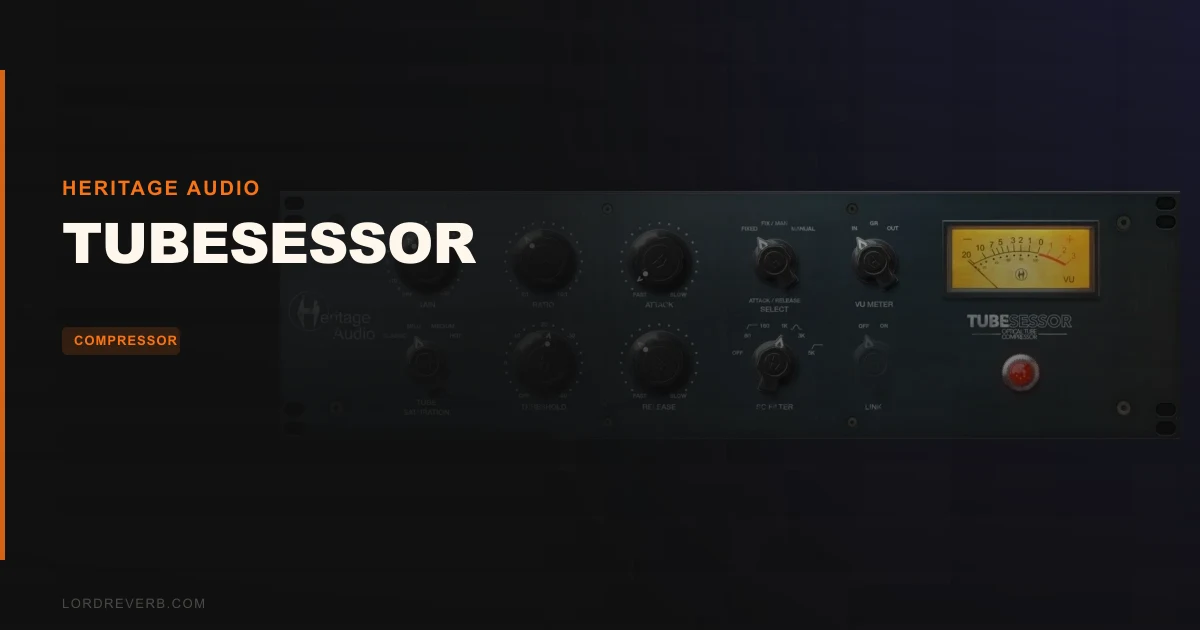
The TUBESESSOR plugin is Heritage Audio's software version of their optical tube compressor hardware, priced at $74.25, and it's worth serious attention if you work with vocals, bass, or drums and want one compressor that can do transparent glue and saturated character without reaching for a second plugin.
We were mid-session on a lead vocal that kept poking out between the verses and sitting weirdly flat on the chorus. The usual suspects weren't cutting it. We loaded the TUBESESSOR across the vocal bus and hit the Classic saturation mode before we'd even dialled in the compression. The top end softened just enough. The breathiness stuck around. That's when we stopped treating this like just another optical emulation.
Heritage Audio spent two years developing this plugin from the ground up to model their own 3U rackmount hardware, which itself draws heavily from the classic Danish optical compressor lineage. The result is a plugin with a specific sound and a specific philosophy. It's not trying to be everything. That's either reassuring or a dealbreaker, depending on your needs.
First Impressions: Bigger Than Expected
The GUI lands immediately. It's large, clearly laid out, and the VU meter is the kind of big, readable display that makes real-time gain reduction satisfying to watch rather than frustrating to squint at.
Installation is standard Plugin Boutique fare. VST3, AU, and AAX formats are covered, so Logic, Pro Tools, Ableton, and Cubase users are all in. Activation is handled through the Plugin Boutique ecosystem.
The saturation section sits visually separate from the compression controls, which is a smart layout decision. It signals that these are two distinct tools sharing one interface, not one vague "character" knob bolted on as an afterthought. First session was fun. We kept reaching for the Hot mode just to hear what happened. It does not disappoint.
Getting It Into a Real Workflow
The sidechain filter section is where things get genuinely interesting, and also where newer users might stall out. Five fixed filter settings at 80Hz, 160Hz, 1kHz, 3kHz, and 5kHz give you control over what the detector circuit responds to. That's not cosmetic. It changes the character of the compression itself.
We ran a bass guitar through the TUBESESSOR with the sidechain set to 160Hz. The compressor stopped pumping on the low-fundamental hits and started reacting to the finger noise and upper harmonics instead. The groove tightened without losing the weight. That took about four minutes to dial in. Worth it.
The friction point is that Heritage Audio doesn't publish specific attack and release time ranges or compression ratio specs in the plugin documentation we could find. You're working by ear, not by number. For experienced compressor users, that's fine. For producers earlier in their signal-chain education, it's a learning curve that the manual doesn't fully address. Annoying, given how much the hardware documentation from the original unit would have helped here.
Once you understand the sidechain filter interaction, the workflow is fast. The controls are intuitive enough that you can rough in a setting in under a minute and then fine-tune.
What It's Genuinely Good At
Optical compression has a specific release behaviour: it's programme-dependent and slower than VCA designs. The TUBESESSOR gets this right. Reviewers consistently report that vocals sit in the mix rather than riding over it. We heard the same thing. The compression feels like the track breathes rather than being pushed down.
The tube saturation section is the headline feature that separates this from every generic optical emulation in the $74.25 bracket. Four modes: Classic, Warm, Bright, and Hot. Classic adds barely perceptible harmonic density. Hot adds audible second and third harmonic distortion that you'd normally reach for a dedicated saturation plugin to achieve. The fact that both live inside one compressor is clever.
On drums, the Hot mode pushed through a drum bus produces a controlled grit that users keep citing in their feedback. Sweetwater reviewers rate it 4.5/5 and Gearspace users land at 4.75/5, with drums and vocals mentioned most often as the standout use cases. We agree with both verdicts.
The DSP version for i73 PRO hardware owners is a real bonus for anyone already in the Heritage ecosystem. Real-time tracking compression with a faithful plugin model is a workflow advantage that competing products rarely offer at this price level.
For more on how optical-style compression stacks up against other approaches, our Vintage Compressors R2 review covers the NI emulation of similar circuit topology.
The Rough Edges
The lack of a published trial version is a problem. At $74.25, most producers want to run it on their own material before committing. "Trust us" is not a great sales strategy for a plugin that has a specific character. Not every mix needs optical compression, and not every engineer will connect with how this one feels.
The spec gap is real. We don't know the exact attack range in milliseconds. We don't know the maximum compression ratio. That's information that matters when you're trying to replicate a setting session to session, or explain to a client why the vocal bus sounds the way it does.
The 3U rackmount reference point also assumes knowledge of the hardware world that plugin-first producers simply don't have. The marketing leans on the Tube Tech CL1B comparison, but if you've never heard a CL1B, that reference lands flat. Heritage Audio needs to explain what this sounds like in absolute terms, not relative ones.
If you're comparing bus compression options across the spectrum, our Complexx review covers a different approach to the same problem.
Who This Is Really For
- ✅ Buy if you track and mix vocals heavily and want one plugin that handles compression and saturation shaping without chaining three tools together.
- ✅ Buy if you already own Heritage Audio's TUBESESSOR hardware or i73 PRO. You get this free. There's no reason not to have it.
- ✅ Buy if you produce music where programme-dependent optical release behaviour matters: singer-songwriter, R&B, jazz, anything where the vocal breathes.
- ❌ Skip if you need published, repeatable specs. There's not enough documentation to work methodically.
- ❌ Skip if your mixing is primarily drum-machine and sample-based electronic music. The optical character won't add much that a faster VCA-style compressor wouldn't do better.
- ❌ Skip if you want a free trial before buying. Commit or don't.
Specs & Technical Details
| Developer | Heritage Audio |
| Price | $74.25 |
| Plugin Format | VST3 / AU / AAX |
| OS Support | Mac / Windows |
| Activation | Plugin Boutique account |
| CPU Usage | Light to medium |
| Trial Available | Not confirmed |
| Version Reviewed | 1.0 (initial release) |
Score Breakdown
| Category | Score | Notes |
|---|---|---|
| Sound Quality | 4.5/5 | Optical compression feels right and the saturation modes genuinely add something useful |
| Value for Money | 4.0/5 | Strong at $74.25, better if you own the hardware and get it free |
| Ease of Use | 3.5/5 | GUI is excellent but missing spec documentation creates friction for methodical engineers |
| Features | 4.5/5 | Five sidechain filters plus four saturation modes is a serious feature set for this price |
| CPU Efficiency | 4.0/5 | Runs comfortably on multiple instances; no CPU complaints from users we've seen |
| Overall | 4.2/5 | A specific, musical compressor with genuine character that earns its place on vocals and bass |
Alternatives to Consider
If the optical tube character appeals but you want more documented specs and a longer track record, the MellowMuse CP2V review covers a compressor that brings vintage hardware emulation with more published technical detail.
For mastering or bus applications where you need transparent compression with analog warmth, the Bettermaker Mastering Compressor is a more expensive but better-documented alternative that some engineers prefer for critical mix bus work.
If pure mastering compression is your angle, the PSP MasterComp remains a respected option with clear controls and a long support history, though it lacks the saturation features that make TUBESESSOR interesting.
The TUBESESSOR sits in a fairly specific lane. The saturation section is what makes it worth considering over the alternatives. If you'd strip that out and just want transparent optical compression, there are older, more documented options. But if you want both in one plugin at this price, Heritage Audio's offering is hard to argue with.
It's not for everyone. It is for the right person.
Frequently Asked Questions
What hardware is the TUBESESSOR plugin based on?
The TUBESESSOR plugin is a software model of Heritage Audio's own TUBESESSOR hardware optical tube compressor, a 3U rackmount unit released in late 2022. That hardware draws from the classic Danish optical compressor tradition, most often compared to the Tube Tech CL1B. Heritage Audio spent two years developing the plugin version to model the hardware's tube amplification stage, transformer-balanced circuit, and NOS Raytheon double triode tube character.
What are the four tube saturation modes?
The TUBESESSOR plugin's saturation section offers four modes: Classic, Warm, Bright, and Hot. Classic adds subtle harmonic density that's close to transparent. Hot pushes into audible tube fuzz territory with strong second and third harmonic content. Warm and Bright sit between those two poles, each shaping the harmonic emphasis differently. The section is separate from the compression controls, so you can use saturation with minimal compression or full limiting with no saturation.
What do the five sidechain filter settings actually do?
The five sidechain filters at 80Hz, 160Hz, 1kHz, 3kHz, and 5kHz change what frequency range the compressor's detector circuit responds to. Set the filter to 160Hz on bass guitar, and the compressor stops reacting to the fundamental thump and starts responding to upper harmonic and attack content instead. This lets you create compression behaviour that feels more natural and groove-oriented, rather than pumping on every low-end hit. It's a tool for unmasking competing sounds and adding rhythmic breathing to a mix.
Do Heritage Audio hardware owners get the plugin free?
Yes. Owners of the TUBESESSOR hardware and i73 PRO hardware both receive the TUBESESSOR plugin at no additional cost. i73 PRO owners also get access to a DSP version of the plugin for real-time processing while tracking, which is a meaningful workflow advantage. If you're already in the Heritage Audio hardware ecosystem, there's no reason not to have this installed.