
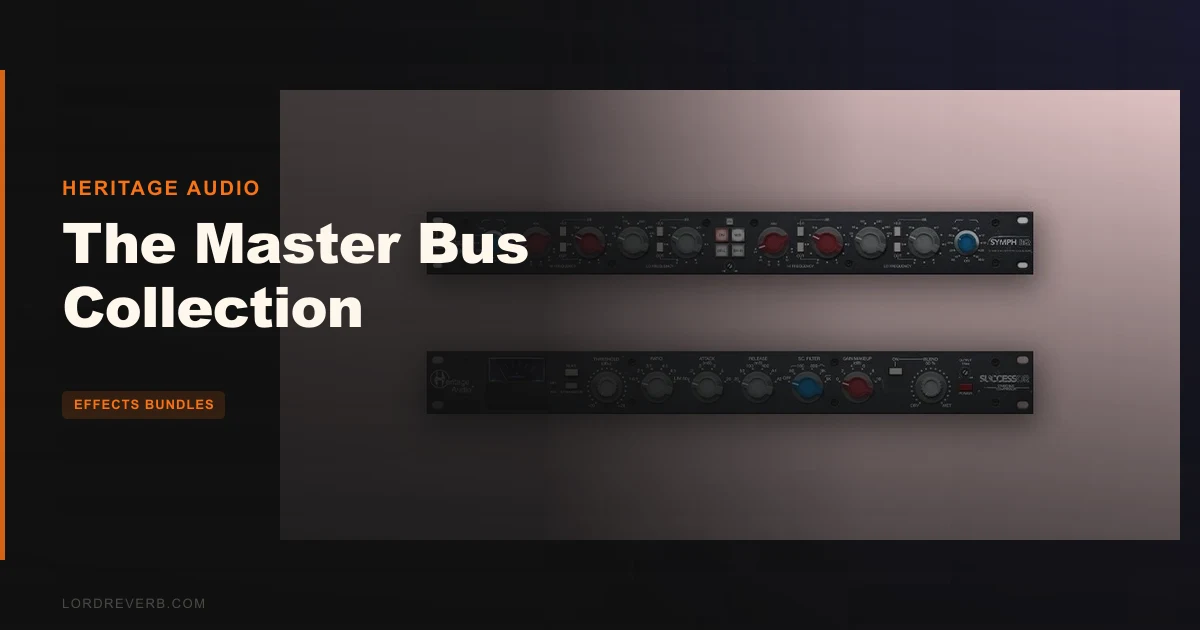
The Master Bus Collection is a two-plugin bundle from Heritage Audio: the SUCCESSOR diode bridge compressor and the SYMPH EQ Baxandall-style stereo bus equalizer, currently priced at $111.75.
We dropped it across a dense pop-rock mix that had been sitting just shy of finished for two weeks. The two-bus was already glued from a VCA-style compressor in the template, and honestly the mix was fine. Then we bypassed everything, loaded SUCCESSOR, and pushed the ratio up. The low mids shifted. Not dramatically. But the kick and bass moved together in a way they hadn't before. That second-order harmonic distortion the diode bridge introduces isn't a myth. It's audible inside the first 30 seconds.
We then stacked SYMPH EQ after it, boosted 2dB at 12kHz on the highs, and cut 1dB at 110Hz in the center via M/S mode. The mix opened up like we'd pulled a curtain back. It was satisfying in a way that felt almost unfair at this price point.
This bundle is built for mix engineers who want analog-flavored bus processing ITB. It's not a mastering suite and it's not a beginner's toolkit.
What It Is (and What It's Not)
The Master Bus Collection pairs two Heritage Audio hardware recreations in one package. SUCCESSOR emulates the diode bridge compressor circuit the company built its reputation on. SYMPH EQ updates the 70-year-old Baxandall topology with M/S processing and 0.5dB step precision.

Together they're a stereo bus chain. A complete one, if your needs are relatively focused.
But let's be clear about what this isn't. It's not a full mastering plugin suite. There's no limiter here. No metering beyond what your DAW provides. No mid-band EQ on the SYMPH beyond its shelving and filtering sections. If you're after a Swiss-army-knife mastering bundle, look elsewhere. This is a focused tool for two specific jobs.
It's also not a transparent processor. The SUCCESSOR adds color. That's the whole point. If you want clean, clinical bus compression, a VCA emulation will serve you better.
Living With It
Setup is straightforward. VST3, AU, and AAX are all covered. Mac and Windows both supported, including Apple Silicon natively. The iLOK cloud account requirement is free, but it's still a dependency that some engineers hate on principle. No iLOK dongle needed, just the cloud login. Annoying if you work offline.
Day-to-day, SUCCESSOR is fast to dial in. The blend control for parallel compression is genuinely useful. We ran a session where we set the compression fairly aggressive, ratio up, fast attack, then blended back to around 60% wet. The transients returned without losing the glue. That's the kind of workflow the Blend ON/OFF button makes easy: instant A/B in one click.
The Nuke mode deserves its own paragraph. Engage it, and SUCCESSOR adds +20dB of gain before the compression stage. The compressor reacts like it's being overdriven. We tried it on a drum bus during a heavy rock track. The room sound collapsed into the kick. It sounded aggressive in a controlled way. It's not a "destroy everything" button. It's a character dial pushed to eleven. The output stage lets you compensate fully, so you're not stuck with the gain jump.
SYMPH EQ rewards patience. The 0.5dB precision steps mean you're making surgical decisions, not broad sweeps. We spent time with the high-frequency shelf at 15kHz, barely touching it, and found the mix responded more naturally than it did with a faster, wider boost on a different EQ. The gentle asymptotic curves keep phase deviation low. You hear the effect without hearing the processing. That's the goal.
M/S mode works cleanly. The side high-pass filter switching to elliptical topology in M/S mode is a detail that matters for anyone cutting records or chasing vintage-adjacent masters. Most engineers won't know to look for it. Those who do will love that it's there.
The Trade-Offs
The diode bridge character is the whole value proposition here, and it's also the main reason to skip this. If you need transparent bus compression, SUCCESSOR will fight you. The 2nd-order harmonic content it introduces is intentional and real. Some mixes love it. Some don't need it.
The SYMPH EQ's shelving-only EQ section is a deliberate design choice, not a limitation to overlook. You get high-frequency and low-frequency shelving, plus filtering. There's no mid-band parametric. For mix bus work, that's usually enough. For problem-solving on a bus with specific resonances, it's not the tool.
The Nuke feature is brilliant for creative compression, but there's a learning curve before it stops sounding like a mistake. We burned the first two or three attempts. Worth the experimentation, but don't expect it to work first try.
The thin user review pool is a genuine concern. Reviewers report positive impressions, but three reviews across a plugin at this price point means the collective wisdom isn't there yet. We'd feel better recommending it with more independent real-world data behind it.
Against the Field
Waves SSL G-Bus Compressor is the reflex purchase for stereo bus compression. It's cheaper, it's everywhere, and the VCA character is well-documented. But it won't give you the diode bridge coloring SUCCESSOR delivers. Different flavor entirely.

Softube's Weiss MM-1 Mastering Maximizer goes further into mastering territory with a limiter and more surgical control. It costs more and does more. If mastering is the goal, Softube wins. If you just need the bus to breathe and sing, the Heritage Audio bundle is more focused and arguably more fun to use.
For the EQ side, the Neve 8803 emulations from various developers handle similar Baxandall-adjacent territory. But SYMPH EQ's M/S implementation is better than most in this bracket.
At $111.75, the bundle undercuts most comparable hardware recreation bundles from established names. That pricing is aggressive and one of its stronger arguments.
The Real Verdict
We'd buy this for a studio that runs dense, modern mixes and wants hardware character without the hardware cost. The SUCCESSOR's diode bridge tone is real. The SYMPH EQ is precise where it counts. Together they work.
Skip it if you need transparent compression, a mid-band EQ, or you're philosophically opposed to iLOK cloud dependency. Skip it if you want a limiter in the chain.
Buy it if you've been chasing that warm, slightly pushed bus sound and keep coming up short with VCA emulations. This is a different tool for a specific job, and it does that job well.
Specs & Technical Details
| Developer | Heritage Audio |
| Price | $111.75 |
| Plugin Format | VST3 / AU / AAX (64-bit) |
| OS Support | macOS 10.15.7+ (Intel & Apple Silicon M1/M2/M3) / Windows 10 & 11 |
| Activation | Free iLOK cloud account (no dongle required) |
| CPU Usage | N/A (not disclosed by developer) |
| Trial Available | No |
| Version Reviewed | N/A |
Score Breakdown
| Category | Score | Notes |
|---|---|---|
| Sound Quality | 4.0/5 | Diode bridge coloring is genuine; SYMPH EQ curves are natural and well-voiced |
| Value for Money | 3.5/5 | Competitive at $111.75 but no trial makes it a blind buy |
| Ease of Use | 4.0/5 | Both plugins are fast to dial in; Nuke mode has a learning curve |
| Features | 3.5/5 | Focused feature sets that do their jobs well but no limiter, no mid-band EQ |
| CPU Efficiency | 3.5/5 | No official data available; performed without issue in our sessions |
| Overall | 3.8/5 | A focused, well-executed bundle for engineers who know exactly what they want from a bus chain |
Alternatives to Consider
If you want a more complete mastering chain ITB, look at the Weiss MM-1 or a dedicated mastering bundle with limiting built in. The Heritage Audio collection deliberately stops short of that territory.
For VCA-style bus compression with more user documentation and community knowledge behind it, the Waves SSL G-Bus remains the practical default. It's a different sound, but the learning resources are rich.
If you're building a full mixing toolkit and want color at every stage, not just the bus, check our broader effects bundles coverage for context on where bus processing fits into the larger signal chain picture.
None of those alternatives give you the SUCCESSOR's specific diode bridge character. That's the thing worth remembering. If that's what you're chasing, nothing on this list is a straight swap.
The Master Bus Collection at $111.75 is one of the more honest hardware-to-plugin translations we've run this year. Not perfect. Not trying to be everything. But when you need that particular color on the two-bus, it delivers in a way that'll make you forget the iLOK login.
Frequently Asked Questions
Does The Master Bus Collection require an iLOK dongle?
No dongle required. You need a free iLOK cloud account to authorize the plugins, but the license lives in the cloud. If you work in offline environments frequently, that dependency is worth factoring into your decision before you buy.
What does the Nuke mode actually do in SUCCESSOR?
Nuke adds +20dB of gain before the compression stage, forcing the diode bridge circuit into a more extreme response. You then use the output stage to pull back as much of that gain as you want. The result is a heavily colored, exaggerated compression effect that sits well outside what most bus compressors offer. It's a creative tool, not a corrective one.
Can SYMPH EQ be used as a mid-band parametric equalizer?
No. SYMPH EQ is a Baxandall-topology shelving EQ with high and low shelves, plus a precision filtering section. There's no mid-band parametric band. It's built for mix bus sweetening and broad tonal shaping, not surgical frequency correction. If you need a mid-band on the bus, you'll need a second EQ in the chain.
Is The Master Bus Collection suitable for mastering?
It can contribute to a mastering chain, and Heritage Audio positions SUCCESSOR as capable in mastering contexts. But the bundle doesn't include a limiter, and the EQ section is shelving-only. Most mastering engineers will want additional tools alongside this. Think of it as a strong character processor in a larger mastering signal chain, not a standalone mastering suite.
