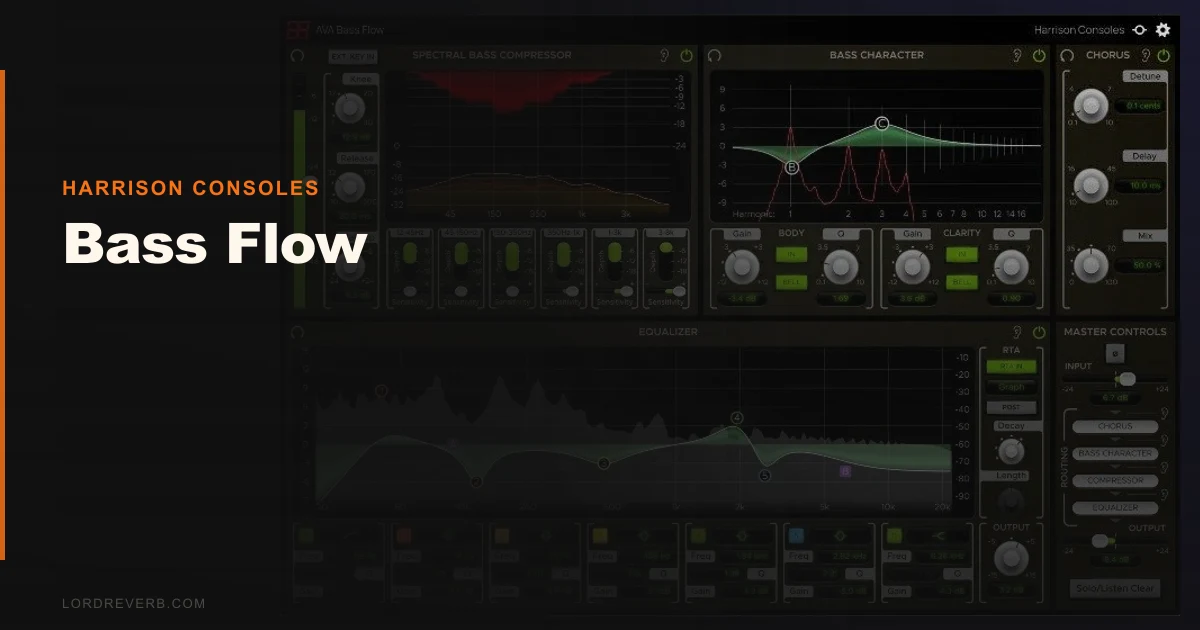
Bass Flow by Harrison Consoles is the most thoughtfully designed bass channel strip plugin we've tested, and at its promotional price it is a no-brainer buy, though at full price it needs a closer look before you commit.
Harrison builds the hardware consoles that sit in major film scoring stages. They know signal flow. Bass Flow carries that pedigree into a plugin that doesn't try to be everything. It's four processing blocks built specifically for bass: a pitch-tracking EQ, a 5-band EQ with dual filter bands, a 6-band spectral compressor, and a chorus. Routable. Soloable. Logical.
It's built for mixing engineers who are tired of stacking three generic plugins on every bass track and still not getting the low end to behave. If that's you, read on.
What You're Actually Getting
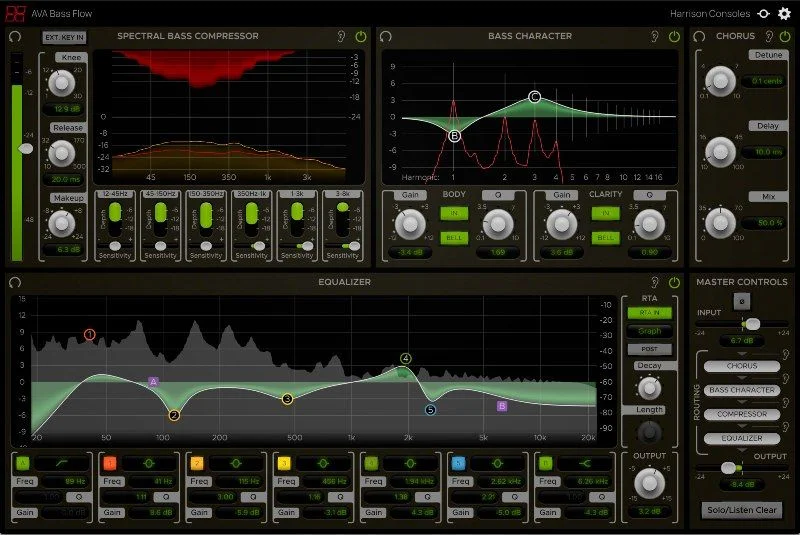
Bass Flow is a channel strip plugin with four processing sections you can reorder freely: the Bass Character module, a full 5-band EQ with two filter bands, the Spectral Bass Compressor, and a chorus module.
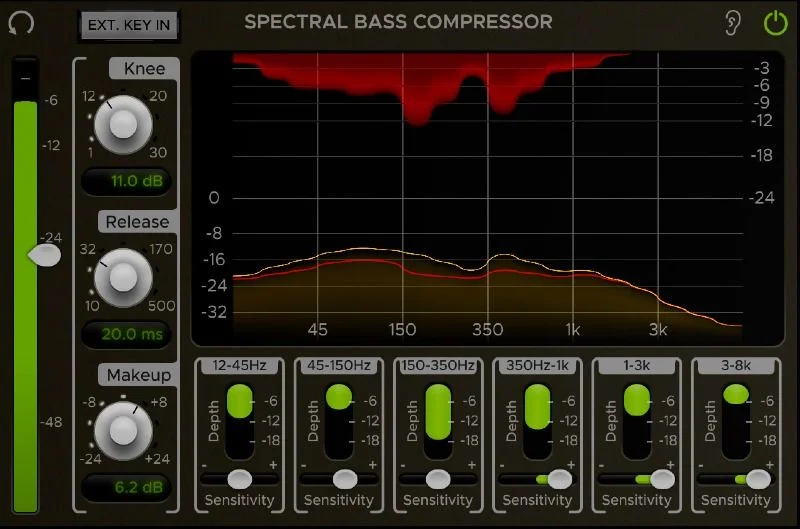
The Bass Character module is Harrison's proprietary pitch-tracking EQ. It reads the fundamental frequency of the bass note being played and adjusts its two EQ bands relative to that pitch. Not relative to a fixed frequency. Relative to the note.
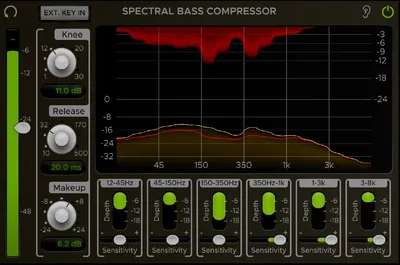
The Spectral Bass Compressor splits the signal into 6 frequency bands and compresses them independently. This is a dedicated multiband compressor focused on the low end, not a broadband comp with a crossover bolted on.
Formats covered: VST3, VST, AAX, and AudioUnit. Mac, Windows, and Linux for most formats. AAX is Mac and Windows only. That's solid cross-platform coverage.
The Good
The Bass Character module is the reason to buy this plugin. Here's the problem it solves: a standard EQ boost at 80Hz hits hard when the bassist plays an E. But when they slide up to A, that same 80Hz boost turns into mud because the fundamental has shifted to 55Hz and you're now boosting a harmonic. Annoying. Familiar. Unavoidable with static EQ.
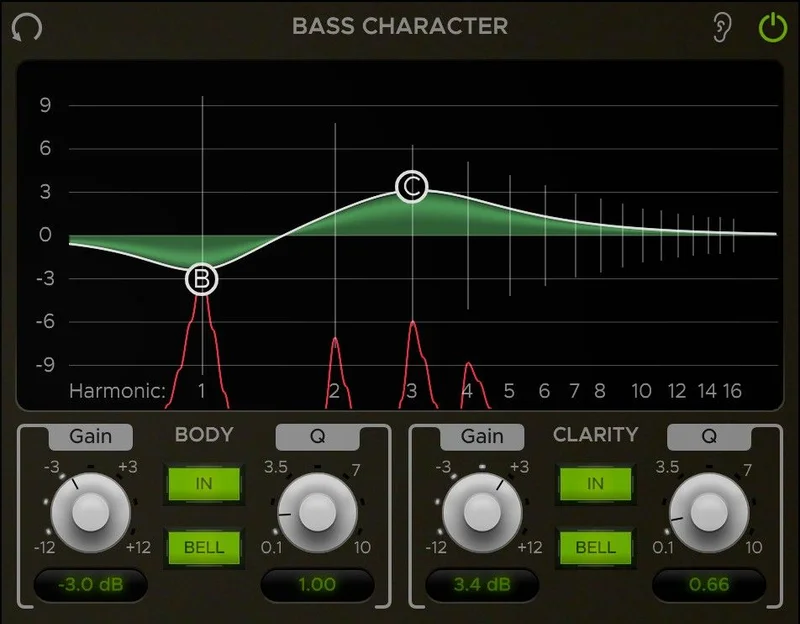
We loaded a fretless bass performance with a wide melodic range into a session. Static EQ at 100Hz gave us a great tone on the low notes and a honky mess on the upper register. We switched to the Bass Character module, set the two bands to follow pitch, and the tone stayed consistent across the entire take without a single automation move.
That's not a small thing. That's hours of automation work eliminated.
The Spectral Bass Compressor is the second win. Six bands, all focused below 500Hz roughly, with independent thresholds and ratios per band. We used it on a synth bass with a aggressive low-mid buildup around 180-220Hz. A standard comp squashed the whole signal every time that frequency spiked. The Spectral comp let us clamp just that band while leaving the sub and the upper harmonics untouched. The result sat in the mix without pumping.
The ability to solo each processing section independently is underrated. You can audition just the compressor's contribution, just the EQ, without bouncing or bypassing manually. That speeds up gain staging decisions and cuts second-guessing time down significantly.
The 5-band EQ with dual filters is clean and musical. Harrison's analogue console heritage shows here: cuts feel smooth, boosts don't get harsh. We pulled 2.5dB at 320Hz with a Q of 1.8 to clear some boxiness on an electric bass and the shelf retained body without the brittle edge you get from some digital EQ curves.
The Not-So-Good
Bass Flow has no saturation module. No harmonic drive. No tape emulation. Nothing that adds upper harmonic content to help a bass translate on small speakers.
That's a real gap. Most professional bass chains include some form of harmonic excitation, whether that's a tube preamp sim, a tape saturation stage, or a dedicated exciter. You'll need a separate plugin for that. For a channel strip positioned as a complete bass solution, that omission is frustrating.
The chorus module feels like an afterthought. It's there, it works, but it's not the reason anyone buys this plugin. We'd have preferred Harrison swap it for even a basic harmonic saturation stage.
At full price, the lack of a saturation section stings more. You're paying full channel strip money but you still need one more plugin in the chain before your signal is actually finished.
Harrison also doesn't publish CPU benchmarks. We ran it in sessions with 30+ instances of other plugins without obvious strain, but we can't give you a specific number. Wish we could.
Compared to the Alternatives
The Waves Bass Rider is often mentioned in the same breath, but it's a levelling tool, not a channel strip. That's a different job entirely. The comparison doesn't hold up.
SSL's Native Channel Strip covers bass tracks perfectly well, but it's a general-purpose strip. No pitch-tracking EQ. No frequency-split compressor targeted at the low end. You're applying generic signal processing to a bass and hoping it behaves.
Waves' API 550A and 560 combination gets used on bass a lot in professional rooms. But again: static EQ, no multiband compression built in, no pitch awareness. You're stacking three separate plugins to do what Bass Flow does in one.
The honest comparison is a custom bass chain: a pitch-tracked EQ plugin (if you can find a standalone one), a multiband comp, a static EQ, and a chorus. Bass Flow does all of that in one interface with routing flexibility. At the promotional price, nothing
touches it. At full price, it is still competitive, but the saturation gap matters.
If you want a great bass synth to feed into this strip, our BassKnob STD review covers one of our favourite SVT alternatives.
Who Should Buy This
- ✅ Buy if you mix bass-heavy genres (hip-hop, R&B, funk, reggae) and fight with low-end consistency across melodic bass lines
- ✅ Buy if you want multiband compression for bass without adding a second heavy plugin to your chain
- ✅ Buy if you can catch the promotional price. At the promotional price, this is a ridiculous deal and you would be silly to pass
- ❌ Skip if you need harmonic saturation as part of your bass tone. You'll be adding a plugin anyway
- ❌ Skip if you're mixing rock or metal bass where transient aggression and amp character matter more than frequency-specific control
- ❌ Skip if you already own a solid multiband comp and a good static EQ. The Bass Character module is the only truly unique piece here
Score Breakdown
| Category | Score | Notes |
|---|---|---|
| Sound Quality | 4.5/5 | Pitch-tracking EQ and spectral comp deliver clean, musical results across genres |
| Value for Money | 4.0/5 | Exceptional at promo price; fair at MSRP; missing saturation holds it back from a 9 |
| Ease of Use | 4.0/5 | Routable sections and per-section soloing make workflow fast; learning curve on Bass Character is short |
| Features | 3.5/5 | Pitch-tracking EQ and spectral comp are brilliant; no saturation is a real omission |
| CPU Efficiency | 3.5/5 | No published benchmark data; performed fine in testing but we can't give you a number |
| Overall | 4.2/5 | Smart, focused, and genuinely useful; one module away from being the definitive bass strip |
Alternatives to Consider
Bogren Digital BassKnob STD, if you want amp character and saturation baked in, this is the plugin Bass Flow doesn't try to be. We covered it in detail in our BassKnob STD review.
BeatSurfing LOW, a bass-focused synth and processing tool that takes a very different approach to low-end shaping. If you're building bass tones from scratch rather than mixing recorded or MIDI bass, check our LOW review to see if it fits your workflow better.
Harrison Guitarstrip, if you like what Bass Flow does conceptually and work with guitar tracks too, Harrison sells both together at a steep discount off the combined regular prices. That bundle makes the purchase even harder to argue against. We've also covered bass-adjacent tools in our MPC Bass Thrill expansion review if you're building bass sounds in MPC workflow.
Our Verdict
Bass Flow is a clever, focused plugin that solves a problem most bass channel strips ignore: the fact that bass is a pitched instrument, and static EQ doesn't know that.
The Bass Character module alone is worth the price of entry. We love what it does to melodic bass lines. The spectral compressor is a satisfying tool that earns its place in any bass-heavy mix. The workflow, with its reorderable sections and individual soloing, is smart and fast.
But it's not complete. No saturation means your signal chain isn't finished when you close Bass Flow. That is an honest limitation that matters at full price, less so during a promotion.
Grab it on promotion. Use it on every bass track you have. Then buy a saturation plugin and stop thinking about it.
The best bass engineers we know treat low-end control like a language. Bass Flow gives you two new words nobody else has. That's enough to warrant a spot in the toolkit.
Frequently Asked Questions
What makes Bass Flow different from a standard EQ and compressor on a bass track?
The Bass Character module tracks the pitch of the bass note being played and adjusts its two EQ bands relative to that fundamental frequency. A standard EQ boosts at a fixed Hz regardless of what note is playing. This means a boost that sounds great on low E can turn muddy when the bassist plays higher up the neck. Bass Flow eliminates that problem without automation. That's the core difference.
Does Bass Flow work on synth bass or only recorded bass?
We tested it on both electric bass recordings and synth bass MIDI instruments. The pitch-tracking EQ works on any pitched bass signal, recorded or synthesised. The spectral compressor is equally useful on both. The chorus is more relevant to synth bass textures in most cases, but there's no limitation built in.
Is the promotional price still available?
The promotional pricing we referenced was tied to a specific sale period. Check Harrison Consoles' website directly for current pricing, as promotions change. The regular price is $99, and Harrison also offers a bundle with Guitarstrip that is worth comparing if you mix both instruments.
Do I still need a saturation plugin if I use Bass Flow?
Yes, if saturation is part of your bass tone. Bass Flow has no harmonic drive or distortion module of any kind. For genres where the bass needs to cut through small speakers or Bluetooth playback, adding upper harmonics through a separate saturation plugin is still necessary. This is the main gap in an otherwise well-designed channel strip.