VSM IV is the best software string machine available right now, and we'd put money on that statement.
We loaded it up at around midnight, dropped the Solina patch into a half-finished cinematic session, and sat there for longer than we'd like to admit. The strings sat immediately, no surgical EQ required, no high-pass fighting with the synth bass below it. There was a slight waver to the sustain, that classic ensemble shimmer, and it felt like something recorded in 1974 rather than rendered in 2026.
That's the pitch, and VSM IV delivers on it. At $119.99, it's a focused tool for a specific job. If that job is your job, read on.
String Machines: What VSM IV Is and What It Absolutely Isn't
VSM IV is a sample-based string machine emulator built from 46 original hardware machines, each sampled across a 49-note range, individually recorded and looped. That's not a general-purpose synth. It doesn't do supersaws, digital FM textures, or modern wavetable movement.
What it does is reproduce the organic, slightly imperfect sound of vintage ensemble string keyboards with unusual accuracy. The Eminent 310, the Freeman String Symphonizer, the Solina, the Elka Rhapsody, the Logan String Melody, the Korg PE-2000. These are the instruments that shaped records from the 1970s through the early 80s, and they're all inside one plugin.
You won't use this for leads. You won't sequence arpeggios through it. If you need a do-everything synth, look at MiniFreak V instead.
But if you're scoring a film cue, building a synthwave soundscape, layering a dreamy ambient piece, or trying to get that warm, slightly wobbly string bed that analogue synthesis can't quite fake, VSM IV is where you go.
Living With 11.5GB of Vintage Iron
Setup is straightforward. The install is big, over 11.5GB, so clear the space before you start. GForce's activation is painless once you're through their portal, and the plugin loads quickly into your DAW.
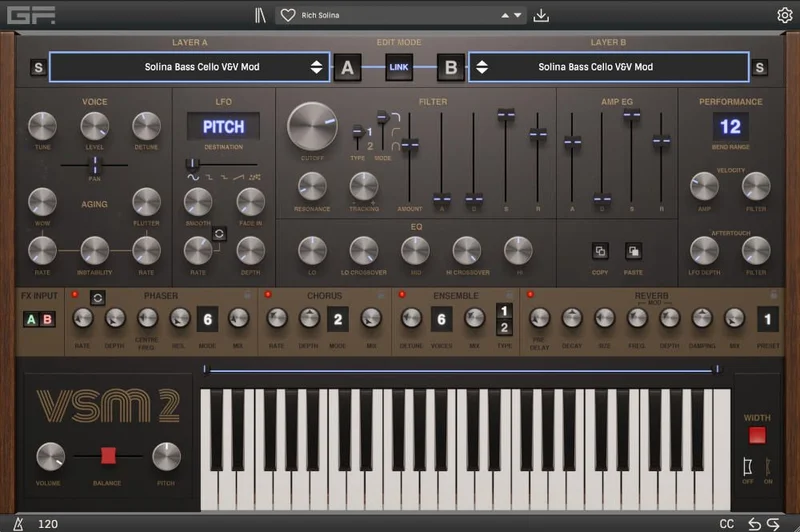
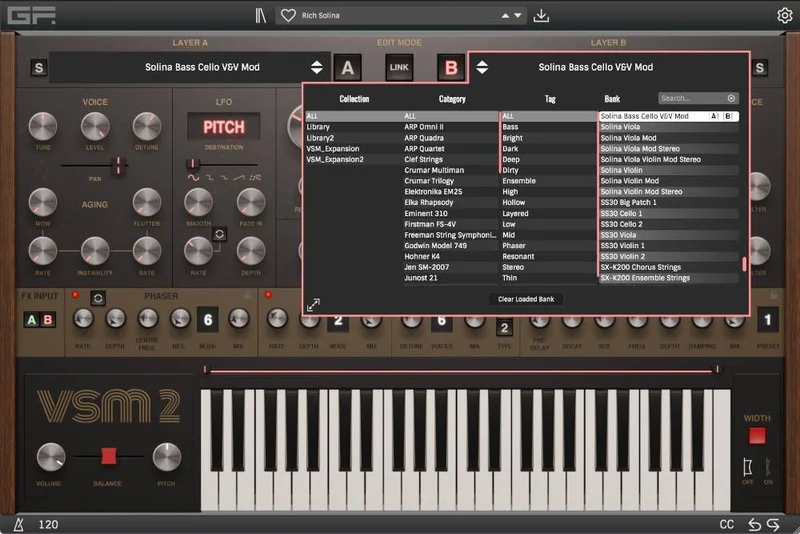
The fully scalable UI is one of the headline additions in version IV, and it genuinely matters. On a 27-inch screen it fills out beautifully. On a laptop at 75%, you can still read every label without squinting. Previous versions felt cramped, and GForce fixed that.
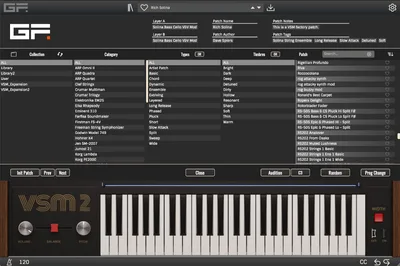
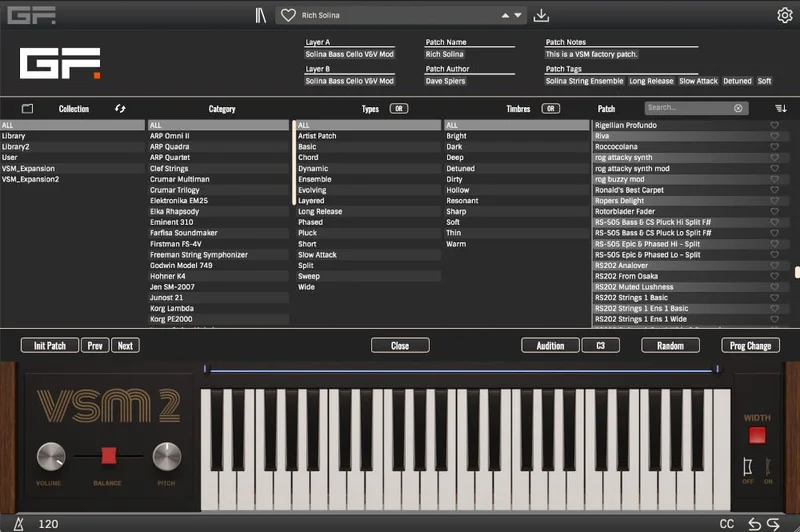
The new Patch and Instrument Browsers deserve credit too. Over 1,900 presets is a lot to navigate, including 200+ new patches created for this version. Without a working browser, that number becomes a liability. The revised layout lets you filter by instrument source, so you can stay inside a single machine's character or jump between them quickly.
The two-layer system is where things get genuinely interesting. Load the Solina on Layer A and the Elka Rhapsody on Layer B, dial the balance, and you get a hybrid that never existed in hardware. That's a creative tool, not just a preset player.
We ran a split keyboard session where Layer A covered the lower two octaves with a Logan String Melody patch and Layer B held a tighter Eminent sound in the upper register. The crossover sat at exactly the right place for a piano-style left-hand, right-hand arrangement. It took about four minutes to set up. That's the kind of workflow win that makes a plugin worth keeping open.
The new undo, redo, copy, and paste functions sound basic, but their absence in VSM III frustrated a lot of users. They're here now. They work.
The Aging Controls: Where VSM IV Gets Interesting
This is the section we'd put in front of anyone skeptical about spending money on an update.
The new Wow and Flutter controls introduce tape-based instability to the pitch and timing. Wow handles slow, cyclical pitch drift. Flutter covers faster, more erratic movement. Together, they recreate the mechanical imperfections of a real string machine that's been sitting in a rehearsal room since 1977.
We set Wow to about a third of its range on a sustained Solina chord. The pitch barely moved, but it breathed. It stopped sounding like a plugin playing a sample and started sounding like something with a motor inside it.
Push Wow higher and you're into obviously degraded territory, which has its own uses for lo-fi production or deliberately damaged textures. The range is wide enough to cover subtle authenticity and deliberate destruction without feeling binary.
Flutter at low settings adds microvariations that sit below conscious perception but above the threshold where listeners feel something is alive. That's the sweet spot, and it's not easy to design. GForce got it right.
The individual FX locks are a clever practical addition. Lock the aging settings while you browse presets and you keep your instability character without resetting it every time you click a new patch. Small detail. Saves real time.
The State-Variable Filter and New Effects Chain
VSM IV ships with both a classic lowpass/bandpass/highpass resonant filter section and a new state-variable filter mode. The state-variable filter has an Oberheim-adjacent character, a faster, slightly brighter response that opens up sound design options the original filter doesn't.
We ran the Freeman String Symphonizer through the state-variable filter with resonance pushed to about 60% and a slow LFO sweeping the cutoff. It didn't sound like a string machine any more, it sounded like something from an early electronic score. That's the correct outcome. You don't always want the preset to stay where it started.
The new LFO section adds pitch, filter, pan, and level as destinations, with shaped LFO options beyond a basic sine or triangle. Assign a slightly random LFO to pan on a long string layer and you get gentle stereo motion that feels organic rather than mechanical.
The new chorus and additional ensemble effect stack alongside the vintage-style ensemble and phaser that carried over from VSM III. That's a lot of modulation options for a string machine plugin. You won't use all of them on every patch. But having the matrix reverb as a final stage, rather than relying on a send in your DAW, makes VSM IV feel more self-contained for demo work and quick scoring.
The three-band EQ is functional and fast. Nothing fancy, nothing to complain about. It does what it says.
Expanded poly aftertouch and velocity controls are genuinely useful for live players. A velocity-sensitive swell from the Freeman into a Korg PE-2000 layer, shaped by aftertouch pressure on the sustain, is the kind of expressive detail that separates a performance from a loop paste. Poly pitchbend is in here too, which MPE-capable controllers will take full advantage of.
The Trade-Offs You Should Know About
The 11.5GB install is the main practical hurdle. For a specialist instrument, that's a significant chunk of an SSD. If you're running a lean laptop setup, factor that into your decision.
CPU load sits in the medium range in our sessions. Nothing alarming, nothing that would embarrass itself next to a more complex physical modelling synth. It ran cleanly alongside other instances in a full orchestral template without audible artifacts or dropout.
The upgrade question is real for VSM III owners. Backward compatibility with VSM III patches is confirmed, so nothing breaks. The new features are meaningful: the aging controls, the state-variable filter, the scalable UI, the browser overhaul, the new effects. But if you're happy with VSM III and your workflow isn't limited by its constraints, the urgency isn't high. New buyers have an easier decision than upgraders.
Reviewers report that the browser, while much improved, can feel slow when first indexing a large library. It's a one-time cost, not a recurring problem, but it's worth knowing before your first session.
Users also note that the depth of the preset library means discovery takes time. 1,900 patches sounds like a luxury until you're auditioning them before a session. Tagging and filtering help. Building a favourites list early is the move.
Against the Field
The honest competition here is Arturia's SEM V for vintage analogue character, though SEM V serves a completely different sonic territory. For pure string machine accuracy, nothing we've tested at this price matches VSM IV's source material depth.
Omnisphere has string machine-adjacent content inside its massive library, but it's a different product category at a very different price. It wins on breadth. VSM IV wins on depth and authenticity within its lane.
The Behringer Solina hardware offers one machine, one character, and costs considerably more than this plugin. If you want the tactile experience, buy the hardware. If you want 46 machines in a DAW session, buy VSM IV.
AudioThing's SX1000 is worth a look for Italian string machine flavour specifically. Read our SX1000 review if that specific character is what you're chasing. It's a narrower tool, which is sometimes exactly what you want.
For anything outside vintage string machine territory, look elsewhere. That's not a criticism. That's clarity about what this plugin is built for.
The Real Verdict
VSM IV is the right buy for film composers, synthwave producers, ambient artists, and anyone who's spent time hunting for that specific warmth that hardware string machines carry. The sample depth is unmatched, the aging controls are genuinely clever, and the UI updates make a real instrument of what was sometimes an unwieldy library.
Skip it if you want a general synth, a lead instrument, or something that will multitask across genres. This doesn't do that, and it doesn't pretend to.
At $119.99, it's not an impulse buy. But it's a serious tool for a specific creative need, and it fills that need better than anything else we've tested in this category.
Specs & Technical Details
| Developer | GForce Software |
| Price | $119.99 |
| Plugin Format | VST / VST3 / AU / AAX / Standalone |
| OS Support | Mac (macOS 10.15+, Intel and Apple Silicon) / Windows 7+ |
| Activation | GForce Software licence activation |
| CPU Usage | Medium |
| Trial Available | N/A |
| Version Reviewed | VSM IV (released March 2024) |
Score Breakdown
| Category | Score | Notes |
|---|---|---|
| Sound Quality | 4.5/5 | 49-note individual sampling from 46 machines sets the standard for this category |
| Value for Money | 4.0/5 | Specialist tool at a fair price; upgrade value depends heavily on your VSM III usage |
| Ease of Use | 4.0/5 | New browser and scalable UI are genuine improvements; initial library indexing can be slow |
| Features | 4.5/5 | Aging controls, state-variable filter, matrix reverb, and poly aftertouch are all meaningful additions |
| CPU Efficiency | 4.0/5 | Runs cleanly in full sessions; the 11.5GB install is the bigger practical cost than CPU draw |
| Overall | 4.3/5 | The deepest, most complete string machine plugin available; just know what you're buying |
Alternatives to Consider
If you want vintage analogue character outside the string machine world, Arturia SEM V is a brilliant filter-led synth with real Oberheim DNA. Different instrument, different use case, worth knowing.
For Italian string machine flavour with a narrower focus, AudioThing SX1000 is a satisfying specialist tool. It won't replace VSM IV's library depth, but it has its own character.
If you need a synth that covers more ground and can sit alongside string textures in the same patch, MiniFreak V earns its keep as a versatile workhorse. String machines, it is not. But it covers what VSM IV leaves behind.
If you're deep into physical modelling and want something that generates texture rather than replaying it, Chromaphone 3 approaches warmth from a completely different angle.
String machines that sit and breathe and do nothing else brilliantly? VSM IV is still the answer.
Frequently Asked Questions
Is VSM IV worth upgrading from VSM III?
It depends on how much the limitations of VSM III are actually slowing you down. The aging controls, state-variable filter, scalable UI, improved browser, and new effects chain are all real improvements, not cosmetic ones. If the old version's cramped interface and lack of undo frustrated you, the upgrade is easy to justify. If VSM III is working fine in your sessions, you can take your time.
Can VSM IV load VSM III patches?
Yes. GForce built in backward compatibility, so your existing VSM III patch library transfers across without issues. Nothing breaks, nothing needs rebuilding. That's the right way to handle a version update.
What genres is VSM IV best suited for?
Cinematic scoring, synthwave, ambient, neo-soul, and any production that needs authentic vintage string machine texture. It's also a strong choice for lo-fi and bedroom pop when you want organic, slightly degraded string tones. It's not built for modern EDM leads or anything that needs aggressive modulation and filter movement as its primary character.
How does the dual-layer system work?
VSM IV runs two independent instrument layers simultaneously, each sourced from any of the 46 sampled machines. You can blend them by volume, split them across the keyboard at a defined point, or run them in parallel for hybrid textures that combine the character of two different vintage instruments. It's the main creative tool beyond preset browsing, and it's genuinely powerful.
What do the Wow and Flutter controls actually do?
Wow introduces slow, cyclical pitch drift that mimics the motor instability of ageing tape and belt-driven mechanisms inside real string machines. Flutter adds faster, more random pitch and timing variations. Used subtly, they make sampled instruments feel organic and alive. Pushed hard, they create deliberately degraded, lo-fi textures. Both are continuous controls with a wide range, so the sweet spot is easy to find without going too far.