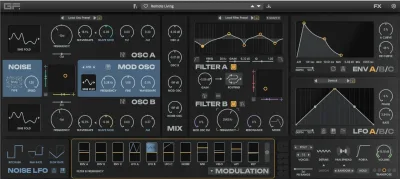
The doubt walking into a MAP review is this: is GForce Software actually delivering a West Coast modular experience, or just slapping "Buchla-inspired" on another wavetable synth with moody presets? It's the real thing, grounded in Serge and Buchla lineage, and it sounds like nothing else in your plugin folder for $119.99.
MAP is for producers who've grown bored of their bread-and-butter virtual analogs. It's for sound designers who want something that pushes back. And it's for anyone who keeps eyeing Eurorack gear but knows their mortgage exists.
It won't replace your Serum or your Massive for quick, predictable results. That's not what it's built for. If you need a synth that rewards exploration over efficiency, keep reading.
Does MAP Actually Deliver What GForce Promises?
GForce has a strong track record. Their M-Tron Pro and Minimonsta showed they could model complex vintage instruments without cutting corners. MAP is a different challenge: not a recreation, but a reimagining of West Coast synthesis philosophy.
West Coast synthesis means complex oscillators, frequency modulation, waveshaping, and a focus on timbral movement over filter-based tone sculpting. MAP checks those boxes with three oscillators, one of which is a dedicated modulation oscillator. FM and amplitude modulation are both accessible without diving into menus.
The dual filter configuration is where MAP earns real credibility. A five-band resonant EQ paired with a multimode filter, switchable between series and parallel routing, gives you filter combinations that most soft synths simply don't offer. We ran the multimode filter in self-oscillation into the EQ section and got sounds that would cost you a hardware session to dial in otherwise.
GForce built this with intention. It shows.
Where MAP Shines
Load the init patch and start with the modulation oscillator feeding FM into oscillator one. Bring in the waveshaping and you're already in territory that sounds genuinely alien. Not alien in a "digital hash" way. Alien in a "1974 San Francisco" way.
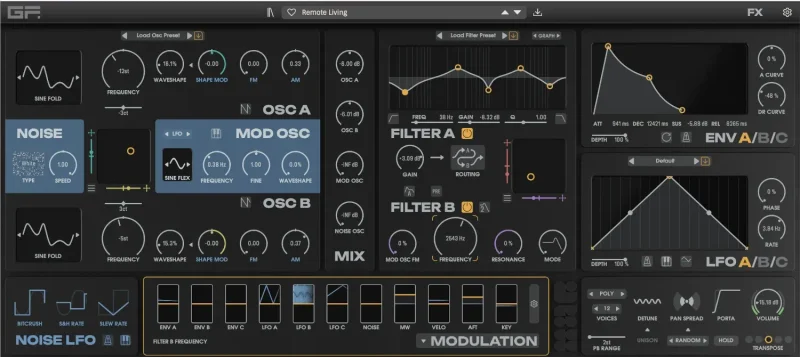
We parked the filter in parallel mode, set the multimode to bandpass with a Q around 3, and layered the five-band EQ to carve a notch at 800Hz. The result sat in a mix like an analogue texture no standard subtractive plugin would produce. Satisfying in a way that made us keep going for another hour.
The modulation system is genuinely clever. Three looping envelopes, three drawable LFOs you can literally sketch the shape of, a noise-powered random LFO, and full MPE support. That's a lot of movement without a visual rat's nest. The modulation matrix keeps it legible.
The nine-type noise source deserves a mention. You can dial in a specific noise colour and route it directly into the filter or the FM path. We used the pink noise variant through the EQ section to build a textured pad that had real air in the high end without adding a separate plugin.
The generative polyphonic arpeggiator is the sleeper hit. We connected it to an XY Pad macro and found ourselves with evolving melodic phrases that shifted every few bars. It's not random for random's sake. It has musical intent baked in.
Where MAP Falls Short
MAP's effects chain has a fixed order: Colour, then Time, then Space. That's it. You can't put the delay before the character effects. You can't run the grain reverb into the frequency splitter. For a synth that promises modular freedom, that's a frustrating wall to hit.
We love the Space section. The grain and reverb combination creates genuinely immersive results. But we kept wishing we could send a dry oscillator signal into Space before it hit Colour. That routing doesn't exist here.
The generative arpeggiator, which we praised above, becomes annoying in a different context: writing actual melodies. It's built for exploration, not composition. If you need to sketch a chord progression quickly, MAP makes you work harder than it should.
There's also no true patch routing between oscillators in a freeform modular sense. You can't feed oscillator two's output into oscillator three's waveshaper input in an arbitrary way. The FM paths are defined. For users coming from actual Eurorack, that rigidity will feel like a cage.
How MAP Stacks Up Against the Competition
The obvious comparison is Arturia's MiniFreak V. MiniFreak V also claims West Coast DNA and delivers a hybrid digital/analogue character. MiniFreak V wins on oscillator variety and its direct tie to the hardware. MAP wins on filter depth and the modulation system's expressiveness.
Buchla Easel V from Arturia is the other name that comes up. It's a stricter recreation of a specific instrument. MAP is a broader sandbox. If you want historical accuracy, Easel V. If you want the spirit without the constraints, MAP.
Tone2's Electra2 covers similar experimental ground at a different price point. It has more oscillator types on paper. But its modulation routing is less intuitive than MAP's drawable LFOs, and its West Coast character is thinner.
MAP has a specific identity. That's not always true of experimental synth plugins.
Is $119.99 a Fair Ask?
Yes. Bluntly: yes.
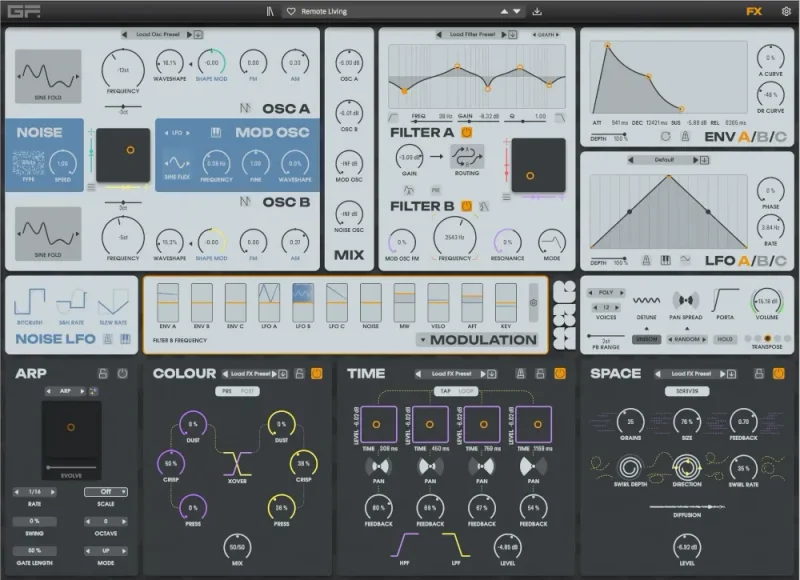
Over 300 presets that actually demonstrate what the synth does. A dual filter architecture you won't find in cheaper alternatives. MPE support, drawable LFOs, and a generative arpeggiator. GForce didn't cut corners on the feature list.
The fixed effects order keeps this from being a perfect buy. If that limitation genuinely matters to your workflow, wait for a sale. But at $119.99, MAP offers more real synthesis depth than most plugins in this category.
Specs & Technical Details
| Developer | GForce Software |
| Price | $119.99 |
| Plugin Format | VST3 / AU / AAX |
| OS Support | Mac / Windows |
| Activation | N/A |
| CPU Usage | Medium |
| Trial Available | N/A |
| Version Reviewed | 1.0 |
Score Breakdown
| Category | Score | Notes |
|---|---|---|
| Sound Quality | 4.5/5 | West Coast FM and waveshaping sounds genuinely distinct and characterful |
| Value for Money | 4.0/5 | Strong feature set at this price, fixed effects order holds it back slightly |
| Ease of Use | 3.5/5 | Modulation matrix is clear, but the philosophy requires time investment to get results |
| Features | 4.5/5 | Dual filters, MPE, drawable LFOs, generative arpeggiator, and 300+ presets cover serious ground |
| CPU Efficiency | 4.0/5 | Medium load in testing, handles polyphony without spiking on a mid-range machine |
| Overall | 4.2/5 | A genuinely distinctive experimental synth that earns its West Coast claims |
Alternatives to Consider
If the West Coast angle appeals but you want something tied to specific hardware history, the Arturia MiniFreak V review is worth your time. It has a different character but overlapping intent.
For purely acoustic and resonant textures with deep modulation options, Chromaphone 3 review takes a completely different physical modelling approach. Different tool, different job.
If you're building a larger sound design kit and want to see how specialist preset banks expand a synth's reach, the Epicycles sound bank for Chromaphone 3 review shows how much presets matter in this category. MAP's built-in 300 presets compare well by that standard.
Tone2 Electra2 is a free mention: cheaper, more oscillator types on paper, but a thinner personality and less expressive modulation routing. Worth a trial download before committing to anything.
The Verdict
MAP is not a plugin you'll master on a Tuesday afternoon. That's the point.
GForce built something that rewards the producers who sit with it. The dual filter routing alone justifies serious attention. The drawable LFOs and MPE support push it further. The fixed effects order is a real frustration, not a minor quibble, and composers who need structured melodic tools will find the generative arpeggiator more chaotic than useful.
But for sound designers, experimental producers, and anyone who keeps looking at Eurorack modules they can't afford, MAP at $119.99 is the closest you'll get to West Coast modular experimentation without renting rack space.
Skip it if you want quick, predictable synth sounds. Buy it if you want your next three hours to disappear into something genuinely new.
MAP rewards the curious. It ignores everyone else. That's not a flaw. It's the whole idea.
Related reviews: TV3
Frequently Asked Questions
What kind of music is MAP best suited for?
MAP works best for ambient, experimental, cinematic, and sound design contexts where unusual timbres and evolving textures matter. It can produce leads and basses, but its West Coast character means those sounds tend to be complex and movement-heavy rather than clean and defined. Producers who need straightforward, punchy synth tones will find it harder to dial in quickly.
Is MAP hard to learn for producers who haven't used West Coast synthesis before?
It has a learning curve. The modulation matrix is well-designed and more readable than most modular-inspired plugins, and the 300+ presets give you a strong starting point for understanding what the synth can do. We'd suggest spending time deconstructing presets before building from scratch. The XY Pad macros on the oscillator and filter sections are a practical entry point for hands-on exploration.
Does MAP support MPE controllers?
Yes. MAP includes full MPE support, which means controllers like the Roli Seaboard or Expressive E Osmose can drive per-note pitch bend, pressure, and slide independently. For West Coast-style performance, this opens up expressive possibilities that standard MIDI simply can't match. It's a meaningful inclusion at this price.
How does MAP's effects section work, and can the order be changed?
MAP's effects run in a fixed chain: Colour (frequency manipulation and character), Time (quad delay), and Space (grain and reverb). The order cannot be changed, which is the plugin's most limiting design decision. Each section is strong individually, and the Space section in particular produces genuinely immersive results. But users who need flexible signal routing for the effects will need a workaround using their DAW's own routing tools.