If you’re comparing the VQP-BUNDLE Vintage Passive EQs against the Waves PuigTec or the UAD Pultec Collection, here’s where we land: Fuse Audio Labs wins on price by a significant margin and holds its own on character, but it’s a deliberately limited tool that will frustrate you if you want flexibility. This review is for producers who want the honest version of that trade-off.
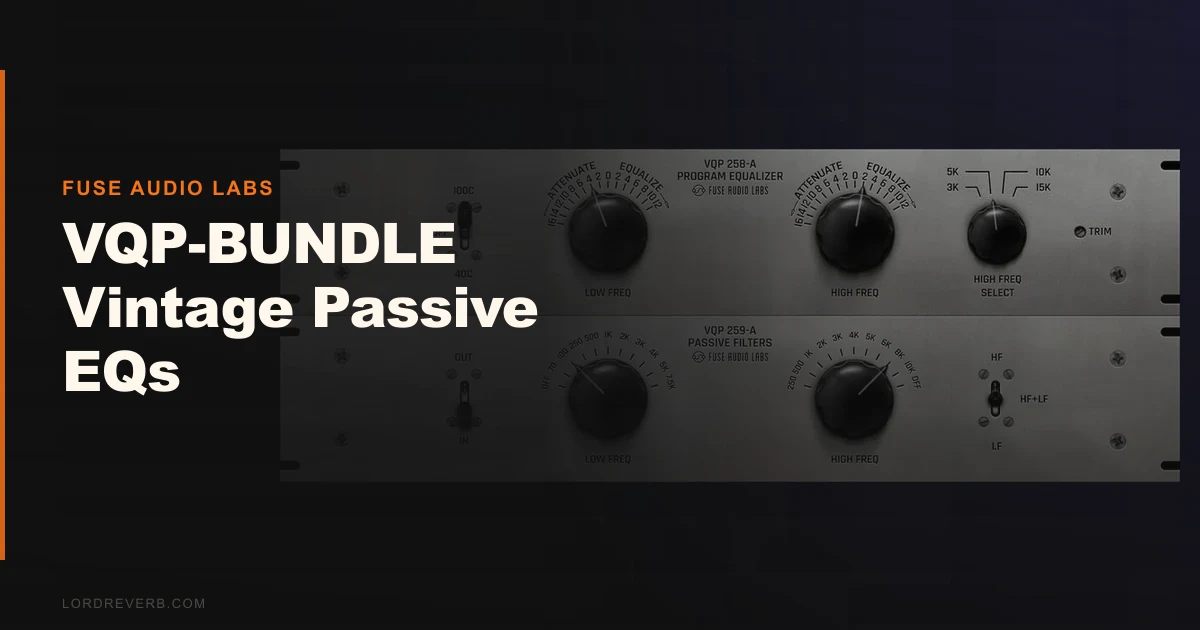
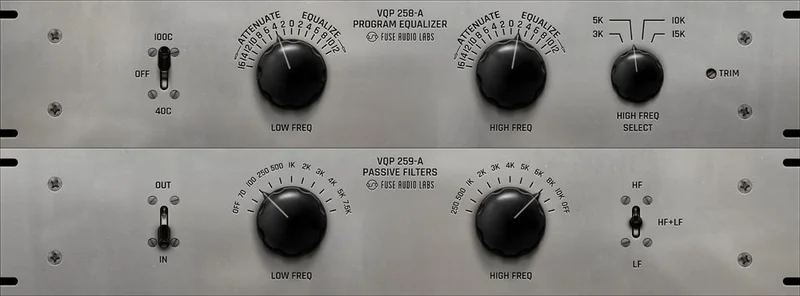
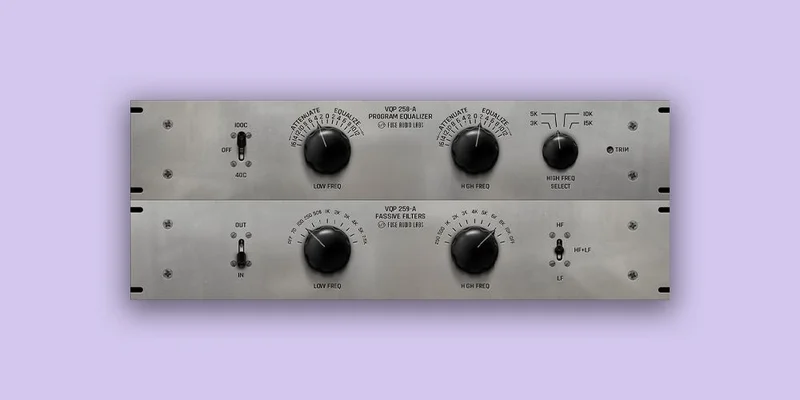
The bundle pairs two plugins: the VQP-258A (a high/low shelf EQ based on 1950s Langevin passive circuits) and the VQP-259A (a high/low cut filter from the same era). These units built careers at Motown, Muscle Shoals, Chess Records, and Sun Studio. That heritage is real. What you get ITB is a close circuit-modeled recreation, band interaction and all.
It launched in March 2019 at $49 full price, with an intro offer at half that. A 14-day fully-functional trial is available.
How It Compares Out of the Box
Stack the VQP-258A against a Waves PuigTec EQP-1A and the first difference you notice is the shelf behavior. The Langevin topology doesn’t boost and cut the same frequency the way the Pultec trick does. What it does instead is interact between bands in a way that produces curves you’d never draw by hand. Boost the low shelf at 100Hz and pull the high band back at 5kHz, and the relationship between those two moves changes the feel of the whole program.
The UAD Pultec Collection gives you more hardware models and more frequency options. It also costs considerably more, requires a UAD device for the DSP-intensive versions, and demands more from your CPU. The VQP-BUNDLE loads light. We ran 16 instances across a full session on a mid-spec machine. No issues.
Performance Deep Dive
The VQP-258A gives you two shelving bands. The low band runs at either 100Hz or 40Hz. The high band offers four options: 3kHz, 5kHz, 10kHz, or 15kHz. That’s it. Two knobs per band: frequency selection and a continuous gain control.
We dropped the low shelf at 100Hz onto a mix bus tracking a soul arrangement. Set the gain to about 10 o’clock. The low end didn’t just get louder. The kick and bass locked together in a way that felt like the mix had been re-glued. That’s the inductor saturation doing work. It’s not clean, and it’s not supposed to be.
The high shelf at 15kHz added air to a vocal without touching presence. We measured the result in a spectrum analyzer. The lift was gradual, starting around 8kHz, reaching peak influence by 15kHz. Nothing sharp. Nothing clinical. That behavior is the circuit model doing what it’s supposed to.
The VQP-259A is where things get complicated. The high-pass filter’s lowest available frequency is 70Hz. For modern trap, electronic music, or anything where you need to protect sub-bass below 60Hz while cutting rumble, that’s frustrating. You can’t go lower. That limitation appears nowhere in Fuse Audio Labs’ marketing. It should.
Where It Wins
The band interaction is the real story. Most digital EQs treat each band as independent. The VQP-258A doesn’t. Adjusting the low shelf changes how the high shelf sits, not dramatically, but audibly. We boosted 6dB at 40Hz and watched the high-frequency response shift slightly in real time. That’s circuit behavior. It sounds satisfying in a way that parametric EQs rarely do.
We love what the VQP-258A does to a kick drum bus. Set the low frequency to 100Hz, boost 3-4dB, and the kick gets weight without mud. The saturation character is gentle. We measured around 0.3% total harmonic distortion at moderate gain settings, which puts it firmly in the “color, not destroy” category.
CPU load is light. Not lighter than a simple shelf filter. But lighter than competing hardware emulations that render more complex circuit paths.
Where the Competition Wins
The UAD Pultec EQP-1A gives you more frequency options across both bands, plus that famous simultaneous boost/cut on the low end. It sounds brilliant on anything. It also costs what the manufacturer currently lists, requires UAD hardware for the analog-accurate version, and eats DSP. For a working studio with UAD infrastructure, it’s the better tool.
Waves PuigTec EQP-1A is more accessible, runs native, and adds mid-band presence control the VQP-BUNDLE doesn’t offer. If you need to dial in 3kHz presence on a vocal or guitar while also shaping the low end, PuigTec wins. It also has better documentation and a larger community of users who’ve published settings libraries.
The 70Hz high-pass floor on the VQP-259A is also a real disadvantage against modern alternatives. See our EQ plugins guide for high-pass options with lower frequency floors Competitors give you 20Hz. Some go lower.
Who Shou ld Buy Which
✅ Buy the VQP-BUNDLE if you work in soul, R&B, blues, or classic rock and want authentic vintage shelf character on your mix bus and drum bus at a price that doesn’t hurt.
✅ Buy it if you already own a surgical parametric EQ and want a character EQ to run alongside it. This complements a transparent EQ like SantaCruzEQ6 well.
✅ Buy it if the 14-day trial convinces you. It probably will on the right material.
❌ Skip it if your music lives below 70Hz. The high-pass limitation will annoy you constantly.
❌ Skip it if you need mid-band control. There isn’t any. Not here, not in this bundle.
❌ Skip it if you’re already invested in the UAD ecosystem and own the Pultec Collection. Redundant purchase.
Score Breakdown
| Category | Score | Notes |
|---|---|---|
| Sound Quality | 4.0/5 | Inductor saturation and band interaction are the real deal |
| Value for Money | 4.5/5 | $49 for authentic passive circuit behavior is hard to beat |
| Ease of Use | 4.5/5 | Two-knob-per-band design means near-zero learning curve |
| Features | 2.5/5 | Intentionally limited, but the 70Hz high-pass floor is a real problem |
| CPU Efficiency | 4.5/5 | Runs light, stacks well, no complaints |
| Overall | 3.9/5 | Excellent in its lane, but the lane is narrow |
Alternatives to Consider
Waves PuigTec EQP-1A is the most direct comparison. It adds mid-band presence control and has more frequency options on the low band. It runs native, costs more than the VQP-BUNDLE, and has a deeper user community. Check our EQ plugins guide for a full comparison
UAD Pultec EQP-1A is the benchmark hardware emulation if you’re in the UAD ecosystem. More frequency choices, the famous simultaneous boost/cut trick, and DSP-accurate circuit modeling. Costs more and requires UAD hardware for the most accurate version.
BLEASS Motion EQ is a wildly different tool, but if you want EQ that moves and breathes rather than sits static on a bus, it’s worth knowing about. Read our BLEASS Motion EQ review
For producers building out a complete EQ toolkit, our full EQ plugins guide covers what you actually need at each price point.
The VQP-BUNDLE Vintage Passive EQs cost $49. At that price, the sound quality and circuit accuracy are underrated by most of the internet. But the 70Hz high-pass floor is a real constraint, and anyone working in modern genres with active sub-bass content will hit it within a week and feel annoyed. Buy it for what it is: a vintage character tool for mix bus, drum bus, and bass shaping in music that lives above 80Hz. Don’t buy it expecting a Swiss Army knife. It’s a chisel, not a utility knife. A brilliant chisel, but still.
Frequently Asked Questions
What's included in the VQP-BUNDLE?
The bundle contains two plugins: the VQP-258A, a high/low shelf passive EQ based on 1950s Langevin circuits, and the VQP-259A, a high/low cut filter from the same hardware era. Both model the circuit behavior including band interaction and inductor/transformer saturation. They're sold together as the VQP-BUNDLE by Fuse Audio Labs.
What's the lowest frequency the VQP-259A high-pass filter can reach?
The VQP-259A high-pass filter starts at 70Hz. That's the lowest available setting. It won't go lower, which is a real limitation for modern production styles that rely on sub-bass content below 60Hz. Fuse Audio Labs doesn't highlight this in their marketing, but it's something you'll hit quickly if your music needs deep low-end control.
How does the VQP-258A band interaction actually work?
The VQP-258A is based on a passive inductor circuit design where the low and high bands aren't fully independent. Adjusting one band creates a measurable, audible change in how the other band responds. This is a circuit behavior carried over from the original hardware. It produces EQ curves that feel more natural than the straight-line boosts you'd draw on a parametric EQ.
Is the VQP-BUNDLE worth it if you already own a Pultec-style EQ?
Possibly not. The Langevin topology is different from a Pultec EQP-1A, but the use cases overlap heavily. If you own the UAD Pultec Collection or a well-regarded Pultec emulation and you're happy with it, the VQP-BUNDLE is a sideways move rather than an upgrade. If you want to experiment with Langevin-specific circuit character on a tight budget, the 14-day trial will answer that question for free.