
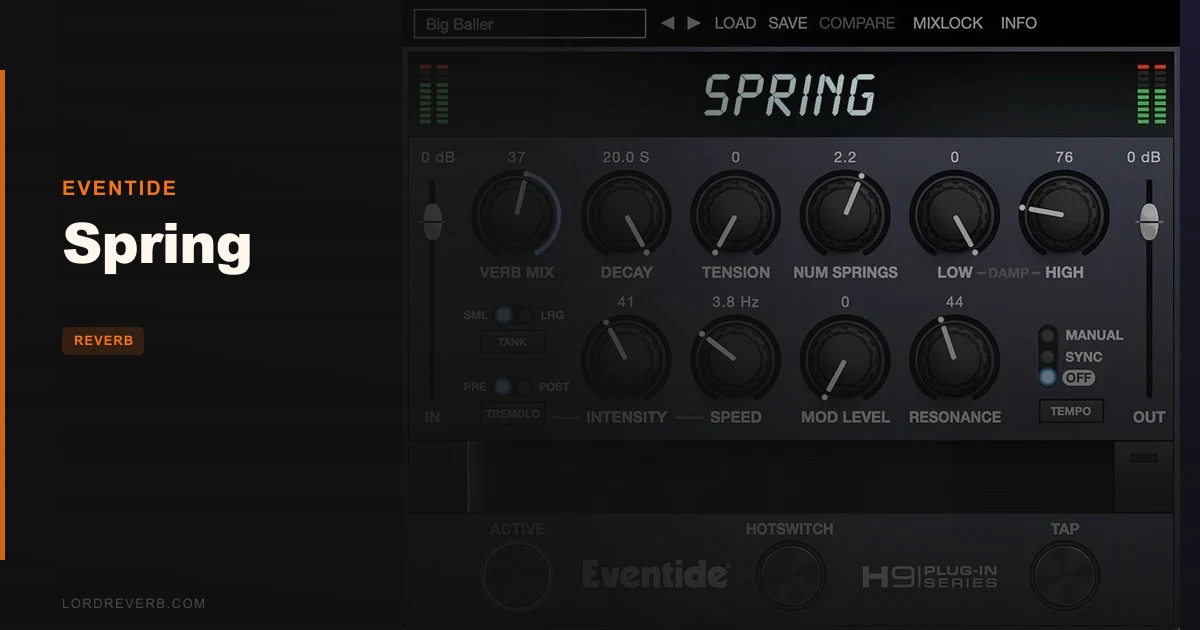
Eventide Spring is the most musically useful spring reverb plugin we've tested, and if you want authentic tank character without bolting a Fender chassis to your rack, this is where we'd spend the money.
The pitch here isn't "it sounds like the real thing." It's better than that. Eventide gave you controls that no physical tank has ever offered, morphable spring count, independent high/low damping, pre or post tremolo routing, and somehow kept it sounding like the springs are actually moving metal in a box somewhere.
It's built for producers who want that surf, garage, or rockabilly shimmer but need it to sit cleanly in a modern session. It also works brilliantly for psychedelic production, lo-fi beats, and anything where reverb texture matters more than reverb transparency. If you want clean, lush halls, look elsewhere. This plugin does dirty spring and does it with conviction.
What You're Actually Getting
Spring models the physical behaviour of spring reverb tanks, the kind found in Fender, Gibson, and Ampeg amps since the 1960s. You get two different tank sizes to choose from, and you can morph the spring count between one and three, which is something no hardware unit lets you do while the audio is running.
Controls cover tank size, spring count, low and high damping frequencies, metallic resonance, and modulation level for chorus-style widening. The tube-amp-style tremolo runs independently and can sit before or after the reverb in the signal chain. That distinction matters: pre-reverb tremolo smears the wobble into the tail, post-reverb tremolo sits on top of it cleanly.
The Ribbon controller maps any two parameter states to a single fader, so you can morph between a short dry slap and a full drowned-out wash in one move. The Hotswitch jumps instantly to a saved alternate setting. Eventide tests it in Live, Cubase, FL Studio, Logic, Pro Tools, and Studio One. No iLok dongle required, just a free iLok account.
The Good
We dropped Spring across a drum machine loop running a TR-808-style snare at 90 BPM. Dialled in the small tank, set spring count to 1.4, and nudged high damping down to around 4kHz. The snare cracked, then you heard metal. A genuine clank in the tail, not a softened algorithmic blur. That's the sound.
The tremolo routing is where Spring earns its keep above the competition. We routed tremolo pre-reverb on a Juno pad at a rate of 2.1Hz and 70% depth. The wobble smeared into the decay in a way that sounded like a vintage amp in a tiled bathroom. Satisfying doesn't cover it.
Artist presets from Matt Lange, Nick Hook, and Nu-Trix aren't filler. Lange's presets lean into synth-friendly territory: longer decays, heavier modulation. Hook's sit closer to raw amp territory. They function as actual starting points, not demos.
Tempo-synced decay is a quiet winner. Locking the reverb tail to your session grid keeps things from clouding up on busier arrangements. We used it on a guitar bus at 130 BPM and it saved headroom without touching a single EQ band.
The Not-So-Good
Spring count morphing is brilliant until it isn't. Push past 2.7 springs on the small tank with high resonance cranked, and you'll find a resonant peak around 3–4kHz that turns ugly fast. It's not a deal-breaker, but it means you need to ride the high damping control carefully. Annoying on a deadline.
This plugin does one thing. If your session needs a plate, a room, or a hall, Spring won't help you. It's a specialist tool with no ambitions outside its lane. That's honest design, but it means you need another reverb alongside it.
There's also no standalone app. Spring lives in your DAW. For guitarists who want to use it with an audio interface outside a full session, that's a real limitation. Eventide's hardware units don't have this problem. The plugin does.
We also wish the Hotswitch had MIDI learn enabled by default rather than requiring manual setup. For live use with the Ribbon, that's a frustrating extra step.
Compared to the Alternatives
UAD's Galaxy Tape Echo has spring reverb built in, but it's secondary to the tape delay core. Spring beats it on reverb depth and control every time. Not a fair fight for Eventide.
Softube's Spring Reverb sits at a similar price point. It sounds accurate and clean. Too clean, if we're honest. It lacks Spring's dirt and character. If you want faithful, Softube. If you want alive, Eventide.
For hardware, an Accutronics tank through a decent preamp runs around $80–$200 depending on the unit. You get one tank, one spring count, no tempo sync, no Ribbon. The Eventide plugin beats it on flexibility every time. Real hardware wins on tactile feel and zero latency into an amp. Pick based on your workflow, not nostalgia.
Valhalla's SpaceRack has spring emulation as part of a wider reverb system. More versatile overall, but the spring algorithm doesn't match Spring's specificity. Best reverb plugins compared
Who Should Buy This
- ✅ Buy if you produce surf, garage, rockabilly, lo-fi, or psychedelic music and want authentic spring character with modern flexibility.
- ✅ Buy if you do sound design and want reverb textures that real hardware can't produce, the spring morphing opens up sounds that sit nowhere in nature.
- ✅ Buy if you want a tremolo/spring combo that can sync to your DAW and morph in real-time via a single fader.
- ❌ Skip if you need a general-purpose reverb that covers rooms, halls, and plates. This isn't that.
- ❌ Skip if you're a guitarist wanting to run it outside a DAW session. No standalone means no direct use with your interface in a practice setup.
- ❌ Skip if high-resonance experimental sounds aren't in your workflow. Half of Spring's range lives in territory most pop and commercial producers won't touch.
Score Breakdown
| Category | Score | Notes |
|---|---|---|
| Sound Quality | 4.5/5 | Genuinely convincing tank character; resonance at extreme settings needs managing |
| Value for Money | 3.5/5 | Specialist tool at a price that requires commitment to the genre |
| Ease of Use | 4.0/5 | Ribbon and Hotswitch are smart; MIDI learn setup is clunkier than it should be |
| Features | 4.0/5 | Spring morphing and pre/post tremolo routing put it ahead of every direct competitor |
| CPU Efficiency | 4.0/5 | Runs light; no issues on multi-instance sessions in our testing |
| Overall | 4.0/5 | The best spring reverb plugin available if spring is what you need |
Alternatives to Consider
Klevgrand Kleverb, More of a general-purpose reverb with spring modes included. Less detailed spring emulation than Eventide, but more versatile if you need one plugin to cover multiple reverb types. Kleverb review
Apogee Clearmountain's Spaces, Bob Clearmountain's personal reverb collection, captured as convolution impulses. Some spring IRs are in there. Not as tweakable as Spring, but you're getting the exact sounds from decades of hit records. Clearmountain's Spaces review
Safari Audio Hippie Elephant, If Spring's spring morphing sounds interesting for weird territory, Hippie Elephant goes further into unconventional reverb design. Different category, but worth knowing about if you liked the creative angle. Hippie Elephant review
For a broader look at where Spring sits in the reverb plugin market: Reverb plugins guide
We also compared IK Multimedia's CSR Room Reverb for producers wanting a cleaner algorithmic option: CSR Room Reverb review
Eventide Spring is a plugin with an honest job description and the sounds to back it up. It doesn't pretend to be a room, a plate, or anything other than a spring tank with superpowers. If that's what your sessions have been missing, buy it. If you need a workhorse reverb that covers every room type in your template, this will frustrate you within a week.
The spring morphing alone is worth the price for the right producer. The tremolo routing makes it worth more. Just know what you're buying before you click checkout: this is a tool built for a specific sound, not a collection.
Related reviews: Perfect Plate XL Review
Frequently Asked Questions
Does Eventide Spring require an iLok dongle?
No dongle required. Spring uses iLok licence management, but you only need a free iLok account and the iLok Manager software installed. The licence sits in your account, not on a physical dongle. That means no extra hardware to lose and no USB port wasted.
Is Eventide Spring good for guitars, or is it mainly for production?
It works on anything, but the lack of a standalone mode is a real limitation for guitarists. You'll need a DAW session running to use it, which rules out quick amp-style practice use. In a recording context, it sounds brilliant on guitar. Just don't expect to use it like a pedal.
What does the Ribbon controller actually do in Spring?
The Ribbon maps any two saved parameter states to opposite ends of a single fader or MIDI controller. You set State A (say, a short bright slap) and State B (a long dark wash), then sweep between them in real-time. It's the kind of live morphing that normally requires automation, done in one gesture.
How does Eventide Spring compare to using a real spring reverb tank?
A real Accutronics tank gives you zero-latency analogue character and no CPU overhead. Spring gives you spring count morphing, tempo sync, independent damping for high and low frequencies, tremolo routing, and modulation control that no physical tank can match. For recording and production, Spring wins on flexibility. For live amp use, hardware wins on simplicity and feel.