The Plugin That Exists Because Drum Synths Got Lazy
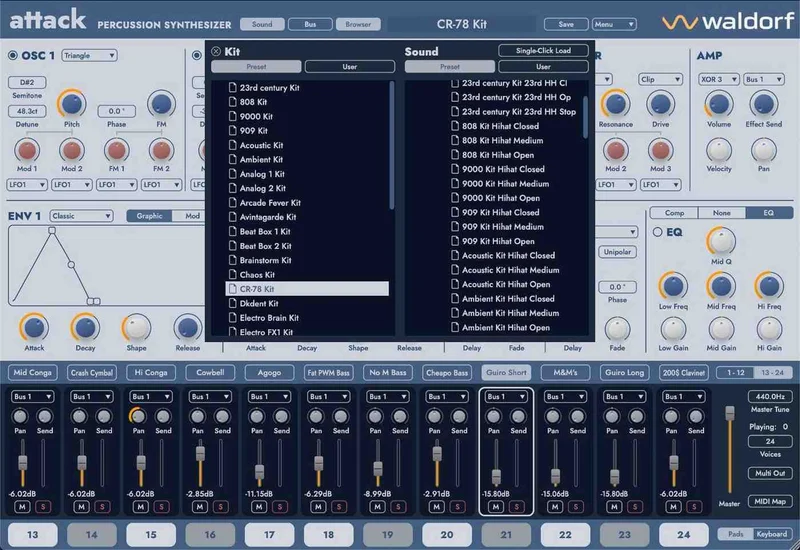
Most drum synths in 2026 give you a sequencer, a handful of synthesis modes, and call it done. What they rarely give you is the ability to take your own samples and run FM synthesis on top of them, or dial in 6 discrete drive character types per sound, or route 24 individual sounds across 6 output busses with per-channel compression and EQ baked in.
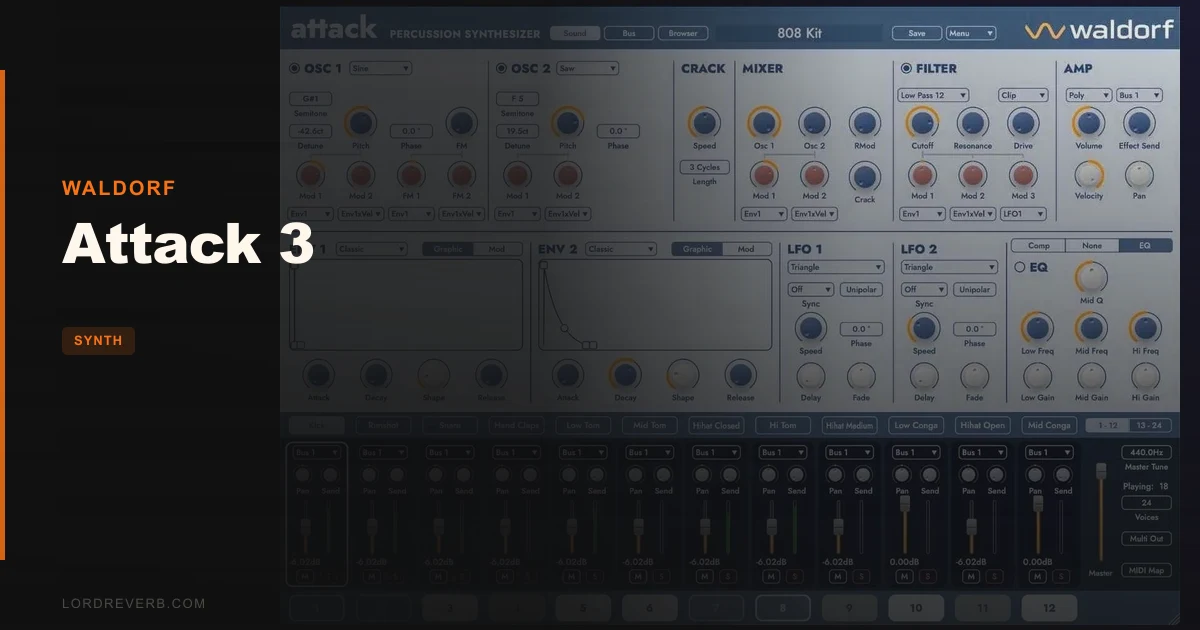
That gap is exactly what Waldorf Attack 3 exists to fill. This is a percussion synthesizer for producers who want synthesis depth first and drum machine convenience never.
It's built for electronic producers, sound designers, and anyone making techno, industrial, IDM, or any genre where "I need a kick that sounds like nothing else" is the actual brief. If that's you, read on.
The Problem This Solves
Here's the frustration: you load a drum synth, dial in a nice synthesized kick, and immediately hit a ceiling. The transient is fixed. The timbral options are three knobs. You want to morph the attack of a sampled 808 into something metallic and FM-fried, but the plugin just… doesn't go there.
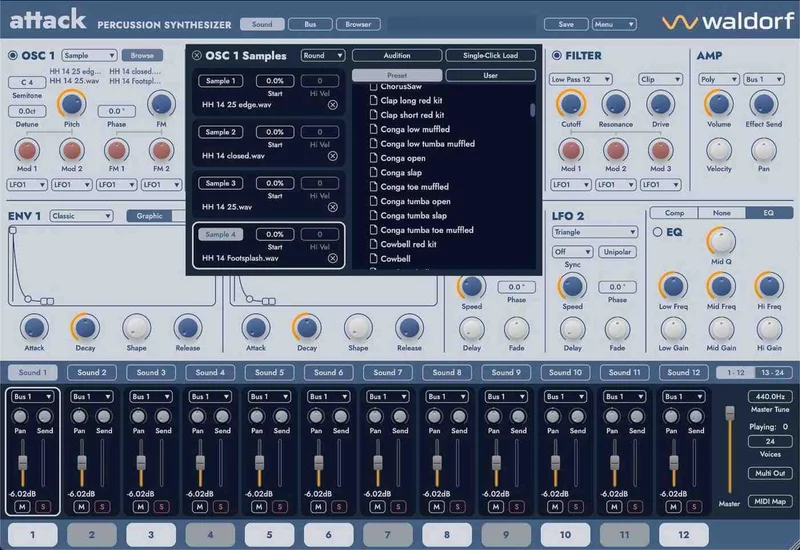
Attack 3 goes there. The version 3.0.1 update added frequency modulation directly to imported samples. That's not a common feature. Most drum synths treat synthesis and sampling as separate workflows. Attack 3 layers them.
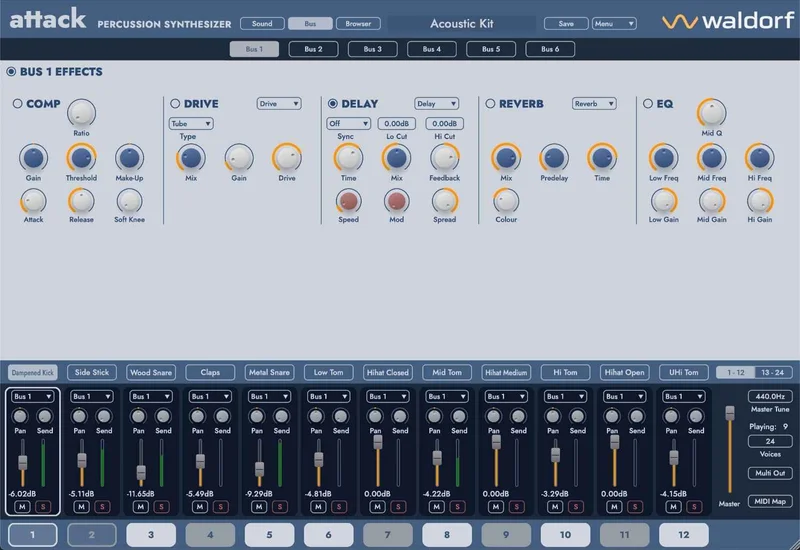
It's also solving the routing problem. Most ITB drum synths collapse everything to a stereo bus. Attack 3 gives you 6 output busses, each with its own compressor, EQ, and three effects slots. That's a proper mix architecture, not an afterthought.
How It Performs in Practice
We loaded a dry, relatively flat 808-style kick sample and applied FM synthesis on top. The result wasn't subtle. Dialling the modulation index up past the midpoint started introducing upper-harmonic content around 2-4kHz that the original sample didn't have. It added a metallic edge, like wrapping a subby low-end in sheet metal. Useful for industrial and dark techno in a way that purely analog-style synthesis can't replicate.
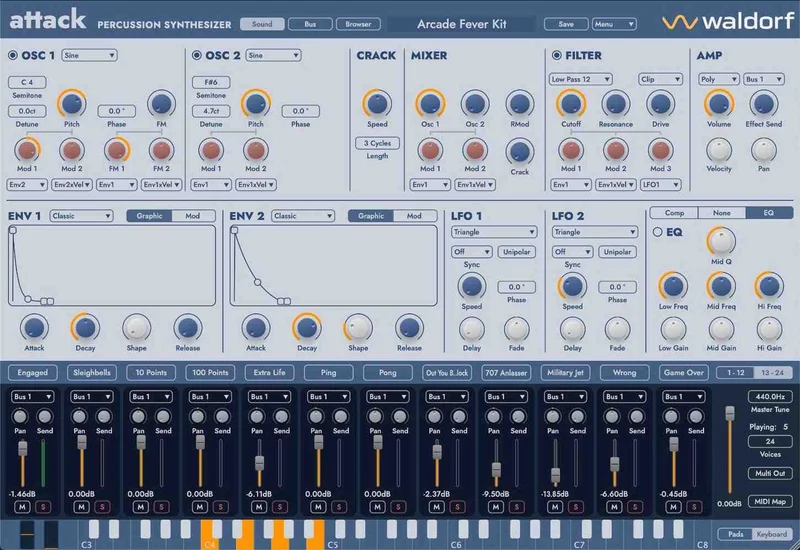
The 24 dB filters are the sharpest thing in the signal chain. Sweeping the low-pass from 18kHz down through 800Hz on a synthesized snare brought the top-end crack down cleanly without introducing the muddy resonance artifacts you'd get from some filter designs. The positive and negative comb filters, paired with sample-rate reduction, let us push a hi-hat from clean to crushed grit in under 30 seconds.
We also loved the 6 drive types. This isn't just one saturation circuit with a "drive" knob. Clip is surgical. Transistor adds low-order harmonic rounding. Diode introduces asymmetric clipping. Crunch gets aggressive. Pickup and Overdrive sit between those poles with different harmonic profiles. Picking the wrong one for the wrong source is actually audible, which means picking the right one matters.
On polyphony: 12 of the 24 sounds play polyphonically, up to 64 voices total system-wide. We ran a pad-style melodic perc sound across a full chord voicing at 6 notes, no dropouts, CPU sitting comfortably around 12-15% on an M2 MacBook Pro. Not lightweight, but not the disaster some complex synths become at high voice counts.
The two LFOs per sound, with sample-and-hold and tempo sync options, are satisfying to modulate against filter cutoff in real time. We set LFO1 to a tempo-synced square wave at 1/16th notes targeting filter cutoff, set LFO2 to noise targeting pitch, and got a rattling, organic snare that no sampler would produce. That's the point of this plugin.
The envelope section now includes a multi-stage ADBDSR mode, with all envelope times and levels fully modulatable. That extra D (a second decay stage) is more useful than it sounds for shaping the body of a kick independently from its tail.
There's no internal sequencer. Not a bug. A decision. Waldorf has always positioned Attack as a multi-layer percussion synthesizer, not a drum machine. You drive it from your DAW's MIDI. For some workflows that's liberating. For producers used to sequencing inside their drum plugin, the first session will feel slightly annoying.
Strengths and Weaknesses
The FM-on-samples capability is the standout strength. It's genuinely underrated in the current coverage of this plugin, and it's the feature that separates Attack 3 from Xfer's Nerve or NI's Battery in a meaningful way. Those tools are excellent samplers. They don't do this.
The per-sound effects chain is brilliant. One selectable effect slot per sound, choosing from Chorus, Delay, Reverb, Drive, Phaser, or Flanger, plus a dedicated compressor and EQ. Then each of the 6 output busses adds another compressor, EQ, and 3 more effects. The total processing depth is ridiculous in the best way.
The weaknesses are real, though. No trial is a genuine problem at $109.99 USD. You can't audition this before buying. That's a trust ask. Velocity mapping and round-robin sample playback are present, but the UI for building those mappings could be cleaner. It's functional, not intuitive. Producers coming from Ableton's Drum Rack workflow will find the round-robin setup slightly fiddly to dial in the first time.
The lack of a sequencer is worth naming clearly. If you're building your next live set with everything self-contained, Attack 3 isn't that. It depends entirely on your DAW or MIDI controller to drive rhythm.
Value for the Price
At the introductory price, this was a no-brainer. At the full $109.99, it still holds up for the right buyer, but that's a harder argument to make.
Compare it to what you'd pay to assemble equivalent functionality: a deep drum synth, a multi-effects chain, a 6-output bus mixer, and FM synthesis on samples. Separately, you're looking at several plugins worth of cost. Attack 3 packages all of it.
Waldorf Edition 2 owners get up to 70% upgrade pricing. Check the manufacturer's site for current pricing on that path. If you qualify, it's worth doing immediately.
Who Should (and Shouldn't) Buy This
- ✅ Buy if you make techno, industrial, IDM, or experimental electronic music and need synthesis depth beyond preset kicks
- ✅ Buy if you're already comfortable programming rhythm in your DAW and want your drum synth to be a dedicated sound design instrument
- ✅ Buy if you're a Waldorf Edition 2 owner: the upgrade pricing makes this close to an obvious yes
- ❌ Skip if you need an internal step sequencer built into the drum plugin
- ❌ Skip if you work primarily with acoustic drum samples and need velocity-layered realism over synthesis
- ❌ Skip if $109.99 is a stretch and you missed the introductory discount window: wait for a sale
Score Breakdown
| Category | Score | Notes |
|---|---|---|
| Sound Quality | 4.5/5 | FM-on-samples and 6 drive types produce timbres most drum synths can't reach |
| Value for Money | 4.0/5 | Full price is fair for the feature set; introductory discount made it exceptional |
| Ease of Use | 3.5/5 | Scalable UI helps, but round-robin mapping and the no-sequencer workflow require adjustment |
| Features | 4.5/5 | 24 sounds, 6 busses, ADBDSR envelopes, 2 LFOs per sound, FM on samples: deep |
| CPU Efficiency | 4.0/5 | Around 12-15% on M2 at moderate use; well-managed for this level of complexity |
| Overall | 4.3/5 | A serious percussion synthesizer that earns its place in an advanced producer's signal chain |
Alternatives to Consider
Xfer Nerve: Excellent step sequencer built in, clean sample playback engine. No FM synthesis on samples, no multi-output bus routing depth. Wins on workflow speed for beat-makers. Loses on sound design range. Compare drum synth options for your workflow
BLEASS Analog/FM Synth Bundle: If FM synthesis is the feature drawing you to Attack 3, the BLEASS bundle shows what dedicated FM design looks like on melodic content. It's not a percussion synthesizer, but it covers hybrid analog/FM territory at a different price point. Analog FM Synth Bundle Review
Applied Acoustics Chromaphone 3: Physical modelling approach to percussion, completely different synthesis method. Better for organic, acoustic-adjacent sounds. Not for industrial or electronic textures. Worth knowing if you need percussive synthesis that goes toward realism rather than away from it. Chromaphone 3 Sound Bank Review
For tape-saturated sample grit as a complement to Attack 3's synthesis engine, check the Tape Synths Expansion review for a different textural angle.
Attack 3 sits in a category of one if FM synthesis on your own samples is non-negotiable. Nothing else at this price does that. If it's not on your must-have list, Nerve handles rhythm programming faster and Chromaphone 3 goes deeper on physicality. But if you're building percussion sounds from the oscillator up, layering FM on imported samples, and routing everything to a proper bus structure, Attack 3 is the pick. At $109.99, it's not cheap. It's not trying to be. Buy it for what it does. Skip it if you want a drum machine.
Frequently Asked Questions
Does Attack 3 have a built-in step sequencer?
No. Waldorf deliberately kept Attack 3 as a pure percussion synthesizer rather than a drum machine. You sequence it from your DAW's piano roll or MIDI controller. This is the same philosophy as the original 2001 Attack. If you need an internal sequencer, look at Xfer Nerve or NI Battery instead.
Can Attack 3 run FM synthesis on my own imported samples?
Yes, and this is the headline feature of the version 3.0.1 update (March 2026). You can apply frequency modulation to user-imported samples, not just the built-in synthesis engine. This opens up timbral territory that most drum synths, which treat synthesis and sampling as separate workflows, don't touch.
What's the difference between the 12 polyphonic sounds and the other 12 sounds in a kit?
Each kit holds 24 sounds total. 12 of those are playable polyphonically, meaning they can hold multiple simultaneous notes across pitch, useful for melodic percussion, pad-style hits, or chromatically tuned elements. The other 12 operate in standard percussive mono/poly mode. Total system polyphony is 64 voices.
Is there a free trial for Attack 3?
No trial is currently available. Activation requires a serial number redeemed through a Waldorf account. Given the $109.99 price point, this is a real weakness. Watch for sale periods and upgrade pricing if you're eligible as a Waldorf Edition 2 owner, where discounts up to 70% have been offered. The current price is shown in the buy box on this page.