
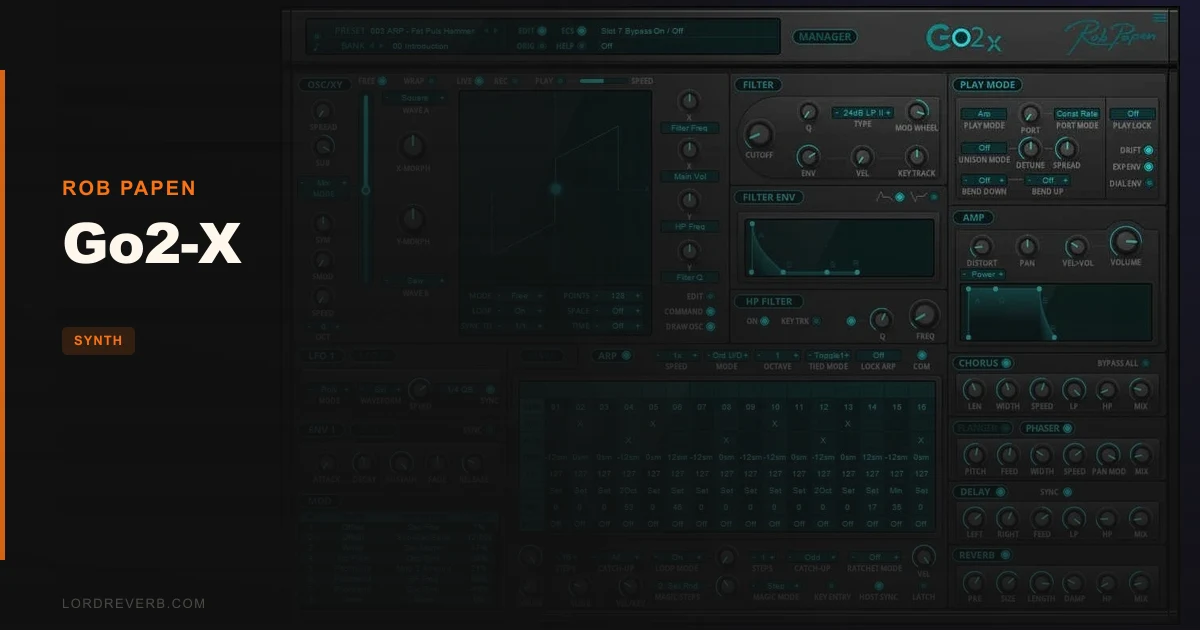
Rob Papen's Go2-X is a $49 synth plugin that earns its price within the first 20 minutes. It's built for producers who want every control visible at once, no page-diving, no hidden menus, just a single screen that does a lot. If you are tired of paying full price for synths you use a fraction of, this is your exit ramp.
We were building a cinematic cue. Needed a pad that moved. Opened Go2-X, landed on a preset called something vaguely cosmic, and within three minutes we'd drawn a custom waveform, pointed the XY pad at filter cutoff and oscillator morph simultaneously, and set it looping bidirectionally at 0.5x speed. The pad breathed. It shifted. It had a life we didn't have to automate manually in the DAW.
That's the pitch. And mostly, it holds up.
First Impressions: One Screen, No Excuses
You open Go2-X and everything is right there. Oscillators top-left. Filter centre. Amplifier, distortion, play mode to the right. LFOs, envelopes, mod matrix, XY pad and arpeggiator filling the lower half. It's dense, but not cluttered.
Rob Papen designed this as the synth missing from their own lineup: one where you never have to navigate away from the main view. In the Rob Papen world of synthesis, there was one type of synthesizer missing: a synthesizer that has all of its controls and features available visually all at once. That concept survives fully intact in the X version.
The GUI scales from 100% to 200%. On a 27-inch 4K monitor at 150% it looks satisfying. On a laptop at 100% it's a squeeze, but still workable.
Install is a serial-based offline activation. The activation system is offline, meaning there's no direct connection between the plugin and robpapen.com during use, and it can be installed on 2 of your own computers. No iLok. No dongle. Good.
Getting It Into a Real Workflow
We dropped Go2-X into an Ableton session and hit the browser first. Over 1,600 presets sorted into bank folders, with a Quick Browser, Favourites system, and Star rating. That's a lot. The Quick Browser is genuinely fast. Scrolling through and auditioning presets while a loop plays takes about 30 seconds to find a starting point.
From there, editing is mostly frictionless. The morph knob between Wave-A and Wave-B is the first thing you'll reach for. The heart of Go2-X is the morph oscillator, which lets you morph between two different waveforms using 15 morph modes including Mix, Morph, Low/High Partial Morph, Odd/Even Partial Morph, Table Interpolate, Table Split, Table Combine, FM, PM, AM, Ring Mod, WaveShaper, and Range. That's not a gimmick list. FM and Ring Mod especially open the synth into metallic, inharmonic territory that surprises you for the price.
The friction point is the waveform editor. Drawing custom waves by hand works fine in Draw mode. Switch to Partials mode and you're editing harmonic content with a frequency-domain view. It's powerful. It's also where producers who learned synthesis on presets will stall out. There's no in-app tutorial. The PDF manual exists but nobody opens it at 2am when inspiration hits.
One other snag: the 4 FX units run in serial mode. Chorus into Flanger/Phaser into Stereo Delay into Reverb. If you want the delay feeding a separate reverb bus with different settings, you're routing outside Go2-X. Not a dealbreaker, but worth knowing before you buy.
What It's Genuinely Good At
The XY pad is where we spent most of our time. And we love it. It's both a live, interactive control and an automated programmable modulation source, with playback of a recorded path at adjustable speed, Poly/Free/Mono modes, loop and bidirectional loop modes, tempo sync, and from 2 up to 128 breakpoints. That's a motion sequencer disguised as a pad.
We mapped the X axis to oscillator morph depth and the Y axis to filter cutoff. Set a 64-point path running at 0.25x speed, bidirectional loop. The result was a pad that took 32 bars to complete one full timbral cycle. No automation clips drawn. No LFO shapes fought with. Just the pad, alive.
The arpeggiator is underrated. It runs up to 16 steps, and per step you can set note on/off, tie, slide, tune, velocity, unison/chord, free, and ratcheting. Ratcheting means individual steps subdivide. Set step 5 to ratchet at ×4 and you get a stuttered flam right where you want it, without touching your MIDI editor.
The distortion sits at voice level inside the amplifier section, which is a clever placement. 11 distortion types: Atan, Bit, Cos, Cross, Fold, Limit, Over, Power, Rate, Saturate, Square. We ran a lead through Fold with the amount at around 40% and got natural-sounding fuzz that sat in the mix without needing a separate saturation plugin on the channel strip.
For comparison: Serum's wavetable editor is more visual and arguably more immediate for someone who learned synthesis on Xfer products. But Serum costs considerably more. Go2-X does FM morphing, partial waveform drawing, a motion XY sequencer, an advanced arp with ratcheting, and 4 serial FX for $49. The dollar-per-feature ratio isn't close.
The Rough Edges
The waveform editor has a real learning curve. Draw mode is fine. Partials mode, where you sculpt harmonic content by adjusting individual overtones, requires you to understand what the 3rd partial sounds like relative to the fundamental. Most producers landing on this synth for its accessibility don't have that fluency. It's frustrating to have the tool there and not know how to use it properly.
The arpeggiator has 11 modes including Chord, Sequencer, and Sequencer Reset. It's a genuinely deep arp. But the Magic Mode, borrowed from Rob Papen's BIT-2, randomises step tuning and arrangement in ways that aren't always predictable. We got brilliant results twice and annoying chaos four times. It's a creativity tool, not a precision one.
CPU load sits at medium-light for a single instance. Stack four with unison and XY animation running and you'll feel it on older machines, but nothing alarming on anything from 2020 onward.
No standalone mode. Not a problem for most DAW-based producers, but worth knowing if you were hoping to use it for live performance outside a host.
Who This Is Really For
- ✅ Buy if you want a single synth that covers pads, leads, bass, and motion design without opening a second plugin.
- ✅ Buy if you do a lot of evolving, slowly-shifting textures and don't want to draw 32 bars of automation per parameter.
- ✅ Buy if you're a Go2 owner wanting the arp ratcheting, waveform drawing, and simultaneous delay/reverb without paying full price for a new synth.
- ❌ Skip if you need a wavetable synth with a visual waveform import and frequency-domain painting like Serum or Vital. Go2-X's waveform editor doesn't compete there.
- ❌ Skip if complex FM synthesis is your main language. Go2-X has FM morph mode, but dedicated FM synths like Dexed or Arturia DX7V go deeper for less or similar money.
- ❌ Skip if you're a bass-specialist producer looking for a focused single-purpose tool. BeatSurfing LOW is built for exactly that and doesn't ask you to scroll past 1,600 pads to get there.
Score Breakdown
| Category | Score | Notes |
|---|---|---|
| Sound Quality | 4.0/5 | Morph oscillator produces genuinely interesting timbres; FM and Ring Mod modes punch above the price |
| Value for Money | 5.0/5 | $49 for 1,600+ presets, 15 morph modes, motion XY sequencer, and advanced arp is hard to argue with |
| Ease of Use | 3.5/5 | One-screen layout is brilliant; Partials waveform editor will stop many producers cold |
| Features | 4.5/5 | Ratcheting arp, XY animation, custom waveforms, 20 filter types, few synths at this price match the breadth |
| CPU Efficiency | 4.0/5 | Light on single instances; stacked unison voices with animated XY will cost you on older hardware |
| Overall | 4.2/5 | One of the most feature-dense synths at $49, with one friction point that matters less as you learn it |
Alternatives to Consider
Vital (free / paid tiers): Free tier gives you a powerful wavetable synth with a more visual waveform editor. Better choice if wavetable sound-design is your priority and you want a shorter learning curve on the oscillator section. We've covered synth bundle options that pair well with it in our BLEASS Analog FM Synth Bundle review.
Serum (premium price): The benchmark for wavetable synthesis ITB. More immediate waveform editing, larger third-party preset ecosystem, higher CPU cost. If you're billing sessions, the investment makes sense. If you are making beats at home, the price gap between this and Serum is a real conversation. Check current pricing on Xfer's site.
Audio Blast ABX3 Bundle: If you specifically want acid-style synthesis and are drawn to Go2-X for its filter section, we tested a more focused alternative. Our ABX3 Bundle review breaks down whether it replaces a dedicated acid synth. Different tool, different target.
For producers coming from a sample and sound-bank angle rather than synthesis, the Synth City Chromaphone 3 review covers a workflow that complements Go2-X well when you need acoustic-model textures alongside its synth pads.
The Verdict
Go2-X is a genuinely clever synth sold at a price that makes it almost risk-free. The one-screen philosophy works. The XY pad is brilliant as a motion sequencer. The arp with ratcheting is the kind of feature that used to cost a lot more to get near. At $49, this is a buy.
The caveat is real though: if you're a beginner producer who finds Serum's wavetable view overwhelming, Go2-X's Partials editor will stop you in the same place. The draw mode is fine. Partials mode needs time investment. Know which mode you'll actually use before you fall in love with the feature list.
For anyone making cinematic, electronic, or experimental music who wants one synth to cover most of their movement and texture needs without opening a second plugin: buy it. For bass-specialists or dedicated FM heads: there are sharper tools at similar prices. But as a generalist workhorse that goes deep when you push it, Go2-X earns its place in the signal chain.
Forty-nine dollars. That's less than a dinner out. The pad we made on day one is still in the project.
Frequently Asked Questions
Is Go2-X an upgrade from the original Go2, or a separate purchase?
Go2-X is a separate product, not a free update to Go2. The original Go2 became very popular and widely used in productions, and Go2-X is its upgraded successor with additional features and enhancements. If you own Go2, check Rob Papen's site for any crossgrade pricing, but expect to pay for the upgrade. At $49 it's not painful.
Can you run the Stereo Delay and Reverb at the same time?
Yes. Go2-X gives you the option to use the Stereo Delay and Reverb simultaneously. The 4 FX units run in serial mode: Chorus, then Flanger or Phaser, then Stereo Delay, then Reverb. You can't run them in parallel inside the plugin, so if you need different wet/dry balances on each, you'll route externally in your DAW.
Does Go2-X support MPE controllers?
Go2-X includes a Poly MPE play mode. This means it responds to per-note pitch, pressure, and slide data from MPE-capable controllers like the Roli Seaboard or Expressive E Osmose. It's one of 9 available play modes, so you switch into it deliberately rather than it being always-on. Useful if you have an MPE controller and want expressive pad performance.