
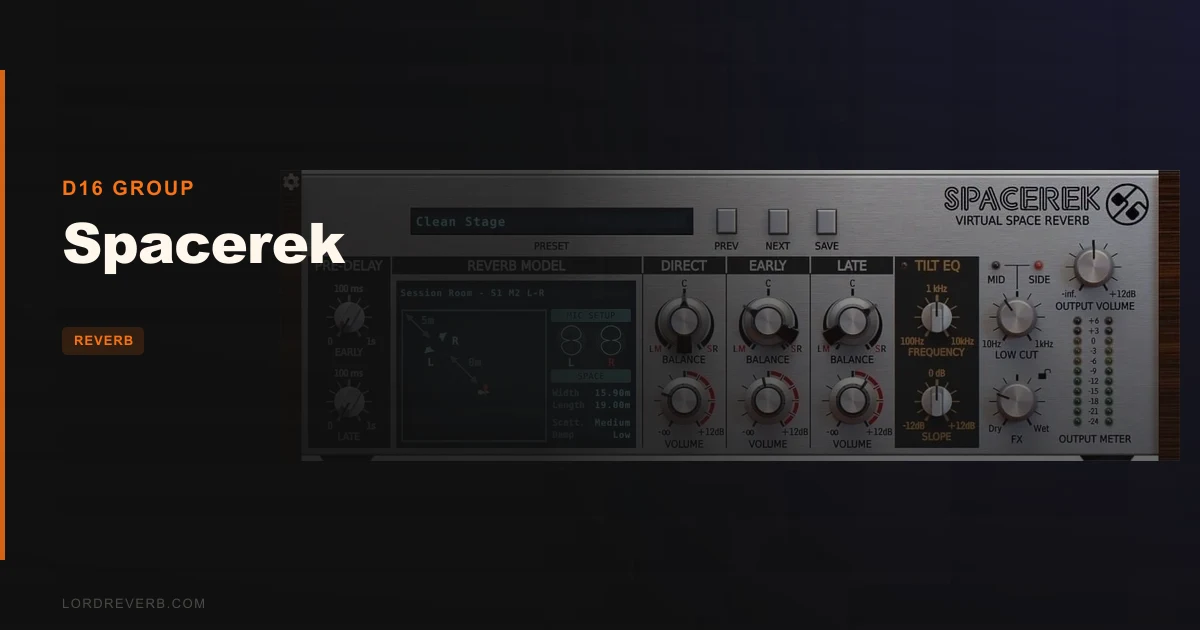
The Spacerek review you're looking for comes down to one honest answer: it's a capable small-room reverb at $42.50 that runs out of convincing space the moment you push it into larger acoustic territory.
Picture this. You're two weeks from a deadline, your track needs a realistic booth or chamber reverb, and your go-to plug-in licence just expired on the machine you're working on. You pull up Spacerek, scroll through 114 room models, dial in an early reflections mix, and get something that sounds genuinely plausible in about three minutes. That's the scenario where D16 Group's approach works. It's fast, it's lean enough most of the time, and the small-room models land with convincing detail.
But push it toward a cathedral or a long tunnel, start expecting the kind of spatial realism that pricier algorithmic or convolution reverbs offer, or try to get grimy and destructive with it without bolting on external processing, and the cracks appear quickly. This is not a one-size signal chain tool. It's a focused instrument with a narrow sweet spot, and at $42.50 that's not a dealbreaker as long as you know where the sweet spot ends.
This review is for producers who are deciding whether Spacerek fits their room-reverb needs or whether the money goes further elsewhere.
What Spacerek Actually Is (and Where It Stops)
Spacerek is a room modelling reverb plugin from D16 Group. It uses a hybrid algorithm that pairs Virtual Space Reverb simulation for early reflections with a dynamic delay network for the late tail. The idea is acoustic accuracy without the CPU weight of full convolution.
114 room models. That's the headline. Booths, chambers, halls, tunnels, chapels, towers. Each model comes with multiple microphone and speaker configurations, though those configurations are fixed. You can't reposition a mic. You can't reshape a room's geometry. What D16 have captured, you get.
That matters more than you might think. Owners describe being frustrated by those fixed positions at first, only to work around them using the three-channel mixer. But there's a ceiling to what mixing dry, early, and late signal ratios can substitute for genuine room parameter control.
What it's not: it's not a creative, destructive reverb. It won't mangle a signal into something unrecognisable without help. It's not a large-hall specialist. And it's not a plug-in for producers who want to sculpt decay, adjust room dimensions, or push beyond what D16's captured models contain.
If you want convincing acoustic space for vocals, drums, or instruments in mid-sized environments, Spacerek earns its keep. For everything else, the limits are real.
The Moment You'll Reach for It
You're mixing a vocal that sounds too dry and too close. You want it to feel like the singer was in a small live room, not a bedroom with acoustic panels. You don't want the reverb to wash the consonants out or introduce a tail that fights the next syllable. You want early reflections that place the voice in a space without drowning it.
That's Spacerek's scene. Pull up one of the booth or small-chamber models, set your early reflections pre-delay to taste, ride the three-channel mixer to bring the late tail back until it's supporting rather than smearing, and you're done faster than you'd expect.
The same applies to room miking on drums, adding chamber character to a piano, or placing acoustic guitar in a believable space. Small-to-mid size rooms are where owners consistently report the plugin sounding convincing, and that report lines up with how the hybrid algorithm's early reflection engine was designed to behave.
Where you won't reach for it: epic string sections that need a sweeping hall. Live drum buses where you want the reverb tail to tell a story over three seconds. Atmospheric texture work where the reverb itself is a sound design element. Those calls go elsewhere.
Inside the Hybrid Algorithm
D16 built Spacerek around two distinct processing stages that hand off signal between them. Early reflections run through the Virtual Space Reverb simulation. This is the perceptually critical part: early reflections define where you are in a room before the diffuse tail arrives, and getting them wrong is what makes algorithmic reverbs sound fake.
Late reflections are handled by a dynamic delay network. This is a more computationally efficient approach than full IR convolution for the late field, which is part of why D16 can claim CPU-friendliness without fully lying.
The handoff between the two stages is where things get interesting. When it works, the blend feels seamless. Owners describe it as clean and natural-sounding in the right presets. But some early reflections presets are reported as transient-heavy and artificial, which suggests the Virtual Space simulation has varying success depending on the room model loaded.
Honestly? The algorithm is clever. Getting super-realistic early reflections cheaply is genuinely hard, and D16 have done something worth attention. The frustration is that you can hear the joins in the larger room models, where the dynamic delay network's late tail doesn't quite match the character the early reflection stage set up.
The Three-Channel Mixer: Your Main Control Surface
This is the part of Spacerek that owners initially underestimate and then rely on heavily.
Three channels: Direct signal, Early reflections, Late reflections. Each has independent volume and balance controls. That's your spatial toolkit when fixed mic positions limit your room sculpting options.
Push the early reflections up and pull the late tail back, and you get a close, defined space with minimal wash. Flip it, and the late field takes over, pushing the source further back in the mix. The balance controls let you shift the stereo image of each reflection stage independently, which is a genuinely useful tool for placing instruments in a field rather than just wetting them.
Stereo mode switches between L-R and M-S processing. The M-S option is useful for controlling how much of the reverb sits in the centre versus the sides, which matters if you're applying Spacerek to a bus and want the tail to open wide without crowding the centre image.
The three-channel mixer doesn't replace full room parameter control. But it's a satisfying workaround for a lot of situations, and it's where the plugin's real spatial flexibility lives.
Pre-Delay Controls: Precision You Might Not Need
Spacerek's pre-delay is adjustable in nanoseconds, microseconds, and milliseconds, with an offset range extending up to 1 second per channel. Early and late reflections each get their own independent pre-delay.
That granularity is unusual. Most reverbs give you a single pre-delay in milliseconds and move on. Having independent pre-delay per reflection stage lets you create more complex spatial staging: you can tell the early reflections to arrive immediately while pushing the late tail back 40ms, or build a pre-delay offset that creates a double-room effect.
In practice, the nanosecond and microsecond precision is probably overkill for most sessions. The millisecond range is where you'll spend your time. But having the option is satisfying, and the independent control per channel is a workflow advantage that the mixer section doesn't replicate.
One real-world snag: users report that inability to control delay time causes groove to feel off in larger room presets. The pre-delay helps manage this, but it's patching a problem that stems from the fixed room parameters rather than solving it at the source.
EQ and Filter Options
Tilt EQ is available for boosting lows or highs across the reverb signal. It's simple: a single tilt rather than a parametric EQ, which means you're trading flexibility for speed. If you want to warm up a room tail slightly or take the edge off a bright early reflection, the tilt handles it without opening a separate EQ plugin in the chain.
The Low Cut filter is independently activatable for Mid and Side components. This is a clever inclusion. Cutting low-end mud from the Mid channel of a reverb tail while leaving the Side component untouched keeps the bottom clean without thinning the stereo width of the effect. It's the kind of detail that shows D16 thought about mixing workflows rather than just acoustic modelling.
What's missing: there's no high cut. No parametric control. No frequency-specific shaping beyond the tilt and the low cut. For producers who habitually high-shelf reverb tails down to control brightness, this means reaching for an EQ after Spacerek in the signal chain, which is an extra step that more expensive reverbs handle internally.
The Preset Browser and Room Library
114 room models with multiple mic and speaker configurations per model means the actual preset count is considerably higher. The tag-based browser lets you filter by room type, which is the right call for a library this size.
Auditioning is fast. Tag-based navigation gets you to booth models or chapel models without scrolling through everything, and the browser is clean enough to use without frustration.
But there's a legitimately annoying UX issue that owners flag: the visualiser in the GUI suggests that microphone positions are clickable and adjustable. They're not. Clicking opens the preset menu instead. For users expecting hands-on room positioning, this reads as false advertising. It's not a subtle misread. The visual language of the interface implies interactivity that doesn't exist.
D16 should fix this, or at minimum redesign the visualiser to remove the implication. It's a trust issue in a product that otherwise earns credibility through its sound. When something looks interactive and isn't, users feel misled.
CPU: The Honest Picture
D16 describe Spacerek as CPU-friendly. The developer claims the hybrid design keeps CPU usage lower than expected for acoustic modelling of this complexity. That claim has real support in some contexts and falls apart in others.
On modern systems with current-generation CPUs, the efficiency story holds up reasonably well for small and mid-room presets. The dynamic delay network for late reflections is a smarter choice than full convolution when you're running multiple instances.
But owners report some presets consuming 30% or more CPU on 2012 i7 systems. That's not a modern system, granted. But it matters if you're running older hardware, and it complicates the "surprisingly low CPU cost" claim that D16 lead with.
The honest answer: Spacerek is moderately CPU-efficient on current hardware, variable on older systems, and genuinely inconsistent across presets. Some presets are lighter than others, and the developer's efficiency claims apply more to the architecture's ceiling than to every preset in the library.
System requirements ask for a minimum of 8 GB RAM and either a 3.2 GHz single-core (Windows) or Intel 1.8 GHz / Apple M1 (Mac). Those aren't aggressive demands. The 16 GB recommended RAM is a reasonable modern baseline.
Large Rooms: Where It Loses the Argument
This is where the mostly critical angle of this review earns its keep. Advanced users report the larger room models sound artificial, which aligns with the broader finding that larger reverb spaces tend to sound unconvincing compared to small-to-mid size rooms.
Load up a hall or tower preset. Push the late tail out. The dynamic delay network that handles late reflections with modest CPU overhead doesn't have the density or the organic decay character that a full convolution reverb or a high-quality algorithmic hall reverb achieves. The tail thins, flattens, or takes on a slightly repetitive texture that breaks the illusion of genuine space.
Compare this to what Lexicon and Quantum-class reverbs do with large spaces. Those tools handle the density and randomness of a true late field differently, and the results in large halls make Spacerek's comparable presets sound like approximations.
If 80% of your reverb work involves rooms, booths, chambers, and mid-sized halls, Spacerek serves you. If you regularly need convincing large spaces, the $42.50 you save over a Valhalla Room licence or a Lexicon reverb buys you a constant reminder that you compromised.
Grimy and Destructive: Not the Tool
Owners note Spacerek is not well-suited for grimy or destructive reverb effects without additional external processing. That's a category of use that matters for certain genres: lo-fi, industrial, experimental electronic, anything where the reverb itself needs to feel broken, saturated, or spatially wrong in an interesting way.
Spacerek aims for acoustic realism. Its algorithm doesn't have saturation, distortion, or modulation parameters designed to push reverb into creative damage territory. You can run it into a distortion plugin after the fact, but the reverb itself won't do the heavy lifting for that aesthetic.
If your room reverb needs to sound like a stairwell recorded on a broken cassette deck, Spacerek provides the stairwell and you provide the broken cassette deck. That's not necessarily a flaw in a tool designed for acoustic modelling, but it's worth knowing before you load it up expecting flexibility it was never built for.
The Trade-Offs
The price is real. At $42.50, Spacerek competes in a range where most reverbs are either basic or overpriced for what they deliver. D16's 114-room library at this price point is legitimately strong value if the room quality matches your needs.
The three-channel mixer and independent pre-delay are genuinely clever workarounds for the fixed mic position limitation. They don't eliminate the limitation, but they give you enough spatial control that many producers will never hit the ceiling.
The trade-off: you're paying for a fixed acoustic library rather than a fully parameterised room engine. Every decision about room geometry, mic placement, and speaker configuration was made by D16's team at capture time. You're a customer choosing from a menu, not a designer building a space. For some workflows, that's liberating. For others, it's a cage.
The CPU inconsistency is a genuine annoyance. A tool sold on efficiency claims should be consistent across its own presets.
Against the Field
D16 Group Toraverb 2 shares early and late reflection control but runs a different engine with more experimental character. If you want controlled acoustic spaces, Spacerek is the more focused tool. If you want something that pushes into unexpected spatial territory, Toraverb 2's character suits that better. Both are D16 products, so the workflow logic is similar, but the sonic direction diverges.
Valhalla Room is the name that comes up most often in the same breath as Spacerek. Valhalla's algorithmic approach handles large spaces more convincingly. The late field density in Valhalla Room's bigger presets doesn't have the same artificial quality owners report in Spacerek's halls. For large-room work, Valhalla Room wins clearly.
Lexicon reverbs handle large spaces differently. Lexicon's large hall pedigree is established and the late-field realism reflects decades of hardware refinement. But Lexicon's price point is considerably higher, which means the comparison only matters if large-hall quality is non-negotiable for you.
Quantum reverbs also handle large spaces differently. If your sessions live in halls and large chambers, either Quantum or Valhalla Room is a stronger investment.
For small-to-mid room work at the price, Spacerek holds its own. That's the lane where it competes honestly.
Valhalla Room
Handles large spaces with more convincing late-field density and broader parameter control
Spacerek
Better value for small-to-mid room modelling from a 114-model library at a lower price
The Real Verdict
Spacerek is worth buying if your reverb work centres on booths, chambers, and small-to-mid halls, and you can live with a fixed acoustic library rather than a fully parameterised room engine. At $42.50, the 114-model library and the three-channel mixer are genuinely useful tools that many producers will get real mileage from.
Skip it if you need convincing large-space reverbs, destructive or creative reverb effects, or deep parameter control over room geometry and decay. Those needs go to Valhalla Room or Toraverb 2 depending on your direction.
Spacerek isn't a bad plugin. It's a narrow one. The producers who understand that upfront will get value from it. The ones who expect it to cover everything will be disappointed faster than they expect.
Specs & Technical Details
| Developer | D16 Group |
| Price | $42.50 |
| Plugin Format | VST2 / VST3 / AU / AAX |
| OS Support | Mac (macOS 10.13 to 12 Monterey, 64-bit) / Windows (7 to 10, 32 or 64-bit) |
| Activation | N/A |
| CPU Usage | Variable: light to medium on current hardware, heavier on older systems with select presets |
| Trial Available | N/A |
| Version Reviewed | N/A |
| Minimum RAM | 8 GB |
| Recommended RAM | 16 GB |
| Windows Min CPU | Single-core 3.2 GHz SSE |
| Mac Min CPU | Intel 1.8 GHz or Apple M1 |
| Internal Processing | 64-bit |
| MIDI Learn | Yes |
| Resizable GUI | Yes |
Score Breakdown
| Category | Score | Notes |
|---|---|---|
| Sound Quality | 3.0/5 | Convincing in small-to-mid rooms, artificial in large spaces, inconsistent across the library |
| Value for Money | 3.5/5 | 114 room models at this price is competitive, but the fixed architecture limits long-term flexibility |
| Ease of Use | 2.5/5 | Tag browser is fast; the misleading visualiser and fixed mic positions create genuine workflow frustration |
| Features | 2.5/5 | Three-channel mixer and independent pre-delay are clever; lack of decay and room parameter editing is a real gap |
| CPU Efficiency | 2.5/5 | Inconsistent: reasonable on current hardware, 30%+ reported on older systems across select presets |
| Overall | 2.8/5 | A focused small-room tool with a fixed library, sold at a fair price for what it delivers in its narrow lane |
Alternatives to Consider
D16 Group Toraverb 2
Toraverb 2 shares Spacerek's early and late reflection control logic but runs a different engine with more experimental spatial character. If you want acoustic realism, Spacerek is more focused. If you want controlled chaos and unusual spatial textures, Toraverb 2 goes places Spacerek doesn't. Both are D16 tools, so the UI logic is familiar if you've used one already.
Valhalla Room
Valhalla Room wins on large spaces. The late-field density and room character in Valhalla's hall and chamber presets hold up where Spacerek's tail thins and flattens. For producers who regularly need convincing long-decay reverbs, the extra investment in Valhalla Room pays back quickly. For small rooms on a tighter budget, Spacerek keeps up better than the price difference suggests it should.
Lexicon Reverbs
Lexicon handles large spaces differently, and the pedigree in that area is genuine. If your sessions live in concert halls and you need a reverb that can carry a string section convincingly, Lexicon's large-room algorithms have decades of refinement behind them. The price gap over Spacerek is significant, so this comparison only makes sense if large-hall accuracy is a non-negotiable production requirement.
Spacerek is the right buy if you need a fast, affordable room modelling tool for small-to-mid acoustic spaces and you're not expecting the library to cover every reverb situation in your session. At $42.50, it earns that narrow recommendation cleanly. But if your mix lives in halls, needs serious spatial flexibility, or demands destructive reverb character, the library's fixed architecture will frustrate you within a week. Skip it and put that money toward Valhalla Room or Toraverb 2 based on which direction your sound lives in.
Related reviews: Radiance Review
Frequently Asked Questions
Is Spacerek good for vocals?
Yes, within specific use cases. Load up a booth or small-chamber model, ride the early reflections up slightly in the three-channel mixer, and pull the late tail back so it supports rather than washes the vocal. Small-to-mid room presets are where owners consistently report the plugin sounding natural. For large, lush vocal reverbs with long tails, it's less convincing.
Can you adjust the microphone positions in Spacerek?
No. Microphone and speaker positions are fixed per room model. The visualiser in the GUI looks like it offers interactive mic positioning, but clicking it opens the preset menu instead. This is a known UX complaint among owners. Your spatial flexibility comes from the three-channel mixer and independent pre-delay, not from repositioning the virtual mic.
How does Spacerek handle CPU on modern systems?
On current hardware, it's reasonably lean for most presets. D16 built the hybrid algorithm to keep CPU lower than full convolution while delivering acoustic modelling complexity. That said, some presets have been reported consuming 30% or more on 2012-era i7 systems, so the efficiency is preset-dependent and hardware-dependent. Modern multi-core machines fare better.
Is Spacerek suitable for large hall reverbs?
Not convincingly. Owners and reviewers note that large room models tend to sound artificial compared to the small-to-mid size rooms where the plugin performs at its best. The dynamic delay network handling late reflections doesn't achieve the late-field density that specialist hall reverbs provide. If large halls are your primary need, Valhalla Room or Lexicon reverbs are stronger options.
What DAWs and formats does Spacerek support?
On Windows, it supports VST2, VST3, and AAX. On Mac, it adds AU alongside those three. Mac support runs from macOS 10.13 up to macOS 12 Monterey in 64-bit only. Windows support covers versions 7 through 10 in both 32 and 64-bit. It requires a host DAW to run; there's no standalone mode.
How does Spacerek compare to D16 Group Toraverb 2?
Both share the concept of independent early and late reflection control, but the engines and characters differ. Spacerek aims for acoustic realism with 114 real-space models. Toraverb 2 runs a different architecture with more experimental spatial character. If you want convincing room modelling, Spacerek is the more focused tool. If you want a reverb that pushes into unusual spatial territory, Toraverb 2 goes places Spacerek was never designed to reach.