
BLEASS Reverb earns a recommendation for producers who want a focused, well-designed reverb with clever ducking and a genuinely satisfying freeze, without spending a lot of time digging through menus to get there. You're at the moment where your drum bus sounds like it's swimming in a school gymnasium. The reverb is too loud, it's fighting the kick, and you need something that gets out of the way on the transient and comes back cleanly in the decay. That's the exact problem BLEASS Reverb is built to solve. It's a three-stage plugin: input shaping, reverb core, and an integrated ducker. No fluff. If you produce drums, percussion, or anything where clarity and reverb need to share the same space without negotiating, this one is worth your attention.
What It Actually Is (and Where It Falls Short)
BLEASS Reverb is a VST3 and AU plugin for macOS 10.15 or later and Windows 10 or later, 64-bit only. No standalone mode. You need a DAW.
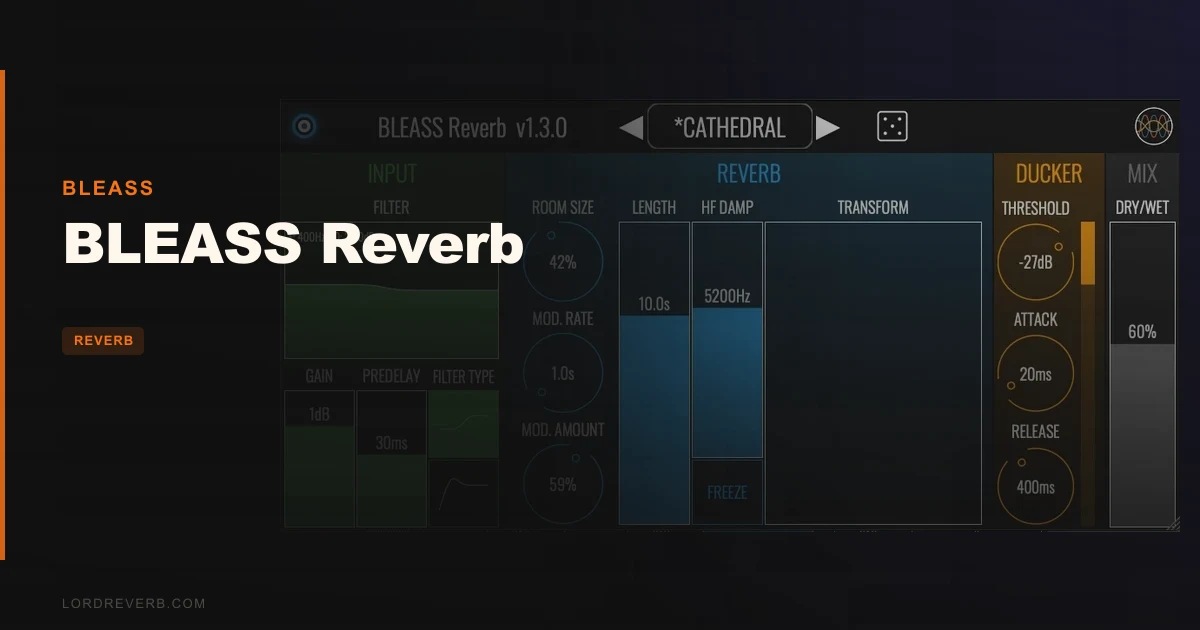
The three stages, Input, Reverb, and Ducker, flow left to right. Input handles gain, pre-delay for early reflections, a low-shelf filter, and a high-pass filter with a resonant peak. Reverb handles size, modulation, length, and high-frequency damping. The Ducker is a compressor side-chained to your dry input.
What it's not: a deep-library workhorse with hundreds of presets. It's not built for lush, 30-second ambient tails either. If you're designing slow-moving atmospheric pads or scoring orchestral rooms, you'll hit the reverb length limit and wish you'd grabbed something else. For surgical sound design or big cinematic spaces, the tool runs out of road.
Where It Fits in Your Session
Drop it on a snare return and push the decay. That's where this plugin earns its place. The high-frequency damping pulls in that plate reverb texture, tight and controlled, nothing blooming out of control into your 2-5kHz range where the vocals sit.
Now engage the Ducker. Your kick fires, the reverb ducks, the tail comes back between hits. No sidechain routing to set up manually. It's already there, built into the third stage. If you've ever spent twenty minutes routing a compressor sidechain just to stop your reverb from eating your low end, you'll love how fast this is.
The X/Y panel in the reverb stage applies a frequency shifter and waveshaper to the reverb space. Push it toward one corner and the tail starts to feel unstable, metallic, moving. Owners describe the transform panel as producing fun self-oscillating effects, and that tracks with how the waveshaper behaves in a moving reverb field. It's not predictable and that's the point.
Freeze the reverb and hold it. Owners rate this freeze function above EOS2's implementation. That's not a small thing. Use it for a swell, a build, a moment where the room itself becomes a note.
The Trade-Offs Worth Knowing
The ducking is clever and the freeze is satisfying. But BLEASS Reverb has a narrower range than you might want if you're doing multiple reverb duties across a full mix.
Some owners find it sterile. That's a real complaint, not just a preference mismatch. A reverb that sounds sterile on strings or acoustic instruments is one you'll keep bypassing in those contexts. The character works on percussion because transients are short and the room doesn't need warmth. On sustained instruments, the lack of organic movement in the tail becomes frustrating.
The maximum reverb length is a genuine limit. Crystalline, which some owners prefer for different character, offers a 30-second maximum. BLEASS Reverb offers a limited reverb maximum length compared to some alternatives like Crystalline, which has a 30-second maximum. If ambient music is part of what you do, that ceiling will annoy you quickly.
The preset situation is sparse. If your workflow starts from a preset and edits outward, you're not going to find a rich library to browse. Some producers love a blank-slate approach. Others hate it. Know which you are before you buy.
Against the Field
FabFilter Pro-R is the comparison point for general-purpose versatility. It wins on sound quality across more source types and comes with a more transparent, studio-grade character. If you need one reverb to cover everything from room to hall to plate, Pro-R is the better tool. BLEASS wins on the integrated ducker and the creative X/Y manipulation.
EOS2 gets compared for freeze performance. Owners say BLEASS handles the freeze better. If freeze is your primary use case, that matters.
Eventide Blackhole is a different beast entirely, premium, hardware-rooted, with a character that some producers chase for years. It's brilliant for what it does, but it's not the same category of tool.
Crystalline wins on reverb length and a warmer, more lush character. If you're doing anything that needs sustained, evolving tails, Crystalline is the stronger call.
The Real Verdict
If drums and percussion are your primary targets and you want ducking built in with a creative freeze that actually works, BLEASS Reverb is an underrated pick. The X/Y panel adds a layer of live performance capability that most simple reverbs skip entirely.
Skip it if you need a full-service reverb for every source type, or if ambient length and warmth matter to you. The sterile character complaint is real enough that string players and ambient producers should look elsewhere first.
Specs & Technical Details
| Developer | BLEASS |
| Price | N/A |
| Plugin Format | VST3 (Windows & macOS), AU (macOS), AUv3 (iOS) |
| OS Support | macOS 10.15 or later (64-bit), Windows 10 or later (64-bit), iOS |
| Activation | N/A |
| CPU Usage | N/A |
| Trial Available | N/A |
| Version Reviewed | 1.4 |
Score Breakdown
| Category | Score | Notes |
|---|---|---|
| Sound Quality | 4.0/5 | Works brilliantly on percussion; sterile on sustained sources |
| Value for Money | 4.0/5 | Integrated ducking and X/Y panel justify the cost for drum-focused producers |
| Ease of Use | 4.5/5 | Intuitive three-stage layout; owners consistently report smooth operation |
| Features | 3.5/5 | Freeze and ducker are clever; preset library is thin and max tail length is limited |
| CPU Efficiency | N/A/5 | Impact not well documented across hardware generations |
| Overall | 4.1/5 | A focused, honest reverb that excels in its lane and knows its limits |
Alternatives to Consider
FabFilter Pro-R is the stronger choice if you need one reverb to cover every source in your mix. It's more transparent, warmer on sustained material, and comes with a more flexible preset architecture.
Crystalline is worth a look if you work in ambient or need reverb tails that run long. The 30-second maximum and warmer sonic character make it the better pick for slow, evolving textures.
Eventide Blackhole earns the comparison for producers chasing that premium, hardware-adjacent character. It's a different investment, and owners hold it in high regard for creative, otherworldly spaces. If that's your target, Blackhole is the benchmark.
For what BLEASS Reverb actually does well, the ducking, the freeze, the percussion-first design, it doesn't have a direct equivalent at the same level of integration. That's either a reason to buy it or a reason to admit it's too narrow for your needs. There's no honest answer that fits both camps.
Frequently Asked Questions
Does BLEASS Reverb work on iOS as well as desktop?
Yes. An AUv3 version is available for iOS. Owners report stable performance on iOS 12.2 running on iPad Pro. If you produce on an iPad, it's one of the few reverbs with a proper AUv3 implementation in this category.
Is BLEASS Reverb good for vocals?
It's not built for vocals as a primary use case. The sterile character that some owners report becomes more noticeable on sustained, harmonic sources like voice. The ducking function could work on lead vocals to keep the dry signal present, but for warmth and tail character on vocals, there are more natural-sounding options. Worth a trial if you can get one before committing.
How does the freeze function in BLEASS Reverb compare to other plugins?
Owners rate it above EOS2's freeze implementation, calling out smoother transitions and fewer audio artifacts when engaging and releasing the freeze toggle. If freeze is a core part of your live performance or sound design work, that's a meaningful endorsement from people who've used both.