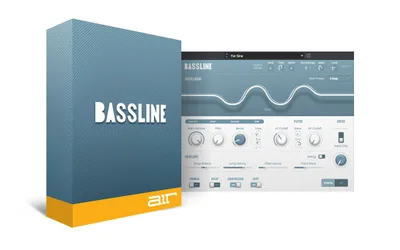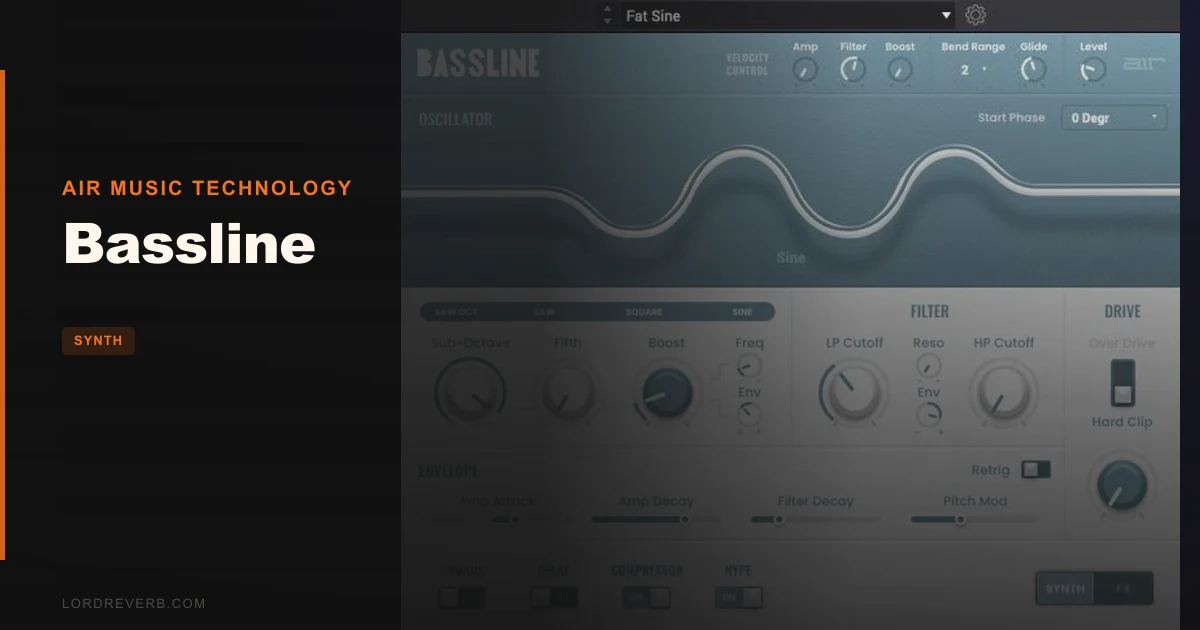
Every producer has hit the same wall: you've got a solid groove, the kick is sitting right, and then the bassline lands, and it's either too muddy to breathe, too clean to feel alive, or so generic it could be on any track from the past decade. Getting bass that is warm, defined, and characterful without spending hours sculpting synthesis from scratch is harder than it looks. AIR Music Technology's Bassline, available at $31, is built to solve that specific problem. It's a monophonic vintage synthesizer using AIR's evolved vacuum tube circuit modelling, and it's aimed squarely at producers who want analogue-era bass and lead sounds without a semester of synthesis study. Whether it actually delivers, and where it falls short, is what we're here to break down.
The Frustration Bassline Is Designed to Fix
Most producers aren't struggling with synthesis theory. They're struggling with time. Building a convincing sub bass from a basic sine oscillator, shaping the mid-punch with the right filter curve, adding just enough harmonic saturation to cut through a dense mix, that's a 45-minute job if you know what you're doing, and a three-hour job if you don't.
The alternative most producers reach for is a sample pack bassline. It fits the template, plays the root note, and blends into the arrangement without drama. It also sounds exactly like every other track using the same pack.
Bassline positions itself between those two extremes. You get the synthesis engine, the analogue character, and a deep preset library, without needing to rebuild a patch from zero every session. The vacuum tube circuit modelling is the key claim here. AIR's Vacuum synth built a real reputation inside Pro Tools as a reference instrument, and Bassline inherits that engine in an evolved form.
The pitch: all that character, plus effects, plus a bassline-optimised preset library, at a price that doesn't require a business case to justify.
That's a smart product brief. Let's see how the execution holds up.
Inside the Engine: Vacuum Tube Synthesis Explained
The foundation of Bassline is AIR's vacuum tube circuit modelling technology. This isn't a marketing reframe of standard wave shaping. The original Vacuum synth was bundled with Pro Tools and became something of a go-to for analogue warmth inside a DAW context, which is genuinely unusual for a stock instrument.
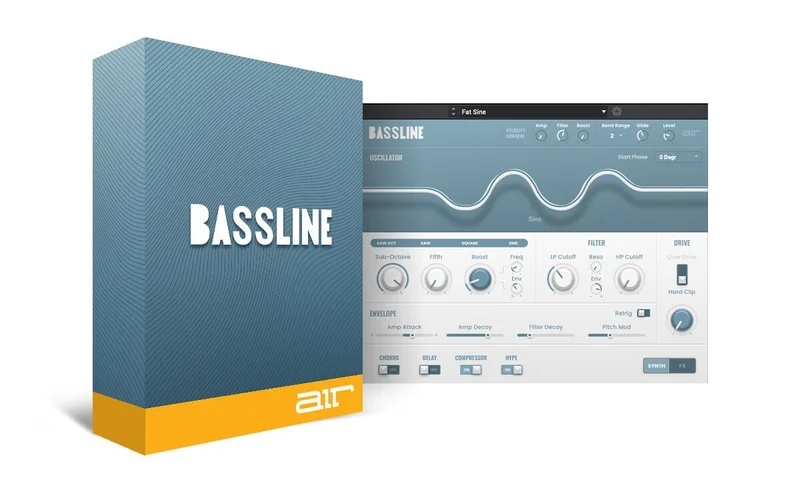
The evolved engine in Bassline targets the harmonic behaviour of tube circuitry: even-order harmonics that add body without brittleness, a softness in the transient attack that makes bass notes feel rounded rather than clinical. When you play a low C and the note has a slight push in the 80Hz to 120Hz region that a pure digital oscillator wouldn't produce, that's the circuit model doing its job.
The oscillator section gives you continuously variable waveshape. That's an important detail. You're not selecting between four discrete options, you're moving through a continuum that includes octave saw, saw, square, and sine positions, with tonal variation throughout the sweep. For bass work, the space between saw and square is where most of the interesting textures live.
Sub and fifth oscillators are available for layered timbres. The sub oscillator is the practical workhorse here. Drop it in, set the blend, and you've immediately added low-end weight without stacking multiple synth instances. The fifth oscillator adds harmonic richness at the interval, which sits well for lead and pluck sounds more than pure sub bass patches.
This is a subtractive synthesis instrument at its core. Oscillator into filter, filter shaped by envelope, output coloured by tube modelling. Nothing experimental or modular. For producers who want reliable analogue character, that's a feature, not a limitation.
The Filter and Envelope Architecture
Bassline ships with multiple filters. AIR doesn't publish an exhaustive list of filter types in the standard documentation, but in use you'll find the classic lowpass behaviour that defines vintage mono synth bass sounds, along with envelope control that shapes attack and decay in ways that directly affect how a note blooms under your mix.
The envelope interaction is where the tube character becomes most audible. A fast attack with moderate decay on a sawtooth wave through a lowpass filter with the cutoff at around 60% gives you the kind of punchy, slightly rounded bass note that defined a lot of late-70s and early-80s analogue production. We pulled up a session at 128 BPM, set the cutoff to track the filter envelope, and ran a simple root-fifth bassline pattern. The attack poked through cleanly. The decay fell away without leaving residue in the 200Hz to 400Hz range where bass mud typically accumulates.
That's a satisfying result from a relatively quick dial-in. Experienced synthesists will want more modulation routing, LFO-to-filter depth and speed, at minimum, and Bassline does offer this, though the routing options stop well short of what you'd get from a deep modulation matrix instrument like Serum or a dedicated analogue emulator with patch point flexibility.
The envelopes feel right for the instrument's purpose. They're not the fastest or most precise in the market, but they produce natural-feeling results for basslines and lead sounds without obsessive tweaking.
Working the Preset Library: 150+ Starting Points
One hundred and fifty presets sounds like a lot. In practice, it depends entirely on whether those presets are genuinely varied or just reshuffles of the same three patch types.
In Bassline's case, the library earns its count. You'll find sub basses that sit at the very bottom of the spectrum, with fundamental energy below 60Hz and almost no upper harmonic content, useful for genres where the sub carries the groove. You'll also find plucks with quick filter decay and present high-mid click that cut through dense arrangements, pads that use the tube warmth to avoid the sterile quality that digital pads often produce, and screaming lead sounds that use the continuous waveshape control to land somewhere between saw aggression and sine smoothness.
We went directly to the bass presets first, which is honest for a product called Bassline. The thunderous bass patches live up to the description. There's one patch in particular, a deep, slightly overdriven sub with a hint of fifth oscillator in the upper range, that we immediately wanted to use on a track. That's the right reaction to a preset library. It should make you want to make music, not spend another hour browsing.
The pad and lead presets are a genuine bonus. They move Bassline out of single-use territory. A mono synth that only sounds good on bass is a niche purchase. One that covers lead, pluck, and pad territory as well becomes a session instrument you reach for regularly.
The limitation: 150 presets is a strong starting point, but with no patch randomisation or algorithmic generation tool in the instrument, you're dependent on manual synthesis for anything beyond these and any third-party preset packs you find. Compare that to dedicated bassline generator tools that can produce novel patterns algorithmically, and you see where Bassline makes different assumptions about the user's workflow.
The Built-In FX Chain: Hype EQ, Distortion, and the Classics
This is where Bassline separates itself most clearly from a bare-bones synth at a similar price point.
The effects section includes Chorus, Delay, Reverb, a Compressor, two distortion algorithms, and the Hype EQ. That's a complete signal chain inside a single plugin. For producers running a tight template or mixing ITB on a laptop, that matters. Every effect you don't need to instantiate on a separate send is headroom and simplicity recovered.
The Hype EQ deserves specific attention because it's not a standard parametric. The Low Hype parameter boosts and shapes the low end in a musical curve designed for sub bass and kick reinforcement rather than surgical correction. Turning it up adds weight in the sub region without automatically causing mud, it's voiced to sit below the typical problem frequencies at 200Hz to 300Hz. The High Hype parameter adds air and shimmer at the top end, which works on pads and strings in a way that feels almost like a harmonic exciter rather than a standard shelf.
We ran a mid-range bass patch through the Hype EQ, pushed Low Hype to about two-thirds, and pulled up a spectrum analyser alongside. The energy increase was concentrated between 40Hz and 90Hz. The 200Hz to 400Hz range stayed clean. That's a clever voicing for a simple two-parameter EQ.
The two distortion algorithms give you grit options without a separate saturation plugin. One runs warmer and more subtle, useful for adding harmonic density to a clean bass patch without pushing it into overdrive territory. The other is more aggressive and works best on lead sounds where crunch is the point.
AIR's Creative FX suite has legitimate credentials. It's been part of Pro Tools since version 8 and has been used on professional film, game, and music production at the highest levels. Having those algorithms inside a $31 synth is not nothing.
Our one frustration: the effects are applied to the full output. There's no per-voice or pre-filter routing option that we can find, which means the reverb and chorus are always post-synthesis. For most bass patches, that's fine. For experimental lead sounds where you might want distortion into reverb rather than reverb on a distorted signal, it's a constraint worth knowing about before you buy.
Dialling In Bass for a Mix: Compression and Frequency Management
Let's talk about the built-in compressor, because this is where Bassline tries to do something genuinely useful for the mixing stage rather than just the sound design stage.
A starting compression ratio for bass in a mix context typically runs between 3:1 and 8:1 depending on how dynamic your playing is and how tight you need the groove to sit. The Bassline compressor gives you control over this, which means you can pre-compress the synth output before it even hits your DAW's channel strip. For producers who sidechain kick to bass externally, you're still doing that on the channel. But for basic dynamic control that keeps the sub consistent across a pattern, the built-in compressor handles it without adding a plugin to your chain.
Frequency management for bass is about one thing above all else: keeping the fundamental clear and the upper harmonics controlled so the bass sits alongside the kick without fighting it. The filter architecture handles this on the synthesis side. The Hype EQ handles the output shaping. And the compressor keeps levels consistent so the filter sweep doesn't suddenly dominate the mix on a louder note.
We ran an eight-bar bassline pattern with a moderate amount of filter envelope modulation, one that would typically cause dynamic problems in the 80Hz to 150Hz range as the filter opened and closed. With the compressor engaged at roughly a 4:1 ratio and moderate attack, the dynamic variance through the filter sweep was reduced significantly. The bass sat. The kick had room. That's the right outcome from a built-in tool.
This workflow won't replace a dedicated mix compressor on a professional production, but it's exactly right for the target user: someone producing full tracks ITB who wants the bass to be mix-ready before it even hits the master bus.
Bassline vs. 303-Style Acid Emulators
Any review of a bass-forward synth in 2026 has to address the 303 question. The Roland TB-303 and its legion of software emulators, AudioRealism ABL3, D16 Group Phoscyon, and others, occupy a specific space in bass synthesis. They're not general-purpose mono synths. They're acid machine emulators, tuned to recreate the specific character of VCA click behaviour, resonance compensation, internal pot variance, and the notoriously limited cutoff range of the original hardware.
Bassline is not a 303 emulator. It doesn't try to be, and that's honest positioning. The vacuum tube character it targets is a different analogue era: the warmer, fatter mono synths of the 70s and early 80s rather than the trebly, resonant acid squelch of the 303.
If you're building acid house, TB-303 influenced techno, or any genre where the specific character of that circuit matters, Bassline isn't your tool. The Audio Blast ABX3 bundle review covers acid-adjacent synthesis in more depth and is worth reading if that's your context.
If you want thick, warm, characterful bass that works across hip-hop, soul, electronic, cinematic, and pop production, Bassline is competing in the right space. It's broader than a 303 emulator, and for most producers, that breadth is more useful.
Standalone App and Hardware Integration
Bassline ships with a Desktop Player application. This is a meaningful addition for live performers and producers who work in hybrid setups.
Connect a MIDI controller via USB or Bluetooth, load Bassline in standalone mode, and you have a performance instrument without opening a DAW. For producers who perform their own music live, or who like to sketch patterns on a controller away from the computer, this removes a barrier that most plugin purchases keep in place.
The original home for Bassline was AKAI Professional's MPC and Force hardware platforms. That hardware-first DNA shows in the interface design: it's visual, playable, and optimised for performance rather than meticulous preset editing. The GUI can be resized from 50% to 200%, which matters on both large studio monitors and smaller laptop screens. This is a recent addition and it's a genuinely welcome one, resizability is something a frustrating number of plugins still don't offer in 2026.
Preset saving and loading directly from the plugin toolbar, including in standalone mode, was also recently added. Before that update, preset management in standalone was reportedly clunky. Now it works the way you'd expect it to, which is the baseline any plugin should clear.
The cross-compatibility across VST2/VST3, AU, AAX, and standalone is close to universal. Logic, Ableton, Pro Tools, FL Studio, Studio One, Bassline runs in all of them. The MPC OS integration gives hardware producers another use case. Few plugins at this price span that many platforms cleanly.
Bassline as a Compositional Tool: Patterns, Groove, and Workflow
One of the gaps in the current bassline plugin market is genuine compositional support for producers who know what sound they want but struggle to construct an interesting pattern. Dedicated MIDI bassline generators handle key, scale, length, and complexity parameters and can produce novel eight-bar patterns algorithmically. Bassline doesn't include this kind of generator.
That's a real gap worth naming. If your core struggle is "I don't know what notes to play" rather than "I don't know what sound to use," Bassline won't solve your problem. It assumes you're bringing the composition and need the sound, not the other way around.
What it does support compositionally is the sound-to-feel relationship. A root-fifth bassline that sits in the pocket with a kick drum sounds different on a clean sine patch versus a warm, tube-saturated saw. The latter makes you play differently. It encourages heavier eighth-note grooves, fills that use the filter envelope as an expressive element, descending basslines where the harmonic content of each note changes character through the filter sweep.
Good synthesis tools inspire composition indirectly, through sound. We found ourselves spending longer building basslines in Bassline than in a sample-based workflow, not because it's slow, but because the sounds pushed us toward more interesting patterns than we'd started with. That's a satisfying outcome.
The mono architecture matters here. Monophonic synthesis forces clarity. You're writing one note at a time. That constraint is genuinely useful for bassline composition, where harmonic clutter is the enemy. Copy-paste patterns that ignore the kick drum interaction never sound locked in, and a mono synth with genuine character discourages lazy composition in a productive way.
Strengths and Weaknesses
The vacuum tube modelling is Bassline's headline strength, and it's legitimate. The warmth in the low-mid range, the way even-order harmonics round out a saw wave without making it muddy, that's harder to achieve at this price than AIR makes it look.
The preset library is broader than the name suggests. Getting genuinely usable pads and leads out of a plugin marketed primarily on its bass sounds is a bonus that extends the value considerably.
The built-in effects chain is excellent for the price. Having a voiced Hype EQ, two distortion algorithms, and a compressor inside the synth means you can deliver a mix-ready bass sound without touching your channel strip at all. That's clever product design.
On the weakness side: the monophonic architecture is the right call for bass synthesis, but it does mean Bassline can't cover chord stabs or any polyphonic texture, and at this price, you might expect a polyphonic mode even if it's optional.
The oscillator architecture, while musically useful, is narrower than competing synths in the mid-tier range. Instruments like the Arturia MiniFreak V review offer dramatically more oscillator types and modulation options for producers who want to grow into more complex synthesis. Bassline is not that instrument. It's focused and intentional, but that focus has a ceiling.
Documentation is thin. The Hype EQ, specifically, benefits from understanding its frequency curves before you use it. Without that context, you might push Low Hype expecting standard shelving behaviour and end up with a different result than you wanted. A built-in tooltip or contextual help system would help newer producers get the most from the instrument faster.
Value for the Price
At $31, Bassline competes in a bracket where the quality bar is real but achievable. The vacuum tube engine alone would justify the price if it were the only feature. Add 150+ presets, a six-module effects section, standalone operation, and cross-platform compatibility from VST to AAX to MPC OS, and the value proposition is strong.
The comparison to buying a 303 emulator, a separate reverb, a separate compressor, and a separate distortion plugin to build an equivalent signal chain makes the math clear. You'd spend more, use more CPU, and manage more instances, and you still wouldn't have the tube character.
The honest caveat: if you need polyphonic synthesis, deep modulation routing, or built-in pattern generation, Bassline's price doesn't buy you those things. You'd need a different instrument. But for what it claims to do, warm, analogue-flavoured mono synthesis with a ready-to-use effects chain, it earns its price without reservation.
Who Should (and Shouldn't) Buy This
- ✅ Buy if you produce hip-hop, soul, electronic, or cinematic music and want warm, characterful bass without deep synthesis study
- ✅ Buy if you work across a DAW and a hardware MPC or Force setup and want one instrument that spans both
- ✅ Buy if you want a mono synth that also covers leads, pads, and plucks convincingly, and the built-in FX chain means fewer plugins to manage
- ❌ Skip if you need polyphonic synthesis or complex modulation routing, Bassline won't grow to meet those needs
- ❌ Skip if you're building acid house or TB-303 influenced music, the circuit character is wrong for that genre; look at dedicated acid synth alternatives instead
- ❌ Skip if you need algorithmic bassline pattern generation, Bassline provides the sound, not the composition
Specs & Technical Details
| Specification | Detail |
|---|---|
| Developer | AIR Music Technology |
| Price | $31 |
| Plugin Format | VST2, VST3, AU, AAX, Standalone Desktop App |
| OS Support | macOS 12, 13, 14, 15 (Intel & Apple Silicon) / Windows 10, Windows 11 |
| Activation | AIR Music Technology account |
| CPU Usage | Light to Medium |
| Trial Available | No |
| Min. RAM | 4 GB (8 GB recommended) |
| Disk Space | 1 GB |
| Min. Processor | Intel Core i5/i7, 2.3 GHz or higher |
| Hardware Integration | AKAI MPC, AKAI Force |
| GUI Resizable | Yes (50% to 200%) |
| Version Reviewed | Current 2026 build |
Score Breakdown
| Category | Score | Notes |
|---|---|---|
| Sound Quality | 4.0/5 | Vacuum tube modelling delivers genuine warmth; sub and fifth oscillators add weight without muddiness |
| Value for Money | 4.5/5 | Six-module FX chain plus 150+ presets at this price is hard to argue against |
| Ease of Use | 3.5/5 | Interface is clean but documentation is thin; Hype EQ behaviour isn't immediately obvious |
| Features | 3.5/5 | Strong for a focused mono synth; loses points for no polyphony, no modulation matrix, no pattern generator |
| CPU Efficiency | 4.0/5 | Light footprint; running multiple instances in a session doesn't cause problems on modern hardware |
| Overall | 4.0/5 | A warm, well-featured mono synth that earns its price through sound quality and built-in tools |
Alternatives to Consider
If Bassline's focused mono approach feels too limiting, a few alternatives are worth serious consideration.
Arturia SEM V is a Oberheim SEM emulation that covers warm, analogue mono synthesis with more filter options and deeper modulation routing. It's a more complex instrument, and the Arturia SEM V review 2026 breaks down whether that complexity justifies the higher price. If you want more control over your analogue emulation, SEM V is the direction to look.
Arturia MiniFreak V goes further still. It's a hybrid synth with digital oscillators feeding analogue-modelled filters, polyphonic capability, and a modulation matrix that makes Bassline's routing look simple. The MiniFreak V review 2026 covers it in detail. If you're growing into synthesis beyond bass and mono lead sounds, MiniFreak V is a better long-term investment.
AudioThing SX1000 is an Italian synth emulation with its own distinctive character. If you find Bassline's tube warmth appealing but want a different flavour of vintage analogue colouring, the AudioThing SX1000 review is a useful comparison point. It's a different sound palette but a similar price bracket.
For producers specifically needing 303-style acid bass rather than warm vintage mono character, the acid synth alternatives covered in our other reviews are a better match than any of the above.
The Final Word
Bassline is a focused instrument that knows exactly what it is. The vacuum tube circuit modelling is the real deal: it produces bass tones with harmonic character and warmth that take meaningfully longer to achieve in a standard subtractive synth without tube emulation.
The built-in FX chain is overbuilt in the best way. At $31, you're not supposed to get a voiced shelf EQ, a compressor, chorus, delay, reverb, and two distortion algorithms inside the synth. You get them anyway.
The limitations are real. No polyphony. No deep modulation matrix. No algorithmic pattern generation. If those are your requirements, look at MiniFreak V or a dedicated bassline generator instead. Bassline won't apologise for what it doesn't do.
What it does do, it does with conviction. We'd buy this. We'd use it on bass and lead tracks in genres from soul to electronic to cinematic without hesitation.
The one producer we'd tell to skip it: anyone whose core problem is writing basslines rather than synthesising them. For that problem, a MIDI generator and any reasonable synth is a better solution. Bassline solves the sound problem brilliantly. The compositional problem is yours to solve.
At $31, it's one of the more honest value propositions in the mono synth space. Buy it if bass is central to your productions. You'll use it on your next track. Probably the one after that too.
Related reviews: Paraphrasis Review
Frequently Asked Questions
Is Bassline by AIR Music Technology only useful for bass sounds?
No. Despite the name, Bassline covers pads, leads, and plucks from its 150+ preset library. The vacuum tube modelling and continuously variable waveshape make it a useful mono synth for any single-voice role in a production, not just bass parts. That said, its name reflects where it excels, and bass is where we'd reach for it first.
Does Bassline work in Ableton Live, Logic Pro, and Pro Tools?
Yes to all three. Bassline ships in VST2, VST3, AU, and AAX formats, covering every major DAW on Mac and Windows. It also runs as a standalone desktop application with MIDI controller support via USB or Bluetooth. The cross-platform compatibility is close to universal for modern production setups.
Is Bassline a TB-303 or acid bass emulator?
No. Bassline uses AIR's vacuum tube circuit modelling, which targets the warmer analogue character of 1970s and early 1980s mono synths, not the specific resonance and VCA click behaviour of a Roland TB-303. If you're building acid house or techno that depends on 303 character, a dedicated emulator like AudioRealism ABL3 is a better fit for that specific sound.
What does the Hype EQ do, and how is it different from a standard EQ?
The Hype EQ uses two parameters: Low Hype and High Hype. Low Hype boosts the sub-bass region in a musically voiced curve that targets energy below the typical mud frequencies, adding weight without the 200Hz to 400Hz buildup that standard low-shelf boosts can cause. High Hype adds air and shimmer to the top end, closer in character to a harmonic exciter than a linear shelf. It's a fast, musical tool rather than a surgical one.
Can Bassline generate MIDI bassline patterns automatically?
No. Bassline is a synthesis instrument, not a MIDI pattern generator. It provides the sound and the effects chain; the compositional decisions are yours. Dedicated algorithmic bassline generators with key, scale, and complexity parameters are separate tools. If pattern generation is your primary need, look at MIDI generator plugins alongside Bassline rather than as a replacement for it.
Is there a free trial for Bassline before purchasing?
Based on current product information, no free trial is available for Bassline. The plugin is available at $31 as a direct purchase. If you're uncertain, the 150+ preset library descriptions and the reputation of AIR's vacuum engine from the original Vacuum synth for Pro Tools are the strongest indicators of whether the character fits your productions. AIR Music Technology's products are also frequently included in bundle sales, which is worth monitoring if the full price gives you pause.