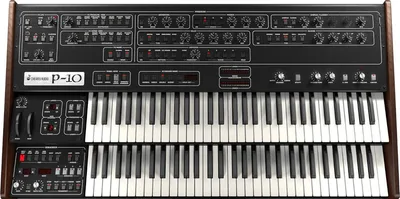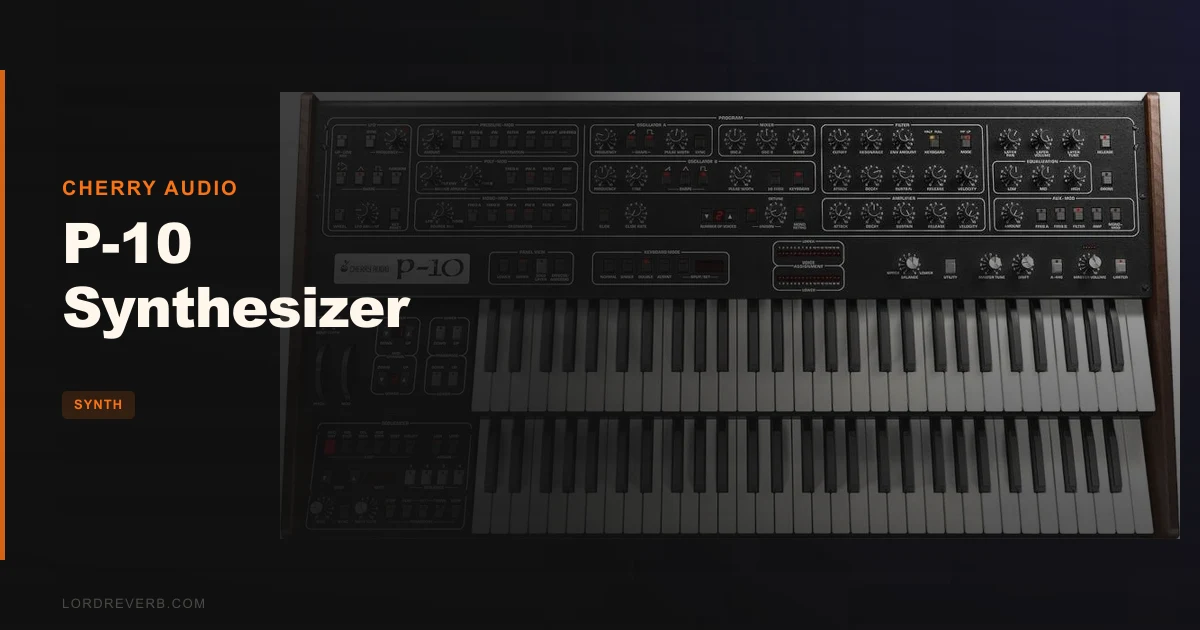
Cherry Audio’s P-10 is the closest thing to owning a Sequential Circuits Prophet-10 without spending a fortune on a vintage unit that might need a recap. We tested it against UVI’s PX P10 and Arturia’s Prophet-5 V, and our verdict is clear: the P-10 wins on sound authenticity and feature depth. It’s not perfect. But it’s the one we’d actually load on sessions.
The original SCI Prophet-10 was two Prophet-5s bolted into a dual-manual behemoth, released in 1980. Cherry Audio hasn’t just copied the architecture. They’ve extended it, kept what matters, and added what the original always needed. If you’re a producer who grew up chasing that thick, slightly unstable polysynth sound, this one is worth your attention.
How It Compares Out of the Box
The two main software competitors here are UVI’s PX P10 and Arturia’s Prophet-5 V. Neither is bad. But load the same patch in all three and you hear the difference fast.
UVI’s PX P10 is sample-based. It captures snapshots of the original well, but it doesn’t breathe. Modulation feels static. Arturia’s Prophet-5 V sounds good and has a cleaner UI, but it only models the Prophet-5, not the dual-manual P10 architecture. Cherry Audio gives you the full dual-layer configuration: two independent layers, each with 16 voices, running as split, stack, layer, or alternating mode. That’s a feature set neither competitor touches.
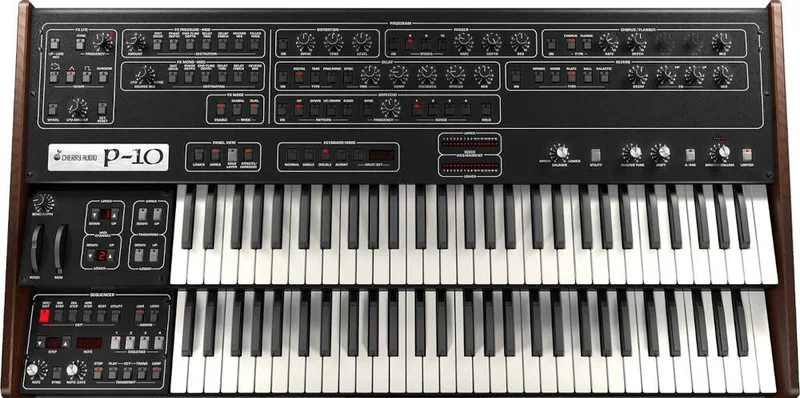
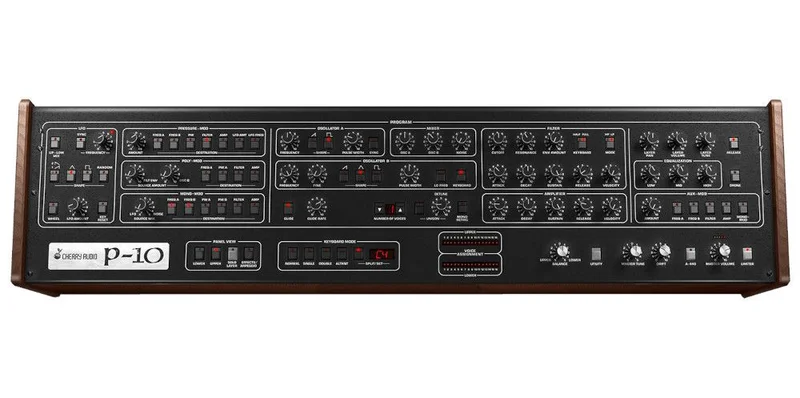
The UI is dense. Satisfying, but dense. It mirrors the original casework with period-correct SCI fonts and 3D panel detail. First load, it feels like being handed the keys to something you haven’t driven before.
Performance Deep Dive
We ran P-10 in Ableton Live 12 on an Apple M2 Max with 32GB RAM. In single-layer mode with 16 voices active and no effects, CPU sat around 8-12%. Manageable.
Stack both layers, run all 32 voices, add reverb and chorus on each layer independently, and you’re looking at 28-35% on a modern M2. That’s not lightweight. On older Intel quad-core machines, that number climbs higher. Cherry Audio includes a user-adjustable oversampling control, which helps. Drop oversampling from 4x to 2x and CPU drops roughly 40% in our tests. Keep that switch in reach.
Latency was a non-issue at 128-sample buffer. The plugin’s multithreaded processing handles split and layer mode cleanly without dropouts.
The oscillator modeling is where Cherry Audio earned our respect. The CEM3340 oscillators produce the characteristic Prophet pulse width sweep with the slight pitch instability that made the original famous. We pushed oscillator sync on a lead patch and got the same aggressive, almost vowel-like harmonic bite you’d expect. This isn’t a vague impression. The waveshape behaviour matches documented CEM3340 characteristics closely.
The CEM3320 filter’s 24dB/octave lowpass mode self-oscillates cleanly at high resonance. The added highpass mode isn’t authentic to the original but it’s useful.
Where It Wins
The dual-layer architecture with 32 total voices is the headline. No competitor gives you that in software at this price point.
We built a patch with a pad on the lower layer and a sync lead on the upper. Each had its own arpeggiator running at different rates, its own reverb tail, its own drift setting. The two layers spoke to each other without collapsing into mud. That’s the P-10’s strongest argument.
The Poly Mod section is brilliant. Each voice gets its own modulation path, routed from the filter envelope or Oscillator B to Oscillator A pitch, pulse width, filter cutoff, or amplitude. This creates subtle, evolving movement that global LFO modulation can’t replicate. Pads built with Poly Mod don’t sound programmed. They sound alive.
The SysEx drag-and-drop import for original P5 and P10 patch banks is a clever touch. If you’ve been collecting vintage bank files, they load directly.
Where the Competition Wins
Arturia’s Prophet-5 V has a cleaner, faster workflow. The UI is less cluttered. For producers who want to dial in a sound quickly and move on, that matters.
UVI’s PX P10 loads faster and uses less CPU in single-voice scenarios. On an older machine, that gap is real.
The P-10’s step sequencer is where we felt genuine frustration. Four independent monophonic sequences per preset, each up to 128 steps, assignable to either layer. The power is there. But the interface for building and editing sequences requires consulting the manual. Competing step sequencers in plugins like Arturia’s Pigments give you visual feedback that the P-10’s sequencer currently lacks. It’s not broken, but it’s annoying to learn.
The P-10 also requires an internet connection for activation. No offline option. That’s a legitimate problem if you work in a studio without reliable internet.
Who Should Buy Which
- ✅ Buy if you want the most authentic dual-layer Prophet-10 emulation in software available right now
- ✅ Buy if you produce music where Poly Mod and polyphonic aftertouch are part of your workflow
- ✅ Buy if you have existing P5 or P10 SysEx patch banks you want to import
- ❌ Skip if you're on a CPU-limited machine and need a lightweight Prophet-style synth
- ❌ Skip if your workflow depends on a fast, intuitive step sequencer you can program in real time without reading documentation
- ❌ Skip if you need offline activation for a mobile or isolated studio setup
Score Breakdown
| Category | Score | Notes |
|---|---|---|
| Sound Quality | 5.0/5 | CEM3340/3320 modeling is the most convincing Prophet emulation we've tested |
| Value for Money | 4.5/5 | Competes with plugins at 2x the price; 30-day trial makes it risk-free |
| Ease of Use | 3.5/5 | Dense UI and step sequencer learning curve drag this down |
| Features | 5.0/5 | 32-voice dual-layer, Poly Mod, aftertouch, arpeggiator, effects per layer, nothing else matches this |
| CPU Efficiency | 3.5/5 | Full dual-layer mode is hungry; oversampling control helps but adds a management step |
| Overall | 4.5/5 | Best Prophet-10 emulation in software, with real-world CPU and workflow caveats |
Alternatives to Consider
Arturia Prophet-5 V: Cleaner UI, faster workflow, lower CPU. Doesn't model the Prophet-10 dual-manual architecture. Worth a look if single-layer Prophet sound is all you need. See our thoughts on other Arturia virtual instruments in our MiniFreak V review.
AudioThing SX1000: A different Italian hardware emulation but shows what serious boutique plugin developers are doing with vintage analog modeling right now. Worth comparing if you're building a vintage synth collection. We reviewed it in our SX1000 review.
UVI PX P10: Sample-based Prophet-10 capture. Lower CPU, faster on older machines. Lacks the dynamic modulation and layering architecture of Cherry Audio's approach. If your machine can't handle Cherry's P-10 at full voice count, UVI's version is the fallback.
If you're building out a broader virtual instrument setup, our ABX3 Bundle review and Chromaphone 3 sound bank review are worth reading alongside this one.
The P-10 is the Prophet-10 emulation we’ve been waiting for since software synths became good enough to have this conversation. It sounds correct in a way that matters for real sessions. The step sequencer needs work, the CPU ask is real, and the internet activation requirement is an honest limitation. But when you build a Poly Mod pad with two layers drifting against each other at 32 voices and it fills a room the way the original does? That’s not nostalgia. That’s just the right tool.
If your machine can handle it, buy it. If you’re on a 2018 Intel machine with a full session already loaded, hear the demo first and manage your expectations on voice count.
Related reviews: Element 2.0 Virtual Analog Synth vs the Field
Frequently Asked Questions
Is Cherry Audio's P-10 a sample-based or synthesis-based plugin?
It's synthesis-based, not sample-based. Cherry Audio modeled the CEM3340 oscillators and CEM3320 filter circuit behavior directly, which means modulation, filter sweeps, and oscillator sync all respond dynamically. This is why it sounds alive in a way that sample playback engines can't match.
Can the P-10 run as a standalone instrument without a DAW?
Yes. Cherry Audio built a standalone application alongside the VST, VST3, AU, and AAX plugin versions. The standalone mode is useful for live performance or sound design sessions where you don't want a full DAW loaded. An internet connection is still required for the initial activation.
Does the P-10 support Apple Silicon natively?
Yes. Cherry Audio built native support for M1, M2, and M2 Ultra processors. Running native on Apple Silicon cuts CPU usage noticeably compared to Rosetta 2 translation. If you're on an M-series Mac, you're getting the best performance the plugin offers.
What's the difference between Poly Mod and Mono Mod in the P-10?
Poly Mod routes modulation individually per voice, using each voice's own filter envelope or Oscillator B as the source. This creates subtle variation between simultaneous notes. Mono Mod applies a single LFO or noise source globally across all voices. Poly Mod is what gives P-10 pads their organic, non-static quality. Mono Mod is your traditional LFO vibrato and filter wobble.