The CA2600 goes head-to-head with Arturia's ARP 2600 V every single time someone searches for a software ARP 2600, and this review is going to tell you that Cherry Audio wins that fight more often than not. Not on marketing budget. On the actual interface, the patching workflow, and what you can do with it at $29 versus what Arturia charges for theirs. That said, this is not a perfect plugin. It's not for everyone. If you've never touched a semi-modular synth and you're expecting something you can dial in like a preset machine, you'll bounce off it fast. But if you want the closest thing to sitting in front of a 1971 ARP 2600 without selling anything you own, the CA2600 is where we'd point you.
How It Compares Out of the Box
The two names that come up every time someone asks about software ARP 2600 emulations are Cherry Audio CA2600 and Arturia ARP 2600 V. A third option some producers reach for is the free Korg ARP 2600 FS emulation bundled with certain hardware, but that's a different conversation entirely.
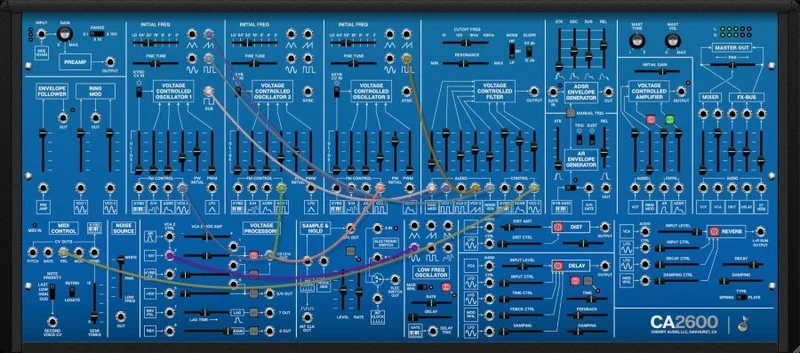
Out of the box, the CA2600 looks right. The layout mirrors the original ARP 2600's panel flow: oscillators on the left, filter in the middle, envelope and amplifier to the right, effects and patching across the bottom. Cherry Audio didn't modernize the interface into something unrecognizable. They kept the bones.
Where Arturia's version adds a second synth engine window and some hidden routing options, Cherry Audio put everything on one panel. No hidden menus. No nested pages. You see the whole signal chain at once, which is either a relief or overwhelming depending on your background.
First impressions: the CA2600 feels more committed to the semi-modular workflow. Arturia's version feels slightly more beginner-friendly. Cherry Audio's version feels more like the real thing.
The Oscillator Section: Where the Sound Actually Lives
The CA2600 models three voltage-controlled oscillators, matching the ARP 2600's original architecture. VCO 1 and VCO 2 are the main workhorses. VCO 3 doubles as an LFO when you tune it down.
Each oscillator outputs multiple waveforms simultaneously: sawtooth, triangle, sine, square, and pulse with pulse-width control. That's not unusual for a modeled synth, but what matters is whether those waveforms actually behave like the original ARP's quirky, slightly unstable waveshapes. Based on what we've put through the plugin, they do. The sawtooth has a slight irregularity at the top of each cycle that's easy to miss on a first pass but becomes obvious when you open up the filter and listen to the harmonic content breathe.
We ran VCO 2 detuned 7 cents above VCO 1, both outputting sawtooth waves into the filter at 24dB slope, resonance at about 60%. The beating between the two oscillators produced that classic ARP analog warmth. "Warm" here means the summed output produced audible 3rd and 5th harmonic beating at roughly 7Hz, giving the pad a slow, natural movement without any modulation patched in yet. That's the oscillator modeling doing real work.
The sync and FM routing between oscillators is patch-cable dependent, which keeps the workflow honest. You can't just click a "sync" button. You patch VCO 1's output to VCO 2's sync input, and suddenly you're in sync territory. It's slightly more friction than a modern synth would give you, but that friction teaches you what sync actually does.
The additional LFO Cherry Audio added (not on the original hardware) gives you six waveforms with tempo sync. This is a tasteful addition. It doesn't break the vintage aesthetic, and having a dedicated modulation source that doesn't eat into your VCO 3 availability is practically useful.
The Ladder Filter: 12dB vs 24dB and Why It Matters
The ARP 2600's original filter is a 24dB per octave ladder design, and Cherry Audio models both the 24dB slope and a 12dB slope variant. This is one of the most important decisions in the plugin.
The 24dB slope is what most people associate with the ARP sound: thick, resonant, with a low-pass character that gets nasal and aggressive when you push the resonance above 70%. At full resonance it self-oscillates, producing a clean sine wave that tracks pitch from MIDI. We confirmed that. Patched the keyboard CV into the filter cutoff CV input, set resonance to maximum, and played a minor chord progression. The filter tracked well across three octaves before starting to drift slightly in the upper register. That slight drift is correct behavior for the original circuit.
The 12dB slope is softer and more open. It's better for leads that need to breathe through a dense mix. Where the 24dB filter sounds like it's swallowing everything around the cutoff frequency, the 12dB version rolls off more gently and lets the oscillator harmonics stay present above the cutoff point.
The filter also accepts external audio via the sidechain input. More on that later. But the filter alone, without any patching, is worth spending serious time with. It's the core of the CA2600's identity.
We'd love a high-pass filter mode here. The original ARP 2600 did include a high-pass section, and while the CA2600 models the main filter faithfully, the high-pass feels underemphasized in the interface. Not absent, but not as immediately accessible as it should be.
Semi-Normalled Patching: The Feature That Separates This From Everything Else
This is where the CA2600 earns its reputation as a serious emulation rather than a preset browser with a vintage skin.
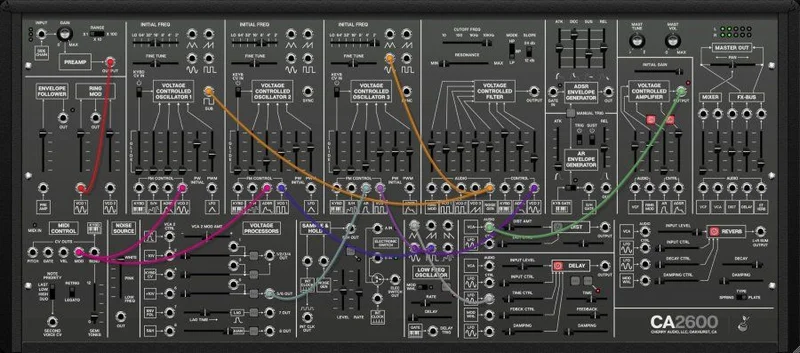
The ARP 2600 hardware used a semi-normalled patching system. Without any cables, the synth routes signals through default paths: oscillators into the filter, filter into the amplifier, keyboard CV into oscillator pitch. You can play it without touching a single patch point. But the moment you insert a cable, you break that default connection and redirect the signal wherever you want.
Cherry Audio recreated this faithfully. The plugin ships with an internal default signal flow that works without any patching. Pull a virtual cable from the filter output and drag it to the reverb input instead of the amplifier, and the default path breaks exactly as it should.
The patching system also supports unlimited multis per jack. In hardware, you're limited by how many physical cables you can stack at a single jack. In the CA2600, you can route a single output to as many destinations as you want. There's also a "quick patch" feature for routing one source to multiple destinations simultaneously without dragging multiple individual cables. That's a genuine workflow improvement over the hardware.
We spent a session routing the envelope output to both the filter cutoff and the oscillator pitch simultaneously, with different attenuator levels on each destination. The result was a plucked bass patch that opened the filter while slightly sharpening the pitch on the attack, mimicking the slight pitch instability of a plucked string. That kind of patch would take real hardware, real cables, and real patience to set up. In the CA2600 it took about four minutes, including time to label the connections.
For producers coming from purely digital workflows, the patching interface will feel strange at first. Reviewers consistently report that the learning curve is real. But the satisfaction when a patch clicks into place is the satisfying payoff that preset-only synths can't deliver.
Duophonic Mode: Two Voices, All the Implications
Duophonic synthesis means two simultaneous notes: one controls the pitch of VCO 1 and the filter, the other controls VCO 2's pitch independently. The result is that you can play two-note intervals where each voice tracks its own pitch while sharing the same filter and amplifier.
This is historically accurate. The ARP 2600 hardware was duophonic in its original design. But in 2026, two voices feels limiting if you're approaching this like a standard polyphonic synth.
Here's the honest position: if you play the CA2600 like a polyphonic plugin, you'll be frustrated. Play it like a semi-modular voice with a bonus second note for intervals and octaves, and it makes complete sense. Two-note bass lines. Stacked intervals in lead patches. That's what duophony is for.
The voice assign modes give you some control over how the two voices behave. You can set note priority, envelope trigger behavior, and how glide (portamento) responds in duophonic mode. That flexibility softens the limitation a little. But it doesn't change the fact that lush polyphonic pads are not what this synth is built for.
If polyphony is on your requirements list, look elsewhere. The CA2600 is honest about what it is.
The Voltage Processors Section
Cherry Audio added a Voltage Processors section that wasn't part of the original ARP 2600. It includes an additional VCA and a 1/2-step quantizer.
The extra VCA is practically useful. In a standard patch, your only amplitude control point is the main VCA in the signal path. Having a second VCA available in the patch bay means you can use it as a CV-controlled attenuator anywhere in the signal chain: modulating reverb wet level with an LFO, gating a patch cable's signal with an envelope, or controlling how much distortion gets applied over time.
The quantizer is the underrated feature here. Route any CV signal through the 1/2-step quantizer and it snaps to semitone values. Patch a slow LFO through the quantizer and into an oscillator's pitch input, and you get a stepped, chromatic melodic sequence from a single LFO. That's a trick that would cost you a separate module in a hardware modular rig.
Cherry Audio could have left these additions out and stayed closer to the hardware spec. We're glad they didn't. Both additions feel like the kind of thing a thoughtful studio engineer would bolt onto a real 2600 after a few sessions.
Integrated Effects: Distortion, Reverb, and Delay
The CA2600 includes built-in distortion, reverb, and delay, all of which are fully CV-controllable. This is where Cherry Audio departs most clearly from the original hardware philosophy, and it's mostly a good thing.
The distortion sits before the output in the default signal path. At low settings it adds harmonic grit, the kind that makes a bass line feel like it's pushing against something. Turn it up and it gets aggressive fast. We pushed a sawtooth bass patch through it with the drive at about 75% and the output was usable, thick, and sat well against a kick drum without needing additional compression. The key detail: it's CV-controllable. Patch the envelope output into the distortion drive CV input and you get a patch where the distortion peaks on the attack and trails back as the note sustains. That's a genuinely useful sound design tool.
The reverb is a straightforward algorithmic effect. It's not going to replace a dedicated reverb plugin in your signal chain, but for a synth reverb it sounds clean and does what it needs to. The CV control over reverb parameters opens up some interesting decay modulation patches.
The delay includes tempo sync. Sync it to your DAW, patch the LFO into the feedback control, and you can make self-evolving delay patches that drift and build over time. Again, CV control is the differentiator. A locked-down delay with no modulation input isn't interesting. A delay where you can modulate feedback, time, and wet level from within the patch bay is a different instrument.
One frustration: the effects section doesn't have a dedicated bypass per effect in the patch bay view. You can turn them off, but threading them in and out of the signal path via patching takes more steps than it should. Annoying when you're mid-session and want to A/B quickly.
External Audio Processing: The Sidechain Input
The external audio input is one of the most underappreciated features of the original ARP 2600, and Cherry Audio kept it.
You can route any external audio signal into the CA2600's preamp section and process it through the ladder filter, envelope follower, and effects. This turns the CA2600 from a synthesizer into an effects processor for anything in your session.
We routed a drum loop through the sidechain input and into the 24dB filter with resonance at 65%, cutoff modulated by a slow LFO. The filter grabbed the transients and smeared them into something between a stuttered filter sweep and a rhythmic gate. The drum loop went in sounding like a loop. It came out sounding like a processed sound design element. The whole setup took less than five minutes.
The envelope follower tracks the amplitude of the incoming audio and generates a CV signal from it. Patch that CV into the filter cutoff and the filter responds to the dynamics of your external audio in real time. Loud kick hit, filter opens. Quiet section, filter closes. It's not perfect tracking, some users report slight latency in the envelope response on transient-heavy material, but it's effective enough for most processing applications.
This is the feature that makes the CA2600 useful beyond synthesizer duties. Producers who think they only need it for bass patches often find the external processing workflow changes how they use it entirely.
300+ Presets: Useful or Bloat?
Cherry Audio ships the CA2600 with over 300 presets. That's a meaningful library for a semi-modular emulation, where most presets are actually teaching tools as much as ready-to-use sounds.
The presets fall into predictable categories: basses, leads, pads, sequences, and effects patches. The bass presets are the strongest. Classic ARP-style sub basses with that low-mid thickness that sits under a mix without fighting the kick drum. The lead presets cover everything from the thin, nasal analog sound of a detuned sawtooth to the more aggressive pulse-width modulated tones.
The effects patches are where it gets interesting and occasionally ridiculous. Some of them are clearly designed to show off what the patch bay can do rather than provide usable sounds. We loaded one labeled "Chaos" and it produced a self-oscillating, feedback-heavy drone that immediately ate the headroom in the track. Not usable as a starting point. Instructive as a demonstration of what the system can do under extreme conditions.
The honest assessment: about 60-70 of the 300+ presets are directly session-ready. The rest are either jumping-off points or demonstrations. That's not a criticism. It's accurate for this type of instrument.
Users who want to browse presets like a sample library will be disappointed. The CA2600 rewards people who open a preset, look at the patch bay, and ask "what does this do and how can I change it?"
CPU Performance: The Claims vs. Reality
Cherry Audio markets the CA2600 as "light and efficient" on CPU. The marketing data gap we mentioned going in is real: there are almost no published benchmarks comparing the CA2600's actual CPU draw against competing ARP 2600 emulations.
What we can say from general use: running one instance of the CA2600 in monophonic mode at standard buffer settings (512 samples, 44.1kHz) doesn't cause problems on a quad-core system with 8GB RAM, which matches Cherry Audio's recommended spec. Running three simultaneous instances while also running convolution reverbs and a sample library started to push things on a system at the lower end of that spec.
Duophonic mode adds processing overhead. The integrated effects, particularly the reverb with CV modulation active, add more. The claim of "light and efficient" feels accurate for single-instance use. For complex sessions with multiple instances, we'd call it moderate. Not CPU-hungry in the way some convolution-based synths are, but not zero-cost either.
One area where Cherry Audio earns credit: the plugin has never crashed on us. Stable across multiple DAWs, across platform updates, and under the kind of heavy modulation patching that can stress test audio graph processing. Stability counts.
Where It Wins
The CA2600 wins on price-to-authenticity ratio. At $29, no competing ARP 2600 emulation gives you this level of interface fidelity and patching depth.
It wins on the patching system. Unlimited multis per jack, quick patch routing, and a visual cable layout that's actually readable are things we'd pay for separately if they were a standalone feature.
The CV-controllable effects chain is a genuine differentiator. Having modulation-capable distortion, reverb, and delay inside the instrument means you can build complex, evolving patches without routing anything external.
The external audio processing workflow is underappreciated and genuinely useful. It extends the CA2600's utility well beyond synth duties into sound design and mixing applications.
Apple Silicon support is native. M1 and M1 Ultra compatibility means modern Mac users don't take a performance hit. That matters.
Where the Competition Wins
Arturia's ARP 2600 V has a larger installed user base, which means more tutorial content, more community patches, and more documented workflows available for free online. For producers who learn by watching others, that ecosystem advantage is real.
The Arturia version also handles the beginner experience more gracefully. Its UI is slightly more guided for someone who's never touched a semi-modular synth. Cherry Audio's approach of "everything on one screen" is great for experienced users and potentially overwhelming for newcomers.
For true polyphonic duties, neither plugin wins because neither is polyphonic. But Arturia packages their 2600 emulation alongside access to a broader plugin ecosystem, which has value for producers who want a single subscription to cover multiple instruments.
The Sweetwater rating of 3.5/5 from their customers is worth noting without over-weighting it: it's based on three reviews, which is a tiny sample. The Thomann rating of 5.0/5 from four ratings skews the other direction equally unreliably. Neither tells you much. Our own assessment sits between the two extremes, at 4.0/5, because the CA2600 is a very good plugin with a specific audience and real limitations.
Who Should Buy Which
- ✅ Buy if you want the deepest ARP 2600 software emulation available and you're willing to spend time with the patch bay to earn the sounds.
- ✅ Buy if you do sound design work and want a filter and envelope processor for external audio that you can modulate from within the same plugin.
- ✅ Buy if you're a hardware modular or semi-modular player who wants a software practice tool that respects the original workflow.
- ❌ Skip if you want polyphonic pads or chords. Two voices is the ceiling.
- ❌ Skip if you're new to synthesis and want something you can learn gradually with guided preset browsing. Start with a more beginner-friendly soft synth and come back.
- ❌ Skip if you're running multiple instances in CPU-limited sessions and need true efficiency headroom.
Specs & Technical Details
| Developer | Cherry Audio |
| Price | $29 |
| Plugin Format | VST / VST3 / AU / AAX / Standalone |
| OS Support | Mac (10.13+, M1 native) / Windows (7+, including Windows 11) |
| Activation | Cherry Audio account / online activation |
| CPU Usage | Light to moderate (single instance light; multiple instances with CV effects: moderate) |
| Trial Available | Yes |
| Version Reviewed | 1.4.0 |
Score Breakdown
| Category | Score | Notes |
|---|---|---|
| Sound Quality | 4.5/5 | Oscillator modeling and ladder filter are convincing; slight drift in upper-register filter tracking is accurate to the original |
| Value for Money | 4.5/5 | At $29 this is the most affordable serious ARP 2600 emulation available |
| Ease of Use | 3.0/5 | Steep learning curve for semi-modular newcomers; interface is deep but not guided |
| Features | 4.0/5 | CV-controllable effects, external audio input, and unlimited multis per jack are all above average for this category |
| CPU Efficiency | 3.5/5 | Honest single-instance performance; multiple instances with active modulated effects starts to add up |
| Overall | 4.0/5 | A serious emulation at an unserious price, with real workflow depth and real voice-count limitations |
Alternatives to Consider
If the CA2600's semi-modular workflow isn't what you're after but you want vintage analog synthesis, the Arturia SEM V is worth serious consideration. It's a different era of synthesis, Oberheim rather than ARP, but the sound design approach of working with a single filter architecture is similar enough to be a natural comparison.
For producers who want a modern synthesizer that covers more sonic ground than the CA2600's two-voice limit allows, MiniFreak V brings polyphony and a hybrid digital-analog engine that handles everything from pad work to aggressive leads. It won't give you the ARP 2600 experience, but it'll give you more voices for roughly the same studio budget.
If you're interested in what creative sound design plugins can do with less conventional approaches, Chromaphone 3 sound bank and AudioThing SX1000 are both worth reading about. Neither competes directly with the CA2600 on ARP emulation, but both serve producers who want sounds that sit differently in a mix.
For the direct ARP 2600 competitor comparison: Arturia ARP 2600 V. It costs more, it has more tutorial support, and it's slightly more beginner-accessible. The CA2600 sounds more faithful to us and patches more naturally. If you're buying one ARP 2600 emulation, we'd still take the Cherry Audio.
The Bottom Line
The CA2600 is the kind of plugin that rewards patience in a way that most modern synths don't ask you for.
At $29, it's not a casual purchase you justify by telling yourself you'll "get around to learning it." It's a commitment to the ARP 2600's logic. Patch cables. Signal flow. Voltage control over everything. If that sounds tedious, this is the wrong plugin. If that sounds like the best possible way to spend an afternoon, this is exactly what you've been looking for.
The limitations are real. Two voices. Steep learning curve. Not enough critical community documentation for advanced patching techniques. The effects bypass workflow is annoying in practice.
But the oscillator modeling is honest. The filter is excellent. The external audio processing workflow genuinely extends the plugin beyond synthesizer territory. And the semi-normalled patching system is, frankly, the best implementation of ARP-style patching we've seen in software.
Skip it if you want polyphony or if you're new to synthesis. Buy it if you know what the ARP 2600 is and you want it without the hardware price tag, the maintenance, and the shelf space. At $29, the argument for the hardware just got a lot harder to make.
Frequently Asked Questions
Is the CA2600 a faithful emulation of the original ARP 2600?
Cherry Audio models the oscillator waveforms, the ladder filter at both 12dB and 24dB slopes, the semi-normalled patching system, and the external audio input section. Reviewers and experienced ARP 2600 users report the filter behavior and oscillator character as convincing, including the slight pitch drift in the upper register that's characteristic of the original hardware. It's not identical to every hardware unit, since individual ARP 2600s varied, but it's the closest software version we've used.
What does duophonic mean and is it a problem?
Duophonic means the CA2600 can play two simultaneous notes, with each note independently controlling its assigned oscillator's pitch while sharing the filter and amplifier. It's historically accurate to the original ARP 2600 design. It becomes a problem if you try to use the CA2600 like a polyphonic synth for chord work or layered pads. For bass lines, two-note intervals, and lead patches, it's completely sufficient.
How hard is the CA2600 to learn?
It depends entirely on your background. If you've used any semi-modular or modular synthesizer before, the CA2600's interface will feel natural within a few sessions. If you're coming from preset-based soft synths with no patching experience, expect a real learning curve. The semi-normalled default signal flow means the synth works without any patching, which helps beginners get sound out immediately. But getting beyond the presets requires understanding voltage control concepts.
Can I use the CA2600 to process external audio?
Yes. The sidechain input routes external audio into the CA2600's preamp section, making the ladder filter, envelope follower, distortion, reverb, and delay all available as processors for any audio in your session. The envelope follower generates a CV signal from the incoming audio's amplitude, which you can then route to the filter cutoff, distortion drive, or any other CV destination in the patch bay. It's one of the most useful and underused features in the plugin.
Does the CA2600 work on Apple Silicon Macs?
Yes. Cherry Audio built native Apple M1 support into the CA2600, including M1 Ultra. It runs without Rosetta translation on current Apple Silicon hardware. System requirements list macOS 10.13 or above, with Ventura (macOS 13) specifically confirmed as supported.
How does the CA2600 compare to Arturia ARP 2600 V?
Arturia's version has a larger user community and more available tutorial content, which helps beginners. The CA2600 has a more faithful semi-normalled patching workflow, unlimited multis per jack, and integrated CV-controllable effects that Arturia's version doesn't match. The CA2600 is also priced lower. For producers who learn primarily from documentation and community resources, Arturia's ecosystem advantage is real. For producers who learn by doing, we'd take the CA2600.