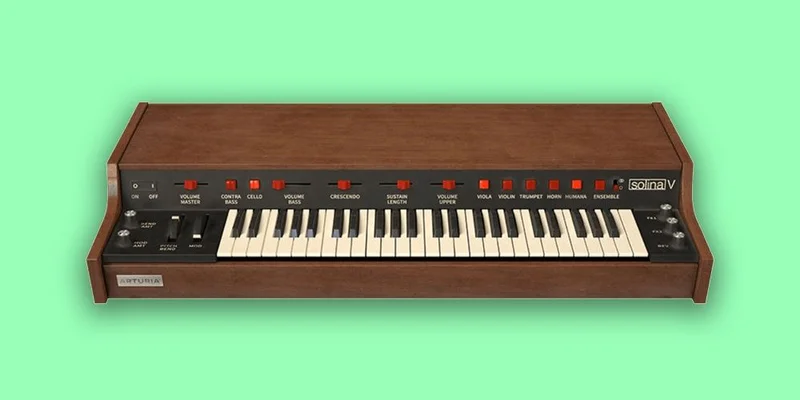
You've been chasing that sound for three tracks now. The lush string wash under a slow chord progression. The thing that makes early Giorgio Moroder records feel like they're breathing. You've tried sample libraries and walked away with something that sounds like a room mic on a cheap keyboard. You've tried rompler patches and got something technically correct and emotionally dead. The ARP/Eminent Solina String Ensemble was heard on more albums in the 1970s and early '80s than almost any other single keyboard, and getting that sound right in a plugin is harder than it looks. Arturia's Solina V, available at $99, is the most serious attempt to solve that problem in software. It's not perfect. But we'd take it over another sample pack.
The Problem Solina V Exists to Solve
String machines are deceptively difficult to emulate. The Solina didn't make strings by sampling a violin section. It generated tones through a divide-down organ circuit and ran them through an ensemble effect, a bucket-brigade chorus that smeared pitch and phase in ways that gave the sound its shimmer.
Sample-based string machines can't replicate that. They capture a static moment of a sound. The Solina's character comes from movement, from the interaction between slightly detuned voices running through the ensemble circuit in real time.
That's the gap Arturia targets with Solina V. Their physical model recreates the signal chain rather than sampling the result. The ENSEMBLE effect is built from a model of the original bucket-brigade circuitry, including separate MK1 and MK2 modes that reflect two distinct hardware revisions.
The MK1 sounds wider and more diffuse. The MK2 runs a bit tighter with a slightly different modulation character. The difference is subtle in isolation. In a mix, it's the difference between a pad that sits and a pad that moves.
Samples can't give you that choice. Solina V can. That alone justifies its existence in a world already full of string plugins.
What You're Actually Working With: The Original Voice Architecture
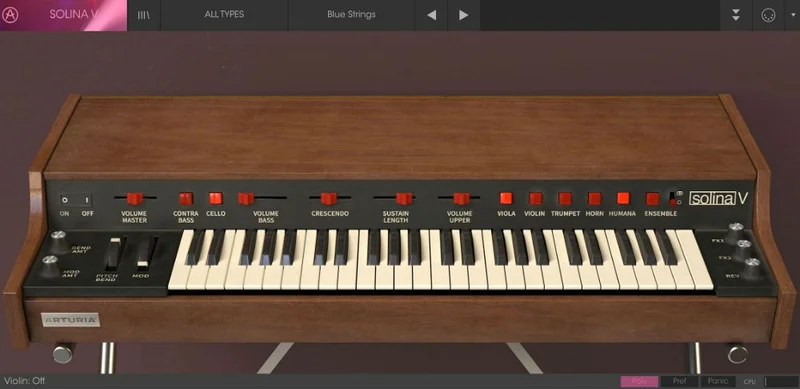
The original Solina had two sections: Upper and Bass. Upper covered Violin, Viola, Cello, Horn, and Trumpet. Bass covered the lower register with its own separate output. Solina V keeps this architecture intact.
The Upper Section runs in either paraphonic or polyphonic mode. Paraphonic is how the original hardware operated: all voices share a single filter envelope, which means held notes affect new notes. It's not a bug. It's what gave Solina recordings their characteristic swell and legato bleed.
Polyphonic mode is new. Each voice gets independent behaviour. This matters when you're building chord progressions that need clean separation between notes, or when you're layering Solina V with other instruments and need it to stay out of the way between attacks.
We ran a four-note held chord in paraphonic mode, then added a fifth note while the others sustained. The fifth note swell bloomed into the chord with a slight sluggishness that felt completely natural in context. Switch to polyphonic, and the fifth note attacks cleanly without disturbing the others.
Both modes are useful. Neither is better. Pick based on the track.
The Ensemble Effect: Where the Magic Actually Lives
The ENSEMBLE section is the heart of this instrument. Get it wrong and nothing else matters. Arturia's physical model is the strongest argument for buying Solina V over anything else in this space.
MK1 mode produces a broader, slightly more unstable shimmer. It drifts more. It's the sound you want under a slow-moving pad where you need the texture to feel alive without being consciously audible.
MK2 mode tightens the modulation. The spread is narrower, the phasing more controlled. It works better when the string sound needs to sit closer to the front of the mix without dissolving into haze.
We loaded a basic Violin patch, bypassed everything else, and ran the output into a clean bus with no additional processing. MK1 with a slow filter LFO sweeping underneath sounded like a proper vintage string bed within about 20 seconds of dialling in. Not "vintage adjacent." Actually there.
That's not something we can say about any sample-based alternative we've tested at this price point.
Vox Humana and the Moog Resonators: Expanding the Palette
Arturia pulled the Vox Humana from the 1978 Bob Moog Polysynth, and it shows. The Vox Humana is a vocal formant sound, a chorus of human voice tones that the original Solina didn't carry but that Arturia added through this expansion.
It sounds like a choir filtered through gauze. Not realistic. Not trying to be. It works brilliantly as a texture layer under Violin or as a solo pad when you want something between string machine and human voice.
The Moog Polysynth's resonator section sits on the Upper voice path. Resonators add harmonic emphasis at specific frequencies, giving the otherwise smooth Solina tones some bite and character. Think of it as adding a physical body resonance to a signal that naturally has none.
At moderate resonator settings, Violin stops sounding like a politely filtered square wave and starts sounding like it's vibrating inside a wooden instrument. It's not subtle once you push past the halfway point.
The resonators are the feature that lets you move Solina V beyond period-accurate reproduction and into sound design territory. Horn patches with resonators cranked start edging toward something between brass and synthesis. Useful for film scoring. Useful for anything that needs texture without identifiable source.
The 24dB Filter and Bass Section Controls
The Bass Section gets a 24dB per octave resonant filter. The original hardware had no such thing. This is a clean addition that doesn't try to pretend it's vintage.
A 24dB per octave slope is aggressive. At low resonance settings it shapes the low end without drawing attention to itself. Push the resonance and you get filter self-oscillation that turns the bass tones into something more synth-adjacent.
We used it to carve sub-range content from the Bass Section output before bussing it alongside the Upper Section. Setting the cutoff around 180Hz with a moderate Q cleaned up the low-mid buildup that happens when you hold sustained bass notes under a full string wash. That's the kind of practical detail that saves you from reaching for an EQ in the master chain.
The Bass Section also gets its own arpeggiator, which is either a nice bonus or an afterthought depending on how you use it. It's functional. It's not deeply configurable compared to dedicated arp implementations. Rate, direction, and octave range are there. You won't be building melodic sequences with it, but for adding rhythmic motion to a bass line under a static pad, it does the job.
The filter and arpeggiator together give the Bass Section a different personality from the Upper voices. You can run atmospheric Upper string washes while the Bass Section does something rhythmically active underneath, all within one plugin instance.
LFO: Vibrato, Tremolo, and Filter Movement
The LFO covers three destinations: vibrato (pitch), tremolo (amplitude), and filter modulation on the bass section.
Rate and depth are the controls. That's it. No LFO shape selection. This is a deliberate constraint in line with the vintage character Arturia is modelling, since the original hardware was similarly simple. But it does mean you can't, for example, run a square-wave tremolo to get a vintage organ-style pulse.
Sine wave modulation is what you get. For string machine purposes, that's exactly right. Vibrato at a slow rate with moderate depth adds the kind of natural pitch movement a real player introduces. Too fast or too deep and it tips into cheap keyboard territory quickly. Set with care and it adds breath to otherwise static sustained notes.
Filter LFO on the bass section is where it gets more interesting for modern production. A slow filter sweep on the bass tones while the Upper Section holds a static pad creates the sense of the whole instrument breathing, even though technically only the Bass cutoff is moving. It's a satisfying trick that works faster than you'd expect.
Aftertouch and Velocity Sensitivity
The original Solina had no velocity sensitivity. Every note hit at the same volume regardless of how hard you played. Arturia adds both velocity and aftertouch control in Solina V, which is where the instrument crosses from recreation into expressive tool.
Velocity controls level. Straightforward. The control is whether you want the vintage-flat dynamic response of the original or modern velocity-sensitive playing.
Aftertouch is more interesting. Mapped to vibrato depth by default, it lets you add pitch modulation mid-note by pressing into the key. On a synth action keyboard with good aftertouch response, this turns long-held notes into something with genuine character. Push into the key and the note slowly wavers. Release pressure and it settles.
It's a clever way to add expression to a sound that traditionally had none. We'd say it's one of the underrated features of Solina V. Most producers using this for background pads won't touch it. The ones playing leads or melody lines with a string ensemble sound will love it.
The Effects Chain: Where Solina V Gets Genuinely Deep
The effects section is substantial for a vintage emulation. Most string machine plugins give you a reverb and maybe a chorus. Solina V ships with a complete chain: 3-mode stereo chorus, stereo dual phaser, analog delay, digital sync delay, and a convolution reverb with 24 modeled spaces.
The 3-mode stereo chorus adds another layer of movement on top of the ensemble effect. Mode 1 is subtle, adding just enough width to push the sound wider in a stereo field. Mode 2 gets deeper and more obviously chorused. Mode 3 is the lush, almost exaggerated setting that works for solo pads in atmospheric tracks but can overwhelm in a dense arrangement.
The stereo dual phaser is where things get genuinely satisfying. Two phaser stages running in parallel with slightly offset rates creates a beating quality, a slow pulse in the stereo field that makes pads feel like they have internal movement. Slow rate, moderate depth, synced to the tempo of the track and it becomes an effect that sounds like you spent three hours building it in a modular rig.
We ran the Cello voice through the dual phaser at 0.35Hz on one stage and 0.45Hz on the other, with a Haas-style spread set to 24ms. The beating between the two stages created a low, slow pulse in the width of the signal. Dropped underneath a vocal as a pad, it felt like the track was breathing. No other processing on that bus. Just Solina V's own phaser.
The analog delay adds warmth and repeats with the slight degradation character of tape-style processing. The digital sync delay is cleaner and tempo-locked. Running both simultaneously, with analog delay at a shorter time than the sync delay, creates layered echoes with different character at each repeat stage. Unusual for a string plugin to carry this kind of depth.
The convolution reverb's 24 modeled spaces cover halls, plates, chambers, and rooms. The largest hall settings are long enough that they'd be overkill on anything but a solo string texture, but several of the mid-sized rooms are genuinely good for sitting string sounds in a mix without additional reverb sends. It saves you a send in the DAW chain, which matters when you're building dense sessions.
Presets and the Preset Browser
150 presets. That's a reasonable number for a focused instrument. What matters more than the count is whether the presets are useful starting points or demo patches designed to impress on first listen and annoy in practice.
Solina V's presets sit closer to the useful side. The categorisation tags work. Search by character (warm, bright, dark, moving) or by type (strings, brass, pad, lead) and you'll narrow to relevant sounds quickly without scrolling through 150 names.
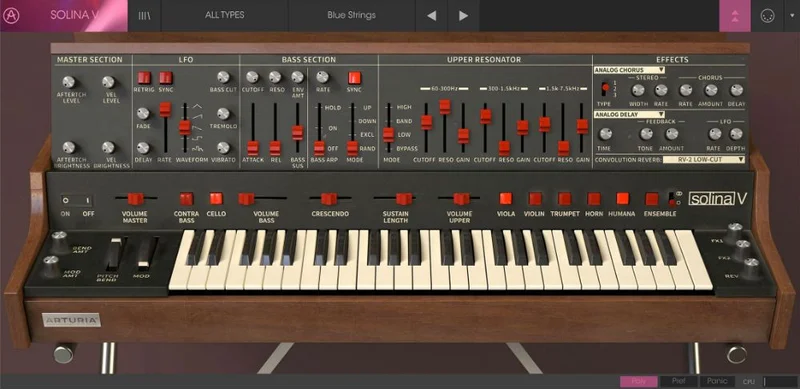
The frustrating part is that several presets lean heavily on the effects chain. That makes them sound impressive in the browser but hard to integrate into a track because you can't hear where the dry instrument ends and the processing begins.
The best presets are the simpler ones. Basic Violin with moderate ensemble. Cello wash with the filter slightly closed. Horn with resonators at 40% depth. These are the sounds you'll actually use. The rest are mostly there to demonstrate what the effects can do, which is fair enough as a sales tool but less useful as a working library.
You can mark favourites, add comments, and build playlists in the browser. That's the right feature set for a working plugin library, not just a demo interface.
Strengths and Weaknesses
The strengths cluster around the core purpose. The physically modeled ensemble effect is the best implementation we've heard in a plugin at this price. MK1 and MK2 modes give you genuine tonal options that affect how the instrument sits in a mix. The polyphonic mode addition fixes the original hardware's most practical limitation without removing the paraphonic character when you want it.
The Vox Humana and Moog resonators give Solina V a sound palette that goes well beyond the hardware it's based on. That's a real creative advantage, not just a marketing bullet point.
The weaknesses are real. The CPU minimum requirement of 4 cores at 3.4GHz is heavy for what is, at its core, a string machine. Live performance contexts on older machines are a genuine concern. Reviewers and users report occasional latency spikes when the convolution reverb and both delays are active simultaneously. That's a combination we'd avoid at low buffer sizes.
The arpeggiator is functional but shallow. If you need serious arp capabilities, you'll be routing MIDI from your DAW rather than relying on Solina V's built-in version.
The GUI can feel dense. When the Upper Section, Bass Section, LFO, effects chain, and preset browser are all in view at the same time, it's a lot of information to parse. The resizable GUI helps, but scaling down to fit a DAW project view makes fine adjustments annoying on smaller labels.
Value for the Price
At $99, Solina V is asking for a real commitment. The justification is there if you need what it does specifically. The physically modeled ensemble effect, the polyphonic upgrade, and the complete effects chain collectively deliver a toolset that would take multiple plugins to replicate otherwise.
It's also part of Arturia's V Collection, which means if you own the bundle, you already have this. If you're buying standalone, you're paying for a deep instrument in a narrow niche.
The honest comparison isn't to a generic string plugin. It's to the effort and cost of rebuilding the Solina sound from components: a string rompler, a dedicated bucket-brigade chorus emulator, a phaser, a dual delay, and a convolution reverb. At $99, Solina V undercuts that stack by a wide margin while keeping everything in one interface.
Worth it for producers who live in this sonic territory. Less worth it if you need a string sound once per album.
Who Should (and Shouldn't) Buy This
- ✅ Buy if you produce Nu Disco, vintage electronic, or film/TV scores where period-accurate string machine sounds are a recurring need, not a one-off request.
- ✅ Buy if you've tested sample-based string libraries and left disappointed by the lack of movement and life in sustained pads.
- ✅ Buy if you own a controller with polyphonic aftertouch and want an expressive vintage instrument that responds to pressure.
- ❌ Skip if you only occasionally need a string layer and can get by with a single decent preset from a rompler or general-purpose synth.
- ❌ Skip if your system is running below the 4-core 3.4GHz minimum, especially for live performance sessions where CPU spikes are punishing.
- ❌ Skip if you're already in the Arturia V Collection. You've had this for a while. Go open it.
Specs & Technical Details
| Developer | Arturia |
| Price | $99 |
| Plugin Format | VST / VST3 / AU / AAX / NKS (Standalone also available) |
| OS Support | Mac (10.13+, including Apple Silicon) / Windows 10+ (64-bit) |
| Activation | Arturia Software Center (ASC), up to 5 simultaneous activations |
| CPU Usage | Medium-Heavy (4 cores at 3.4GHz minimum; convolution reverb + dual delay adds load) |
| RAM Requirement | 4GB minimum |
| Disk Space | 3GB free required |
| Trial Available | Yes (via Arturia Software Center demo download) |
| Version Reviewed | Solina V (V Collection compatible, current build 2025/2026) |
| GPU | OpenGL 2.0 compatible required |
| ARM (Windows) | Not supported |
Score Breakdown
| Category | Score | Notes |
|---|---|---|
| Sound Quality | 4.5/5 | Physically modeled ensemble is the best available at this price; presets vary in usefulness |
| Value for Money | 4.0/5 | Strong standalone value; even stronger as part of V Collection |
| Ease of Use | 3.5/5 | GUI gets busy fast; preset browser is well-designed but instrument layout is dense |
| Features | 4.5/5 | Effects chain depth is rare in this category; arpeggiator is shallow but the rest is thorough |
| CPU Efficiency | 3.5/5 | Minimum requirements are high for a string machine; convolution reverb adds significant load |
| Overall | 4.2/5 | Best software Solina available; earns its price if this is your sonic territory |
Alternatives to Consider
If the Solina V's vintage string machine niche fits you but you're curious what else exists, here's where we'd look.
AudioThing SX1000: AudioThing's Italian synth emulations tend toward the obscure and the specific. The SX1000 review covers an instrument in a similar vintage territory. Narrower sound palette than Solina V, but lighter on CPU and worth comparing if your primary need is texture rather than string accuracy.
Arturia SEM V: Different architecture entirely but within Arturia's own lineup, the SEM V review offers a vintage synth voice that layers well with Solina V pads. If you're building a vintage-leaning rig from Arturia's catalogue, these two complement each other without overlapping.
Arturia MiniFreak V: If you find Solina V too narrow in focus, the MiniFreak V review covers a much broader synthesis engine that can approximate string machine textures among dozens of other sounds. Less authentic to the specific Solina character, but more versatile as a general-purpose instrument at a different price point.
Applied Acoustics Chromaphone 3: For producers who want physical modelling in a completely different direction, the Chromaphone 3 review approaches acoustic modelling through percussion and resonator bodies. No string machine comparison, but it shows what physically modelled sound design can do when applied differently.
No dedicated string machine plugin we've tested matches Solina V's ensemble accuracy at this price. The nearest alternatives are either sample-based (and miss the movement quality) or significantly more expensive hardware emulations aimed at different production contexts.
The Verdict on Solina V
The Solina V gets purchased by producers who've spent time chasing that moving, breathing string pad and kept coming back empty-handed.
It's not a general-purpose synth. It's not trying to be. It's a deep, focused emulation of one of the most recorded keyboard sounds in pop history, expanded with features the original designers never had access to. The physically modeled ensemble effect delivers what every sample-based competitor fails to: the sense that the sound is alive rather than replayed.
The weaknesses are real but contained. CPU demands are higher than they should be for this category. The arpeggiator is shallow. The GUI rewards patience over immediacy. Users and reviewers report that the convolution reverb can push CPU hard at low buffer sizes, which matters if you perform live.
At $99 standalone, this is the instrument for one kind of producer: the one who loads a slow Cello wash, adjusts the MK1 ensemble depth, sweeps the dual phaser to a low pulse rate, and feels the track click into place. If that sentence describes a workflow you recognise, buy it.
If you need strings once a year and any lush pad will do, the Solina V is the wrong tool. A one-shot library or a general synth preset will cost you less and take up less CPU. Solina V is for the producers who know exactly what they're missing. For everyone else, it's a beautiful instrument solving a problem they don't have.
Related reviews: MASSIVE X · Flow Motion FM Synth
Frequently Asked Questions
What is the Solina V based on?
Solina V is a physical model of the ARP/Eminent Solina String Ensemble, a keyboard heard on more album recordings in the 1970s and early '80s than almost any other instrument. Arturia's model recreates the original MK1 hardware signal chain, including the bucket-brigade ensemble effect, with MK2 mode added as a variant. The instrument is expanded with features from the 1978 Bob Moog Polysynth, including the Vox Humana voice and the resonator section.
What's the difference between paraphonic and polyphonic mode?
Paraphonic mode is how the original Solina hardware operated: all active voices share a single filter envelope, meaning holding notes affects new notes as they're played. This creates the characteristic swell and legato bleed of vintage Solina recordings. Polyphonic mode, added by Arturia, gives each voice independent behaviour, which is better for chord progressions where you need clean separation between notes. Both modes are useful and the choice depends entirely on the musical context.
Is Solina V compatible with Apple Silicon Macs?
Yes. Arturia explicitly lists Apple Silicon CPU as a supported configuration on Mac. Windows ARM processors are not supported, so Windows users on ARM-based machines won't be able to run it. All other 64-bit Mac and Windows configurations meeting the minimum specs are compatible.
How many activations does Solina V allow?
Arturia Software Center (ASC) manages licensing and allows up to five simultaneous activations per license. This means you can install Solina V on a studio desktop, a laptop for live use, and additional machines without purchasing separate licenses. ASC also handles updates and lets you sync licenses across devices.
How does Solina V compare to sample-based string plugins?
The core difference is in how the sound is generated. Sample-based string plugins replay recorded audio and can't replicate the movement and phase interaction of a real ensemble effect. Solina V's physical model recreates the signal chain of the original hardware, including the bucket-brigade chorus circuitry, which produces movement that samples inherently can't. Reviewers consistently identify this as the reason Solina V sounds alive where samples sound static, especially in sustained chord textures.
Can Solina V handle live performance, or is it strictly a studio plugin?
It runs in standalone mode as well as all major plugin formats, so live performance is possible. The concern is CPU. The minimum requirement of 4 cores at 3.4GHz is high for a string machine, and users report that running the convolution reverb alongside both delay effects at low buffer sizes can cause spikes. For live use, we'd recommend either bypassing the convolution reverb in favour of a lighter hall setting, or running at higher buffer sizes if latency tolerance allows. The dry instrument and ensemble effect alone are efficient enough to perform reliably on a modern machine.