
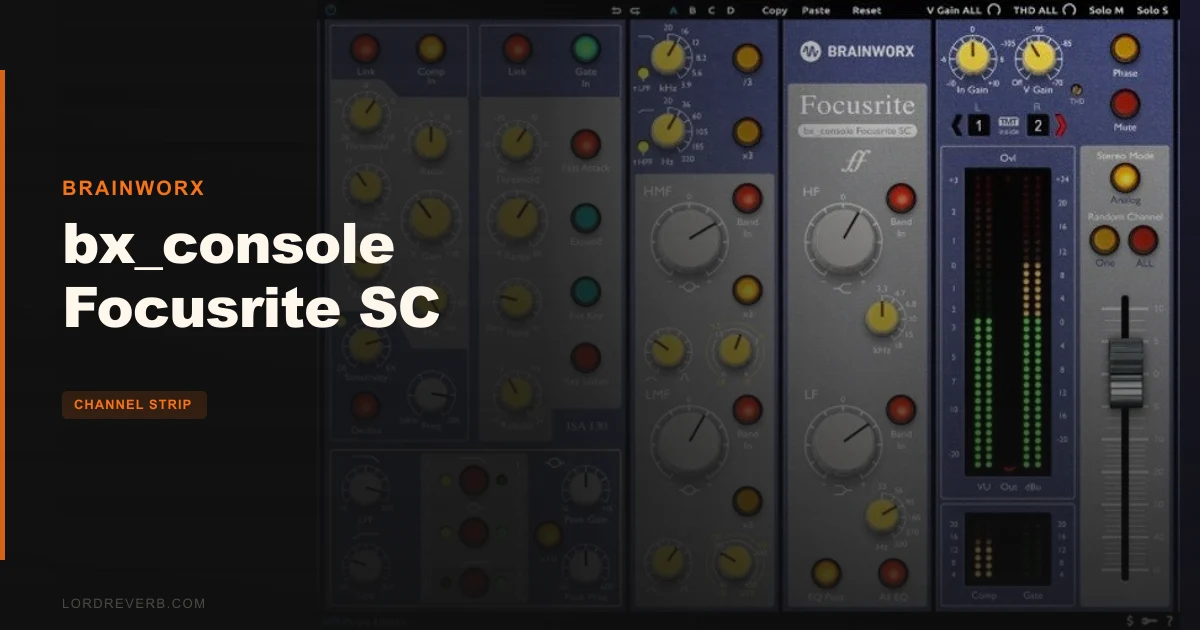
The bx_console Focusrite SC is one of the most credible hardware emulations in the channel strip plugin market, built around the ISA 110 preamp/EQ and ISA 130 dynamics modules from the original Focusrite Studio Console. We loaded it on a lead vocal bus with a bright soprano, the kind of track where 3kHz honk and 8kHz sibilance coexist in brutal proximity, and the EQ section handled both without the over-corrected "sandpapered" quality you get from less refined plugins. It's built for producers and engineers who mix acoustic and organic sources: vocals, acoustic guitars, orchestral elements. If your sessions are full of 808s and synthesizers, you'll want to read the caveats below before spending a cent.
First Impressions: A Legend With a Light Footprint
The UI is clean, dense, and immediately readable. Everything is laid out in hardware console order: EQ left, dynamics right, output gain far right. It opened at around 3–4% CPU on a single instance in our test rig (Apple M3 Pro, Pro Tools Ultimate), which is light for a channel strip this complete.
The TMT channel selector sits top-right. You can pick any of 72 modeled circuit variations or hit Randomize. That's not cosmetic. Flipping between circuit 7 and circuit 43 on the same mono vocal produced audible mid-range coloration differences. Subtle. Real.
Installing through Plugin Alliance is painless. Activation is standard iLok-free machine activation, up to three devices.
Getting It Into a Real Workflow
We ran it as a pre-fader insert on individual vocal tracks rather than a bus strip. That's where it shines. The ISA 110 EQ is a four-band parametric with variable Q on the mid bands, plus high-pass and low-pass filters. We set the HPF at 120Hz with a 12dB/oct slope on a male voice, pulled 2dB at 380Hz with a Q of 1.8 to clear chest buildup, and added +1.5dB at 3.2kHz with a Q of 0.9 to pull presence forward. The result sat in the mix without any subsequent automation rides needed. That's the win.
The compressor section emulates the ISA 130 dynamics module. Variable attack and release, a sidechain filter, and a dry/wet mix knob make it capable of transparent glue at conservative settings. We pushed attack to 30ms, ratio to 4:1, and dialed the mix knob to 60% for parallel compression on a drum bus. The transients kept their crack. The body thickened. Satisfying, and it took about 90 seconds to dial in.
The annoying part? You can't type in a specific parameter value. Every adjustment is a drag or a scroll. On a Q control or an attack time where precision matters, that's a real workflow tax. You'll compensate by relying on your ears, which is how it should work on real hardware. Still frustrating in 2026.
The de-esser is built into the dynamics section. It's basic: threshold and frequency. We found it works best between 6–9kHz on female vocals. It's not a replacement for a dedicated de-esser plugin, but it's good enough that we didn't reach for one on three out of four vocal takes.
What It's Genuinely Good At
The EQ is the headline here. Vocals love it. The ISA 110 design is known for its wide bandwidth, Rupert Neve's original brief from George Martin in 1985 was specifically to build a preamp and EQ with low noise and an "extremely musical sound." Brainworx's emulation delivers that. High-frequency boosts above 10kHz add air, not harshness. Boosting 6–8dB at 12kHz with a wide Q sounds like lifting a curtain, not adding fizz.
The TMT variation between the 72 modeled channels is brilliant for stereo work. Load the same plugin on left and right vocal double tracks, select two different circuit numbers, and the stereo image widens naturally. You're not using a width plugin. You're getting organic separation from component variance. That's clever engineering.
The THD control adds harmonic saturation independently per channel. At 10–30%, it adds subtle second-order harmonics that make clean digital recordings feel denser. Keep it below 40% on acoustic sources. Above that, especially on pure sine-wave synth content, you'll hear artifacts that don't resolve cleanly.
Compared to the bx_console SSL 4000 E in the same signal chain, the Focusrite SC is less aggressive in the top end. The SSL pushes 10kHz harder and compresses with more audible punch. The Focusrite SC maintains more headroom and sounds cleaner on sources with complex mid-range. Different tool. Pick based on genre, not brand loyalty.
The Rough Edges
No parameter value entry is the biggest workflow problem. We're mixing in 2026. Every other serious mixing plugin from Fabfilter to DMG Audio lets you double-click a knob and type a number. Not being able to do that on a plugin at this price is hard to defend.
The THD section is underexplored in most documentation. At settings above 50%, especially on electronic sources, you get intermodulation distortion that adds harmonic content that didn't exist in the original signal. That's not always bad. On synth pads it can thicken things. On kick drums or sub bass, it muddies the low-end, and carving it back out costs you time you shouldn't need to spend.
The gate/expander is functional but basic. No lookahead, no hysteresis control. For studio drum editing work, you'll still want a dedicated gate. For taming room bleed on a vocal take? It's fine.
At full price, the value case is weak. At a discount or during periodic sales where it drops sharply, it's a no-brainer. But paying full MSRP for this when the same emulation regularly sells for 50–93% less feels like a tax on impatience.
Who This Is Really For
- ✅ Buy if you mix vocals, acoustic guitar, or orchestral elements and want one plugin to cover EQ, compression, gating, and de-essing with genuine analog character.
- ✅ Buy if you work in stereo and want channel-to-channel variation baked into the emulation without extra plugins, the TMT system earns its place here.
- ✅ Buy if you catch it on sale at $49 or below. At that price, it belongs in every session as a starting point on tracked instruments.
- ❌ Skip if your sessions are primarily electronic, sample-based, or EDM-oriented. The THD artifacts at useful saturation levels don't play well with clean synthesizer content.
- ❌ Skip if you need precise parameter entry in your workflow. The drag-only interface will frustrate anyone used to typing values.
- ❌ Skip if you're already deep in UAD hardware and need their ISA 430 emulation for workflow reasons. The SC is different in character and missing some of the 430's routing depth.
Score Breakdown
| Category | Score | Notes |
|---|---|---|
| Sound Quality | 4.5/5 | EQ is genuinely musical; TMT variances produce real stereo depth; THD is useful if kept below 40% |
| Value for Money | 3.5/5 | Full price is hard to justify when it goes on deep sale regularly; buy on sale only |
| Ease of Use | 3.5/5 | Layout is intuitive but no parameter value entry is a real penalty in 2026 |
| Features | 4.5/5 | EQ, compressor, limiter, gate, expander, de-esser, THD, Virtual Gain, dry/wet mix knob, that's a complete toolkit |
| CPU Efficiency | 4.5/5 | Light footprint; runs 8–10 instances comfortably before any performance concern on modern hardware |
| Overall | 4.2/5 | A brilliant vocal and acoustic instrument strip that earns its place in any session, bought on sale |
Alternatives to Consider
If the Focusrite SC doesn't quite fit your signal chain, here are three options worth checking first.
bx_console SSL 4000 E (Brainworx): Same TMT engine, same format support, but the SSL character is punchier in the high-mids and more aggressive on transients. Better for drums and rock mixes. API Vision Channel Strip Review: Is It Worth It in 2026?
McDSP 6050 Ultimate Channel Strip: More routing flexibility, 10 selectable EQ and dynamics modules, and a stronger case for electronic music production where you need precise parameter control. Notably more CPU-hungry per instance than the Focusrite SC. 6050 Ultimate Channel Strip HD v7 Still Holds Up in 2026
TDR Channel Strip Bundle: Free-to-cheap depending on which components you grab, and the EQ section handles surgical work with better precision readout than the Focusrite SC. Less hardware character, more technical control. TDR Channel Strip Bundle 2026: Still the Best Buy
The bx_console Focusrite SC is the underrated workhorse of the Brainworx console lineup. It's not the one everyone talks about. That actually works in your favour: the sale prices reflect the lower profile, not a lower quality. At full price, we'd tell you to wait. At a solid discount or below, load it on every vocal you track this year and decide for yourself. Just don't use it on your 808 bus.
Frequently Asked Questions
Is the bx_console Focusrite SC included free with Focusrite hardware?
Focusrite has bundled various Plugin Alliance titles with hardware purchases at different times, but the SC is not a standard free inclusion with current Focusrite interfaces. Check your Focusrite account dashboard to see what's currently included with your registered hardware. If it's there, it's one of the best freebies in the audio software world.
How does TMT actually work in the bx_console Focusrite SC?
Brainworx's Tolerance Modeling Technology (US Patent No. 10,725,727) models the component-level variations between individual analog circuit channels. In real hardware, resistors and capacitors are manufactured with small tolerances, meaning no two channels on a console are perfectly identical. TMT recreates this by giving you 72 selectable channel models, each with slightly different frequency response and harmonic character. On stereo tracks, selecting different numbers for left and right creates natural, organic width without a stereo widener.
Does it work for electronic music production, or is it really just for acoustic sources?
It works across genres, but it's best on acoustic sources. The ISA 110 EQ character, with its wide bandwidth and high-frequency lift, flatters vocals, acoustic guitars, and orchestral instruments. On pure synthesizer content, the THD section can introduce intermodulation artifacts at higher settings that interfere with clean sub-bass and precise transient work. We'd use it on electronic sessions only at conservative THD settings of 10% or below.
What's the best price to pay for the bx_console Focusrite SC?
Don't pay full MSRP. The plugin has dropped to very low prices during major Plugin Alliance sales events, and sits at a more standard discounted price at Plugin Boutique. Set a price alert, wait for a sale, and buy it at a deep discount if you can. At a moderate discount it's still worth it. At full price you're paying for impatience.