
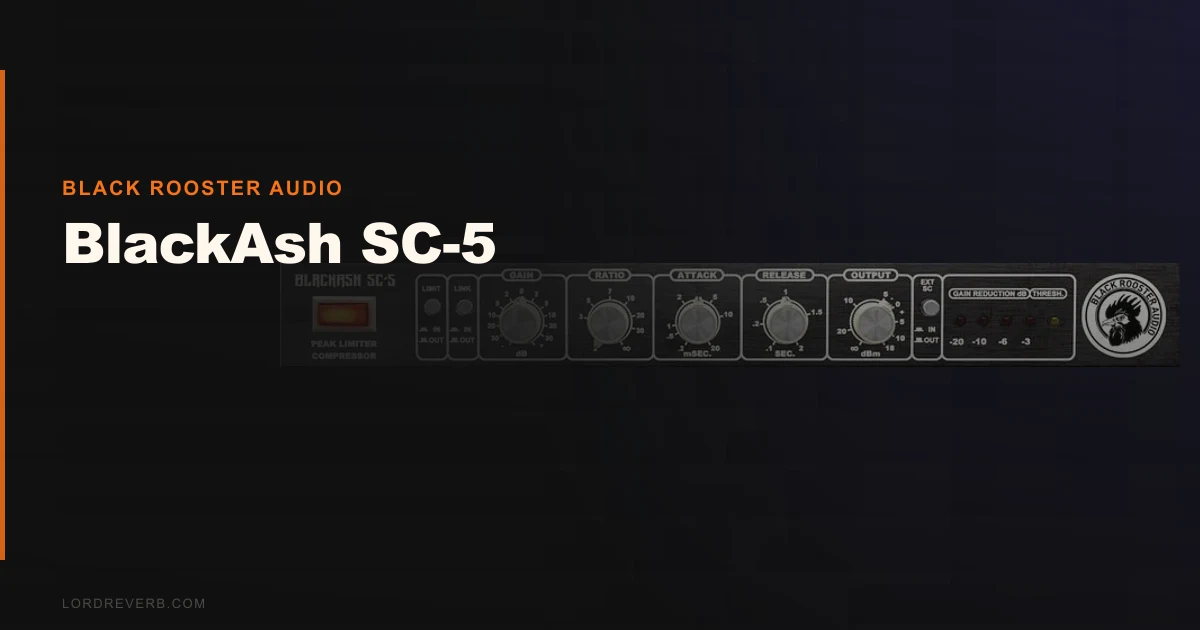
You've got a drum bus that sounds right but feels wrong. Plenty of transient snap, decent body, but no weight. No glue. Every VCA plugin in your session is either too clean to add character or too aggressive to stay invisible, and you're sitting there at 2am pulling automation on a bus that should just work. That's the exact problem the BlackAsh SC-5 from Black Rooster Audio is built to fix. It's a circuit-modeled emulation of the rare black-frontplate revision of the Ashly SC-50, a 1980s hardware compressor that most engineers have never seen in person but whose sonic fingerprint shows up on records you've definitely heard.
This review is for producers and mix engineers who care specifically about tonal character in their compression, not just gain reduction math. If you want a clean, transparent VCA, skip this one. The BlackAsh is opinionated hardware, and the plugin makes no apologies for that.
The Specific Problem This Hardware Revision Solves
Most vintage compressor emulations model the most famous hardware version. The safest, most documented one. Black Rooster went a different direction with the BlackAsh SC-5.
The black-frontplate Ashly SC-50 revision has a 31.2kHz first-order lowpass filter baked into its audio path. That's not a feature you switch on. It's part of the circuit. It rolls off the very top of the frequency range in a way that adds warmth without killing air, and it pulls the harmonic structure toward the darker end compared to the standard silver-frontplate unit (which Black Rooster modeled separately as the BlueAsh SC-5).
That difference matters on sources that are already bright. Sibilant vocals, brittle digital drums, overcooked room mics. The BlackAsh naturally tames those problem frequencies as part of its compression behavior, not as a separate EQ step.
The external sidechain also separates it from most budget VCA emulations. You can frequency-shape what the detector is responding to without reaching for a separate plugin on a sidechain bus.
How It Performs in an Actual Session
We ran a full drum bus through the BlackAsh at a 4:1 ratio, attack at 10ms, release at auto. The kick and snare retained their transient punch for the first few milliseconds, then the compressor caught the sustain and squeezed it into the room sound underneath. We ended up at roughly 4-5dB of gain reduction sitting on top, and the bus stopped fighting the rest of the mix.
That's satisfying in a way that takes some plugin emulations months of tweaking to achieve. The BlackAsh did it in under two minutes of dialing.
We also put it across a lead vocal that had a harsh 8-10kHz peak we'd been fighting. Instead of reaching for a de-esser, we routed a high-shelf boost into the sidechain at around 8kHz. The compressor reacted harder when those frequencies spiked, and the vocal smoothed out without losing presence. Not a replacement for a de-esser in every case, but clever on this particular track.
Where it got frustrating: there's no numerical gain reduction display. You're reading a VU-style meter and estimating. When we were riding around 2-3dB of reduction on a mix bus, we had to trust our ears more than we wanted to. That's period-authentic, but annoying in 2026 when every competing plugin gives you a digital readout.
CPU load sat around medium on an M1 Mac in Logic Pro. Multiple instances on separate buses didn't cause any spikes during our testing, which puts it in comfortable territory compared to some circuit-modeled compressors that cost twice as much and eat 3x the processing.
For direct comparison: up against the Bettermaker Mastering Compressor on a mix bus, the BlackAsh sounds darker and more colored. The Bettermaker is cleaner and gives you more precise control. Neither is wrong. They're solving different problems.
Strengths and Weaknesses, Without Softening Either
The circuit modeling is the headline strength, and it earns that position. Black Rooster's real-time SPICE-style component simulation isn't just marketing language. You can hear where the algorithm is doing something different from a generic VCA topology, especially in the way the compressor releases. It breathes. The tail of a snare, the back of a vocal note, releases gradually rather than snapping back.
The external sidechain is underrated for what it costs. Most plugins at this price point give you a fixed detector. The BlackAsh lets you shape what triggers the compression, which opens up mid-side routing and frequency-selective compression without buying another tool.
The weakness that actually bothers us: the list price. We love the plugin. We hate the pricing logic. This thing has sold at a deep discount at Plugin Boutique and sits regularly across a wide range of prices at major vendors. Paying full retail for the BlackAsh SC-5 is a bad move. Wait for a sale. You will not wait long.
The lack of a BlueAsh bundle at a combined price is also a missed opportunity. If you want both characters of the SC-50, you're paying full price twice. That's a real cost for producers who want both voices in their toolkit.
Is the Price Actually Justified?
At list price, no. Not when the historical low was a fraction of list and it regularly retails well below that.
At $39 on sale? Yes, without hesitation. The circuit modeling work that went into this plugin is serious, and the resulting sound is worth that number easily.

At a mid-range sale price, it depends on how much you need the specific tonal character. If you're chasing the dark, slightly filtered sound of the black-revision Ashly and nothing else in your plugin folder scratches that itch, a mid-range sale price is defensible. If you're just looking for "a good VCA compr essor," there are more cost-effective options.
Never pay list price. Check Plugin Boutique and Black Rooster's own site for current pricing and watch for their sale cycles.
Who Should Buy This (and Who Should Skip It)
- ✅ Buy if you're after the darker, filtered tonal character of 1980s VCA compression and want it without tracking down hardware.
- ✅ Buy if you need external sidechain routing for frequency-conscious compression on vocals or overheads.
- ✅ Buy if you catch it on a good sale. At that price it's a no-brainer and earns permanent shelf space.
- ❌ Skip if you want a clean, transparent VCA. The BlackAsh is not that. It will color your signal.
- ❌ Skip if you're paying full retail. The sale price is real and recurring. Don't rush.
- ❌ Skip if you need detailed gain reduction metering. The analog-style VU readout will frustrate workflows that rely on precise visual feedback.
Score Breakdown
| Category | Score | Notes |
|---|---|---|
| Sound Quality | 4.3/5 | The circuit modeling produces real tonal character; the 31.2kHz filter is audible and useful |
| Value for Money | 3.3/5 | Great at a sale price like $39, hard to justify at list. |
| Ease of Use | 3.8/5 | Simple signal chain, but the absence of numeric GR metering costs points |
| Features | 3.8/5 | External sidechain is a genuine differentiator; feature set is otherwise focused rather than expansive |
| CPU Efficiency | 4.0/5 | Medium load, multi-instance capable on modern hardware without drama |
| Overall | 4.1/5 | Brilliant at the right price; the pricing strategy is the plugin's biggest problem |
Alternatives to Consider
If the BlackAsh's dark character doesn't match what you're after, these are worth your time.
Waves CLA-2A / CLA-76: Different compression topology entirely (optical and FET respectively), but both are frequently on sale at low prices and cover different character territory. If you need clean VCA work, neither of these is the answer either, but they're worth knowing about for your signal chain overall. You can find our thoughts in the best compression plugins round-up.
Bettermaker Mastering Compressor: Higher price point and cleaner character, but if you're working on mix buses and masters where transparency matters more than color, it's the stronger tool. We broke it down in our Bettermaker Mastering Compressor review.
Waves C4 Multiband: Not a vintage VCA, but if your reason for reaching for the BlackAsh is frequency-specific compression on a bus, the C4 gives you four bands of independent control. We covered whether it still holds up in the Waves C4 Multiband Compressor review.
BlueAsh SC-5 (same developer): Same hardware family, brighter character. If you've heard the BlackAsh and it's too dark for your material, the BlueAsh models the silver-frontplate SC-50 revision and sits differently in the mix. The question of which one you need is a tonal question, not a quality question. Both are worth auditioning before committing.
The BlackAsh SC-5 is a serious piece of circuit modeling work that sounds exactly like what it claims to be. The hardware inspiration is rare and the plugin nails its character. But pay attention to that pricing. Nobody should be spending full list price on a plugin that routinely sells for a fraction of that on sale. Catch it at a low price, load it on your drum bus, and you'll wonder how you lived without it. Pay full retail, and you'll resent it every time you see the sale notification three weeks later.
Frequently Asked Questions
What is the difference between the BlackAsh SC-5 and the BlueAsh SC-5?
Both model the Ashly SC-50 hardware compressor, but different hardware revisions. The BlackAsh emulates the black-frontplate revision, which has a 31.2kHz first-order lowpass filter baked into the audio path. That filter makes the BlackAsh darker and more colored in its harmonic character. The BlueAsh models the silver-frontplate revision and sits brighter and more open-sounding. The right choice depends on your source material and how much color you want the compressor to add.
Is the BlackAsh SC-5 good on vocals?
Yes, with a caveat. The darker character and external sidechain make it strong on vocals that are already bright or sibilant. You can route a boosted high-shelf into the sidechain to make the detector react harder to harsh frequencies, which smooths out sibilance as part of the compression behavior. For vocals that already sit dark in the mix, the BlackAsh can make things muddier. Bright, forward, slightly harsh vocals are where it earns its place.
Does the BlackAsh SC-5 work on Apple Silicon Macs?
Black Rooster Audio supports macOS 10.9 and above in VST, VST3, AU, and AAX formats. We tested it on an M1 Mac with no stability issues. For the most current compatibility information, check the Black Rooster Audio site directly, as plugin updates sometimes bring additional optimizations.
Is the BlackAsh SC-5 worth buying at full price?
No. The plugin has sold for very little and regularly appears at a discount at Plugin Boutique and other major vendors. The sound quality is easy to justify at a sale price, but the list price is hard to defend given how often it goes on sale. Add it to your wishlist on a plugin store that sends sale alerts and you'll almost certainly see a discount within a few weeks.
