BollyX is a drum machine VST plugin from BeatSkillz that loads 50 hand-crafted kits and over 300 Indian percussion hits into a 32-step sequencer, and it's the fastest way to get authentic Bollywood-flavoured rhythm beds into a modern production at $29. That's the honest answer to whether it's worth your time. But the regret some buyers feel is real, and it's worth knowing about before you spend anything.
The specific regret looks like this: you buy it thinking it's a one-stop solution for complex Indian rhythm arrangement. You open it, the first kit sounds great, you drop in a pattern, and it feels inspired. Then you try to build something more structurally ambitious, something with evolving rhythmic layers and odd-metre phrasing, and you hit the wall. Five pattern slots per kit. Preset patterns that lock you into existing ideas. Limited per-voice routing. For certain producers, that wall shows up fast.
For others, it never shows up at all. If you're writing hip-hop with a South Asian flavour, trap beats that need a dhol hit instead of an 808, cinematic cues that want a tabla texture underneath strings, BollyX is satisfying to work with and priced at a point where the question barely needs asking.
The question worth asking is whether you're the first type of producer or the second. That's what this review is for.
Who Ends Up Regretting This
The mismatch is almost always the same. You're a producer who works from the rhythm up, building patterns manually, changing metre mid-sequence, treating a drum machine as a composition tool rather than a texture library. BollyX wasn't built for you.
Five pattern slots per kit sounds workable until you're two hours into a track and you need eight variations. The preset patterns are genuinely useful as starting points, but some owners report feeling fenced in by them. If your process is "erase everything and start from zero," you'll spend most of your session fighting the preset logic rather than working with it.
The 5000ms sample length cap is also a real limit. Long tabla resonances, tanpura drones, sustained frame drum hits: anything that naturally breathes past five seconds gets cut. That's annoying if Indian classical textures are what you're after, not just punchy percussion hits.
Advanced composers who want per-voice compression, aux sends, or independent reverb chains per pad will find the mixing section thin. The built-in EQ, compressor, and reverb are there, but they're not deep. If you're mixing at a professional level, you'll route out through the 8-channel multiout and handle everything in your DAW, which works fine but adds steps.
Skip it if you need a full rhythm arrangement toolkit. Buy it if you need great Indian drum sounds with a workflow that gets out of your way.
What Owners Actually Say
The praise from producers who use BollyX is consistent on a few points. The MIDI mapping is one of them. Owners report that the pre-assignment for Akai MPC Mini controllers makes the plugin feel physically immediate in a way that laptop-only plugins don't. You load it, hit the pads, and it responds. That matters more than spec sheets suggest.
The five-minutes-to-music claim gets repeated enough to take seriously. Producers describe a workflow where the kits and patterns are configured well enough that you don't spend the first session just setting things up. For producers who buy plugins and lose half a night to routing and troubleshooting, that's something worth noting.
The 300+ hits get consistent praise for variety. Indian percussion is regionally diverse, and owners appreciate that the library covers more than just tabla and dhol. The coverage spans enough ground to feel like a real toolkit rather than a novelty sample pack.
The complaints cluster around the same limits mentioned above. Preset pattern reliance comes up often from producers trying to do more structurally complex work. And a handful of users note that the per-voice mixing controls leave them wanting more. Those are real complaints, not nitpicks, and they tell you something about where the plugin's ceiling is.
What nobody complains about is the sound quality itself. The hits are clean and the tuning is consistent across the kits.
The Sample Pads and What You Can Load
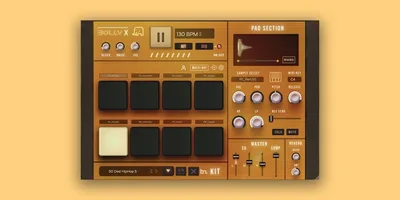
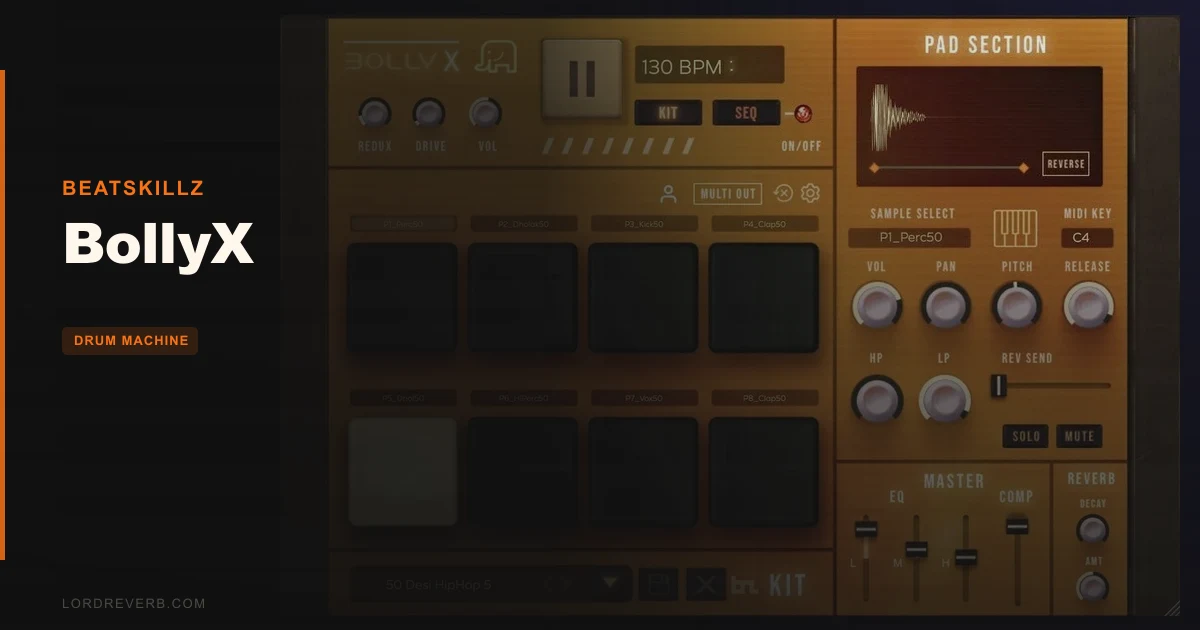
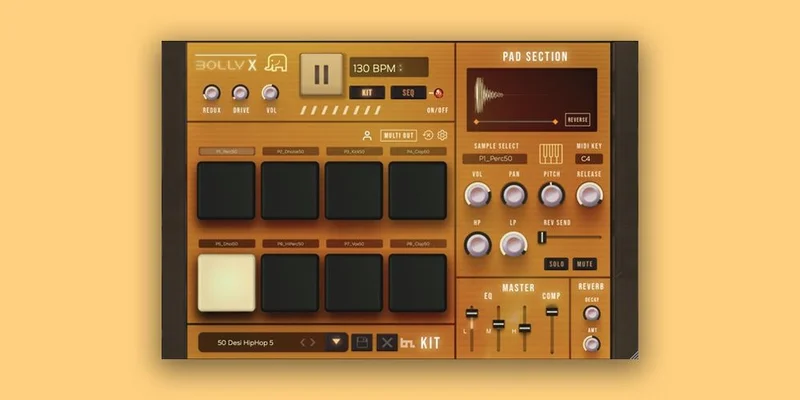
BollyX gives you 8 sample pad slots per kit. Each slot shows a waveform display with start and endpoint controls, so you can trim a sample without opening a separate editor. That's a genuinely useful feature for a drum machine at this price point.
Drag-and-drop loading accepts WAV, DIFF, FLAC, and MP3 files. So if you've got a folder of field recordings from a trip to Rajasthan, or a sample pack you've been sitting on, you can swap factory content for your own material without leaving the plugin. That extends the library well past the included 300 hits.
Per-pad controls cover volume, pitch, pan, release, reverse, low-pass filter, high-pass filter, and sample trim. The pitch control lets you tune individual hits to key, which matters when tabla or dhol hits are sitting against a melodic chord. The reverse switch is fast to reach and works well for glitch and transition effects.
The 5000ms cap deserves a second mention here. For short percussive hits, it's completely irrelevant. For anything with a natural decay longer than five seconds, you'll either trim the source file before loading or accept the cutoff. It's a limit the developer doesn't advertise loudly, so check your sample lengths before you plan a session around long sustained textures.
MIDI note assignment per pad is straightforward. Right-click any control to map it to MIDI CC. The whole surface is mappable, which means you can control volume, filters, and pitch from hardware without touching the mouse mid-performance.
The 32-Step Sequencer in Practice
The sequencer is where BollyX does its most interesting work. Thirty-two labeled steps in a grid window, DAW-tempo-synced, with loop creation by clicking step numbers directly. That last part matters: you don't need to set loop points in a separate menu. Click the steps you want, and the loop range updates immediately.
Time division options run from 1 BAR down to 1/64. That range gives you everything from slow one-bar phrases to fast 32nd-note hi-hat patterns without changing any global settings. Each step carries its own parameter set: pitch (minus 12 to plus 12 semitones), note length (0 to 3ms), velocity (0 to 127), swing, reverb (0 to 1), and pan.
Per-step pitch is clever for Indian percussion. Tabla playing involves real pitch inflection, and being able to shift individual steps by semitone increments lets you approximate that in a sequencer context. It won't replace a real tabla player. But it gets closer than a flat, velocity-only grid.
The five pattern slots per kit are where the ceiling becomes visible. Five slots give you five variations per kit, which is enough for a song with intro, verse, chorus, bridge, and outro. If your arrangement is more complex than that, you're either reloading kits mid-session or bouncing pattern outputs and assembling in your DAW timeline. Neither is a dealbreaker, but both add friction.
The MIDI drop feature exports your sequences to the DAW as MIDI, which solves the pattern limitation for most workflows. Build your five patterns, export the MIDI, arrange in the timeline. It's a reasonable workaround, and most producers who've been using drum machines for a while will work this way naturally.
Swing, Reverb, and the Per-Step Parameter Set
Swing at the per-step level is underrated as a feature. Most budget drum machines give you a global swing amount. BollyX lets you set swing individually per step, which means you can push one hit late while keeping the surrounding grid tight. For Bollywood and bhangra, where rhythmic feel is as important as pattern, that granularity is satisfying to have.
The per-step reverb control runs 0 to 1, letting you add space to individual hits without routing through the global reverb. It lets you add space to individual hits without routing through the global reverb. A short dhol hit can sit dry while a rim hit blooms into the room. That's a workflow detail that larger, more expensive drum machines sometimes miss.
Per-step pan works the way you'd expect. Push a hi-hat step slightly right and the main beat sits centre. It's basic stereo field shaping, but having it at the step level rather than just the pad level means your patterns can have spatial movement built in without automation lanes.
The global built-in effects are EQ, compressor, and reverb. They're not deep. The EQ won't replace your channel strip. The compressor is useful for glue but doesn't have the control you'd want for detailed transient shaping. Use them for quick tone-correction in context. For serious mixing, the 8-channel multiout is there for a reason.
The Kit Library: 50 Kits, What They Actually Cover
Fifty kits with 50 patterns is a solid starting library. The sounds were designed by Gaurav Dayal and Sentury Status, and the developer describes influences from Timbaland, Afrika Bambaataa, Balkan Beat Box, and Bally Sagoo. That's not a list you assemble by accident. It signals something about where these kits sit culturally: they're built for fusion, not for ethnomusicological accuracy.
That matters. If you need sample-perfect traditional Indian percussion for a documentary or a classical arrangement, BollyX is probably not your first call. If you need tabla-inspired hits that work in a trap context, dhol sounds that sit next to a 808 without clashing, or bhangra percussion that holds its own next to a synthesiser bass, the library is designed exactly for that crossover.
The 300+ hits span enough regional variety to avoid feeling like a single-stereotype library. The developer specifically mentions "pristinely recorded sounds from many regions of India," and the kit spread supports that. You'll find textures that don't all sound like the same session room.
Five pattern slots per kit means each of the 50 kits ships with up to five preset patterns. That's up to 250 patterns in the factory library. For a producer with no background in Bollywood or bhangra rhythm structures, that's a genuinely useful pool to draw from. For a producer who already knows these rhythms well, it may feel like a collection of suggestions you'll mostly ignore.
Multiout, MIDI Mapping, and DAW Integration
The 8-channel multiout is one of the more practical specs here. Run each pad to its own channel in your DAW and you've got full per-voice processing with whatever plugins you've already paid for. Your own compressor on the tabla, your own reverb on the frame drum, your own saturation on the dhol. This is how professional drum machine use works in 2026, and BollyX supports it properly.
All controls are MIDI-mappable via right-click. That's not a complicated workflow: right-click a knob, move a controller, done. For live performance setups or hardware-controlled mixing, this is essential rather than optional.
MPC Mini pre-mapping is listed as a specific feature. If you've got an Akai MPC Mini sitting on your desk, BollyX loads ready to play without any setup. Owners report this as one of the more immediately satisfying aspects of the plugin. It's a small thing that makes a real difference in the first session.
DAW compatibility is broad. On macOS: Logic Pro X, Ableton Live 11, Pro Tools 12, FL Studio 20, and Reason 12. On Windows: Ableton Live 11, Pro Tools 12, FL Studio 20, Bitwig, Reaper, Cubase, and Reason 12. AAX support is 64-bit only, which is worth knowing if you're on an older Pro Tools installation.
The Library Relocate feature lets you move the content to any drive. If your system drive is tight and you keep sample libraries on an external, that's a practical necessity and it's good that BollyX handles it without workarounds.
System Requirements and Format Coverage
Windows 10 or later. macOS Mojave or later. M1 and M2 native installers are available, which matters for Apple Silicon users who've been burned by Rosetta performance issues with other plugins.
The minimum processor spec is Intel i5 or AMD Athlon 64 equivalent. 2 GB RAM. 300 MB hard drive space. Those are light requirements in 2026, and BollyX should run without stress on any reasonably modern production machine.
Plugin formats: AU, VST3, and AAX (64-bit only). That covers every major DAW on the market. No VST2, but that's not a loss worth grieving in 2026.
The M1/M2 native support is worth calling out specifically. BeatSkillz built a native installer rather than relying on Rosetta emulation. For producers on Apple Silicon who've had plugins behave inconsistently under emulation, that's a decision that earns some goodwill.
The Smarter Route
If BollyX isn't the right fit, BeatSkillz makes two other drum machines worth looking at. Sequel 2 is the developer's other drum machine, pitched as a competing option in the same family. Vinylistik targets professional users specifically and is positioned as the more advanced option from the same house.
The honest routing advice: if you're a professional user who needs deeper mixing, more pattern slots, and more compositional flexibility in a drum machine, check Vinylistik before committing to BollyX. If you're looking for something with more general-purpose scope and less Indian-specific focus, Sequel 2 is worth comparing directly.
If your need is specifically Indian percussion sounds and you don't need the sequencer at all, a dedicated sample pack loaded into your DAW's native sampler may give you more flexibility for less money. The BollyX case rests on the sequencer and the kit-plus-pattern workflow. If those aren't the features you need, the argument for buying it weakens.
But if the combination of authentic Indian percussion sounds, a functional 32-step sequencer with per-step parameters, and a price of $29 is what you're looking for, there's nothing else from BeatSkillz that occupies this exact space.
Buy or Wait?
Buy it if you're making fusion-genre music with Indian percussion as a core element and you want sounds that don't require a session of fine-tuning to sit in a modern mix. The five-minute-to-music claim holds up for the target use case, and $29 is a reasonable price for 50 kits, 300+ hits, and a sequencer with real per-step control.
Wait, or look elsewhere, if you're a composer who needs deep rhythmic architecture tools, a producer who wants per-voice compression and send routing built in, or anyone whose main use case is long, sustained Indian classical textures. The 5000ms sample cap and the five-pattern-per-kit limit will frustrate you before the week is out.
The wrong buyer is the advanced producer who mistakes BollyX's feature list for something more modular than it is. The right buyer knows exactly what they're buying: great Indian drum sounds in a fast, friendly wrapper.
Specs & Technical Details
| Spec | Detail |
|---|---|
| Developer | BeatSkillz |
| Price | $29 |
| Plugin Format | VST3 / AU / AAX (64-bit only) |
| OS Support | macOS Mojave+ / Windows 10+ |
| Apple Silicon | M1/M2 native installer available |
| Activation | N/A |
| CPU Usage | N/A |
| Trial Available | N/A |
| Version Reviewed | N/A |
| Minimum Processor | Intel i5 or AMD Athlon 64 equivalent |
| RAM Required | 2 GB |
| Storage Required | 300 MB |
| Kits Included | 50 |
| Patterns Included | 50 |
| Total Percussion Hits | 300+ |
| Sequencer Steps | 32 |
| Multiout Channels | 8 |
| Sample Formats Supported | WAV, DIFF, FLAC, MP3 |
| Max Sample Length | 5000ms |
| DAW Compatibility (macOS) | Logic Pro X, Ableton Live 11, Pro Tools 12, FL Studio 20, Reason 12 |
| DAW Compatibility (Windows) | Ableton Live 11, Pro Tools 12, FL Studio 20, Bitwig, Reaper, Cubase, Reason 12 |
Score Breakdown
| Category | Score | Notes |
|---|---|---|
| Sound Quality | 4.5/5 | 300+ hits are clean, well-tuned, and regionally varied across Indian percussion styles |
| Value for Money | 4.0/5 | 50 kits and a functional sequencer at $29 is hard to argue with for the target use case |
| Ease of Use | 4.5/5 | MPC Mini pre-mapping, drag-and-drop loading, and DAW sync make setup fast |
| Features | 3.5/5 | Per-step parameters are genuinely useful; five pattern slots and thin per-voice mixing hold it back |
| CPU Efficiency | N/A | No data available from current sources |
| Overall | 4.0/5 | A focused, well-executed Indian percussion drum machine that knows what it is and doesn't pretend otherwise |
Alternatives to Consider
BeatSkillz Sequel 2
Sequel 2 is BeatSkillz's other drum machine in the same family. It's the alternative to reach for if you want a drum machine from the same developer but need a different sound palette or slightly different workflow. The direct comparison between Sequel 2 and BollyX comes down to your genre focus: BollyX is built around Indian percussion; Sequel 2 is a broader drum machine option from the same house. Check it if Indian-specific content isn't your primary need.
BeatSkillz Vinylistik
Vinylistik is BeatSkillz's drum machine for professional users. If you've hit the ceiling on BollyX's mixing and routing options and you're already in the BeatSkillz catalogue, Vinylistik is the logical step up. It's positioned above BollyX in the developer's own lineup, so if you find yourself routing every pad out through the multiout and wishing for more built-in control, that's the product the developer would point you toward.
How BollyX Stacks Up
Here's a direct look at how BollyX sits against the other BeatSkillz drum machines it's most often compared to.
| Product | Best For | Strongest Point | Weakest Point |
|---|---|---|---|
| BollyX | Bollywood, bhangra, hip-hop fusion, world music | Authentic Indian percussion library with per-step sequencer controls | Five pattern slots per kit; 5000ms sample cap; thin per-voice mixing |
| BeatSkillz Sequel 2 | Producers wanting a general-purpose drum machine from the same developer | Broader sound palette beyond Indian-specific content | Not the right choice if Indian percussion is your core need |
| BeatSkillz Vinylistik | Professional users who need deeper mixing and more advanced workflow | Built for professional-level use within the BeatSkillz ecosystem | Overkill for producers who just need fast, genre-specific pattern work |
The winner by situation: BollyX wins when Indian percussion authenticity and fast workflow are the brief. Vinylistik wins when you need professional-depth mixing and routing. Sequel 2 wins when you want BeatSkillz quality without the Indian-specific focus.
None of these overlap enough to make the choice difficult. The question is really about which brief you're answering.
The Final Word
BollyX is a focused instrument. It doesn't try to be everything. Fifty kits of authentic Indian percussion, a 32-step sequencer with per-step pitch and swing, drag-and-drop custom sample loading, 8-channel multiout, and MPC Mini-ready pad mapping. That's the product. At $29, it doesn't need to be more than that for the right producer.
If you're writing hip-hop with a South Asian flavour, scoring fusion with Indian rhythm textures, or building a bhangra track that needs to hold up next to a modern mix, you'll open BollyX and start working. The five-minutes-to-music claim is real for this use case. The sounds are clean, the tuning is consistent, and the per-step parameters let you dial in feel rather than just triggering flat patterns.
The frustration is real too. Put yourself in this scenario: you're two hours into a track, the kit sounds brilliant, and you need a sixth pattern variation for the bridge. You can't have it without bouncing MIDI first. That's not a catastrophic limitation, but it's an annoying one, and it'll happen to you if you use this plugin seriously.
Or imagine loading a long tanpura sample to use as a textural layer under your percussion. You drag it onto a pad, set your start point, and watch the waveform cut off at the five-second mark. That's the 5000ms cap in practice. For short, punchy hits, it's invisible. For long, atmospheric textures, it's a wall.
And here's the thing producers who build complex arrangements need to know: you will eventually wish BollyX had more routing depth. The built-in compressor is there, but you'll stop trusting it once you're mixing at a level where the difference between good and great is in the dynamics. Route out through the multiout and use your own tools. It's the right move.
None of that changes the core verdict. BollyX is an underrated plugin for a specific job. It does that job well, it's priced honestly, and the sounds are the kind you'll actually use in releases rather than audition once and forget. If Indian percussion in a modern production context is what you need, buy it. If you need something more structurally flexible or professionally deep from the same developer, Vinylistik is waiting.
What BollyX gets right is the thing that's hardest to fake: the sound of a culture's percussion, translated into a tool that works in a laptop studio. That's worth something real.
Frequently Asked Questions
Does BollyX work on Apple Silicon Macs?
Yes. BeatSkillz provides an M1/M2 native installer for BollyX, so it doesn't rely on Rosetta emulation on Apple Silicon machines. If you're on a modern Mac with an M-series chip, the native installer is the one to use. Installation is separate from the Intel version, so make sure you download the correct build from the BeatSkillz site.
Can you load your own samples into BollyX?
Yes, via drag-and-drop onto any of the 8 pad slots. It accepts WAV, DIFF, FLAC, and MP3 files. The one limit to know upfront: samples longer than 5000ms will be cut at that point, so check your file lengths before loading anything with a long natural decay. Short percussive hits load and play without any issues.
How many patterns does BollyX support per kit?
Five pattern slots per kit, across 50 kits. That gives you up to 250 preset patterns in the factory library. For simple song arrangements, five slots per kit covers verse, chorus, bridge, and transitions. For more complex arrangement work, the MIDI drop feature lets you export sequences to your DAW timeline, which removes the five-slot ceiling for the arrangement phase.
Which DAWs is BollyX compatible with?
On macOS: Logic Pro X, Ableton Live 11, Pro Tools 12, FL Studio 20, and Reason 12. On Windows: Ableton Live 11, Pro Tools 12, FL Studio 20, Bitwig, Reaper, Cubase, and Reason 12. Plugin formats are VST3, AU, and AAX, with AAX limited to 64-bit only. If you're on an older Pro Tools system running 32-bit AAX, check your version before buying.
Is BollyX good for genres outside of Bollywood and bhangra?
Producers use it across hip-hop, trap, cinematic scoring, fusion, and world music, not just Bollywood and bhangra specifically. The key is whether Indian percussion textures fit your music. If you're writing trap and want a dhol hit where most producers would use a 909 clap, BollyX gives you that option with sounds designed to sit in modern mixes. If Indian percussion has no place in your genre, the library won't help you much regardless of how good the sequencer is.