Triaz by Wave Alchemy is a virtual drum machine plugin that earns serious consideration for electronic producers who need fast beat-building, deep sound design, and a mastering chain all in one place, priced at $66.
Picture this: you're 40 minutes into a session, the arrangement's roughed in, and your drum bus sounds like cardboard. You've got Battery open with 12 samples loaded and zero sequencer. You're jumping between three plugins just to humanize a hi-hat. That's the exact problem Triaz was built to solve.
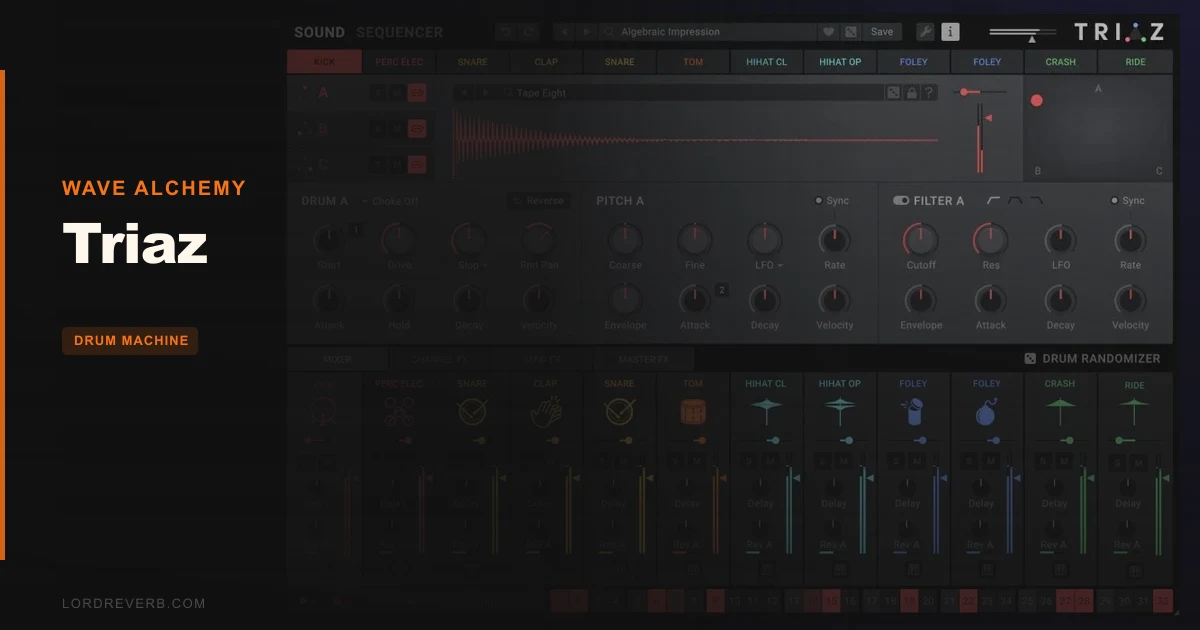
It's not for acoustic drum specialists. It's not for people who need deep slice editing. But for hip-hop, trap, drill, house, and anything else that runs on programmed drums, Triaz puts the whole workflow in one window. Twelve channels, three sample layers each, six sequencer modes, and a mastering chain that handles the final glue before you bounce.
At $66, it's the kind of purchase you either use every session or forget about. For the right producer, it'll be the former.
What's In The Box
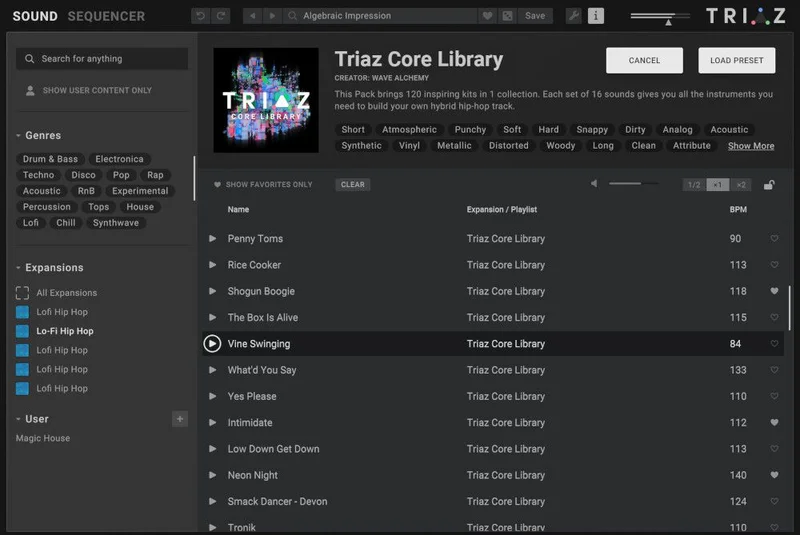
Triaz ships with 15,000 curated samples spread across 700+ presets covering 18 genres. That's a real library, not filler padding the number.
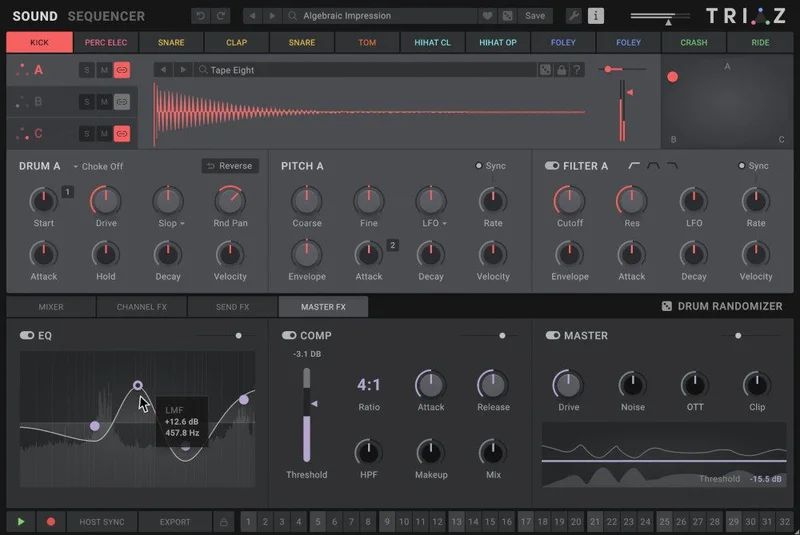
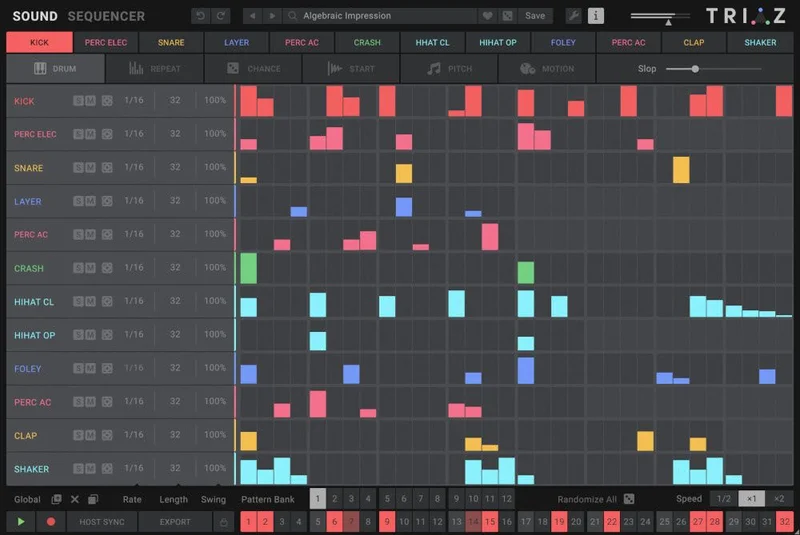
The core layout is 12 drum channels, each holding up to three layered samples. Six sequencer editing modes are available by name: Step, Repeat, Chance, Offset, Pitch, and Keyboard Pitch Mode. Each mode does exactly what it says. Chance adjusts trigger probability per step. Offset shifts timing forward or backward. Repeat fires a hit up to nine times per step.
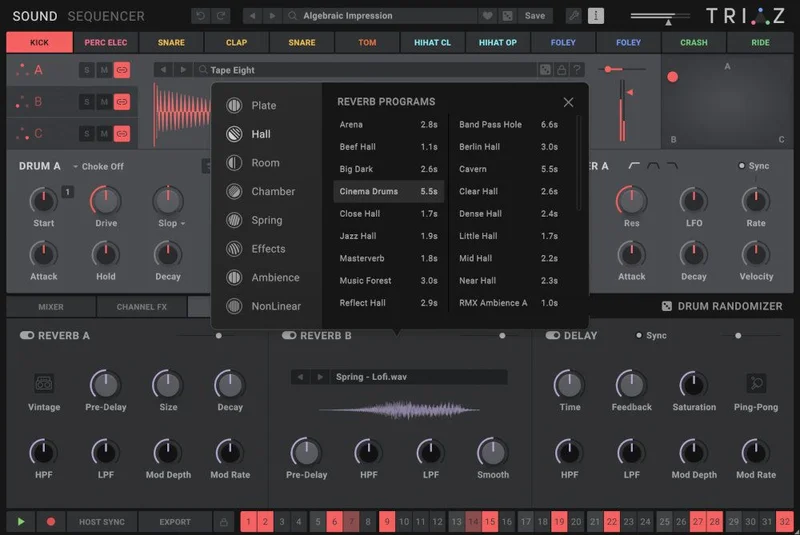
Per-channel processing includes multi-mode filters, envelopes, distortion, LFOs, reverse, Tilt EQ, a mastering-grade compressor, Transient Shaper, OTT Maximiser, Stereo Widener, Analog Modelled Saturation, and SP1200 sampler emulation. Reverb A is algorithmic. Reverb B pulls from over 350 impulse responses. Delay includes Ping-Pong mode and modulation.
The global mastering chain adds four-band Mid/Side EQ, a bus compressor, maximizer with multi-mode saturation, noise layering, OTT-style multi-band exciter, a modern limiter, and a transparent hard clipper.
Export covers stereo loops, unmastered stems, and MIDI patterns with full pitch and modulation data.
Where Triaz Fits In Your Production Process
Triaz works as your primary drum instrument and sequencer from first note to final bounce. You don't need a separate sampler for sound design and a separate sequencer for pattern building. It handles both.
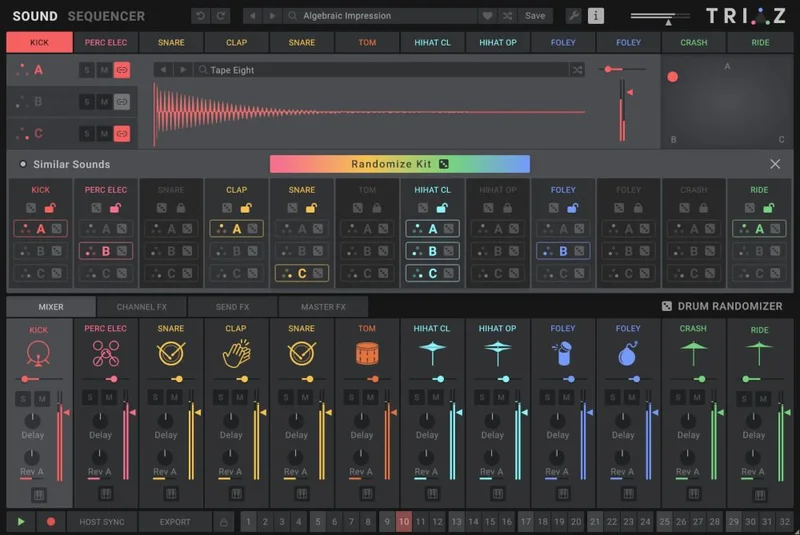
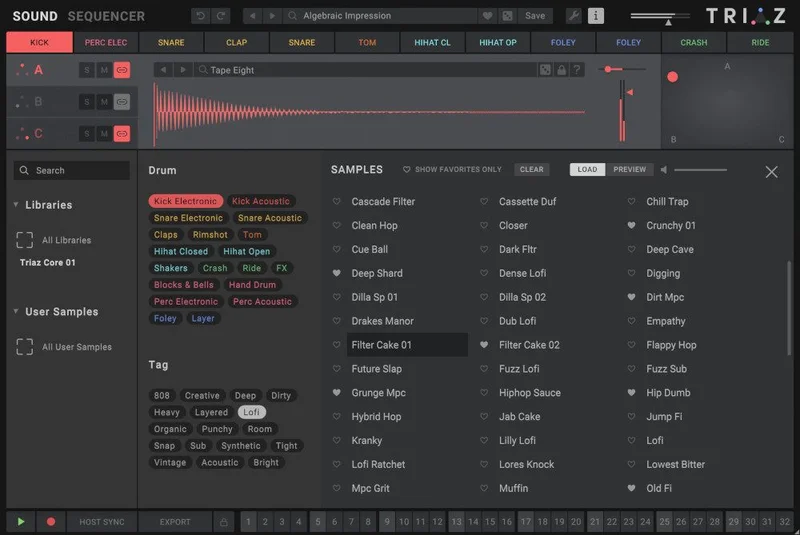
Open a preset, fire up the Drum Randomizer for a starting point, then build from there. The Sound Browser's tagging system lets you filter 15,000 samples by drum type and sound character. Preview mode auditions sounds before they load, which saves the annoying loop of loading, hating, loading again.
Drag samples directly onto layers or mixer channels. Import an entire sample pack and Triaz auto-categorizes it. The favorites system marks sounds you'll return to. These are small things, but they add up fast in a live session.
Motion Sequencer runs parameter modulation in sync with the beat. The XY pad shapes layer blend position over time. Real-time recording via MIDI controller captures live drum performances for Keyboard Pitch Mode. And undo/redo with sample locking means you can randomize aggressively without destroying a layer you love.
Where it doesn't fit: if your sessions revolve around slicing breaks, loop warping, or acoustic drum replacement, Triaz isn't your tool. It has no slice mode, no loop playback, and no end-point editing. Those limits are real. Know them before you buy.
What Triaz Is Genuinely Good At
Layering Without the Phase Headaches
Stack three samples on a single kick channel and push play. Owners report no phasing or flamming from layering, which is the first thing you'd worry about and a genuine win. Combining a punchy transient, a sub body, and a texture layer sounds coherent straight away. The visual XY pad for mix position modulation gives you something tactile to work with, not just a numeric blend control.
The SP1200 Saturator and 808 Content
Hip-hop and trap producers specifically call this out. The SP1200 emulation adds the kind of grit that makes a sample feel pressed rather than rendered. Push it into an 808 channel and the low end turns thick and slightly rough, the way a real sampler hardware unit would choke it. That character sits in a mix without fighting the sub. It's satisfying in a way that clean digital processing rarely is.
Polyrhythmic Sequencing at Speed
Six modes in one sequencer is clever design. You don't need to open a separate piano roll to add pitch variation to a tom. Switch to Pitch mode and tune hits in semitones across two octaves per step. Want a hi-hat that rushes slightly on every third beat? Offset mode does that in four clicks. Repeat mode fires up to nine times per step for rolls and stutters without drawing them manually.
The Slop control adds humanization across volume, tuning, start position, and filter cutoff simultaneously. Set it low for a loose live feel. Push it higher and the kit starts to breathe. It's a single dial doing the work of four separate modulation routings.
The Mastering Chain As a Real Workflow Tool
Having a four-band Mid/Side EQ, bus compressor, maximizer, limiter, and hard clipper on the master output means you can bounce a loop that's already production-ready. This matters if you work fast and want stems that don't need revisiting. Owners report raw samples sit well in a mix straight from the box. Add the mastering chain on top and the gap between demo and deliverable shrinks considerably.
The Sample Library's Tagging System
Auto-tagging imported samples by drum type and sound characteristics sounds like a minor feature. It isn't. Bring in a pack of 500 one-shots and Triaz categorizes them. No manual folder-sorting. No mystery file named "kick_final_v3.wav" buried three levels deep. The 15,000 built-in samples are already sorted. Filtering by genre or type in the Sound Browser takes seconds.
The Rough Edges
The layer browsing workflow is the most consistent complaint from owners. Flicking between layers while selecting sounds is fiddly. If you're trying to compare multiple samples across all three layers of one channel, the interface requires more clicks than it should. It's not a dealbreaker, but it's annoying enough that you'll notice it repeatedly in long sessions.
The Motion Sequencer can't target the sample blenders. That's a frustrating gap in what is otherwise a deep modulation system. You can sequence almost every parameter, then hit this one wall.
Missing features that experienced sampler users will wish for: no envelope end-point editing, no slice mode, no loop playback inside the plugin. These aren't bugs. They're design choices. But if you're coming from a workflow built around chopping breaks or building kits from long samples, you'll feel the absence immediately.
The depth of features also means a real learning curve. The interface is praised for usability, but six sequencer modes, per-layer processing, Motion Sequencer, and a mastering chain is a lot to internalize. Budget a few sessions just to learn the instrument before you rely on it for a deadline.
Who This Is Really For
- ✅ Buy if you produce hip-hop, trap, drill, house, or any electronic genre where programmed drums are the foundation. The SP1200 saturator, 808 content, and sequencer depth are built for exactly this.
- ✅ Buy if you want one plugin that covers drum design, beat programming, and bus processing without routing between three separate tools. The workflow compression is real.
- ✅ Buy if you work fast and need a large, well-organized sample library with smart search. 15,000 samples with auto-tagging and preview mode will save hours over a year.
- ❌ Skip if you need slice-based sampling, loop editing, or end-point control. Those features aren't here, and no amount of workaround changes that.
- ❌ Skip if acoustic drum programming is your primary work. Superior Drummer or BFD are built for that; Triaz isn't.
- ❌ Skip if you're not willing to invest time learning a deep interface. The learning curve is genuine, and a rushed session is not the moment to discover a new drum machine.
Specs & Technical Details
| Developer | Wave Alchemy |
| Price | $66 |
| Plugin Format | VST3 / AU / AAA |
| OS Support | macOS / Windows |
| Activation | N/A |
| CPU Usage | N/A |
| Trial Available | N/A |
| Version Reviewed | N/A |
Score Breakdown
| Category | Score | Notes |
|---|---|---|
| Sound Quality | 4.5/5 | SP1200 emulation and layering without phasing are the standout wins |
| Value for Money | 4.5/5 | Sample library, sequencer, per-channel FX, and mastering chain at this price is hard to argue with |
| Ease of Use | 3.5/5 | Intuitive interface but genuine depth means a real learning curve; layer browsing is fiddly |
| Features | 4.5/5 | Six sequencer modes, Motion Sequencer, full effects suite; loses points for missing slice and loop tools |
| CPU Efficiency | N/A/5 | Developer states low CPU impact but no independent data available to verify |
| Overall | 4.5/5 | One of the most complete self-contained drum machines available in this price range |
Alternatives to Consider
Native Instruments Battery
Battery offers deep sample editing and layering. If granular sample control and envelope precision matter more to you than built-in sequencing, Battery has the edge there. What it lacks is a built-in sequencer, so you'll be building patterns in your DAW's piano roll and routing between tools Triaz keeps in one window.
XLN Audio XO
XO is brilliant at sample organization, using a visual scatter plot to map sonic relationships between sounds. If your main frustration is finding the right kick in a massive library, XO solves that problem in an interesting way. The trade-off is sound design depth. It doesn't have the per-channel FX suite or the sequencer sophistication that Triaz offers.
FXpansion Geist
Geist covers similar ground: sequencing and sound design in one instrument. The comparison is close. Triaz pulls ahead on the effects suite, which is broader and deeper than Geist's. If you're weighing these two specifically, the reverb selection alone (350 impulse responses plus algorithmic) tips the balance toward Triaz for most electronic producers.
The Verdict on Triaz
Triaz is the kind of plugin that makes you rethink how many tools you actually need open at once.
At $66, you're getting a sample library that would justify its own purchase, bolted to a sequencer with six editing modes, sitting on top of a per-channel FX chain that most standalone mixers would be proud of, capped off with a mastering bus. That's a lot of territory for one plugin to cover. The fact that it covers most of it well is what makes owners call it a Battery killer with conviction.
The fiddly layer browsing is real. The missing slice and loop features are real. If you need those things, go elsewhere without hesitation.
But if you produce electronic music and you're tired of routing between a sampler, a sequencer, a drum bus, and a maximizer just to hear a beat the way it should sound? Triaz collapses that chain into one window, and the collapse is clean.
It's not the right tool for everyone. For the producer it was built for, it's going to be hard to open anything else.
Related reviews: Punch 2 Upgrade from Punch 1
Frequently Asked Questions
Is Triaz good for beginners?
Triaz has an intuitive interface that owners praise for quick entry, and the Drum Randomizer generates full beats in one click. Six sequencer modes, per-layer processing, and a mastering chain add up to a real depth that takes time to master. Beginners can get results fast, but expect a learning curve if you want to use the full feature set.
Can Triaz replace Native Instruments Battery?
For electronic and beat-focused production, many owners say yes. Triaz adds a built-in sequencer, a full per-channel FX suite, and a mastering chain that Battery doesn't have. Where Battery holds an advantage is in deep sample editing and end-point control. If that level of editing is core to your workflow, Battery still earns its place. For most electronic producers, Triaz covers more ground in one window.
Does Triaz work well with MIDI controllers?
Yes. Keyboard Pitch Mode captures real-time melodic patterns via MIDI controller, and the real-time recorder handles live drum performance input. MIDI export includes detailed pitch and modulation data, so patterns you record or build can be dragged directly into your DAW timeline. Drag-and-drop MIDI integration is supported for both audio and MIDI output.
What genres is Triaz best suited for?
Hip-hop, trap, and drill producers specifically report the SP1200 saturator and 808 content as valuable, and those communities rate it highly. The 700+ presets span 18 contemporary genres, covering house, drum and bass, and other electronic styles. Acoustic drum specialists are the notable exception: the plugin has no slice mode, loop capabilities, or the kind of deep articulation mapping that Superior Drummer or BFD provide for realistic kit programming.
Can you import your own samples into Triaz?
Yes. Drag-and-drop lets you place samples onto individual layers or mixer channels. You can also import entire sample packs at once, and Triaz auto-categorizes them using its tagging system. Imported samples are tagged by drum type and sound characteristics, so they appear in the Sound Browser alongside the built-in library. Preview mode lets you audition before loading, and favorites marking saves the sounds you want to return to.